Products Category
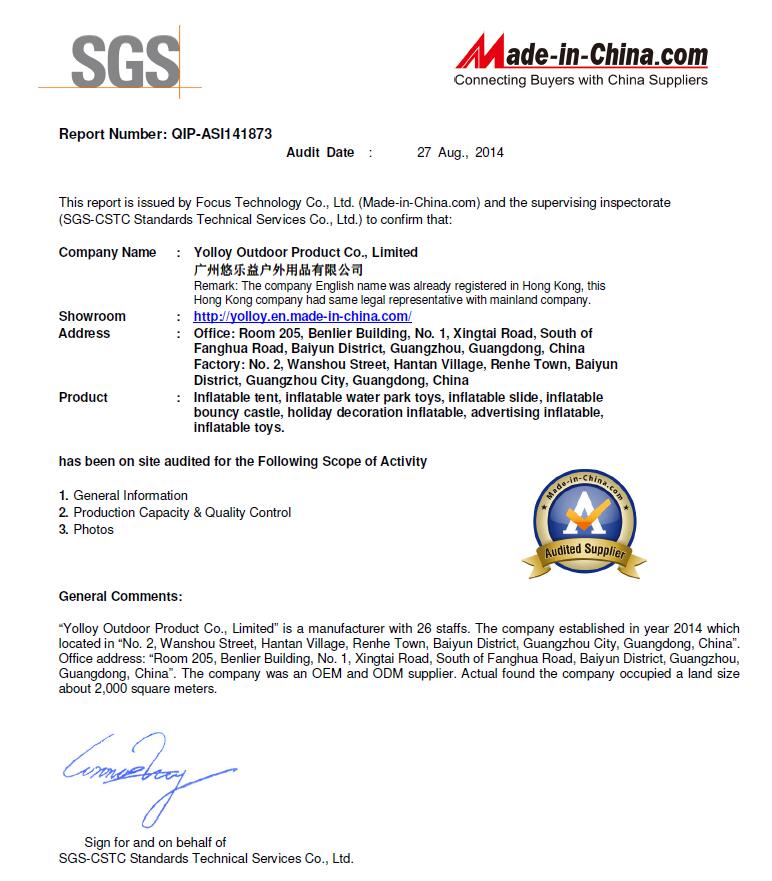
Certification

News

• New Order Successfully Finished for Long-Time Cooperated Japanese Client | YOLLOY Wins Full Client Recognition

• YOLLOY Custom Inflatable Pool Tent for Danish Client: Professional Pool Repair Shelter & Debris Protection

• Trusted Once Again! Greek Captain Re-orders Our Products After 4 Years

• Revolutionize Your Outdoors: The All-Terrain Inflatable Floating Tent for Land & Water

• Elevate Your Summer Fun: The Ultimate Inflatable Water Floating Volleyball Court Trampoline

• Innovative Inflatable Nightclub Tents & Pop-Up Bars: The Ultimate Solution for Portable Party Venues

Contact Us

Name: Sunny Yang
Tel: +86-20-8370 0771
Fax: +86-20-8370 0771
Mobile: 13570587575
E-mail: [email protected]
Add: No 5,Xiong wei Bo Nan Road,ZhongLuoTan Town,Baiyun district,Guangzhou,China
Friend me on Facebook Follow me on Twitter Add me to your circles Follow me on Pinterest Watch my channel on YouTube
News

What are the best bounce house sizes for different age groups?

Author:yolloy Date:2026/8/12 16:54:53

Choosing the right bounce house size is not just about how much space you have in your backyard — it is about matching the unit to the age, weight, and activity level of the children who will use it. A bounce house that is perfect for a toddler can be unsafe for a 10-year-old, and a teen-rated unit is far too aggressive for a preschooler. This guide walks you through the best bounce house sizes for every age group while highlighting what to look for in a high-quality, commercial-grade inflatable.

Toddlers (Ages 1–3): Small and Gentle

For the youngest bouncers, safety and control are the top priorities. Toddlers lack the coordination to navigate a large bounce area, and they are easily knocked over by even gentle bouncing from other children. A toddler bounce house should measure between 6 by 6 feet and 8 by 8 feet, with wall heights of no more than 5 feet so parents can see their child at all times from outside the unit.

The bounce surface should be firm enough to walk on but not so stiff that a 30-pound child gets launched sideways. A lower-output blower in the 0.75 to 1 HP range is ideal. Mesh netting on all four sides is mandatory — toddlers have no sense of boundary awareness and will walk straight off an open edge. Maximum occupancy for this age group is 2 to 3 children, with an adult supervising within arm's reach at all times.

Young Children (Ages 3–7): Medium and Enclosed

Children in this age range are ready for a standard bounce house but still need the protection of enclosed walls and a simple layout. The recommended size is 10 by 10 feet to 12 by 12 feet, which accommodates 4 to 6 children bouncing simultaneously with enough spacing to reduce collisions. Wall heights of 6 to 7 feet keep children contained while allowing parents to peek over and monitor the action.

Weight limits for this age group typically range from 60 to 90 pounds per child. Features like a small slide or a basketball hoop add variety and keep children engaged longer, but avoid tall climbing walls or complex obstacle features — these are not yet developmentally appropriate for the 3-to-7 range. Blower power in the 350 to 580W range provides a comfortable bounce that is firm but not aggressive.

Older Kids (Ages 8–12): Large and Feature-Rich

This is the sweet spot for bounce house rentals and sales. Children in the 8-to-12 age range have the coordination, strength, and confidence to enjoy larger units with more features. The recommended bounce surface is 13 by 13 feet to 15 by 15 feet, with wall heights of 7 to 8 feet. These dimensions comfortably accommodate 8 to 12 children at a time, with per-rider weight limits of 100 to 150 pounds.

Combo units that integrate a bounce area with a slide, climbing wall, or obstacle course are particularly popular for this age group. A combo delivers multiple activities in one footprint, keeping children entertained for longer periods. Blower requirements step up to 580 to 750W or 1.0 to 1.5 HP for larger units, and reinforced seams are essential to handle the higher impact forces from older children's jumping.

Teens (Ages 13–17): Extra-Large and Reinforced

Teenagers are the most physically demanding users of bounce houses. They jump harder, roughhouse more, and test the structural limits of any inflatable. Units designed for teen use need a minimum bounce surface of 15 by 15 feet, with 20 by 20 feet preferred. Wall heights should be 8 feet or higher, and per-rider weight limits must accommodate up to 200 pounds.

Obstacle courses and interactive sports inflatables outperform plain bounce houses for this age group. Teens find a simple bounce surface boring within 15 to 20 minutes, but an obstacle course with climbing walls, squeeze-throughs, and racing lanes can maintain engagement for over an hour. Anchor security is critical — the combined force of multiple teenagers jumping in rhythm can generate lateral loads that demand heavy-duty stakes or sandbag anchoring of 50 to 60 pounds per anchor point.

Adults (Ages 18+): Commercial-Grade Large Format

Adult bounce house bookings are a growing segment, driven by corporate team-building events, college activities, festival entertainment, and adult birthday parties. These units require a minimum bounce surface of 20 by 20 feet, reinforced floors with double or triple stitching at all seam points, and per-rider weight limits of 250 pounds or higher. Total capacity ratings should be 1,500 to 2,000 pounds.

Blower requirements step up to 2 HP or dual 1.5 HP units — adult weight compresses the bounce surface more than children's weight, requiring higher air volume to maintain bounce performance. The structural reinforcement is the key differentiator: wider baffle spacing, reinforced base tubes with larger diameters of 15 to 18 inches, and heavier-gauge PVC on the floor surface where wear is concentrated are all essential for adult-rated units.

Age Group Recommended Size Wall Height Max Occupancy Blower Power
Toddlers (1–3) 6'×6' to 8'×8' 4–5 ft 2–3 kids 0.75–1 HP
Young Kids (3–7) 10'×10' to 12'×12' 6–7 ft 4–6 kids 350–580W
Older Kids (8–12) 13'×13' to 15'×15' 7–8 ft 8–12 kids 580–750W / 1.0–1.5 HP
Teens (13–17) 15'×15' to 20'×20' 8+ ft 5–8 teens 1.5 HP
Adults (18+) 20'×20' and up 8+ ft 2–4 adults 2 HP or dual 1.5 HP

What Makes a Quality Bounce House?

Beyond size, the material and construction quality of a bounce house determine how safe it is and how long it lasts. Commercial-grade inflatable bounce houses are built with heavy-duty PVC tarpaulin that resists tearing, UV degradation, and repeated compression cycles. Look for units that use precision sewing equipment with reinforced seams and waterproof nylon thread — especially at high-load areas like entry points, slide connections, and anchor rings.

Certifications are another important indicator of quality. Reputable inflatable bounce house manufacturers have their products tested to meet EN 14960 standards for inflatable play equipment, and their blowers should carry CE or UL certification. A repair kit should be included with every purchase, and the manufacturer should offer a reasonable warranty — typically 3 years for products that are used and maintained correctly.

Pro Tip: When purchasing a bounce house for commercial use — such as a rental business, amusement park, or event company — always choose a unit with commercial-grade PVC construction rather than residential nylon. Commercial units withstand hundreds of setups and takedowns, handle mixed-age groups safely, and maintain their bounce quality over years of heavy use.

Customization: Get the Exact Size and Design You Need

Off-the-shelf bounce houses come in fixed sizes, but what if your space or target audience requires something specific? Working with an experienced inflatable bounce house manufacturer that offers custom design services gives you full control over the dimensions, colors, themes, and features of your unit. Whether you need a princess-themed castle for a daycare center, a jungle-themed combo for a family entertainment venue, or a large-format obstacle course for corporate team-building events, a custom bounce house can be built to your exact specifications.

Custom options include:

  • Size and dimensions — build the exact footprint that fits your space and age group
  • Colors and themes — match your brand colors or event theme
  • Logo and artwork printing — display your business logo or custom graphics directly on the inflatable
  • Feature combinations — add slides, climbing walls, basketball hoops, splash pools, and obstacle elements
  • Blower voltage options — 110V, 220V, or 380V to match your local electrical standards
Key Considerations When Ordering Custom Bounce Houses:
• Confirm the manufacturer's minimum order quantity — some suppliers require bulk orders, but flexible manufacturers accept orders starting from just one piece.
• Ask about production time — typical production for a regular inflatable is 6 to 15 days, while complex custom designs may take longer.
• Verify the materials used — commercial PVC tarpaulin with EN 14960 and RoHS compliance ensures safety and durability.
• Check shipping options — air freight takes 5 to 7 days, while sea freight is more economical for larger orders at 15 to 30 days.

Safety Tips for Every Age Group

Regardless of the bounce house size you choose, safety rules should always be enforced:

  • Separate age groups — never allow a 180-pound teenager to bounce next to a 50-pound child; this is the most common cause of bounce house injuries at mixed-age events.
  • Enforce weight limits — every bounce house has a maximum per-rider weight limit and total capacity; exceeding these compromises the structural integrity of the unit.
  • Anchor securely — use the D-ring or round metal anchor systems provided with the unit, and check that all stakes are driven fully into the ground at a 45-degree angle.
  • Supervise at all times — an adult should always be present and watching, especially for toddler and young children's units.
  • No flips or rough play — set clear rules before children enter the bounce house and enforce them consistently.

Conclusion

Choosing the right bounce house size comes down to understanding your audience: toddlers need small, gentle units with low walls; young children thrive in medium-sized enclosed bounce houses; older kids and teens demand larger, feature-rich combos; and adults require full commercial-grade large-format structures. By matching the unit size, material, and blower power to the age group, you create a safe, fun experience that keeps users coming back.

Whether you are buying a single bounce house for your backyard or building a fleet for a rental business, investing in commercial-grade quality from a trusted manufacturer pays off in safety, durability, and long-term value. For more information about custom bounce houses, commercial inflatables, and factory-direct pricing, explore the full range of products at Yolloy.

Looking for high-quality, custom bounce houses built to your exact specifications? Yolloy Outdoor Product Co., Limited designs and manufactures commercial-grade inflatable bounce houses for all age groups — from toddler units to adult-rated obstacle courses. Browse our bounce house collection or contact us for a custom quote today.

What are the best bounce house sizes for different age groups?

Author:yolloy Date:2026/8/12 16:54:53

Choosing the right bounce house size is not just about how much space you have in your backyard — it is about matching the unit to the age, weight, and activity level of the children who will use it. A bounce house that is perfect for a toddler can be unsafe for a 10-year-old, and a teen-rated unit is far too aggressive for a preschooler. This guide walks you through the best bounce house sizes for every age group while highlighting what to look for in a high-quality, commercial-grade inflatable.

Toddlers (Ages 1–3): Small and Gentle

For the youngest bouncers, safety and control are the top priorities. Toddlers lack the coordination to navigate a large bounce area, and they are easily knocked over by even gentle bouncing from other children. A toddler bounce house should measure between 6 by 6 feet and 8 by 8 feet, with wall heights of no more than 5 feet so parents can see their child at all times from outside the unit.

The bounce surface should be firm enough to walk on but not so stiff that a 30-pound child gets launched sideways. A lower-output blower in the 0.75 to 1 HP range is ideal. Mesh netting on all four sides is mandatory — toddlers have no sense of boundary awareness and will walk straight off an open edge. Maximum occupancy for this age group is 2 to 3 children, with an adult supervising within arm's reach at all times.

Young Children (Ages 3–7): Medium and Enclosed

Children in this age range are ready for a standard bounce house but still need the protection of enclosed walls and a simple layout. The recommended size is 10 by 10 feet to 12 by 12 feet, which accommodates 4 to 6 children bouncing simultaneously with enough spacing to reduce collisions. Wall heights of 6 to 7 feet keep children contained while allowing parents to peek over and monitor the action.

Weight limits for this age group typically range from 60 to 90 pounds per child. Features like a small slide or a basketball hoop add variety and keep children engaged longer, but avoid tall climbing walls or complex obstacle features — these are not yet developmentally appropriate for the 3-to-7 range. Blower power in the 350 to 580W range provides a comfortable bounce that is firm but not aggressive.

Older Kids (Ages 8–12): Large and Feature-Rich

This is the sweet spot for bounce house rentals and sales. Children in the 8-to-12 age range have the coordination, strength, and confidence to enjoy larger units with more features. The recommended bounce surface is 13 by 13 feet to 15 by 15 feet, with wall heights of 7 to 8 feet. These dimensions comfortably accommodate 8 to 12 children at a time, with per-rider weight limits of 100 to 150 pounds.

Combo units that integrate a bounce area with a slide, climbing wall, or obstacle course are particularly popular for this age group. A combo delivers multiple activities in one footprint, keeping children entertained for longer periods. Blower requirements step up to 580 to 750W or 1.0 to 1.5 HP for larger units, and reinforced seams are essential to handle the higher impact forces from older children's jumping.

Teens (Ages 13–17): Extra-Large and Reinforced

Teenagers are the most physically demanding users of bounce houses. They jump harder, roughhouse more, and test the structural limits of any inflatable. Units designed for teen use need a minimum bounce surface of 15 by 15 feet, with 20 by 20 feet preferred. Wall heights should be 8 feet or higher, and per-rider weight limits must accommodate up to 200 pounds.

Obstacle courses and interactive sports inflatables outperform plain bounce houses for this age group. Teens find a simple bounce surface boring within 15 to 20 minutes, but an obstacle course with climbing walls, squeeze-throughs, and racing lanes can maintain engagement for over an hour. Anchor security is critical — the combined force of multiple teenagers jumping in rhythm can generate lateral loads that demand heavy-duty stakes or sandbag anchoring of 50 to 60 pounds per anchor point.

Adults (Ages 18+): Commercial-Grade Large Format

Adult bounce house bookings are a growing segment, driven by corporate team-building events, college activities, festival entertainment, and adult birthday parties. These units require a minimum bounce surface of 20 by 20 feet, reinforced floors with double or triple stitching at all seam points, and per-rider weight limits of 250 pounds or higher. Total capacity ratings should be 1,500 to 2,000 pounds.

Blower requirements step up to 2 HP or dual 1.5 HP units — adult weight compresses the bounce surface more than children's weight, requiring higher air volume to maintain bounce performance. The structural reinforcement is the key differentiator: wider baffle spacing, reinforced base tubes with larger diameters of 15 to 18 inches, and heavier-gauge PVC on the floor surface where wear is concentrated are all essential for adult-rated units.

Age Group Recommended Size Wall Height Max Occupancy Blower Power
Toddlers (1–3) 6'×6' to 8'×8' 4–5 ft 2–3 kids 0.75–1 HP
Young Kids (3–7) 10'×10' to 12'×12' 6–7 ft 4–6 kids 350–580W
Older Kids (8–12) 13'×13' to 15'×15' 7–8 ft 8–12 kids 580–750W / 1.0–1.5 HP
Teens (13–17) 15'×15' to 20'×20' 8+ ft 5–8 teens 1.5 HP
Adults (18+) 20'×20' and up 8+ ft 2–4 adults 2 HP or dual 1.5 HP

What Makes a Quality Bounce House?

Beyond size, the material and construction quality of a bounce house determine how safe it is and how long it lasts. Commercial-grade inflatable bounce houses are built with heavy-duty PVC tarpaulin that resists tearing, UV degradation, and repeated compression cycles. Look for units that use precision sewing equipment with reinforced seams and waterproof nylon thread — especially at high-load areas like entry points, slide connections, and anchor rings.

Certifications are another important indicator of quality. Reputable inflatable bounce house manufacturers have their products tested to meet EN 14960 standards for inflatable play equipment, and their blowers should carry CE or UL certification. A repair kit should be included with every purchase, and the manufacturer should offer a reasonable warranty — typically 3 years for products that are used and maintained correctly.

Pro Tip: When purchasing a bounce house for commercial use — such as a rental business, amusement park, or event company — always choose a unit with commercial-grade PVC construction rather than residential nylon. Commercial units withstand hundreds of setups and takedowns, handle mixed-age groups safely, and maintain their bounce quality over years of heavy use.

Customization: Get the Exact Size and Design You Need

Off-the-shelf bounce houses come in fixed sizes, but what if your space or target audience requires something specific? Working with an experienced inflatable bounce house manufacturer that offers custom design services gives you full control over the dimensions, colors, themes, and features of your unit. Whether you need a princess-themed castle for a daycare center, a jungle-themed combo for a family entertainment venue, or a large-format obstacle course for corporate team-building events, a custom bounce house can be built to your exact specifications.

Custom options include:

  • Size and dimensions — build the exact footprint that fits your space and age group
  • Colors and themes — match your brand colors or event theme
  • Logo and artwork printing — display your business logo or custom graphics directly on the inflatable
  • Feature combinations — add slides, climbing walls, basketball hoops, splash pools, and obstacle elements
  • Blower voltage options — 110V, 220V, or 380V to match your local electrical standards
Key Considerations When Ordering Custom Bounce Houses:
• Confirm the manufacturer's minimum order quantity — some suppliers require bulk orders, but flexible manufacturers accept orders starting from just one piece.
• Ask about production time — typical production for a regular inflatable is 6 to 15 days, while complex custom designs may take longer.
• Verify the materials used — commercial PVC tarpaulin with EN 14960 and RoHS compliance ensures safety and durability.
• Check shipping options — air freight takes 5 to 7 days, while sea freight is more economical for larger orders at 15 to 30 days.

Safety Tips for Every Age Group

Regardless of the bounce house size you choose, safety rules should always be enforced:

  • Separate age groups — never allow a 180-pound teenager to bounce next to a 50-pound child; this is the most common cause of bounce house injuries at mixed-age events.
  • Enforce weight limits — every bounce house has a maximum per-rider weight limit and total capacity; exceeding these compromises the structural integrity of the unit.
  • Anchor securely — use the D-ring or round metal anchor systems provided with the unit, and check that all stakes are driven fully into the ground at a 45-degree angle.
  • Supervise at all times — an adult should always be present and watching, especially for toddler and young children's units.
  • No flips or rough play — set clear rules before children enter the bounce house and enforce them consistently.

Conclusion

Choosing the right bounce house size comes down to understanding your audience: toddlers need small, gentle units with low walls; young children thrive in medium-sized enclosed bounce houses; older kids and teens demand larger, feature-rich combos; and adults require full commercial-grade large-format structures. By matching the unit size, material, and blower power to the age group, you create a safe, fun experience that keeps users coming back.

Whether you are buying a single bounce house for your backyard or building a fleet for a rental business, investing in commercial-grade quality from a trusted manufacturer pays off in safety, durability, and long-term value. For more information about custom bounce houses, commercial inflatables, and factory-direct pricing, explore the full range of products at Yolloy.

Looking for high-quality, custom bounce houses built to your exact specifications? Yolloy Outdoor Product Co., Limited designs and manufactures commercial-grade inflatable bounce houses for all age groups — from toddler units to adult-rated obstacle courses. Browse our bounce house collection or contact us for a custom quote today.