Products Category
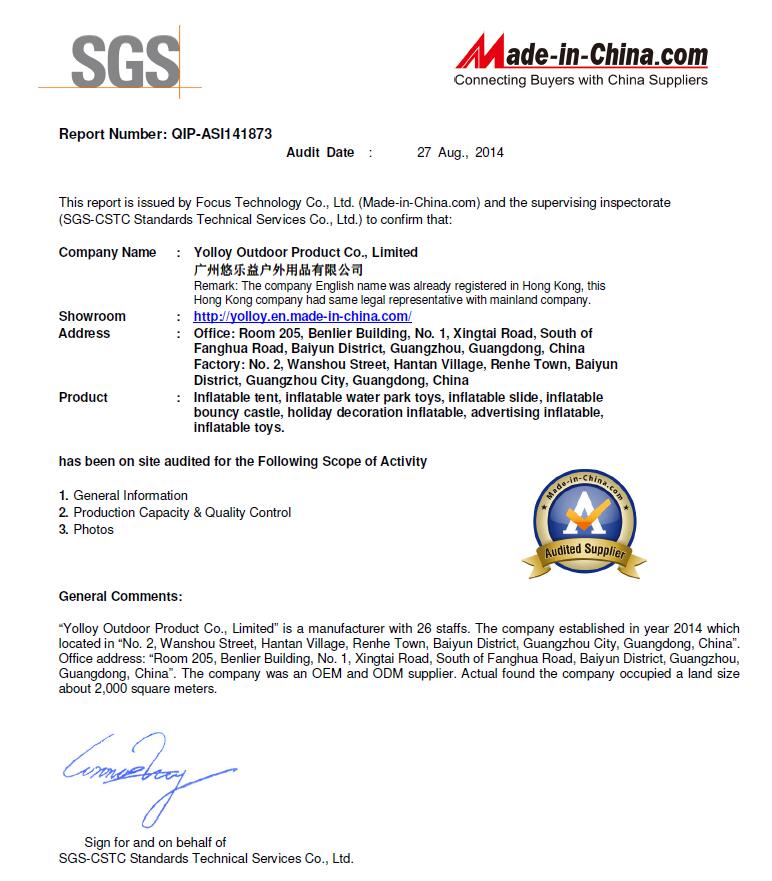
Certification

News

• New Order Successfully Finished for Long-Time Cooperated Japanese Client | YOLLOY Wins Full Client Recognition

• YOLLOY Custom Inflatable Pool Tent for Danish Client: Professional Pool Repair Shelter & Debris Protection

• Trusted Once Again! Greek Captain Re-orders Our Products After 4 Years

• Revolutionize Your Outdoors: The All-Terrain Inflatable Floating Tent for Land & Water

• Elevate Your Summer Fun: The Ultimate Inflatable Water Floating Volleyball Court Trampoline

• Innovative Inflatable Nightclub Tents & Pop-Up Bars: The Ultimate Solution for Portable Party Venues

Contact Us

Name: Sunny Yang
Tel: +86-20-8370 0771
Fax: +86-20-8370 0771
Mobile: 13570587575
E-mail: [email protected]
Add: No 5,Xiong wei Bo Nan Road,ZhongLuoTan Town,Baiyun district,Guangzhou,China
Friend me on Facebook Follow me on Twitter Add me to your circles Follow me on Pinterest Watch my channel on YouTube
News

What are the best paintball obstacles for training?

Author:yolloy Date:2026/8/12 15:35:21

When you step onto a paintball field, the obstacles around you are not just random pieces of cover — they are the foundation of every tactical move, every snap shot, and every successful advance. Whether you are a beginner learning the basics or a competitive player refining your tournament skills, the right training obstacles make all the difference. Choosing quality paintball obstacles for training means you can practice real game scenarios safely and consistently, building muscle memory and tactical awareness that translate directly to match day.

Key Types of Paintball Training Obstacles

Paintball training obstacles come in several distinct shapes, each designed to simulate specific field positions you will encounter in actual gameplay. Understanding the purpose of each type helps coaches and players build more effective training layouts.

  • Cans (Stand-up Cylinders): Tall cylindrical bunkers that provide excellent vertical cover. Cans are the go-to obstacle for practicing snap shooting — the quick peeking-and-shooting motion from behind cover. They force players to work on their stance, gun positioning, and shot timing. A standard training set should include multiple cans of varying heights to simulate different engagement scenarios.
  • Doritos (Triangle Bunkers): Named after the triangular chip, these three-sided pyramid bunkers are tournament staples. Doritos are typically placed along the tape line and are essential for practicing aggressive corner play and lane denial. Their angled faces make them perfect for ricochet drills and off-angle shooting practice, helping players develop the ability to shoot from unconventional positions.
  • Snake Beams: Long, low-profile obstacles that sit close to the ground. Snake beams are designed for crawling and low-body-position play. Training with snake beams builds core strength, teaches players how to stay compact under fire, and develops the ability to shoot accurately from a prone position — a critical skill for competitive speedball.
  • Temples and Aztecs: Four-sided bunkers with a flat top, offering reliable mid-field cover. These are versatile obstacles used for practicing movement between positions, coordinating with teammates, and holding down central shooting lanes. Their shape makes them ideal for both offensive pushes and defensive stands.
  • Walls, Wedges, and Rollies: Rectangular walls, wedge-shaped barriers, and horizontal cylindrical rollies create longer cover zones and interesting sight-line breaks. These are excellent for team drills like coordinated advances, covering fire, and defensive repositioning. Mixing these shapes with taller bunkers produces a realistic, tournament-style field layout.

Each obstacle type serves a unique training purpose. A well-designed training field mixes multiple shapes to create dynamic layouts that challenge players to adapt their tactics on the fly rather than relying on memorized positions.

Why Inflatable Bunkers Are the Best Choice for Training

While some fields still use wooden pallets or permanent structures, inflatable paintball bunkers have become the industry standard for training — and for good reason.

Safety is the most important factor. Inflatable bunkers are made from soft, commercial-grade PVC tarpaulin that absorbs impact rather than causing injury when a player dives behind cover or accidentally collides with an obstacle during an intense drill. Unlike hard wooden or metal structures, inflatables reduce the risk of cuts, bruises, and more serious injuries. This makes them suitable for players of all ages and skill levels, from youth teams to professional squads.

Flexibility is another major advantage. You can set up, rearrange, and deflate an entire training field in minutes. Coaches can design fresh layouts for every session, keeping training interesting and preventing players from developing habits tied to a single field configuration. The portability of inflatable bunkers means you can bring your training setup to any location — a gymnasium, a backyard, a rented field, or an event space — without the need for permanent installation or heavy equipment.

Durability has also improved dramatically in modern inflatable bunkers. High-quality products use reinforced seams, waterproof nylon thread, and additional reinforcement at high-load areas. When properly maintained, a good set of inflatable bunkers can withstand years of regular training use. Many manufacturers also include repair kits with each order, making field maintenance straightforward.

How to Set Up an Effective Training Field

Setting up an effective training field requires more than scattering obstacles randomly. Start by defining your training objectives for the session. If you are focusing on snap shooting, arrange cans and doritos in a line with clear shooting lanes between them. For breakout drills, position obstacles at varying distances from the start box to simulate different field speeds and force players to make split-second decisions about which bunker to target.

Always ensure bunkers are properly secured. Use ground stakes and sandbags for outdoor setups, and consider water-fillable base compartments for extra stability in windy conditions. Quality inflatable bunkers from a reliable manufacturer will come with appropriately powered blowers, repair kits, and anchoring accessories, making field setup straightforward and hassle-free. For indoor training, look for bunkers that stay stable without constant air supply, allowing you to focus on drills rather than equipment management.

When choosing inflatable paintball bunkers for your training program, look for commercial-grade PVC tarpaulin construction, reinforced seams, CE or UL-certified blowers, and materials tested to EN71 and EN14960 safety standards. A complete set should include multiple shape types, a powerful air pump, ground stakes, repair materials, and a carrying bag for transport.

Custom Training Solutions from a Professional Manufacturer

For serious teams, training facilities, and paintball field operators, working with a professional inflatable bunkers manufacturer offers significant advantages over buying off-the-shelf consumer products. Custom bunkers can be produced in your team colors, with logos and sponsor artwork printed directly on the material. You can also specify exact dimensions that match your target competition format — whether you train for NXL regulation fields, local tournament layouts, or recreational scenarios.

A factory-direct supplier like YOLLOY, based in Guangzhou, China, operates as a full-service inflatable product manufacturer with a complete custom design-to-production workflow. Their designers prepare simulation renderings from your specifications, revise the design until approval, and then release it for factory production. This approach ensures you get exactly what your training program needs, from single replacement pieces to complete arena sets. The company supplies products with appropriately powered blowers for 110V, 220V, or 380V requirements, and all products are inspected and tested before shipment. With a stated minimum order quantity of just one piece and a typical production time of 6 to 15 days for regular inflatable products, custom training bunkers are more accessible than many teams realize.

Conclusion

The best paintball obstacles for training are the ones that match your team's specific needs, hold up under repeated use, and create realistic game scenarios. Inflatable bunkers check all these boxes while adding the benefits of safety, portability, and customizability. By understanding the purpose of each obstacle type — from cans and doritos for snap shooting to snake beams for low-position crawling — you can design training sessions that build real competitive skills. Whether you need a basic set for weekend practice or a complete tournament-grade arena, investing in quality inflatable paintball bunkers from a trusted manufacturer will elevate your training sessions and give your team a competitive edge on the field.


What are the best paintball obstacles for training?

Author:yolloy Date:2026/8/12 15:35:21

When you step onto a paintball field, the obstacles around you are not just random pieces of cover — they are the foundation of every tactical move, every snap shot, and every successful advance. Whether you are a beginner learning the basics or a competitive player refining your tournament skills, the right training obstacles make all the difference. Choosing quality paintball obstacles for training means you can practice real game scenarios safely and consistently, building muscle memory and tactical awareness that translate directly to match day.

Key Types of Paintball Training Obstacles

Paintball training obstacles come in several distinct shapes, each designed to simulate specific field positions you will encounter in actual gameplay. Understanding the purpose of each type helps coaches and players build more effective training layouts.

  • Cans (Stand-up Cylinders): Tall cylindrical bunkers that provide excellent vertical cover. Cans are the go-to obstacle for practicing snap shooting — the quick peeking-and-shooting motion from behind cover. They force players to work on their stance, gun positioning, and shot timing. A standard training set should include multiple cans of varying heights to simulate different engagement scenarios.
  • Doritos (Triangle Bunkers): Named after the triangular chip, these three-sided pyramid bunkers are tournament staples. Doritos are typically placed along the tape line and are essential for practicing aggressive corner play and lane denial. Their angled faces make them perfect for ricochet drills and off-angle shooting practice, helping players develop the ability to shoot from unconventional positions.
  • Snake Beams: Long, low-profile obstacles that sit close to the ground. Snake beams are designed for crawling and low-body-position play. Training with snake beams builds core strength, teaches players how to stay compact under fire, and develops the ability to shoot accurately from a prone position — a critical skill for competitive speedball.
  • Temples and Aztecs: Four-sided bunkers with a flat top, offering reliable mid-field cover. These are versatile obstacles used for practicing movement between positions, coordinating with teammates, and holding down central shooting lanes. Their shape makes them ideal for both offensive pushes and defensive stands.
  • Walls, Wedges, and Rollies: Rectangular walls, wedge-shaped barriers, and horizontal cylindrical rollies create longer cover zones and interesting sight-line breaks. These are excellent for team drills like coordinated advances, covering fire, and defensive repositioning. Mixing these shapes with taller bunkers produces a realistic, tournament-style field layout.

Each obstacle type serves a unique training purpose. A well-designed training field mixes multiple shapes to create dynamic layouts that challenge players to adapt their tactics on the fly rather than relying on memorized positions.

Why Inflatable Bunkers Are the Best Choice for Training

While some fields still use wooden pallets or permanent structures, inflatable paintball bunkers have become the industry standard for training — and for good reason.

Safety is the most important factor. Inflatable bunkers are made from soft, commercial-grade PVC tarpaulin that absorbs impact rather than causing injury when a player dives behind cover or accidentally collides with an obstacle during an intense drill. Unlike hard wooden or metal structures, inflatables reduce the risk of cuts, bruises, and more serious injuries. This makes them suitable for players of all ages and skill levels, from youth teams to professional squads.

Flexibility is another major advantage. You can set up, rearrange, and deflate an entire training field in minutes. Coaches can design fresh layouts for every session, keeping training interesting and preventing players from developing habits tied to a single field configuration. The portability of inflatable bunkers means you can bring your training setup to any location — a gymnasium, a backyard, a rented field, or an event space — without the need for permanent installation or heavy equipment.

Durability has also improved dramatically in modern inflatable bunkers. High-quality products use reinforced seams, waterproof nylon thread, and additional reinforcement at high-load areas. When properly maintained, a good set of inflatable bunkers can withstand years of regular training use. Many manufacturers also include repair kits with each order, making field maintenance straightforward.

How to Set Up an Effective Training Field

Setting up an effective training field requires more than scattering obstacles randomly. Start by defining your training objectives for the session. If you are focusing on snap shooting, arrange cans and doritos in a line with clear shooting lanes between them. For breakout drills, position obstacles at varying distances from the start box to simulate different field speeds and force players to make split-second decisions about which bunker to target.

Always ensure bunkers are properly secured. Use ground stakes and sandbags for outdoor setups, and consider water-fillable base compartments for extra stability in windy conditions. Quality inflatable bunkers from a reliable manufacturer will come with appropriately powered blowers, repair kits, and anchoring accessories, making field setup straightforward and hassle-free. For indoor training, look for bunkers that stay stable without constant air supply, allowing you to focus on drills rather than equipment management.

When choosing inflatable paintball bunkers for your training program, look for commercial-grade PVC tarpaulin construction, reinforced seams, CE or UL-certified blowers, and materials tested to EN71 and EN14960 safety standards. A complete set should include multiple shape types, a powerful air pump, ground stakes, repair materials, and a carrying bag for transport.

Custom Training Solutions from a Professional Manufacturer

For serious teams, training facilities, and paintball field operators, working with a professional inflatable bunkers manufacturer offers significant advantages over buying off-the-shelf consumer products. Custom bunkers can be produced in your team colors, with logos and sponsor artwork printed directly on the material. You can also specify exact dimensions that match your target competition format — whether you train for NXL regulation fields, local tournament layouts, or recreational scenarios.

A factory-direct supplier like YOLLOY, based in Guangzhou, China, operates as a full-service inflatable product manufacturer with a complete custom design-to-production workflow. Their designers prepare simulation renderings from your specifications, revise the design until approval, and then release it for factory production. This approach ensures you get exactly what your training program needs, from single replacement pieces to complete arena sets. The company supplies products with appropriately powered blowers for 110V, 220V, or 380V requirements, and all products are inspected and tested before shipment. With a stated minimum order quantity of just one piece and a typical production time of 6 to 15 days for regular inflatable products, custom training bunkers are more accessible than many teams realize.

Conclusion

The best paintball obstacles for training are the ones that match your team's specific needs, hold up under repeated use, and create realistic game scenarios. Inflatable bunkers check all these boxes while adding the benefits of safety, portability, and customizability. By understanding the purpose of each obstacle type — from cans and doritos for snap shooting to snake beams for low-position crawling — you can design training sessions that build real competitive skills. Whether you need a basic set for weekend practice or a complete tournament-grade arena, investing in quality inflatable paintball bunkers from a trusted manufacturer will elevate your training sessions and give your team a competitive edge on the field.