Picture this: a warm summer evening, a crowd gathered on the lawn, and a movie flickering to life on a massive screen under the stars. Or imagine a classroom of students stepping inside a darkened dome, gasping as the solar system materializes around them in vivid detail. These experiences share a common thread — they are powered by an inflatable projection screen. Whether you are planning an outdoor cinema event, running an educational planetarium program, or setting up a traveling exhibition, the quality of your projection surface can make or break the experience. But with so many options on the market, how do you identify the best inflatable projection screen for your needs? This guide walks through the key considerations, from materials and sizing to sourcing from a reliable manufacturer.
Why Inflatable Projection Screens Have Surpassed Traditional Options
For years, outdoor projection relied on portable frame screens — metal structures with stretched fabric surfaces. While functional, these systems come with notable drawbacks: they are heavy, time-consuming to set up, require level ground, and are vulnerable to wind. An outdoor inflatable projection screen solves all of these problems at once.
The inflatable design eliminates the need for a rigid frame. A continuous-duty blower keeps the screen structure firm and stable, while the projection surface — typically made from high-quality polyester or PVC material — remains taut and wrinkle-free. Setup takes minutes rather than an hour, and the entire system packs down into a compact carry bag for transport. This portability is a game-changer for rental businesses, event organizers, and schools that move equipment between locations regularly.
Another advantage is wind resistance. Traditional frame screens act like sails in breezy conditions, often requiring sandbags or complex guy-line systems. Inflatable screens, by contrast, have a lower center of gravity and distribute wind pressure more evenly across their rounded structure. Many models include D-ring or metal anchor points for additional stability, making them suitable for open outdoor environments where frame screens would struggle.
Two Distinct Categories: Flat Screens and Dome Structures
When shopping for an inflatable projection screen, it is important to understand that the term covers two fundamentally different product types, each serving distinct purposes.
Flat inflatable projection screens are the classic outdoor movie setup. They feature a large, rectangular projection surface supported by an inflatable frame. These screens are designed for front or rear projection and are commonly used for backyard movie nights, community film screenings, drive-in cinema events, and corporate presentations. Sizes typically range from 10 to 20 feet or larger, and the surface material is optimized for brightness, color accuracy, and wide viewing angles.
Inflatable dome projection structures, often called portable planetarium dome tents, take projection to a fully immersive level. Instead of a flat screen, the interior of the dome serves as a 360-degree projection surface. These domes are used by science centers, schools, museums, and event companies to create immersive experiences — from astronomy shows and planetarium presentations to immersive art installations and virtual reality environments. The dome structure requires a projector capable of fisheye or spherical projection, and the interior surface is coated to maximize image reflection and uniformity.
Key Factors to Evaluate When Choosing an Inflatable Projection Screen
Not all inflatable screens deliver the same viewing experience. Here are the critical factors to assess before making a purchase:
Screen material and gain — The projection surface material directly affects brightness, color reproduction, and viewing angle. High-quality screens use double-layer polyester or PVC with a matte white or silver coating that balances gain (reflectivity) with a wide viewing cone. A gain of around 1.0 to 1.3 is typical for outdoor screens, providing good brightness without creating hot spots. For dome interiors, the material should have a uniform, non-reflective coating that works well with 360-degree projection.
Frame construction and durability — The inflatable frame should be made from commercial-grade materials that resist punctures, UV degradation, and repeated inflation cycles. Look for reinforced seams, waterproof nylon thread, and additional reinforcement at stress points where the blower connects and where anchor points are attached. Materials that have passed EN71 and RoHS testing provide assurance of safety and quality.
Blower quality and power options — The blower is the engine of any inflatable screen. A reliable blower should run continuously for hours without overheating, operate quietly enough for movie dialogue to be heard, and meet CE or UL safety standards. Confirm that the blower voltage matches your local power supply — options typically include 110V, 220V, and 380V configurations.
Setup time and portability — The whole point of an inflatable screen is quick setup and easy transport. A well-designed screen should inflate in under five minutes and pack down into a bag that one or two people can carry. If you will be moving the screen between locations frequently, weight and packed dimensions matter.
Front and rear projection capability — For flat screens, front-and-rear projection compatibility gives you flexibility in event setup. Rear projection places the projector behind the screen, keeping equipment out of the audience area and eliminating shadows from people walking in front of the projector.
Anchoring and stability system — Even inflatable screens need proper anchoring. Look for systems with D-ring or metal anchor points, stakes, and guy lines. For dome structures, the anchoring system is even more critical, as the dome must maintain its shape in windy conditions to preserve the immersive projection effect.
Key Takeaway: The best inflatable projection screen is not necessarily the largest or the most expensive. It is the one that matches your specific use case — outdoor cinema, educational planetarium, or traveling exhibition — while delivering reliable performance through quality materials, a dependable blower, and thoughtful design features.
Applications That Go Beyond the Backyard
While backyard movie nights are the most familiar use case, inflatable projection screens and domes serve a surprisingly wide range of professional and community applications:
School and library planetarium programs — A portable planetarium dome brings astronomy education directly to students. Instead of busing children to a fixed planetarium, schools can set up the dome in a gymnasium or auditorium. The immersive environment makes abstract concepts like planetary orbits, constellations, and deep-space phenomena tangible and memorable.
Community outdoor cinema events — Municipal parks departments, neighborhood associations, and community centers use inflatable projection screens to host free or low-cost movie nights. These events build community engagement, attract families, and can generate revenue through concessions or sponsorships.
Corporate and brand activations — Marketing agencies use inflatable screens and domes for product launches, immersive brand experiences, and trade show exhibits. A dome can be transformed into a branded 360-degree experience that immerses visitors in a company's story, product features, or virtual environment.
Museums and science centers — Portable domes allow museums to expand their programming beyond fixed exhibits. They can host traveling planetarium shows, immersive art installations, and interactive science demonstrations that rotate throughout the year.
Wedding and private event entertainment — Outdoor weddings and private parties increasingly feature inflatable screens for evening entertainment, photo slideshows, or even live video feeds of the event itself.
Drive-in cinema revival — The resurgence of drive-in movie theaters has created demand for large-format inflatable screens that can be set up in parking lots, fairgrounds, and open fields.
Questions to Ask Before Sourcing from a Manufacturer
When you are ready to purchase an inflatable projection screen, the manufacturer you choose will determine the quality, longevity, and overall satisfaction of your investment. Here are the questions that separate reliable suppliers from the rest:
What materials do they use and are they certified? Ask for documentation showing that materials have passed relevant safety and quality standards. For inflatable products, EN71, EN14960, and RoHS certifications are common benchmarks. The projection surface material should be specified clearly — double-layer polyester and PVC tarpaulin are industry standards.
Can they customize the screen to your specifications? A good manufacturer should offer custom sizes, colors, and logo printing. For dome structures, they should be able to design based on your space requirements, audience capacity, and projection setup. Some manufacturers can produce a complete design from a description, sketch, or site plan, delivering a simulation rendering for approval before production begins.
What is the minimum order quantity? Some manufacturers accept orders as low as a single piece, which is ideal for businesses testing a new product line or schools purchasing their first dome. Others may require larger minimums, which can be a barrier for smaller organizations.
How long does production take? A typical production timeline for a standard inflatable screen is 6 to 15 days, though larger or highly customized products may take longer. Always confirm the timeline and factor in shipping when planning for an event.
Is a repair kit included? Every inflatable product should come with a repair kit containing patching material and adhesive. This allows for quick field repairs if minor damage occurs during setup or use.
What shipping options are available? Air freight (typically 5-7 days) and sea freight (15-30 days or more) are the standard options. Choose based on your timeline and budget, and confirm that the manufacturer provides appropriate packaging — soft carpet protection, waterproof PVC bags, and outer PE film are common for inflatable products.
What warranty and service life can you expect? A well-made inflatable projection screen, when properly maintained, should deliver a service life of around three years or more. Ask about warranty coverage and what it includes, as well as the manufacturer's policy on replacement parts like blowers.
Why YOLLOY Is a Trusted Manufacturer of Inflatable Projection Screens and Domes
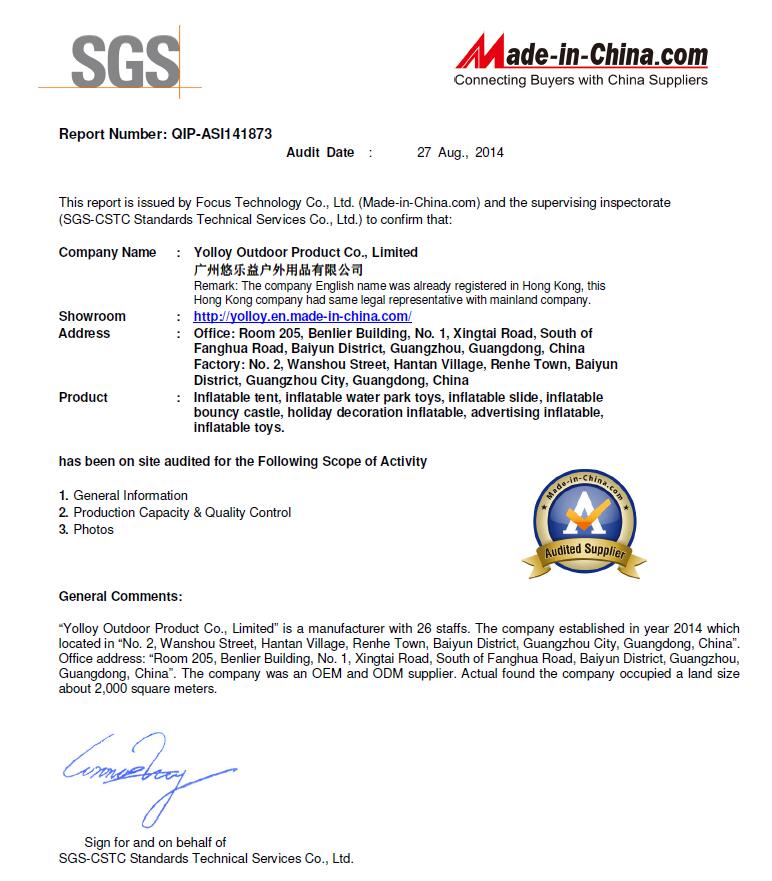
YOLLOY Outdoor Product Co., Limited, based in Guangzhou, China, has built its reputation as a full-service inflatable product manufacturer with deep expertise in projection screens and dome structures. The company's product line includes flat inflatable projection screens for outdoor cinema and events, as well as portable planetarium dome tents designed for immersive education and entertainment.
What distinguishes YOLLOY is the company's design-to-production approach. Rather than offering only off-the-shelf products, YOLLOY works collaboratively with each client. You can share a concept, a rough sketch, photographs of your venue, or even a site plan, and the design team will prepare a simulation rendering showing exactly how the finished product will look. Production begins only after you approve the design, ensuring that the final screen or dome matches your requirements precisely.
On the manufacturing side, YOLLOY uses commercial-grade materials that have passed EN71, EN14960, and RoHS testing. Blowers meet CE or UL requirements and are available in 110V, 220V, or 380V configurations to suit any region's power supply. The production process employs precision sewing equipment with reinforced seams and waterproof nylon thread, along with high-temperature fusion welding for airtight components. Every product undergoes inspection and testing before it leaves the factory.
With a minimum order quantity of just one piece, YOLLOY serves organizations of every size — from a school purchasing its first planetarium dome to a rental company building a fleet of outdoor cinema screens. Products are exported worldwide to Europe, Asia, South America, Africa, the Middle East, and Latin America, with a reported 95% on-time delivery rate. The team commits to responding to inquiries within 24 hours, and every inflatable product ships with a repair kit for field maintenance. Packaging includes soft carpet protection, waterproof PVC bags, and outer PE film to ensure products arrive in excellent condition.
Making an Informed Decision
Choosing the best inflatable projection screen comes down to matching the product to your purpose. A flat screen optimized for outdoor cinema will not serve the needs of an immersive planetarium program, and a dome designed for educational use may be overkill for a backyard movie night. Define your primary use case first, then evaluate screen material, frame construction, blower quality, and manufacturer reliability against that standard.
The difference between a screen that delights audiences for years and one that disappoints after a few events often comes down to the manufacturer's attention to detail — the quality of the stitching, the durability of the projection surface, the reliability of the blower, and the thoughtfulness of the design. Take the time to ask the right questions and review examples of a manufacturer's previous work before committing to a purchase. A well-chosen inflatable projection screen is not just an equipment purchase; it is an investment in the experiences you will create for your audience.
Ready to bring big-screen experiences to your events or educational programs? YOLLOY Outdoor Product Co., Limited specializes in custom inflatable projection screens and portable planetarium domes built to your exact specifications. From concept to delivery, the team partners with you at every stage. Contact YOLLOY today at [email protected] or call +86-20-8370 0771 to discuss your project. Visit www.yolloy.net to explore the full range of inflatable projection solutions.