Products Category
Certification

News

• New Order Successfully Finished for Long-Time Cooperated Japanese Client | YOLLOY Wins Full Client Recognition

• YOLLOY Custom Inflatable Pool Tent for Danish Client: Professional Pool Repair Shelter & Debris Protection

• Trusted Once Again! Greek Captain Re-orders Our Products After 4 Years

• Revolutionize Your Outdoors: The All-Terrain Inflatable Floating Tent for Land & Water

• Elevate Your Summer Fun: The Ultimate Inflatable Water Floating Volleyball Court Trampoline

• Innovative Inflatable Nightclub Tents & Pop-Up Bars: The Ultimate Solution for Portable Party Venues

Contact Us

Name: Sunny Yang
Tel: +86-20-8370 0771
Fax: +86-20-8370 0771
Mobile: 13570587575
E-mail: sales@yolloy.com
Add: No 5,Xiong wei Bo Nan Road,ZhongLuoTan Town,Baiyun district,Guangzhou,China
Friend me on Facebook Follow me on Twitter Add me to your circles Follow me on Pinterest Watch my channel on YouTube
News

How to Choose an Inflatable Floating Water Park Supplier: A Buyer's Guide to Quality, Safety, and ROI

Author:yolloy Date:2026/7/19 15:38:35
Two resort managers sit on the same lakeside dock. Both ordered an inflatable floating water park six months ago. One has guests lining up before opening, a fully booked summer calendar, and a maintenance log that is mostly air-pressure checks. The other is on the phone with a supplier who stopped answering emails three weeks after the invoice cleared.
The difference between the two was not budget. It was not location. It was the questions they asked before signing the purchase order.
The Floating Water Park Boom Is Real — and So Are the Risks
Floating water parks have become one of the fastest-growing categories in outdoor recreation. Hotels, resorts, campgrounds, and lakeside operators are discovering that an inflatable water park transforms a passive body of water into a high-margin revenue center. Guests stay longer, spend more on concessions, and return with friends. The math is straightforward: a one-time capital investment that generates ticket revenue season after season.
But the supply chain is uneven. A quick search for "floating water park supplier" returns factories with polished websites and little else — no verifiable certifications, no documented quality control, and no track record of international delivery. The product looks the same in a catalog photo. The difference shows up in month three, when seams start separating and blowers burn out.
Material Quality: The Part You Cannot See in a Photo
Every floating water park product lives outdoors — under UV radiation, in chlorinated or salt water, subjected to constant mechanical stress from jumping, climbing, and sliding. The material you choose determines whether your park lasts three seasons or ten.
Commercial-grade PVC tarpaulin is the industry standard for inflatable water park structures, but not all PVC is equal. Look for material that has been independently tested against relevant safety standards. For inflatable water park products, EN 15649 is the European standard covering floating leisure articles for use on and in water. For inflatable toys and play equipment, EN 14960 applies. Materials that have passed EN71 and RoHS-related testing add an additional layer of confidence — particularly if your park will serve children.
Ask your supplier for the test reports. Not a statement that the material "meets standards." The actual reports, with batch numbers. A China inflatable manufacturer that is serious about export quality will have these documents on file and will share them without hesitation. One that stalls or deflects is telling you something.
Construction Methods: Sewing vs. Welding, and Why It Matters
There are two dominant construction methods in inflatable manufacturing: high-frequency welding (heat fusion) and precision sewing. Each has its place, and a capable factory uses both — but for different purposes.
Airtight structures — the main bodies of floating platforms, slides, and climbing elements — should be manufactured with high-temperature fusion equipment. This creates a seamless, airtight bond that holds pressure consistently. Sewn products, on the other hand, require reinforced seams, waterproof nylon thread, and additional reinforcement at high-load areas. The best factories run both processes under one roof, giving them control over every seam in the final product.
When evaluating a supplier, ask how they handle the transition between welded and sewn sections. The answer will tell you more about their engineering capability than any brochure.
Customization: Why Off-the-Shelf Rarely Fits
Your lake is not the same size as the one in the catalog photo. Your brand colors are not the same as the stock product. Your target age group might be different from the default configuration. These are not edge cases — they are the normal operating conditions of a successful floating water park.
A serious supplier offers custom sizing, custom colors, and logo printing as standard — not as an expensive add-on. The design process should start with your specifications: a site plan, a budget, a description of your target audience, and an idea of the experience you want to create. From there, the factory's design team should produce simulation renderings for your review, iterating until the design matches your vision.
Minimum order quantity is another signal. A factory that requires a container-load minimum is optimized for mass production, not for your project. A factory that accepts a minimum order of one piece — and still delivers on time — is built for custom work. That flexibility matters when you are testing a new concept or adding elements to an existing park.
The Blower: The Heart of Your Park
An inflatable water park is only as reliable as the blower keeping it inflated. The blower is not a commodity accessory — it is the single point of failure that determines whether your park opens or closes on any given day.
Your supplier should be able to provide blowers configured for your local voltage requirements — 110V, 220V, or 380V — and the blowers themselves should carry CE or UL certification. Ask whether the blower is included with the product or quoted separately. Ask about power consumption, noise levels, and whether spare blowers are available for rapid replacement. The answer to these questions reveals whether the supplier treats the blower as part of the product or as an afterthought.
Anchoring and Wind Resistance: What Keeps Your Park in Place
A floating water park operates in conditions that change by the hour — wind, current, water level, and user load. The anchoring system is not optional. It is what keeps your investment from drifting into the next bay.
Look for products that incorporate D-ring or round metal anchor systems at multiple attachment points. The anchor system should be integrated into the design, not added as an aftermarket solution. Ask your supplier for wind-load specifications and recommended anchoring configurations for your specific water conditions. A factory that cannot answer this question has not designed the product for the real world.
Production Timeline and Quality Control
A typical production cycle for a regular inflatable product runs 6 to 15 days, excluding transit time. Complex or large custom projects will take longer — and a supplier who promises otherwise is either cutting corners or misrepresenting their capacity.
During production, the factory should conduct inspections and testing at multiple stages — not just a final visual check before packing. The testing protocol should include inflation testing under load, seam-strength verification, and blower compatibility checks. Before shipment, every product should be fully inflated and inspected.
Five Questions to Ask Before You Place an Order
  • Can you provide the EN 15649 and EN 14960 test reports for the materials used in my order?
  • Do you manufacture with both high-frequency welding and precision sewing equipment in your own facility?
  • Can you supply blowers with CE or UL certification configured for my local voltage?
  • What is your warranty period and what does it cover — materials, workmanship, blowers?
  • Do you include a repair kit and spare parts list with every shipment?
Packaging, Shipping, and What Arrives at Your Door
The gap between "shipped" and "arrived in usable condition" is where many import relationships break down. The best inflatable product in the world is useless if it arrives with abrasion damage from poor packaging.
Proper packaging for inflatable products includes soft carpet protection around vulnerable surfaces, waterproof PVC bags as the inner layer, and an outer PE film for moisture protection. Large or heavy products should ship on steel pallets to prevent crushing during transit. Air shipping typically takes 5 to 7 days, while sea freight runs 15 to 30 days or more. A supplier with a documented 95% on-time delivery rate is worth a premium over one that ships late and blames the port.
Every shipment should include a repair kit. This is not a nicety — it is a minimum requirement. The kit should contain patching material, adhesive, thread, and basic tools. Your maintenance team should know how to use it before the first guest arrives.
Warranty and After-Sales Support: The Three-Year Benchmark
A warranty is a statement about how much the manufacturer trusts its own product. In the inflatable industry, a three-year service-life expectation — when products are used and maintained correctly — is a reasonable benchmark. The warranty should cover material defects and workmanship issues, and the terms should be clearly stated in writing before the order is placed.
Beyond the warranty, evaluate the supplier's responsiveness. Do they answer emails within 24 hours? Do they provide technical support for installation and maintenance? A supplier that goes silent after the wire transfer clears is not a partner — they are a transaction. Your floating water park will need replacement parts, additional elements, and technical advice over its lifetime. The relationship matters.
Beyond Floating Parks: Building a Complete Attraction
Once you have a successful floating water park, the next question is natural: what else can this body of water support? The same manufacturer that builds your floating platforms can also produce inflatable boats, floating loungers, water balls, water rollers, and inflatable swimming pools — creating a comprehensive aquatic recreation zone from a single supplier relationship.
Many operators also find that expanding into land-based inflatables — interactive sports games, obstacle courses, bounce houses, and commercial slides — extends their season and diversifies their revenue. A supplier with a broad commercial inflatable products catalog gives you the flexibility to grow your attraction portfolio without sourcing from multiple vendors and managing multiple quality standards.
Start with a Conversation, Not a Catalog
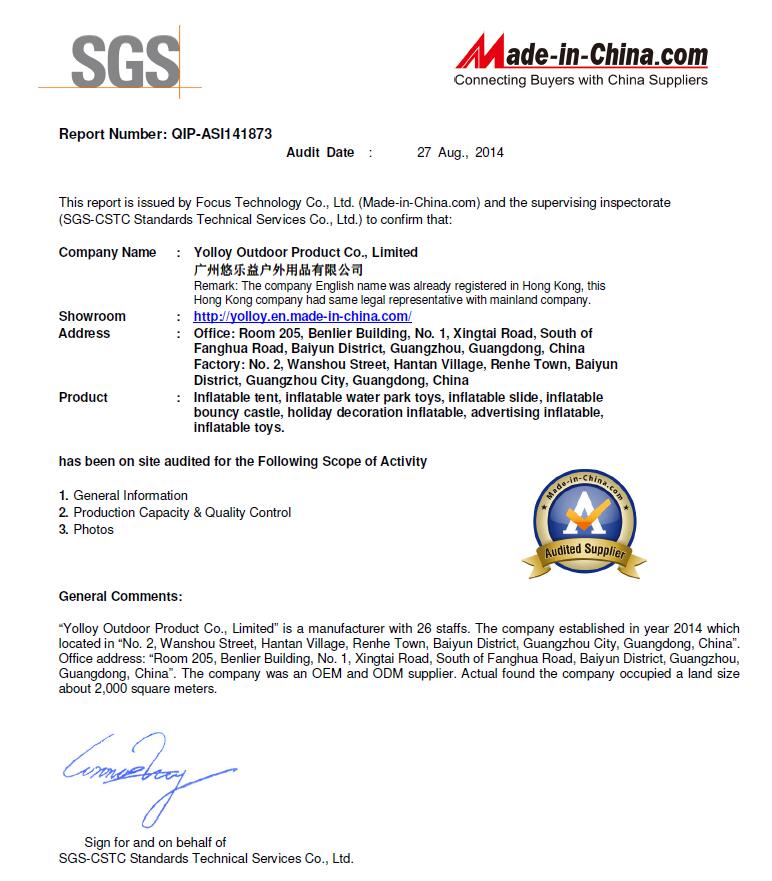
YOLLOY Outdoor Product Co., Limited designs and manufactures custom inflatable water parks, floating platforms, and a full range of commercial inflatable products from its factory in Guangzhou, China. Every product is built to order — to your size, your colors, and your specifications — with materials that meet EN71, EN14960, and EN15649 standards. Blowers are supplied with CE or UL certification configured for your voltage. Every shipment includes a repair kit, and every customer receives a response within 24 hours.
Browse our inflatable water park collection or contact us with your site plan and requirements. The good conversations happen before the order, not after.


How to Choose an Inflatable Floating Water Park Supplier: A Buyer's Guide to Quality, Safety, and ROI

Author:yolloy Date:2026/7/19 15:38:35

Two resort managers sit on the same lakeside dock. Both ordered an inflatable floating water park six months ago. One has guests lining up before opening, a fully booked summer calendar, and a maintenance log that is mostly air-pressure checks. The other is on the phone with a supplier who stopped answering emails three weeks after the invoice cleared.
The difference between the two was not budget. It was not location. It was the questions they asked before signing the purchase order.
The Floating Water Park Boom Is Real — and So Are the Risks
Floating water parks have become one of the fastest-growing categories in outdoor recreation. Hotels, resorts, campgrounds, and lakeside operators are discovering that an inflatable water park transforms a passive body of water into a high-margin revenue center. Guests stay longer, spend more on concessions, and return with friends. The math is straightforward: a one-time capital investment that generates ticket revenue season after season.
But the supply chain is uneven. A quick search for "floating water park supplier" returns factories with polished websites and little else — no verifiable certifications, no documented quality control, and no track record of international delivery. The product looks the same in a catalog photo. The difference shows up in month three, when seams start separating and blowers burn out.
Material Quality: The Part You Cannot See in a Photo
Every floating water park product lives outdoors — under UV radiation, in chlorinated or salt water, subjected to constant mechanical stress from jumping, climbing, and sliding. The material you choose determines whether your park lasts three seasons or ten.
Commercial-grade PVC tarpaulin is the industry standard for inflatable water park structures, but not all PVC is equal. Look for material that has been independently tested against relevant safety standards. For inflatable water park products, EN 15649 is the European standard covering floating leisure articles for use on and in water. For inflatable toys and play equipment, EN 14960 applies. Materials that have passed EN71 and RoHS-related testing add an additional layer of confidence — particularly if your park will serve children.
Ask your supplier for the test reports. Not a statement that the material "meets standards." The actual reports, with batch numbers. A China inflatable manufacturer that is serious about export quality will have these documents on file and will share them without hesitation. One that stalls or deflects is telling you something.
Construction Methods: Sewing vs. Welding, and Why It Matters
There are two dominant construction methods in inflatable manufacturing: high-frequency welding (heat fusion) and precision sewing. Each has its place, and a capable factory uses both — but for different purposes.
Airtight structures — the main bodies of floating platforms, slides, and climbing elements — should be manufactured with high-temperature fusion equipment. This creates a seamless, airtight bond that holds pressure consistently. Sewn products, on the other hand, require reinforced seams, waterproof nylon thread, and additional reinforcement at high-load areas. The best factories run both processes under one roof, giving them control over every seam in the final product.
When evaluating a supplier, ask how they handle the transition between welded and sewn sections. The answer will tell you more about their engineering capability than any brochure.
Customization: Why Off-the-Shelf Rarely Fits
Your lake is not the same size as the one in the catalog photo. Your brand colors are not the same as the stock product. Your target age group might be different from the default configuration. These are not edge cases — they are the normal operating conditions of a successful floating water park.
A serious supplier offers custom sizing, custom colors, and logo printing as standard — not as an expensive add-on. The design process should start with your specifications: a site plan, a budget, a description of your target audience, and an idea of the experience you want to create. From there, the factory's design team should produce simulation renderings for your review, iterating until the design matches your vision.
Minimum order quantity is another signal. A factory that requires a container-load minimum is optimized for mass production, not for your project. A factory that accepts a minimum order of one piece — and still delivers on time — is built for custom work. That flexibility matters when you are testing a new concept or adding elements to an existing park.
The Blower: The Heart of Your Park
An inflatable water park is only as reliable as the blower keeping it inflated. The blower is not a commodity accessory — it is the single point of failure that determines whether your park opens or closes on any given day.
Your supplier should be able to provide blowers configured for your local voltage requirements — 110V, 220V, or 380V — and the blowers themselves should carry CE or UL certification. Ask whether the blower is included with the product or quoted separately. Ask about power consumption, noise levels, and whether spare blowers are available for rapid replacement. The answer to these questions reveals whether the supplier treats the blower as part of the product or as an afterthought.
Anchoring and Wind Resistance: What Keeps Your Park in Place
A floating water park operates in conditions that change by the hour — wind, current, water level, and user load. The anchoring system is not optional. It is what keeps your investment from drifting into the next bay.
Look for products that incorporate D-ring or round metal anchor systems at multiple attachment points. The anchor system should be integrated into the design, not added as an aftermarket solution. Ask your supplier for wind-load specifications and recommended anchoring configurations for your specific water conditions. A factory that cannot answer this question has not designed the product for the real world.
Production Timeline and Quality Control
A typical production cycle for a regular inflatable product runs 6 to 15 days, excluding transit time. Complex or large custom projects will take longer — and a supplier who promises otherwise is either cutting corners or misrepresenting their capacity.
During production, the factory should conduct inspections and testing at multiple stages — not just a final visual check before packing. The testing protocol should include inflation testing under load, seam-strength verification, and blower compatibility checks. Before shipment, every product should be fully inflated and inspected.
Five Questions to Ask Before You Place an Order
  • Can you provide the EN 15649 and EN 14960 test reports for the materials used in my order?
  • Do you manufacture with both high-frequency welding and precision sewing equipment in your own facility?
  • Can you supply blowers with CE or UL certification configured for my local voltage?
  • What is your warranty period and what does it cover — materials, workmanship, blowers?
  • Do you include a repair kit and spare parts list with every shipment?
Packaging, Shipping, and What Arrives at Your Door
The gap between "shipped" and "arrived in usable condition" is where many import relationships break down. The best inflatable product in the world is useless if it arrives with abrasion damage from poor packaging.
Proper packaging for inflatable products includes soft carpet protection around vulnerable surfaces, waterproof PVC bags as the inner layer, and an outer PE film for moisture protection. Large or heavy products should ship on steel pallets to prevent crushing during transit. Air shipping typically takes 5 to 7 days, while sea freight runs 15 to 30 days or more. A supplier with a documented 95% on-time delivery rate is worth a premium over one that ships late and blames the port.
Every shipment should include a repair kit. This is not a nicety — it is a minimum requirement. The kit should contain patching material, adhesive, thread, and basic tools. Your maintenance team should know how to use it before the first guest arrives.
Warranty and After-Sales Support: The Three-Year Benchmark
A warranty is a statement about how much the manufacturer trusts its own product. In the inflatable industry, a three-year service-life expectation — when products are used and maintained correctly — is a reasonable benchmark. The warranty should cover material defects and workmanship issues, and the terms should be clearly stated in writing before the order is placed.
Beyond the warranty, evaluate the supplier's responsiveness. Do they answer emails within 24 hours? Do they provide technical support for installation and maintenance? A supplier that goes silent after the wire transfer clears is not a partner — they are a transaction. Your floating water park will need replacement parts, additional elements, and technical advice over its lifetime. The relationship matters.
Beyond Floating Parks: Building a Complete Attraction
Once you have a successful floating water park, the next question is natural: what else can this body of water support? The same manufacturer that builds your floating platforms can also produce inflatable boats, floating loungers, water balls, water rollers, and inflatable swimming pools — creating a comprehensive aquatic recreation zone from a single supplier relationship.
Many operators also find that expanding into land-based inflatables — interactive sports games, obstacle courses, bounce houses, and commercial slides — extends their season and diversifies their revenue. A supplier with a broad commercial inflatable products catalog gives you the flexibility to grow your attraction portfolio without sourcing from multiple vendors and managing multiple quality standards.
Start with a Conversation, Not a Catalog
YOLLOY Outdoor Product Co., Limited designs and manufactures custom inflatable water parks, floating platforms, and a full range of commercial inflatable products from its factory in Guangzhou, China. Every product is built to order — to your size, your colors, and your specifications — with materials that meet EN71, EN14960, and EN15649 standards. Blowers are supplied with CE or UL certification configured for your voltage. Every shipment includes a repair kit, and every customer receives a response within 24 hours.
Browse our inflatable water park collection or contact us with your site plan and requirements. The good conversations happen before the order, not after.