Products Category
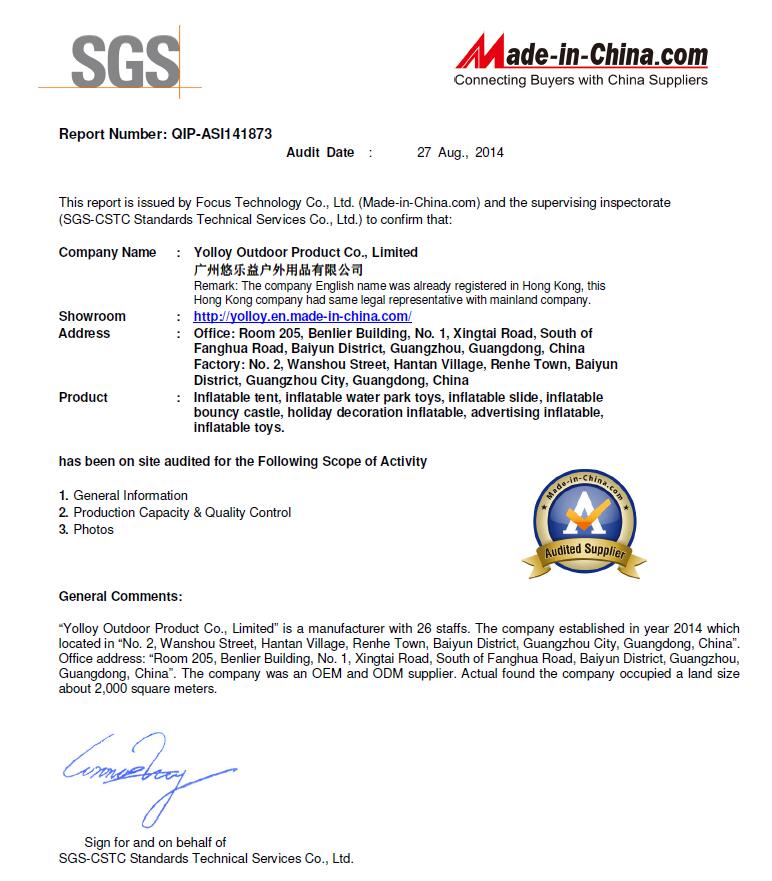
Certification

News

• New Order Successfully Finished for Long-Time Cooperated Japanese Client | YOLLOY Wins Full Client Recognition

• YOLLOY Custom Inflatable Pool Tent for Danish Client: Professional Pool Repair Shelter & Debris Protection

• Trusted Once Again! Greek Captain Re-orders Our Products After 4 Years

• Revolutionize Your Outdoors: The All-Terrain Inflatable Floating Tent for Land & Water

• Elevate Your Summer Fun: The Ultimate Inflatable Water Floating Volleyball Court Trampoline

• Innovative Inflatable Nightclub Tents & Pop-Up Bars: The Ultimate Solution for Portable Party Venues

Contact Us

Name: Sunny Yang
Tel: +86-20-8370 0771
Fax: +86-20-8370 0771
Mobile: 13570587575
E-mail: sales@yolloy.com
Add: No 5,Xiong wei Bo Nan Road,ZhongLuoTan Town,Baiyun district,Guangzhou,China
Friend me on Facebook Follow me on Twitter Add me to your circles Follow me on Pinterest Watch my channel on YouTube
News

Why Inflatable Tents Are Revolutionizing Outdoor Events, Business, and Emergency Response

Author:yolloy Date:2026/7/19 13:06:32

When you think about setting up a temporary space for an outdoor event, a trade show, or even an emergency shelter, the first image that comes to mind is probably a heavy metal-framed structure that takes hours to assemble and a team of workers to handle. But the landscape of portable shelter has changed dramatically. Today, forward-thinking businesses, event planners, and organizations are turning to a smarter alternative: inflatable tent solutions that combine speed, durability, and versatility in ways that traditional tents simply cannot match.

What Makes Inflatable Tents Different from Traditional Tents?

The fundamental difference lies in the structural support system. Traditional tents rely on rigid metal or aluminum poles that must be threaded through fabric sleeves, locked into place, and anchored individually — a process that demands time, labor, and experience. An outdoor inflatable tent, by contrast, uses pressurized air beams as its skeleton. These air beams are permanently integrated into the tent body, which means the entire structure can be deployed simply by inflating it with an electric blower or foot pump.

This design eliminates dozens of separate components. There are no poles to bend, no connectors to lose, and no complicated instruction manuals to decipher. For businesses that need to set up and tear down repeatedly — whether at weekend markets, corporate events, or touring exhibitions — the time savings alone can justify the investment many times over.

Rapid Setup and Takedown: A Game-Changer for Event Professionals

One of the most compelling advantages of inflatable tents is the speed of deployment. While a traditional pole tent can take a crew of four or five people an hour or more to assemble, an inflatable tent can be fully operational in a matter of minutes with just one or two people. The process is straightforward: unroll the tent on a flat surface, connect the blower, and switch it on. The air beams inflate, the structure rises, and within minutes you have a rigid, stable shelter ready for use.

Taking the tent down is equally simple. Deflate the air beams — either naturally or with a pump — fold the fabric, and pack it into its storage bag. There is no disassembly of metal frames, no sorting of pole segments, and no risk of losing small connecting parts. This efficiency makes inflatable tent for events an ideal choice for rental companies that need to turn around equipment quickly between bookings, as well as for event organizers working with tight setup windows.

Built to Last: Materials and Construction That Withstand the Elements

A common misconception about inflatable tents is that they are somehow less durable than their metal-framed counterparts. In reality, the opposite is often true. A quality inflatable tent manufacturer constructs its products using commercial-grade PVC tarpaulin for the air beams and high-strength fabrics such as Oxford fabric, nylon, or TPU for the outer shell, depending on the specific application requirements.

The manufacturing process combines precision sewing with high-temperature fusion welding to create airtight, waterproof chambers. Reinforced seams, waterproof nylon thread, and additional reinforcement at high-load stress points ensure that the structure maintains its integrity even under demanding conditions. D-ring and round metal anchor systems are built into the design, providing secure attachment points for wind resistance and stability on various terrain types.

For water park and aquatic applications, the materials are engineered to resist prolonged exposure to water and UV radiation. The fabrics used are treated for anti-mildew, anti-ultraviolet, and moisture-proof performance — qualities that extend the service life of the product significantly when used and maintained properly.

Beyond the Basic Tent: Endless Customization Possibilities

One of the most significant advantages of working with a specialized inflatable tent manufacturer is the ability to customize virtually every aspect of the product. Off-the-shelf tents force you to adapt your needs to the product; custom inflatable tents adapt to your needs instead.

Customization options include dimensions, colors, window and door placements, flooring types, and ventilation systems. Branding is another major area where custom inflatable tents excel — company logos, artwork, and promotional graphics can be printed directly onto the fabric, turning the tent itself into a marketing asset. Whether you need a tent for a corporate hospitality suite, a branded product launch, or a themed party venue, the visual identity of your brand can be integrated seamlessly into the structure.

The range of tent types available today is remarkably broad. Cube tents offer clean, modern lines suitable for trade show booths and retail pop-ups. Tunnel tents provide elongated spaces ideal for exhibition walkways and registration areas. Dome tents deliver spacious, open interiors perfect for presentations, dining, and social gatherings. Custom inflatable dome options, including clear bubble tents and snow globe designs, have become especially popular for glamping, outdoor dining, and party venues where aesthetics and visibility are priorities.

Key Takeaway: Whether you are looking for a cube tent, tunnel tent, dome tent, shelter tent, car tent, party tent, sports tent, or emergency workshop tent, a custom inflatable solution can be designed from a simple description, sketch, photograph, or site plan — and the minimum order quantity can be as low as one piece.

Applications That Go Far Beyond Camping

While camping was the original use case for inflatable tents, the technology has now expanded into a wide range of commercial, industrial, and institutional applications. Event companies use inflatable tents for outdoor weddings, corporate functions, music festivals, and food fairs. Exhibition organizers deploy them as eye-catching booth spaces and product demonstration areas. Sports organizations use them as temporary locker rooms, medical stations, and VIP lounges at tournaments and competitions.

In the automotive sector, inflatable spray booths and ventilated painting enclosures provide a portable, controlled environment for vehicle detailing and refinishing work. Golf facilities and entertainment venues use inflatable golf simulator enclosures to create indoor-outdoor practice spaces that can be deployed or stored as needed. The education and museum sectors have embraced portable planetarium domes and inflatable projection screens for immersive learning experiences and traveling science shows.

Emergency response and disaster relief organizations rely on inflatable shelters for rapid deployment in crisis situations. When traditional infrastructure is compromised, an inflatable tent can be air-dropped into affected areas and set up within minutes to serve as a field hospital, command center, or temporary housing unit. The ability to provide immediate shelter in hostile environments is one of the most compelling reasons why inflatable technology has become a standard tool in humanitarian logistics.

Safety, Certification, and Quality Assurance

When purchasing inflatable products for commercial use, safety and compliance should be non-negotiable priorities. Reputable manufacturers subject their materials and finished products to rigorous testing against internationally recognized standards. For inflatable toys and recreational products, EN 14960 certification is a key benchmark. For inflatable water park equipment, EN 15649 provides the relevant safety framework. Materials used in manufacturing should pass EN71 and RoHS testing, confirming that they are free from harmful substances and safe for human contact.

Beyond material certifications, the blowers and electrical components supplied with inflatable tents should meet CE or UL requirements, ensuring safe operation across different voltage standards (110V, 220V, or 380V). A comprehensive quality control process should include inspection and testing of every product before shipment, and each product should be supplied with a repair kit for on-site maintenance. When properly maintained, a well-manufactured inflatable tent can deliver reliable service for three years or more, depending on usage intensity and environmental conditions.

What to Look for When Choosing an Inflatable Tent Supplier

Selecting the right supplier is as important as choosing the right product. Here are the key factors to evaluate:

Design-to-Production Capability: The supplier should offer a complete design-to-production service. This means their design team prepares simulation renderings based on your proposal, revises the design until you approve it, and only then releases it for factory production. This workflow ensures that what you envision is what you receive.

Customization Flexibility: The supplier should be willing to work from a description, a rough sketch, a photograph, a site plan, and a budget — not just from a catalog of existing designs. Custom sizes, colors, and logo printing should be standard offerings rather than premium add-ons.

Production and Delivery Reliability: Ask about typical production times and on-time delivery rates. A production cycle of 6 to 15 days for regular products is common in the industry, though complex or large custom projects may take longer. The supplier should be able to arrange both air freight (5–7 days transit) and sea freight (15–30+ days) depending on your urgency and budget.

Packaging and After-Sales Support: Quality packaging protects your investment during transit. Look for suppliers that use soft carpet protection, waterproof PVC bags, and outer PE film, with steel pallets for large products. A repair kit should be included with every inflatable product, and the supplier should respond to inquiries within 24 hours.

The Bottom Line: Why Inflatable Tents Are the Smarter Choice

The shift from traditional metal-frame tents to inflatable structures is not a passing trend — it is a logical evolution driven by clear operational advantages. Inflatable tents offer faster setup and takedown, reduced labor requirements, excellent durability, and a level of customization that traditional tents cannot match. They are lighter to transport, easier to store, and more adaptable to different environments and use cases.

For businesses that depend on temporary structures — event rental companies, exhibition organizers, sports facilities, hospitality providers, and emergency response agencies — the operational efficiency gains translate directly into cost savings and improved service delivery. For brands and marketers, the ability to print custom graphics on the tent surface turns a functional shelter into a mobile billboard that works around the clock.

As the inflatable tent industry continues to innovate, the range of available products and the quality of manufacturing will only improve. The question is not whether inflatable tents are a viable alternative to traditional tents — they have already proven that they are. The question is whether your business is ready to take advantage of the technology that is reshaping the portable shelter market.

Ready to explore custom inflatable tent solutions for your business? YOLLOY Outdoor Product Co., Limited designs and manufactures a comprehensive range of inflatable tents, clear domes, water park products, interactive games, slides, and advertising inflatables from its production facility in Guangzhou, China. With a complete design-to-production service, international certifications, and a 95% on-time delivery rate, YOLLOY supplies custom inflatable products to clients across Europe, Asia, South America, Africa, the Middle East, and Latin America. Visit www.yolloy.net to browse the full product catalog or contact the team at sales@yolloy.com to discuss your project requirements.

Why Inflatable Tents Are Revolutionizing Outdoor Events, Business, and Emergency Response

Author:yolloy Date:2026/7/19 13:06:32

When you think about setting up a temporary space for an outdoor event, a trade show, or even an emergency shelter, the first image that comes to mind is probably a heavy metal-framed structure that takes hours to assemble and a team of workers to handle. But the landscape of portable shelter has changed dramatically. Today, forward-thinking businesses, event planners, and organizations are turning to a smarter alternative: inflatable tent solutions that combine speed, durability, and versatility in ways that traditional tents simply cannot match.

What Makes Inflatable Tents Different from Traditional Tents?

The fundamental difference lies in the structural support system. Traditional tents rely on rigid metal or aluminum poles that must be threaded through fabric sleeves, locked into place, and anchored individually — a process that demands time, labor, and experience. An outdoor inflatable tent, by contrast, uses pressurized air beams as its skeleton. These air beams are permanently integrated into the tent body, which means the entire structure can be deployed simply by inflating it with an electric blower or foot pump.

This design eliminates dozens of separate components. There are no poles to bend, no connectors to lose, and no complicated instruction manuals to decipher. For businesses that need to set up and tear down repeatedly — whether at weekend markets, corporate events, or touring exhibitions — the time savings alone can justify the investment many times over.

Rapid Setup and Takedown: A Game-Changer for Event Professionals

One of the most compelling advantages of inflatable tents is the speed of deployment. While a traditional pole tent can take a crew of four or five people an hour or more to assemble, an inflatable tent can be fully operational in a matter of minutes with just one or two people. The process is straightforward: unroll the tent on a flat surface, connect the blower, and switch it on. The air beams inflate, the structure rises, and within minutes you have a rigid, stable shelter ready for use.

Taking the tent down is equally simple. Deflate the air beams — either naturally or with a pump — fold the fabric, and pack it into its storage bag. There is no disassembly of metal frames, no sorting of pole segments, and no risk of losing small connecting parts. This efficiency makes inflatable tent for events an ideal choice for rental companies that need to turn around equipment quickly between bookings, as well as for event organizers working with tight setup windows.

Built to Last: Materials and Construction That Withstand the Elements

A common misconception about inflatable tents is that they are somehow less durable than their metal-framed counterparts. In reality, the opposite is often true. A quality inflatable tent manufacturer constructs its products using commercial-grade PVC tarpaulin for the air beams and high-strength fabrics such as Oxford fabric, nylon, or TPU for the outer shell, depending on the specific application requirements.

The manufacturing process combines precision sewing with high-temperature fusion welding to create airtight, waterproof chambers. Reinforced seams, waterproof nylon thread, and additional reinforcement at high-load stress points ensure that the structure maintains its integrity even under demanding conditions. D-ring and round metal anchor systems are built into the design, providing secure attachment points for wind resistance and stability on various terrain types.

For water park and aquatic applications, the materials are engineered to resist prolonged exposure to water and UV radiation. The fabrics used are treated for anti-mildew, anti-ultraviolet, and moisture-proof performance — qualities that extend the service life of the product significantly when used and maintained properly.

Beyond the Basic Tent: Endless Customization Possibilities

One of the most significant advantages of working with a specialized inflatable tent manufacturer is the ability to customize virtually every aspect of the product. Off-the-shelf tents force you to adapt your needs to the product; custom inflatable tents adapt to your needs instead.

Customization options include dimensions, colors, window and door placements, flooring types, and ventilation systems. Branding is another major area where custom inflatable tents excel — company logos, artwork, and promotional graphics can be printed directly onto the fabric, turning the tent itself into a marketing asset. Whether you need a tent for a corporate hospitality suite, a branded product launch, or a themed party venue, the visual identity of your brand can be integrated seamlessly into the structure.

The range of tent types available today is remarkably broad. Cube tents offer clean, modern lines suitable for trade show booths and retail pop-ups. Tunnel tents provide elongated spaces ideal for exhibition walkways and registration areas. Dome tents deliver spacious, open interiors perfect for presentations, dining, and social gatherings. Custom inflatable dome options, including clear bubble tents and snow globe designs, have become especially popular for glamping, outdoor dining, and party venues where aesthetics and visibility are priorities.

Key Takeaway: Whether you are looking for a cube tent, tunnel tent, dome tent, shelter tent, car tent, party tent, sports tent, or emergency workshop tent, a custom inflatable solution can be designed from a simple description, sketch, photograph, or site plan — and the minimum order quantity can be as low as one piece.

Applications That Go Far Beyond Camping

While camping was the original use case for inflatable tents, the technology has now expanded into a wide range of commercial, industrial, and institutional applications. Event companies use inflatable tents for outdoor weddings, corporate functions, music festivals, and food fairs. Exhibition organizers deploy them as eye-catching booth spaces and product demonstration areas. Sports organizations use them as temporary locker rooms, medical stations, and VIP lounges at tournaments and competitions.

In the automotive sector, inflatable spray booths and ventilated painting enclosures provide a portable, controlled environment for vehicle detailing and refinishing work. Golf facilities and entertainment venues use inflatable golf simulator enclosures to create indoor-outdoor practice spaces that can be deployed or stored as needed. The education and museum sectors have embraced portable planetarium domes and inflatable projection screens for immersive learning experiences and traveling science shows.

Emergency response and disaster relief organizations rely on inflatable shelters for rapid deployment in crisis situations. When traditional infrastructure is compromised, an inflatable tent can be air-dropped into affected areas and set up within minutes to serve as a field hospital, command center, or temporary housing unit. The ability to provide immediate shelter in hostile environments is one of the most compelling reasons why inflatable technology has become a standard tool in humanitarian logistics.

Safety, Certification, and Quality Assurance

When purchasing inflatable products for commercial use, safety and compliance should be non-negotiable priorities. Reputable manufacturers subject their materials and finished products to rigorous testing against internationally recognized standards. For inflatable toys and recreational products, EN 14960 certification is a key benchmark. For inflatable water park equipment, EN 15649 provides the relevant safety framework. Materials used in manufacturing should pass EN71 and RoHS testing, confirming that they are free from harmful substances and safe for human contact.

Beyond material certifications, the blowers and electrical components supplied with inflatable tents should meet CE or UL requirements, ensuring safe operation across different voltage standards (110V, 220V, or 380V). A comprehensive quality control process should include inspection and testing of every product before shipment, and each product should be supplied with a repair kit for on-site maintenance. When properly maintained, a well-manufactured inflatable tent can deliver reliable service for three years or more, depending on usage intensity and environmental conditions.

What to Look for When Choosing an Inflatable Tent Supplier

Selecting the right supplier is as important as choosing the right product. Here are the key factors to evaluate:

Design-to-Production Capability: The supplier should offer a complete design-to-production service. This means their design team prepares simulation renderings based on your proposal, revises the design until you approve it, and only then releases it for factory production. This workflow ensures that what you envision is what you receive.

Customization Flexibility: The supplier should be willing to work from a description, a rough sketch, a photograph, a site plan, and a budget — not just from a catalog of existing designs. Custom sizes, colors, and logo printing should be standard offerings rather than premium add-ons.

Production and Delivery Reliability: Ask about typical production times and on-time delivery rates. A production cycle of 6 to 15 days for regular products is common in the industry, though complex or large custom projects may take longer. The supplier should be able to arrange both air freight (5–7 days transit) and sea freight (15–30+ days) depending on your urgency and budget.

Packaging and After-Sales Support: Quality packaging protects your investment during transit. Look for suppliers that use soft carpet protection, waterproof PVC bags, and outer PE film, with steel pallets for large products. A repair kit should be included with every inflatable product, and the supplier should respond to inquiries within 24 hours.

The Bottom Line: Why Inflatable Tents Are the Smarter Choice

The shift from traditional metal-frame tents to inflatable structures is not a passing trend — it is a logical evolution driven by clear operational advantages. Inflatable tents offer faster setup and takedown, reduced labor requirements, excellent durability, and a level of customization that traditional tents cannot match. They are lighter to transport, easier to store, and more adaptable to different environments and use cases.

For businesses that depend on temporary structures — event rental companies, exhibition organizers, sports facilities, hospitality providers, and emergency response agencies — the operational efficiency gains translate directly into cost savings and improved service delivery. For brands and marketers, the ability to print custom graphics on the tent surface turns a functional shelter into a mobile billboard that works around the clock.

As the inflatable tent industry continues to innovate, the range of available products and the quality of manufacturing will only improve. The question is not whether inflatable tents are a viable alternative to traditional tents — they have already proven that they are. The question is whether your business is ready to take advantage of the technology that is reshaping the portable shelter market.

Ready to explore custom inflatable tent solutions for your business? YOLLOY Outdoor Product Co., Limited designs and manufactures a comprehensive range of inflatable tents, clear domes, water park products, interactive games, slides, and advertising inflatables from its production facility in Guangzhou, China. With a complete design-to-production service, international certifications, and a 95% on-time delivery rate, YOLLOY supplies custom inflatable products to clients across Europe, Asia, South America, Africa, the Middle East, and Latin America. Visit www.yolloy.net to browse the full product catalog or contact the team at sales@yolloy.com to discuss your project requirements.