Why an Inflatable Water Park Is the Smartest Summer Investment
A well-designed
inflatable water park does more than fill a body of water with colorful shapes. It transforms a plain lakefront, pool, or beach into a revenue-generating destination. Guests stay longer. They spend more on concessions, rentals, and return visits. And compared to permanent construction, the upfront cost is a fraction — with the flexibility to relocate, expand, or reconfigure as your business grows.
From
inflatable floating water parks anchored on lakes and reservoirs to
commercial inflatable slides installed poolside, the category covers a wide range of products. Inflatable swimming pools, floating platforms, water balls, zorb balls, inflatable boats, and jet ski docks each serve a different customer need — and a smart buyer picks the combination that matches their site, audience, and season.
The Two Questions That Separate Reliable Products from Headaches
When you browse supplier catalogs, every product looks bright and inviting. But what you see in a photograph tells you nothing about what happens after six months of UV exposure, constant foot traffic, and repeated inflation cycles. Two questions reveal more than any spec sheet.
1. What material is it made of, and how is it assembled?
The answer should be specific. Commercial-grade PVC tarpaulin is the industry standard for water park products — it is UV-resistant, tear-resistant, and designed for heavy-duty use. But the material alone is not enough. The manufacturing method matters just as much. High-temperature fusion welding creates airtight seams that do not leak under pressure. Precision sewing equipment with reinforced seams and waterproof nylon thread handles the high-load areas where stitched construction is required. Additional reinforcement at stress points — entry steps, anchor points, slide connections — prevents premature wear. If a supplier cannot describe their assembly process in detail, treat that silence as a warning.
2. What certifications do the materials and blowers carry?
Certifications are not decoration. They are evidence that a product has been tested against a published standard. For inflatable water park products, look for EN 14960 (inflatable play equipment) and EN 15649 (floating leisure articles for use on and in the water). The blowers that keep everything inflated should meet CE or UL requirements. Materials should have passed RoHS and EN71 testing. These are not optional checkboxes — they are the difference between a product that meets regulatory requirements in your market and one that does not. Ask for certificates with scope statements. A logo on a homepage is marketing. A certificate with a scope statement is documentation.
Customization: When Off-the-Shelf Is Not Enough
Every site is different. Your lakefront has a specific shoreline profile. Your pool deck has limited staging space. Your brand has a color palette and a logo that customers recognize. An off-the-shelf product forces you to adapt your operation to the equipment. A custom product adapts the equipment to your operation.
A capable
China inflatable manufacturer should be able to work from your description, drawing, sketch, photograph, or site plan — and produce simulation renderings before a single panel is cut. Custom sizes, custom colors, printed logos, and branded artwork should all be standard options, not premium add-ons. The design workflow should be transparent: you submit a proposal, the design team prepares renderings, you revise until approval, and only then does production begin. If the process feels like a black box where you send money and hope for the best, keep looking.
Five Questions to Ask Before You Place an Order
A supplier who answers in specifics is a supplier who runs a controlled process. A supplier who answers in adjectives is a reseller. Here are five questions that separate the two.
What is the minimum order quantity?
If you are testing a new product or launching a pilot program, you do not want to be forced into a container-sized order. The right MOQ for a first-time buyer is one piece. You should be able to order a single unit, evaluate it in real conditions, and scale up when you are confident.
What is the production time and delivery window?
A typical production cycle for a regular inflatable product is 6 to 15 days, excluding transit. Complex or large custom projects take longer — and a responsible manufacturer will tell you that upfront. Air shipping takes 5 to 7 days. Sea shipping takes 15 to 30 days or more. Ask about the on-time delivery rate. A manufacturer that tracks this number and publishes it (one reports 95%) is a manufacturer that manages its production schedule seriously.
What comes in the box?
Every inflatable product should ship with an appropriately powered blower — and the manufacturer should ask you about your voltage requirements (110V, 220V, or 380V) before selecting the unit. A repair kit should be included. The packaging should use soft carpet protection, waterproof PVC bags, and outer PE film. Large products should ship on steel pallets. If a repair kit is not included, ask why — because field repairs are not optional; they are inevitable.
What is the expected service life, and what is covered?
When used and maintained correctly, a well-made commercial inflatable product should deliver around three years of service. The warranty terms should be clear and documented. Ask about the anchor system — D-ring or round metal anchors are standard for wind resistance and installation stability. Ask about replacement part availability. A manufacturer that stocks spare parts and answers service inquiries within 24 hours is a manufacturer that treats your business as an ongoing relationship, not a one-time transaction.
Can you show me the full product range?
A manufacturer worth your time should offer more than one product category.
Commercial inflatable products span a broad spectrum: water park toys, floating platforms, inflatable boats, pools, slides, bounce houses, interactive sports games, paintball bunkers, and advertising inflatables. A supplier with a wide catalog signals manufacturing depth. A supplier with three products signals a narrow operation. Look for the range — because the water park you open this year may need a different product line next year, and you want a partner who can grow with you.
The Real Cost of Choosing the Wrong Supplier
The price on the quote is the smallest cost you will pay. The real costs of a bad decision show up later: a seam that splits on opening weekend, a blower that trips the circuit breaker in front of a line of guests, a product that fades to a washed-out ghost of its catalog photo after one summer of sun. Each of these failures costs you revenue, reputation, and the confidence of your customers. The price list is the last document you should read, not the first. The first documents to read are the material specifications, the certification records, and the answers to the five questions above.
Ready to Build Your Inflatable Water Park?
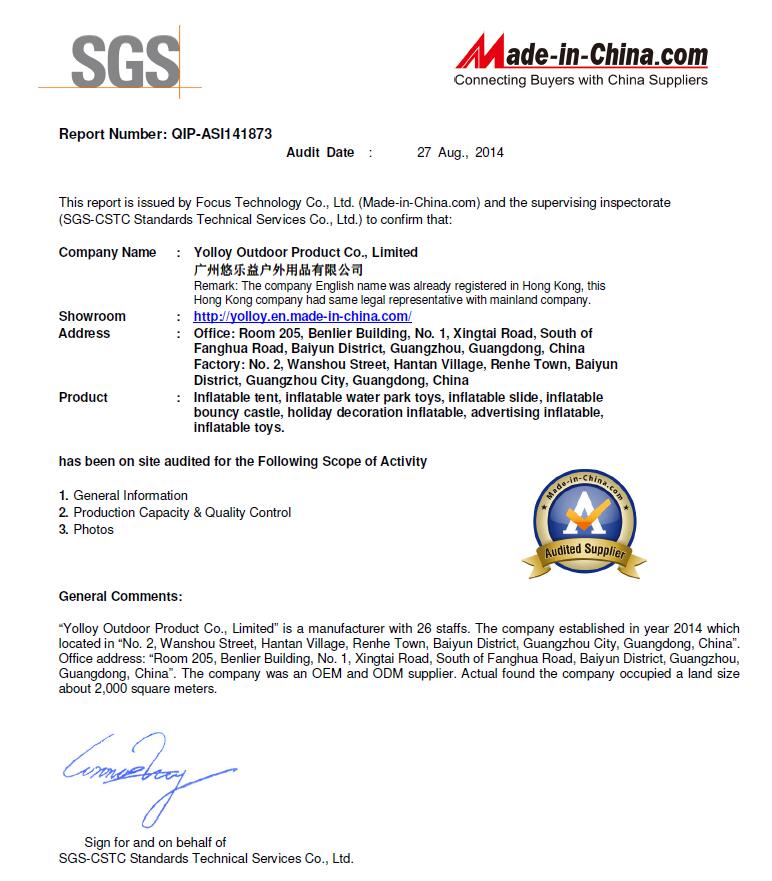
YOLLOY Outdoor Product Co., Limited designs and manufactures custom inflatable water parks, floating platforms, slides, pools, and interactive water toys from its production facility in Guangzhou, China. Products are built with commercial-grade PVC tarpaulin, reinforced seams, and high-temperature fusion welding — and backed by EN 14960, EN 15649, CE, UL, and RoHS-compliant materials. Custom sizes, colors, and logo printing are available. Minimum order quantity is one piece. Repair kits are included with every order. Email and fax inquiries are answered within 24 hours.
Browse the full range of inflatable water park products at
yolloy.net or contact the team at
[email protected] to discuss your project. Send your site plan, sketch, or description — and get a custom design proposal with simulation renderings before you commit.