Products Category
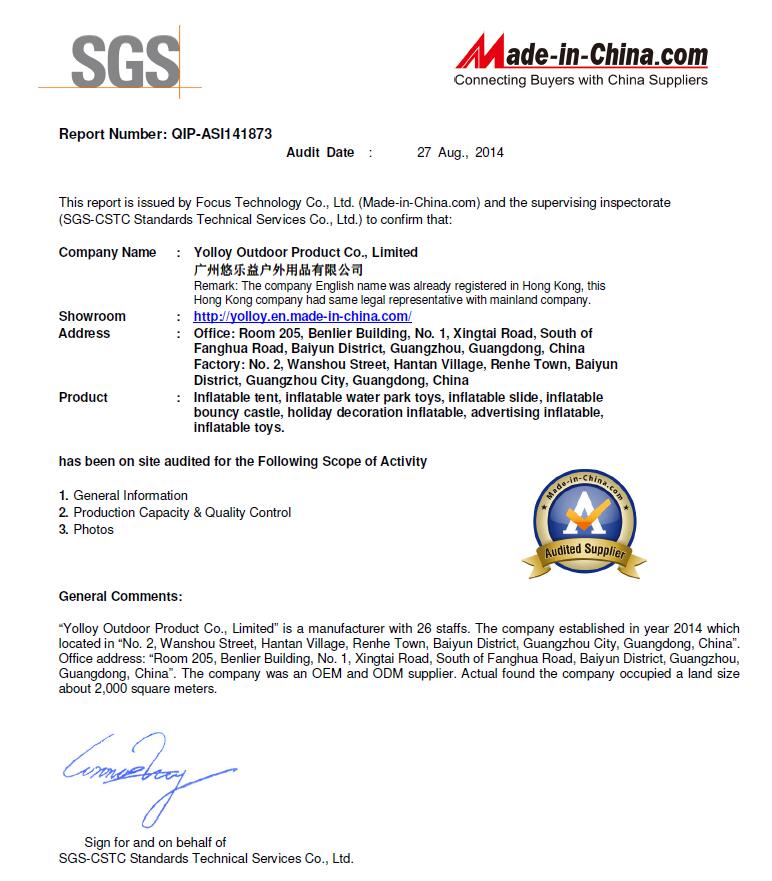
Certification

News

• New Order Successfully Finished for Long-Time Cooperated Japanese Client | YOLLOY Wins Full Client Recognition

• YOLLOY Custom Inflatable Pool Tent for Danish Client: Professional Pool Repair Shelter & Debris Protection

• Trusted Once Again! Greek Captain Re-orders Our Products After 4 Years

• Revolutionize Your Outdoors: The All-Terrain Inflatable Floating Tent for Land & Water

• Elevate Your Summer Fun: The Ultimate Inflatable Water Floating Volleyball Court Trampoline

• Innovative Inflatable Nightclub Tents & Pop-Up Bars: The Ultimate Solution for Portable Party Venues

Contact Us

Name: Sunny Yang
Tel: +86-20-8370 0771
Fax: +86-20-8370 0771
Mobile: 13570587575
E-mail: sales@yolloy.com
Add: No 5,Xiong wei Bo Nan Road,ZhongLuoTan Town,Baiyun district,Guangzhou,China
Friend me on Facebook Follow me on Twitter Add me to your circles Follow me on Pinterest Watch my channel on YouTube
News

Before You Book an Inflatable Tent for Your Next Event, Read This

Author:yolloy Date:2026/7/19 11:07:00
Two event planners are preparing for the same outdoor trade show. One orders a standard tent from a catalog and spends the next three weeks chasing tracking numbers, clarifying voltage requirements, and explaining to the client why the color does not match the brand palette. The other sends a site plan, a logo file, and a budget to a manufacturer who handles the rest.
The difference is not luck. It is the supply chain.
A successful outdoor event depends on more than a good location and a well-written program. The shelter you put over your guests, exhibits, or equipment is the first thing attendees see and the last thing they want to think about. When the tent works, nobody notices. When it does not — a seam splits, a blower trips, a wall panel will not zip — everyone notices.
This article explains what to look for in an inflatable tent for events, how to evaluate a manufacturer, and why custom designs do not have to mean complicated logistics.
What Counts as an Inflatable Event Tent — and What Does Not
An inflatable event tent is not a camping tent with air poles. It is a commercial-grade structure built from PVC tarpaulin, Oxford fabric, nylon, or TPU, held rigid by continuous air pressure from an electric blower. The blower runs throughout the event. The air inside the structural tubes does the work that aluminum poles do in a traditional frame tent — but faster, with fewer people, and without rigid parts that can bend or snap.
The category is broad. A single manufacturer might produce an inflatable cube tent for a product launch, a tunnel tent for a registration corridor, a dome tent for a VIP lounge, and a shelter tent for a medical station — all from the same production floor. Different shapes suit different functions, but the underlying engineering is the same: a sealed air chamber, a reinforced skin, and an anchor system that keeps the structure on the ground.
The Shape Should Follow the Function
Event planners often start with a visual reference — a photo of a tent they saw at another event, or a rendering from a concept artist. That is a useful starting point, but the shape needs to earn its place.
A cube tent provides straight walls and a predictable footprint. It works well for exhibition booths, registration desks, and catering stations where you need to mount signage, hang lighting, or arrange furniture against flat surfaces. A tunnel tent creates a natural flow — guests enter at one end and exit at the other, which is ideal for product walkthroughs, brand experiences, and covered walkways. A dome tent offers a striking silhouette and a clear-span interior with no internal poles, making it a strong choice for keynote stages, lounges, and immersive projection environments.
If you need an outdoor inflatable tent that will be seen from across a festival ground, shape matters. If you need a tent that will be packed into a van and deployed by two people, weight and setup time matter more. A good manufacturer helps you resolve that tension before the first cut of fabric.
What to Ask Before You Order
The cost of a tent is the price on the quotation. The real cost is what happens after delivery. Here are five questions that separate a reliable supplier from a source of regret.
One: What material is being used, and why?
Commercial-grade PVC tarpaulin is the workhorse of the inflatable industry — it is strong, waterproof, and weldable. But not every application calls for PVC. A tent used for a golf simulator enclosure might benefit from Oxford fabric for better breathability and lighter weight. A clear bubble tent for a winter event might use TPU for optical clarity at low temperatures. The answer should be specific to the application, not a generic claim about "premium materials."
Two: What certifications apply to this product?
Materials matter, but proof matters more. For inflatable tents, relevant certifications include EN71 (toy safety, applicable when the tent might be used by children), EN14960 (inflatable play equipment), and RoHS (restriction of hazardous substances). Blowers should carry CE or UL marks appropriate to the destination market. If a manufacturer cannot produce a test report, the material label on the quotation is a promise, not a fact.
Three: What is the actual production time?
A standard inflatable product from a well-organized factory takes 6 to 15 days of production time, excluding transit. Complex custom projects take longer. Be wary of any supplier that quotes a flat 7 days regardless of complexity — that number was probably chosen because it sounds good, not because it reflects the production schedule.
Four: What blower voltage is supplied, and can it be changed?
Blowers are not universal. A 110V blower shipped to a 220V country creates an immediate problem. A reliable supplier asks about the destination voltage before the order is confirmed and supplies the blower accordingly. 380V options should also be available for larger installations.
Five: What happens if something tears?
Every inflatable product should ship with a repair kit. A three-year service life is a reasonable expectation when products are used and maintained correctly. If a supplier cannot describe their repair kit contents or warranty terms, assume that after-sales support will be an exercise in email archaeology.
Custom Does Not Mean Complicated
One of the most persistent myths in the inflatable industry is that customization adds months to the timeline and zeros to the budget. It can, if the manufacturer is a reseller with no design capability. It does not have to, if the manufacturer runs an in-house design-to-production workflow.
The process at a factory that does its own design work typically follows this sequence: a designer prepares simulation renderings from the customer's proposal — a description, a drawing, a sketch, a photograph, or a site plan. The design is revised until the customer approves it. Then it is released for production. Logos, artwork, and custom colors are printed directly onto the fabric during manufacturing. The minimum order quantity for a custom inflatable tent can be as low as one piece, because the factory is not amortizing tooling costs across a large batch.
This is the crucial distinction: a manufacturer that designs and produces under one roof can iterate quickly. A trading company that outsources production to a third-party factory cannot. When you ask for a revision, the trading company forwards your email and waits. The manufacturer walks to the design desk.
Why the Factory Matters More Than the Catalog
Every inflatable tent on the market starts as a roll of fabric and a set of production decisions. The difference between a tent that lasts three seasons and one that fails on its third deployment is in those decisions.
Precision sewing equipment and reinforced seams keep air chambers sealed under pressure. Waterproof nylon thread prevents stitch-line leaks. High-temperature fusion welding creates airtight bonds that stitching alone cannot achieve. Additional reinforcement at high-load areas — entry points, anchor attachments, blower connections — prevents the kind of failure that starts small and propagates fast.
D-ring and round metal anchor systems, integrated into the design rather than added as an afterthought, keep the structure on the ground in wind. Products are inspected and tested before shipment. The factory reports a 95% on-time delivery rate. These are not marketing claims to be taken on faith; they are process descriptions that can be verified by asking for photos of the production floor, the testing area, and the packaging line.
The Logistics Layer Nobody Talks About
An inflatable tent for events spends most of its life in storage or transit, not in use. How it is packed determines how it arrives.
A well-packed inflatable product uses soft carpet protection against abrasion, a waterproof PVC inner bag, and an outer PE film. Large products may ship on steel pallets. Air freight takes 5 to 7 days. Sea freight takes 15 to 30 days or more. The choice between them is a trade-off between speed and cost, and a good supplier walks you through both options before the invoice is issued.
Emails and faxes are answered within 24 hours. That is a simple metric, but it is one of the most reliable predictors of what the relationship will feel like six months after the order.
A Smarter Way to Source
There is a particular kind of event professional who treats the tent as infrastructure — something you order, check off a list, and forget about. There is another kind who treats it as part of the experience. The second group tends to have fewer emergencies on event day.
The right tent, built to the right specification by a manufacturer that designs and produces under one roof, arrives on time, sets up in minutes, and runs until the blower is switched off. The wrong tent arrives late, looks different from the rendering, and creates a cascade of problems that the event budget did not anticipate.
If you are planning an event and need an inflatable tent that matches your site, your brand, and your timeline, start the conversation with a drawing, a photo, or a written brief. The manufacturer that asks questions before quoting is the one worth working with.
Contact YOLLOY today to discuss your custom inflatable tent requirements. Send your specifications, site plans, or concept sketches to sales@yolloy.com, and receive a design proposal within 24 hours.

Before You Book an Inflatable Tent for Your Next Event, Read This

Author:yolloy Date:2026/7/19 11:07:00

Two event planners are preparing for the same outdoor trade show. One orders a standard tent from a catalog and spends the next three weeks chasing tracking numbers, clarifying voltage requirements, and explaining to the client why the color does not match the brand palette. The other sends a site plan, a logo file, and a budget to a manufacturer who handles the rest.
The difference is not luck. It is the supply chain.
A successful outdoor event depends on more than a good location and a well-written program. The shelter you put over your guests, exhibits, or equipment is the first thing attendees see and the last thing they want to think about. When the tent works, nobody notices. When it does not — a seam splits, a blower trips, a wall panel will not zip — everyone notices.
This article explains what to look for in an inflatable tent for events, how to evaluate a manufacturer, and why custom designs do not have to mean complicated logistics.
What Counts as an Inflatable Event Tent — and What Does Not
An inflatable event tent is not a camping tent with air poles. It is a commercial-grade structure built from PVC tarpaulin, Oxford fabric, nylon, or TPU, held rigid by continuous air pressure from an electric blower. The blower runs throughout the event. The air inside the structural tubes does the work that aluminum poles do in a traditional frame tent — but faster, with fewer people, and without rigid parts that can bend or snap.
The category is broad. A single manufacturer might produce an inflatable cube tent for a product launch, a tunnel tent for a registration corridor, a dome tent for a VIP lounge, and a shelter tent for a medical station — all from the same production floor. Different shapes suit different functions, but the underlying engineering is the same: a sealed air chamber, a reinforced skin, and an anchor system that keeps the structure on the ground.
The Shape Should Follow the Function
Event planners often start with a visual reference — a photo of a tent they saw at another event, or a rendering from a concept artist. That is a useful starting point, but the shape needs to earn its place.
A cube tent provides straight walls and a predictable footprint. It works well for exhibition booths, registration desks, and catering stations where you need to mount signage, hang lighting, or arrange furniture against flat surfaces. A tunnel tent creates a natural flow — guests enter at one end and exit at the other, which is ideal for product walkthroughs, brand experiences, and covered walkways. A dome tent offers a striking silhouette and a clear-span interior with no internal poles, making it a strong choice for keynote stages, lounges, and immersive projection environments.
If you need an outdoor inflatable tent that will be seen from across a festival ground, shape matters. If you need a tent that will be packed into a van and deployed by two people, weight and setup time matter more. A good manufacturer helps you resolve that tension before the first cut of fabric.
What to Ask Before You Order
The cost of a tent is the price on the quotation. The real cost is what happens after delivery. Here are five questions that separate a reliable supplier from a source of regret.
One: What material is being used, and why?
Commercial-grade PVC tarpaulin is the workhorse of the inflatable industry — it is strong, waterproof, and weldable. But not every application calls for PVC. A tent used for a golf simulator enclosure might benefit from Oxford fabric for better breathability and lighter weight. A clear bubble tent for a winter event might use TPU for optical clarity at low temperatures. The answer should be specific to the application, not a generic claim about "premium materials."
Two: What certifications apply to this product?
Materials matter, but proof matters more. For inflatable tents, relevant certifications include EN71 (toy safety, applicable when the tent might be used by children), EN14960 (inflatable play equipment), and RoHS (restriction of hazardous substances). Blowers should carry CE or UL marks appropriate to the destination market. If a manufacturer cannot produce a test report, the material label on the quotation is a promise, not a fact.
Three: What is the actual production time?
A standard inflatable product from a well-organized factory takes 6 to 15 days of production time, excluding transit. Complex custom projects take longer. Be wary of any supplier that quotes a flat 7 days regardless of complexity — that number was probably chosen because it sounds good, not because it reflects the production schedule.
Four: What blower voltage is supplied, and can it be changed?
Blowers are not universal. A 110V blower shipped to a 220V country creates an immediate problem. A reliable supplier asks about the destination voltage before the order is confirmed and supplies the blower accordingly. 380V options should also be available for larger installations.
Five: What happens if something tears?
Every inflatable product should ship with a repair kit. A three-year service life is a reasonable expectation when products are used and maintained correctly. If a supplier cannot describe their repair kit contents or warranty terms, assume that after-sales support will be an exercise in email archaeology.
Custom Does Not Mean Complicated
One of the most persistent myths in the inflatable industry is that customization adds months to the timeline and zeros to the budget. It can, if the manufacturer is a reseller with no design capability. It does not have to, if the manufacturer runs an in-house design-to-production workflow.
The process at a factory that does its own design work typically follows this sequence: a designer prepares simulation renderings from the customer's proposal — a description, a drawing, a sketch, a photograph, or a site plan. The design is revised until the customer approves it. Then it is released for production. Logos, artwork, and custom colors are printed directly onto the fabric during manufacturing. The minimum order quantity for a custom inflatable tent can be as low as one piece, because the factory is not amortizing tooling costs across a large batch.
This is the crucial distinction: a manufacturer that designs and produces under one roof can iterate quickly. A trading company that outsources production to a third-party factory cannot. When you ask for a revision, the trading company forwards your email and waits. The manufacturer walks to the design desk.
Why the Factory Matters More Than the Catalog
Every inflatable tent on the market starts as a roll of fabric and a set of production decisions. The difference between a tent that lasts three seasons and one that fails on its third deployment is in those decisions.
Precision sewing equipment and reinforced seams keep air chambers sealed under pressure. Waterproof nylon thread prevents stitch-line leaks. High-temperature fusion welding creates airtight bonds that stitching alone cannot achieve. Additional reinforcement at high-load areas — entry points, anchor attachments, blower connections — prevents the kind of failure that starts small and propagates fast.
D-ring and round metal anchor systems, integrated into the design rather than added as an afterthought, keep the structure on the ground in wind. Products are inspected and tested before shipment. The factory reports a 95% on-time delivery rate. These are not marketing claims to be taken on faith; they are process descriptions that can be verified by asking for photos of the production floor, the testing area, and the packaging line.
The Logistics Layer Nobody Talks About
An inflatable tent for events spends most of its life in storage or transit, not in use. How it is packed determines how it arrives.
A well-packed inflatable product uses soft carpet protection against abrasion, a waterproof PVC inner bag, and an outer PE film. Large products may ship on steel pallets. Air freight takes 5 to 7 days. Sea freight takes 15 to 30 days or more. The choice between them is a trade-off between speed and cost, and a good supplier walks you through both options before the invoice is issued.
Emails and faxes are answered within 24 hours. That is a simple metric, but it is one of the most reliable predictors of what the relationship will feel like six months after the order.
A Smarter Way to Source
There is a particular kind of event professional who treats the tent as infrastructure — something you order, check off a list, and forget about. There is another kind who treats it as part of the experience. The second group tends to have fewer emergencies on event day.
The right tent, built to the right specification by a manufacturer that designs and produces under one roof, arrives on time, sets up in minutes, and runs until the blower is switched off. The wrong tent arrives late, looks different from the rendering, and creates a cascade of problems that the event budget did not anticipate.
If you are planning an event and need an inflatable tent that matches your site, your brand, and your timeline, start the conversation with a drawing, a photo, or a written brief. The manufacturer that asks questions before quoting is the one worth working with.
Contact YOLLOY today to discuss your custom inflatable tent requirements. Send your specifications, site plans, or concept sketches to sales@yolloy.com, and receive a design proposal within 24 hours.