Products Category
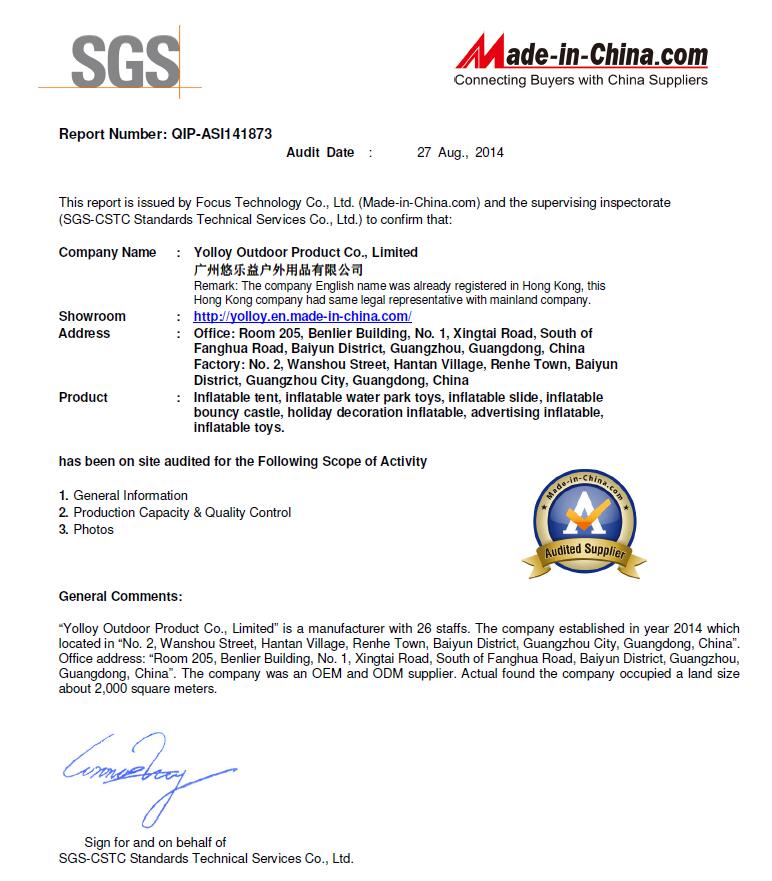
Certification

News

• New Order Successfully Finished for Long-Time Cooperated Japanese Client | YOLLOY Wins Full Client Recognition

• YOLLOY Custom Inflatable Pool Tent for Danish Client: Professional Pool Repair Shelter & Debris Protection

• Trusted Once Again! Greek Captain Re-orders Our Products After 4 Years

• Revolutionize Your Outdoors: The All-Terrain Inflatable Floating Tent for Land & Water

• Elevate Your Summer Fun: The Ultimate Inflatable Water Floating Volleyball Court Trampoline

• Innovative Inflatable Nightclub Tents & Pop-Up Bars: The Ultimate Solution for Portable Party Venues

Contact Us

Name: Sunny Yang
Tel: +86-20-8370 0771
Fax: +86-20-8370 0771
Mobile: 13570587575
E-mail: [email protected]
Add: No 5,Xiong wei Bo Nan Road,ZhongLuoTan Town,Baiyun district,Guangzhou,China
Friend me on Facebook Follow me on Twitter Add me to your circles Follow me on Pinterest Watch my channel on YouTube
News

How does a clear inflatable tent manufacturer ensure product quality?

Author:yolloy Date:2026/8/13 6:05:06

Clear inflatable tents have gained remarkable popularity across the events, hospitality, and glamping industries. Their transparent design offers an immersive outdoor experience while maintaining shelter and comfort. But behind every durable and safe clear inflatable tent lies a rigorous manufacturing and quality assurance process. So, how does a clear inflatable tent manufacturer ensure product quality? Let us walk through the key stages — from material selection to final inspection.

1. Premium Material Selection: The Foundation of Quality

Quality begins with raw materials. A reliable clear inflatable tent factory sources only commercial-grade PVC tarpaulin for the transparent panels, combined with high-strength Oxford fabric, nylon, or TPU for structural components. The transparent PVC must meet strict optical clarity requirements — allowing guests to enjoy panoramic views without distortion — while also delivering exceptional tear resistance and UV stability. At YOLLOY, all materials undergo incoming inspection before entering production. The PVC tarpaulin used in clear inflatable bubble tent products is tested for tensile strength, elongation, and cold-crack resistance to ensure it performs reliably across diverse climates, from hot summer days to chilly winter evenings.

2. Precision Manufacturing Processes

2.1 High-Frequency Welding for Airtight Seams

Unlike traditional sewn tents, clear inflatable tents require complete airtightness. The transparent panels and the structural air columns are joined using high-temperature fusion welding equipment. This process melts the PVC layers together at a molecular level, creating a bond that is actually stronger than the surrounding material. No needle holes, no stitching leaks — just a seamless, airtight structure. Key stress-bearing areas, such as corners and air column intersections, receive additional reinforcement layers to handle repeated inflation cycles without compromising integrity.

2.2 Precision Sewing with Reinforced Techniques

For fabric-to-fabric connections — such as attaching zippers, anchoring points, and outer fabric panels — precision sewing equipment is employed. The factory uses waterproof nylon thread and double-stitch reinforcement at all high-load areas. D-ring and round metal anchor systems are integrated into the design to provide secure ground anchoring and wind resistance, ensuring the tent remains stable even in challenging outdoor conditions.

3. Multi-Stage Quality Inspection

Every single clear inflatable tent passes through multiple inspection checkpoints before it is approved for shipment:

Inspection StageWhat Is Checked
Material InspectionPVC thickness, clarity, tensile strength, color consistency, and coating uniformity
In-Process InspectionWeld quality, seam alignment, zipper functionality, and accessory attachment during production
Inflation & Leak DetectionFull inflation to working pressure with a 24-hour pressure-hold test; any pressure drop beyond the acceptable threshold triggers a rework
Waterproof TestingSimulated rain exposure to verify that all seams are properly sealed and no water penetrates the interior
Final Assembly CheckComplete visual inspection, blower compatibility verification, anchor point integrity, and accessory completeness

Did you know? Some manufacturers go a step further by simulating extreme weather conditions — including heavy rain and strong winds — in a controlled testing lab. This ensures the tent can handle the real-world adventures that customers expect.

4. International Certifications and Safety Compliance

A quality-focused manufacturer ensures its products meet recognized international safety standards. For clear inflatable tents and related products, key certifications include:

  • EN71 — European safety standard for toys, confirming that materials are non-toxic and safe for human contact
  • EN14960 — Specifically for inflatable play equipment, validating structural safety and performance
  • EN15649 — Safety standard for floating leisure products used on water
  • RoHS — Restriction of hazardous substances in materials and electronic components
  • CE / UL — Certifications for blowers and electrical components supplied with the tent

Compliance with these standards is not a one-time achievement — it requires ongoing material testing and production audits to maintain certification validity.

5. Custom Design Accuracy and Pre-Production Validation

Before production begins, a professional design team creates simulation renderings based on the customer's requirements — whether it is a simple sketch, a photograph, a site plan, or a detailed specification. The design is revised until the customer approves every detail. Once approved, the production team follows the exact specifications for dimensions, color schemes, logo placement, and functional features. This custom design-to-production workflow ensures that what the customer envisions is precisely what they receive. As a clear inflatable tent manufacturer serving global markets, the ability to deliver accurate customizations — from small boutique domes to large event tents — is a hallmark of quality commitment.

6. Packaging, Accessories, and After-Sales Support

Quality does not end at the factory gate. Proper packaging protects the product during transit. Tents are packed with soft carpet protection, encased in waterproof PVC bags, and wrapped with an outer PE film. Large products may be secured on steel pallets for added stability during sea freight. Each product is supplied with a repair kit, a properly powered blower (available in 110V, 220V, or 380V configurations), and comprehensive setup instructions. The company also provides a three-year service life warranty when the product is used and maintained correctly, reflecting confidence in the manufacturing quality.

7. Continuous Improvement and Customer Feedback

A mature quality system is never static. A responsible clear inflatable tent factory collects feedback from distributors, event planners, and end users worldwide. This feedback loop informs refinements in material selection, structural design, and manufacturing techniques. Whether it is improving the clarity of PVC panels after months of UV exposure or enhancing the zipper durability for high-frequency use, continuous improvement keeps product quality aligned with evolving market demands.

Conclusion

Ensuring the quality of a clear inflatable tent is a comprehensive effort that spans premium material sourcing, precision manufacturing, rigorous multi-stage testing, international safety compliance, and attentive after-sales service. When choosing a supplier, look for a manufacturer that demonstrates transparency in its quality control processes, holds relevant certifications, and has a proven track record of on-time delivery — such as maintaining a 95% on-time delivery rate. A well-made clear inflatable tent is not just a product; it is a reliable foundation for unforgettable outdoor experiences, from starlit glamping nights to elegant garden events.


How does a clear inflatable tent manufacturer ensure product quality?

Author:yolloy Date:2026/8/13 6:05:06

Clear inflatable tents have gained remarkable popularity across the events, hospitality, and glamping industries. Their transparent design offers an immersive outdoor experience while maintaining shelter and comfort. But behind every durable and safe clear inflatable tent lies a rigorous manufacturing and quality assurance process. So, how does a clear inflatable tent manufacturer ensure product quality? Let us walk through the key stages — from material selection to final inspection.

1. Premium Material Selection: The Foundation of Quality

Quality begins with raw materials. A reliable clear inflatable tent factory sources only commercial-grade PVC tarpaulin for the transparent panels, combined with high-strength Oxford fabric, nylon, or TPU for structural components. The transparent PVC must meet strict optical clarity requirements — allowing guests to enjoy panoramic views without distortion — while also delivering exceptional tear resistance and UV stability. At YOLLOY, all materials undergo incoming inspection before entering production. The PVC tarpaulin used in clear inflatable bubble tent products is tested for tensile strength, elongation, and cold-crack resistance to ensure it performs reliably across diverse climates, from hot summer days to chilly winter evenings.

2. Precision Manufacturing Processes

2.1 High-Frequency Welding for Airtight Seams

Unlike traditional sewn tents, clear inflatable tents require complete airtightness. The transparent panels and the structural air columns are joined using high-temperature fusion welding equipment. This process melts the PVC layers together at a molecular level, creating a bond that is actually stronger than the surrounding material. No needle holes, no stitching leaks — just a seamless, airtight structure. Key stress-bearing areas, such as corners and air column intersections, receive additional reinforcement layers to handle repeated inflation cycles without compromising integrity.

2.2 Precision Sewing with Reinforced Techniques

For fabric-to-fabric connections — such as attaching zippers, anchoring points, and outer fabric panels — precision sewing equipment is employed. The factory uses waterproof nylon thread and double-stitch reinforcement at all high-load areas. D-ring and round metal anchor systems are integrated into the design to provide secure ground anchoring and wind resistance, ensuring the tent remains stable even in challenging outdoor conditions.

3. Multi-Stage Quality Inspection

Every single clear inflatable tent passes through multiple inspection checkpoints before it is approved for shipment:

Inspection StageWhat Is Checked
Material InspectionPVC thickness, clarity, tensile strength, color consistency, and coating uniformity
In-Process InspectionWeld quality, seam alignment, zipper functionality, and accessory attachment during production
Inflation & Leak DetectionFull inflation to working pressure with a 24-hour pressure-hold test; any pressure drop beyond the acceptable threshold triggers a rework
Waterproof TestingSimulated rain exposure to verify that all seams are properly sealed and no water penetrates the interior
Final Assembly CheckComplete visual inspection, blower compatibility verification, anchor point integrity, and accessory completeness

Did you know? Some manufacturers go a step further by simulating extreme weather conditions — including heavy rain and strong winds — in a controlled testing lab. This ensures the tent can handle the real-world adventures that customers expect.

4. International Certifications and Safety Compliance

A quality-focused manufacturer ensures its products meet recognized international safety standards. For clear inflatable tents and related products, key certifications include:

  • EN71 — European safety standard for toys, confirming that materials are non-toxic and safe for human contact
  • EN14960 — Specifically for inflatable play equipment, validating structural safety and performance
  • EN15649 — Safety standard for floating leisure products used on water
  • RoHS — Restriction of hazardous substances in materials and electronic components
  • CE / UL — Certifications for blowers and electrical components supplied with the tent

Compliance with these standards is not a one-time achievement — it requires ongoing material testing and production audits to maintain certification validity.

5. Custom Design Accuracy and Pre-Production Validation

Before production begins, a professional design team creates simulation renderings based on the customer's requirements — whether it is a simple sketch, a photograph, a site plan, or a detailed specification. The design is revised until the customer approves every detail. Once approved, the production team follows the exact specifications for dimensions, color schemes, logo placement, and functional features. This custom design-to-production workflow ensures that what the customer envisions is precisely what they receive. As a clear inflatable tent manufacturer serving global markets, the ability to deliver accurate customizations — from small boutique domes to large event tents — is a hallmark of quality commitment.

6. Packaging, Accessories, and After-Sales Support

Quality does not end at the factory gate. Proper packaging protects the product during transit. Tents are packed with soft carpet protection, encased in waterproof PVC bags, and wrapped with an outer PE film. Large products may be secured on steel pallets for added stability during sea freight. Each product is supplied with a repair kit, a properly powered blower (available in 110V, 220V, or 380V configurations), and comprehensive setup instructions. The company also provides a three-year service life warranty when the product is used and maintained correctly, reflecting confidence in the manufacturing quality.

7. Continuous Improvement and Customer Feedback

A mature quality system is never static. A responsible clear inflatable tent factory collects feedback from distributors, event planners, and end users worldwide. This feedback loop informs refinements in material selection, structural design, and manufacturing techniques. Whether it is improving the clarity of PVC panels after months of UV exposure or enhancing the zipper durability for high-frequency use, continuous improvement keeps product quality aligned with evolving market demands.

Conclusion

Ensuring the quality of a clear inflatable tent is a comprehensive effort that spans premium material sourcing, precision manufacturing, rigorous multi-stage testing, international safety compliance, and attentive after-sales service. When choosing a supplier, look for a manufacturer that demonstrates transparency in its quality control processes, holds relevant certifications, and has a proven track record of on-time delivery — such as maintaining a 95% on-time delivery rate. A well-made clear inflatable tent is not just a product; it is a reliable foundation for unforgettable outdoor experiences, from starlit glamping nights to elegant garden events.