If you operate a commercial inflatable water slide rental business, you already know that cleaning is not optional. Visible mold stains, musty odors, and discolored vinyl are the fastest way to lose bookings. The question is not whether to clean your slide — it is which product to use. The wrong cleaner can destroy PVC material within two to three applications. The right one extends its service life by years. This article breaks down exactly which maintenance products are best, what to avoid, and how quality manufacturing from a reliable inflatable water slide factory makes all the difference.
The Best Cleaning Products for Inflatable Water Slides: A Side-by-Side Comparison
There is no single miracle product that works for every situation. Instead, the best maintenance approach uses a combination of cleaners applied at the right time. Here is a comparison of the four product categories that commercial operators rely on:
| Product Type |
Best For |
Cost Level |
PVC Safety |
Mold Effectiveness |
| Mild pH-neutral detergent |
Daily cleaning, general grime, sunscreen residue |
Low |
Safe when rinsed thoroughly |
Low — prevention only |
| Diluted white vinegar (1:4) |
Surface mold, mildew spots, musty odors |
Low |
Safe, non-damaging to coating |
Moderate — kills spores without stripping finish |
| Hydrogen peroxide (3%) |
Stubborn mold patches, deep-set stains |
Low |
Safe when spot-applied |
High — breaks down organic growth |
| Commercial vinyl cleaner with UV conditioner |
Seasonal finishing, restoring sheen, UV protection |
Medium |
Safe, cosmetic step |
Low — not a mold treatment |
For roughly 90% of routine cleaning, warm water and a mild pH-neutral detergent such as Dawn dish soap — mixed at 2 to 3 tablespoons per gallon of water — is all you need. It is cheap, safe on commercial PVC coatings, and effective on body oils, sunscreen, and food residue. For mold and mildew, diluted white vinegar is the working choice. Its acidity kills spores without attacking the protective coating, unlike bleach, which degrades PVC plasticizers and destroys printed graphics within two to three applications.
What You Should Never Use on an Inflatable Water Slide
Warning: The wrong cleaning product causes more damage than neglect. Here are four things to avoid at all costs:
- Bleach or chlorine-based cleaners: These degrade PVC plasticizers, causing the material to become brittle and crack. Print graphics can be destroyed within two to three applications.
- Pressure washers above 1,200 PSI: High-pressure water delaminates welded seams and can blast through thinner vinyl sections near fold points.
- Abrasive pads or steel wool: These scratch the vinyl surface, creating micro-abrasions where mold spores embed and multiply.
- Petroleum-based solvents (acetone, mineral spirits): These dissolve PVC on contact and permanently damage the material.
If a cleaning product does not explicitly state that it is safe for vinyl or PVC, assume it is not. The cost of replacing a ruined inflatable far exceeds any savings from using a cheaper, harsher cleaner.
Step-by-Step Post-Event Cleaning Protocol
Field cleaning should happen immediately after each event, before the unit is deflated and packed. Skipping this step means organic material dries onto the vinyl during transport and becomes exponentially harder to remove later. Here is a proven five-step protocol:
Step 1: Debris Removal
With the unit still inflated, walk the entire surface and remove all visible debris — leaves, grass clippings, food wrappers, bandages, and hair ties. Check the splash pool and landing zones where debris collects in standing water. A leaf blower on a low setting clears loose material from slide surfaces faster than hand-picking.
Step 2: Rinse
Using the garden hose that supplied the slide during operation, rinse the entire surface from top to bottom. Focus on slide lanes where body oils and sunscreen accumulate, climbing wall grips where hand sweat concentrates, and the splash pool interior where standing water breeds bacteria within hours.
Step 3: Spot Treatment
If you see visible staining — grass stains, sunscreen streaks, or food spills — spray a mild dish soap solution directly on the spots and scrub with a soft-bristle deck brush while the unit is still inflated and firm. Scrubbing a deflated unit is ineffective because the material flexes away from pressure.
Step 4: Drain and Air-Dry
Open all drain ports on the splash pool and base sections. Allow 15 to 20 minutes of continued blower operation with drains open to air-dry interior surfaces. If the schedule allows, tilt the unit by partially deflating one side to direct water toward drain points. This step alone prevents the majority of mold issues.
Step 5: Deflate, Fold, and Transport
Once surfaces are visibly dry, deflate and fold according to manufacturer specifications. If you must pack a unit that is not fully dry — due to rain or tight schedules — unfold and re-inflate it at the shop within 12 hours for a complete dry cycle. Mold colonization begins in earnest beyond 12 hours.
Deep Cleaning: When and How
Deep cleaning should happen at minimum every five to seven uses, or immediately when any mold, mildew, or odor is detected. Inflate the unit fully in your shop or yard. Mix your cleaning solution — dish soap for routine deep cleans, vinegar solution for odor issues, hydrogen peroxide for visible mold. Apply the solution to the entire surface using a pump sprayer, working in sections from top to bottom. Scrub each section with a soft-bristle brush using circular motions, paying extra attention to seam lines, baffle attachment points, and the underside of slide lane lips where water pools during operation.
Rinse thoroughly with clean water. Residual soap attracts dirt on the next deployment. After rinsing, run the blower for a minimum of two hours with all access panels and drain ports open. In humid climates, extend this to four hours or use a dehumidifier.
Pro Tip: Cleaning time is also inspection time. While you are already examining every surface, document any needed repairs. Small punctures or abrasions should be patched during the drying phase when the PVC is clean and dry, which produces the strongest adhesive bond.
How to Remove Mold from an Inflatable Water Slide
Mold on inflatable vinyl shows up first as gray, green, or black speckling along seam lines, in the shaded underside of slide lanes, and inside the splash pool. Catch it at the speckle stage and removal is straightforward. Let it root into the seam structure and the staining becomes permanent. Here is the complete mold removal process:
1. Inflate and Inspect
Fully inflate the unit in a well-ventilated area — outdoors in sunlight is ideal, since UV exposure helps kill surface spores. Walk the entire slide and mark every patch of mold or mildew.
2. Apply the Mold Removal Solution
For light growth, mix one part white vinegar to four parts water. For darker spots, use 3% hydrogen peroxide applied at full strength. Spray the solution directly onto each marked area and let it dwell for 10 to 15 minutes so it can break down the organic growth. Then scrub with a soft-bristle brush using circular motions.
3. Rinse and Dry Completely
Rinse every treated area with clean water until no residue remains. Run the blower for at least two to four hours with all drain ports and access panels open, or dry in direct sunlight. Any trapped moisture restarts colonization within days. Once bone-dry, apply a vinyl-safe anti-microbial spray for residual protection.
Why Quality Manufacturing Reduces Maintenance Headaches
The best maintenance product is not a cleaner at all — it is a well-made inflatable from the start. The quality of the PVC material, the precision of the seams, and the manufacturing process directly determine how well a water slide resists wear, mold, and UV damage over time.
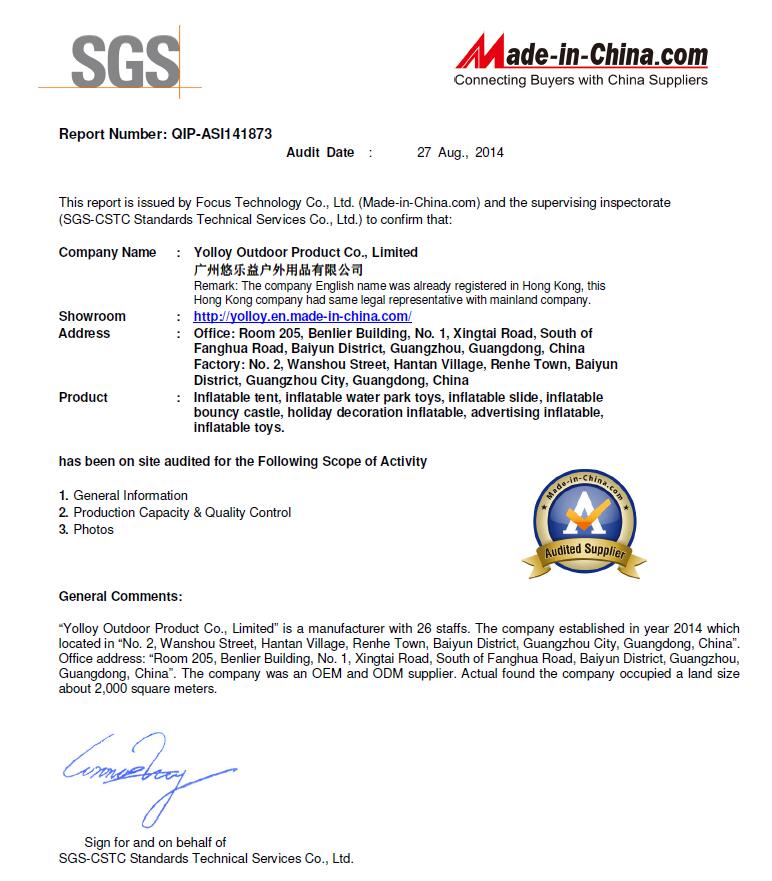
At YOLLOY Outdoor Product Co., Limited, every commercial inflatable water slide is built with commercial-grade PVC tarpaulin and precision sewing equipment. Seams are reinforced with waterproof nylon thread, and high-load areas receive additional reinforcement. Airtight products are manufactured using high-temperature fusion and welding equipment, ensuring a bond that holds up to years of commercial use. Materials used in production have passed EN71, EN14960, EN15649, and RoHS-related testing, and blowers meet CE or UL requirements.
YOLLOY also provides a repair kit with every inflatable product, so operators have the right materials on hand for patching from day one. A three-year service life is expected when products are used and maintained correctly, and the company's responsive support team answers inquiries within 24 hours. All products can be customized in size, color, and branding — from a single unit to bulk orders — with a typical production time of 6 to 15 days. Whether you are looking for an inflatable water slide for sale or a complete water park solution, investing in well-manufactured equipment from a dedicated inflatable water slide factory means less time cleaning, fewer repairs, and a longer service life.
Conclusion: The Best Product Is a System, Not a Single Bottle
The best maintenance product for an inflatable water slide is not found in a single bottle. It is a combination of:
- A mild pH-neutral detergent for daily cleaning
- White vinegar or hydrogen peroxide for mold treatment
- A disciplined drying protocol that runs the blower for at least two hours before storage
- Climate-controlled storage below 60% relative humidity
- Prompt repairs using the manufacturer-supplied repair kit
- A well-built inflatable from a factory that uses certified materials and precision manufacturing
Operators who follow this system see their units last five to seven seasons instead of two. The cleaners are simple and affordable. The real investment is in the discipline — and in choosing equipment built to withstand commercial use from the start.