An inflatable military obstacle course is a large-scale, air-filled structure designed to replicate the physical challenges of a traditional military training course — but in a safer, portable, and more versatile format. These courses are constructed from heavy-duty commercial-grade PVC tarpaulin and feature a series of interconnected obstacles such as climbing walls, crawl tunnels, balance beams, net climbs, pop-up barriers, and slides. Each section is inflated using a continuous air blower, creating a firm yet cushioned surface that absorbs impact and reduces the risk of injury during use.
Unlike permanent obstacle courses built from wood, metal, or concrete, an inflatable obstacle course can be set up on nearly any flat surface — grass fields, gymnasium floors, parking lots, or sandy beaches — in a matter of minutes. Once the blower is plugged in and the anchor points are secured, the entire structure takes shape within 10 to 20 minutes. This makes it an ideal choice for event rental businesses, training facilities, schools, military bases, and corporate team-building programs.
How Does an Inflatable Military Obstacle Course Work?
The core working principle behind an inflatable military obstacle course is continuous air inflation. A powerful electric blower constantly pumps air into the structure through sealed tubes, keeping all sections fully inflated throughout the entire session. The blower does not need to run at high pressure — it simply maintains a steady airflow that compensates for any minor air leakage through seams, zippers, and the natural porosity of the fabric. This constant-air design means the course remains firm and responsive even as multiple participants move through it simultaneously.
Each obstacle within the course is shaped by internal air chambers and baffles. The walls, tunnels, and climbing surfaces are engineered with internal partitions that guide the air into the correct shape and maintain structural integrity under load. High-stress areas such as climbing footholds, slide entry points, and load-bearing beams are reinforced with extra layers of PVC fabric and double-stitched seams using waterproof nylon thread, ensuring the course can withstand repeated high-impact use.
Typical Obstacles Found in the Course
A well-designed inflatable military obstacle course includes a variety of challenge elements that test different physical abilities. Common obstacles include:
- Climbing walls — vertical or inclined surfaces with built-in handholds and footholds that require upper-body strength and grip coordination to scale.
- Crawl tunnels — enclosed cylindrical passages that force participants to move on hands and knees, testing agility and spatial awareness.
- Cargo net climbs — suspended mesh nets that must be climbed using both hands and feet, simulating the rope-climbing challenges found in real military drills.
- Pop-up barriers — tall inflatable pillars or walls that participants must vault over, duck under, or weave between, demanding quick direction changes.
- Balance beams — narrow elevated walkways that test core stability and foot placement precision.
- Slides — typically placed at the end of the course as a rewarding descent, which also serves as a controlled exit point.
The specific layout and combination of obstacles can be customized to match the intended difficulty level, age group, and available space. For instance, a course designed for children’s events may emphasize fun elements like tunnels and slides, while a course built for adult fitness training can include taller climbing walls and more demanding physical challenges.
Materials and Construction Standards
The quality of an inflatable military obstacle course depends heavily on the materials used in its construction. Reputable manufacturers use commercial-grade PVC tarpaulin with a thickness of at least 0.55mm, which provides the necessary balance of weight, flexibility, and tear resistance. This material is waterproof, UV-resistant, and capable of withstanding extended outdoor exposure without significant degradation.
For high-wear sections such as climbing surfaces, entry points, and sliding lanes, manufacturers often apply additional layers of reinforced PVC fabric. Seams are typically joined using high-temperature welding or fusion techniques for airtight sections, while load-bearing areas are sewn with precision stitching equipment and reinforced at stress points. The blowers supplied with the course are designed to meet CE or UL electrical safety standards, and they are available in multiple voltage configurations to suit different regional power supplies.
When choosing an inflatable obstacle course manufacturer, it is important to verify that the materials used have passed relevant safety testing. Certifications such as EN71 and EN14960 indicate that the product meets recognized safety standards for inflatable play equipment, while RoHS compliance confirms that the materials are free from restricted hazardous substances.
Setup, Operation, and Safety Considerations
Setting up an inflatable military obstacle course follows a straightforward process. First, the deflated course is laid out flat on the chosen ground surface and unrolled to its full footprint. The blower tube is connected to the air intake port, and the blower is switched on. As the structure inflates, the operator checks that all sections are rising evenly and that no twists or folds have formed in the fabric. Once fully inflated, the course is anchored to the ground using D-ring or round metal anchor points with stakes, sandbags, or water weights, depending on the surface type. The entire process typically takes 10 to 20 minutes for a standard-sized course.
Safety during operation relies on several factors. First, the course must be placed on a level surface free of sharp objects, debris, or overhead hazards. The anchor system must be properly secured to prevent shifting or tipping. A trained attendant should supervise the course at all times, enforcing participant limits per obstacle and ensuring that users follow the intended direction of travel. Most courses are designed with soft, padded surfaces throughout, which significantly reduces the risk of bruises, scrapes, and impact injuries compared to traditional hard-surface obstacle courses.
Applications and Use Cases
The versatility of inflatable military obstacle courses makes them suitable for a wide range of applications:
- Event rental businesses — Party rental companies and event organizers use these courses as headline attractions at festivals, fairs, and community gatherings.
- Team-building programs — Corporate groups use obstacle courses for collaborative challenges that build trust, communication, and problem-solving skills among team members.
- School and youth programs — Schools incorporate these courses into field days, physical education classes, and summer camps to encourage active play and friendly competition.
- Military and tactical training — Armed forces and law enforcement agencies use inflatable courses as a portable supplement to fixed training installations, allowing them to conduct physical readiness drills in the field or at temporary deployment sites.
- Fitness events and fun runs — Race organizers integrate inflatable obstacle segments into muddy run events, charity challenges, and adventure races, adding variety and spectator appeal.
Customization Options
One of the key advantages of ordering from a dedicated inflatable obstacle course supplier is the ability to customize the course to exact specifications. Customization options typically include:
- Size and layout — The overall dimensions and obstacle arrangement can be adjusted to fit the available venue space and desired participant capacity.
- Color scheme — Colors can be chosen to match brand identity, event theme, or organizational standards. Military-style camouflage patterns are a popular choice.
- Logo and branding — Company logos, unit insignia, sponsor graphics, and custom artwork can be printed directly onto the PVC fabric using high-quality printing techniques.
- Obstacle selection — Buyers can choose which obstacles to include based on the target age group, fitness level, and intended use of the course.
- Blower configuration — Blowers can be specified for 110V, 220V, or 380V electrical systems to match the power infrastructure of the destination country.
Portability and Storage
After use, the course is deflated by switching off the blower and opening the air release valves. The structure collapses within minutes and can be folded, rolled, and packed into a compact storage bag. This portability is a major advantage for businesses that need to transport the course between multiple event locations. The deflated package can typically fit into the cargo area of a standard van or truck, and the lightweight nature of the PVC fabric means that a small crew can handle setup and takedown without the need for heavy machinery or specialized equipment.
Each inflatable product from YOLLOY comes with a repair kit and is packed using soft carpet protection, waterproof PVC bags, and outer PE film to ensure it arrives in excellent condition. For large orders, steel pallets are used for additional protection during transit.
Why Choose YOLLOY for Your Inflatable Obstacle Course?
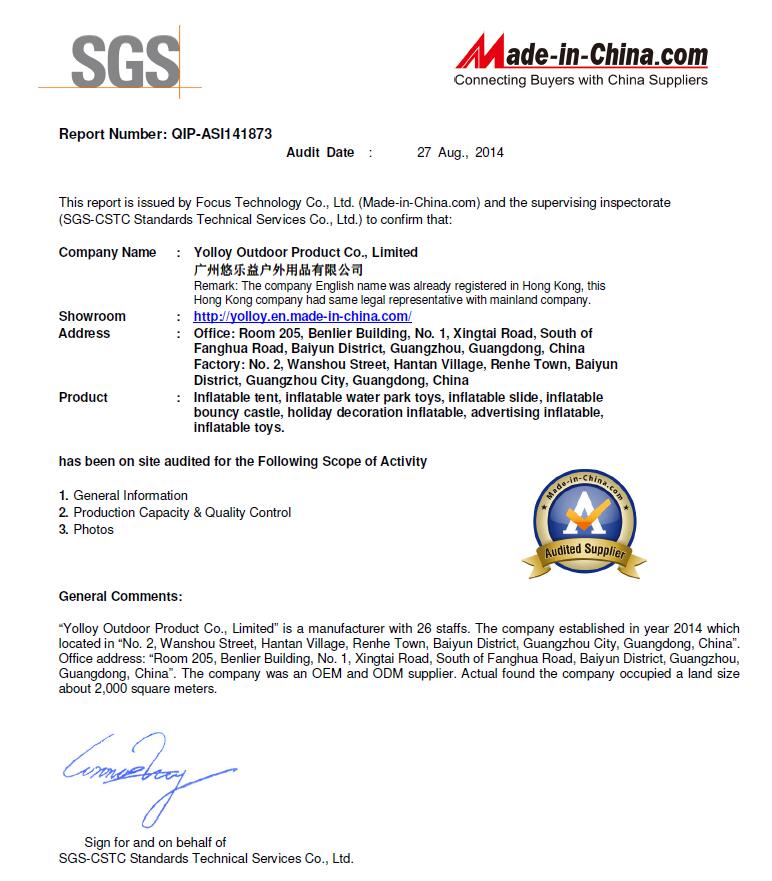
YOLLOY Outdoor Product Co., Limited is a China-based inflatable product manufacturer with extensive experience in designing and producing custom inflatable structures for clients around the world. YOLLOY’s design team works directly with customers to create simulation renderings based on descriptions, sketches, photographs, or site plans. The design is refined through client feedback until approval is reached, and only then does production begin in the factory. This collaborative approach ensures that every course meets the buyer’s exact requirements.
All products are manufactured using precision sewing equipment, reinforced seams, and waterproof nylon thread. High-stress areas receive additional reinforcement, and every product is inspected and tested before shipment. YOLLOY supplies blowers configured for the customer’s local voltage requirements, and the minimum order quantity is just one piece, making it accessible for both small businesses testing a new rental product and large organizations outfitting multiple training facilities.
With a wide range of inflatable products — from outdoor tents and water park toys to interactive sports games and commercial slides — YOLLOY is well-positioned to serve as a single-source supplier for businesses in the event, entertainment, and training industries. The company serves customers across Europe, Asia, South America, Africa, the Middle East, and Latin America, with air and sea shipping options available to meet different budget and timeline requirements.
An inflatable military obstacle course combines the physical challenge of traditional military training with the portability, safety, and customization flexibility of modern inflatable technology. Whether for a weekend rental event, a corporate team-building day, or a professional training program, these courses offer a reliable and engaging solution backed by the quality manufacturing standards of experienced suppliers like YOLLOY.