Products Category
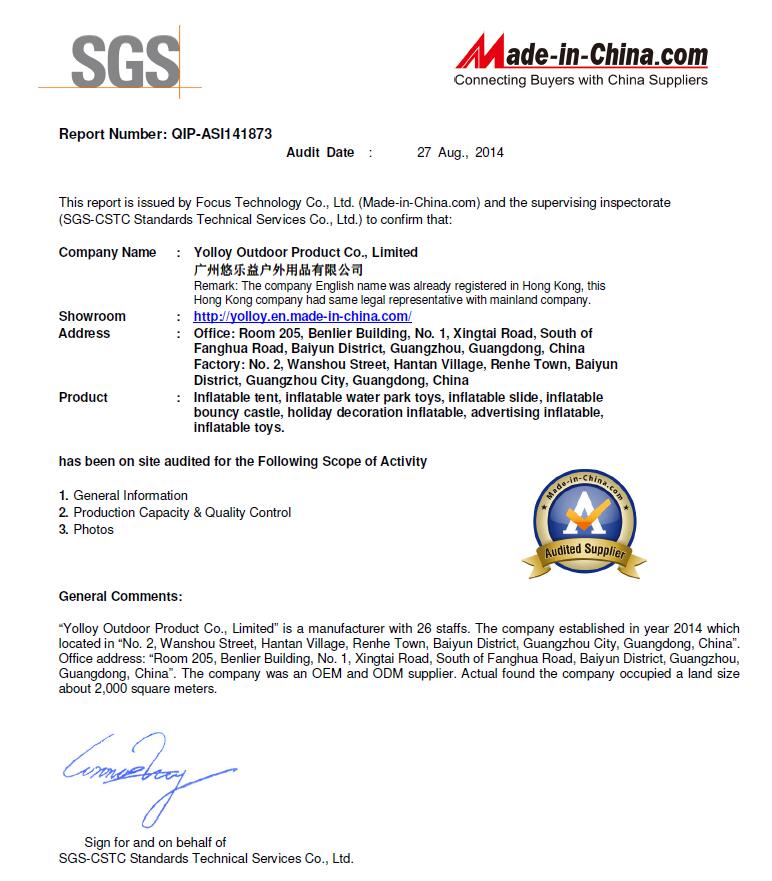
Certification

News

• New Order Successfully Finished for Long-Time Cooperated Japanese Client | YOLLOY Wins Full Client Recognition

• YOLLOY Custom Inflatable Pool Tent for Danish Client: Professional Pool Repair Shelter & Debris Protection

• Trusted Once Again! Greek Captain Re-orders Our Products After 4 Years

• Revolutionize Your Outdoors: The All-Terrain Inflatable Floating Tent for Land & Water

• Elevate Your Summer Fun: The Ultimate Inflatable Water Floating Volleyball Court Trampoline

• Innovative Inflatable Nightclub Tents & Pop-Up Bars: The Ultimate Solution for Portable Party Venues

Contact Us

Name: Sunny Yang
Tel: +86-20-8370 0771
Fax: +86-20-8370 0771
Mobile: 13570587575
E-mail: [email protected]
Add: No 5,Xiong wei Bo Nan Road,ZhongLuoTan Town,Baiyun district,Guangzhou,China
Friend me on Facebook Follow me on Twitter Add me to your circles Follow me on Pinterest Watch my channel on YouTube
News

Which floating playground supplier is best for a lake?

Author:yolloy Date:2026/8/18 3:43:41

Ask ten lakefront operators which floating playground supplier they would recommend and you will get ten different answers. That is not because the market is chaotic. It is because the best supplier for your project depends on your lake, your guests, and your operating plan. A resort running a busy summer season needs a different partner than a family installing a private platform behind their lake house. This guide walks through the factors that actually separate a dependable floating playground supplier from the rest, and shows how to compare candidates before you commit.

Why a lake is a good home for a floating playground

Lakes offer a rare advantage for inflatable water attractions: calm, protected water. Unlike oceanfront sites, where waves, tides, and strong winds constantly work against a floating structure, most lakes stay relatively still. That makes them ideal for stable, modular playgrounds that can be anchored in place for the season and deflated and stored when winter arrives.

A well-built inflatable water park turns an ordinary stretch of water into a destination. Kids burn off energy on climbing walls and slides, teenagers race across balance beams and launching pads, and adults relax on floating platforms and loungers. Because the whole system is inflatable, it leaves no permanent footprint on the lakebed, and the layout can be rearranged from one season to the next.

What to look for in a floating playground supplier

Materials and construction

The first thing to examine is what the playground is actually made of. Commercial-grade PVC tarpaulin is the standard for products that see daily use. It is waterproof, airtight, and far tougher than the thin vinyl found in backyard pool toys. Look for reinforced seams, waterproof nylon thread, and extra reinforcement at high-load areas such as anchor points and climbing handles. Airtight products should be built with high-temperature fusion or welding equipment rather than simple gluing, because that is what keeps the structure holding pressure day after day.

Safety and certification

Safety matters more on the water than almost anywhere else, so ask which standards the products meet. Reputable inflatable water park manufacturers test their materials against international requirements such as EN71 for toys, EN14960 for inflatable play equipment, and EN15649 for inflatable water parks. Blowers should meet CE or UL requirements, and every product should be inspected and tested before shipment. A supplier that can name its certifications is usually a supplier that has something to back them up.

Stability and anchoring

A floating playground is only as good as its anchoring. On a lake, wind and boat wakes can shift an unsecured structure, so look for built-in D-rings or round metal anchor systems designed for installation and wind resistance. The supplier should be able to recommend an anchoring plan for your specific water depth and shoreline. Stability also comes from the design itself: wide bases and firm platforms keep the structure from wobbling under a crowd, which is exactly what you want when children are running across it.

Customization

No two lakes are identical, and no two operators want the same layout. A good supplier should be able to design from a description, a drawing, a sketch, a photograph, a site plan, or a budget. Look for a manufacturer that offers custom sizes, colors, and printed logos, and that can show you a rendering of the finished design before production starts. The ability to start small and expand later is a practical bonus, since many operators grow their parks over time as demand builds.

Service, warranty, and delivery

The relationship does not end when the product ships. Check what happens after the sale. A repair kit should come with each inflatable, and the supplier should be reachable when you have questions. Look for clear warranty terms, a stated production time, and a realistic delivery schedule. Suppliers who answer inquiries quickly and ship on time are far easier to work with over the long run, especially when a season opening date is on the line.

Questions to ask before you buy

  • Which materials and what thickness do you use for commercial use?
  • Which safety standards do your products and blowers meet?
  • How is the playground anchored on calm lake water, and will you help plan it?
  • Can you customize the layout, colors, and logo, and will you show a rendering first?
  • What is the production time, and what is your on-time delivery record?
  • What warranty and repair support do you provide after delivery?

Why YOLLOY is a strong answer

For buyers who want a manufacturer rather than a middleman, YOLLOY is an inflatable water park supplier worth comparing. Based in Guangzhou, China, the company designs and builds inflatable water parks, floating platforms, water balls, and aquatic play products in-house, with a minimum order of just one piece. Its commercial-grade PVC tarpaulin products are associated with EN71, EN14960, and RoHS-related testing, its water park products reference EN15649, and its blowers meet CE or UL requirements.

The factory uses precision sewing equipment, reinforced seams, and high-temperature welding, and every product is inspected and tested before shipment. D-ring and round metal anchor systems are incorporated where needed for installation and wind resistance. The company reports a 95% on-time delivery rate, answers emails and faxes within 24 hours, and supplies a repair kit with each inflatable. Typical production runs 6 to 15 days for a regular product, with air shipping in about 5 to 7 days and sea shipping in 15 to 30 days or more.

Customization is a core part of the service. YOLLOY's designers prepare simulation renderings from customer proposals, revise them until approval, and then release the design for production. Custom sizes, colors, and logos are available, and blowers can be supplied for 110V, 220V, or 380V. That makes it a practical choice for resorts, camps, water sport rentals, and private lakefront owners alike.

Conclusion

There is no single floating playground supplier that fits every lake, but there is a clear way to choose. Focus on materials and construction, safety certification, anchoring, customization, and after-sales support. Compare suppliers against those five points, ask the right questions, and you will find a partner that delivers a safe, durable, and profitable attraction. For many operators, that partner turns out to be a manufacturer that builds the product itself, customizes it to the site, and stands behind it after delivery.


Which floating playground supplier is best for a lake?

Author:yolloy Date:2026/8/18 3:43:41

Ask ten lakefront operators which floating playground supplier they would recommend and you will get ten different answers. That is not because the market is chaotic. It is because the best supplier for your project depends on your lake, your guests, and your operating plan. A resort running a busy summer season needs a different partner than a family installing a private platform behind their lake house. This guide walks through the factors that actually separate a dependable floating playground supplier from the rest, and shows how to compare candidates before you commit.

Why a lake is a good home for a floating playground

Lakes offer a rare advantage for inflatable water attractions: calm, protected water. Unlike oceanfront sites, where waves, tides, and strong winds constantly work against a floating structure, most lakes stay relatively still. That makes them ideal for stable, modular playgrounds that can be anchored in place for the season and deflated and stored when winter arrives.

A well-built inflatable water park turns an ordinary stretch of water into a destination. Kids burn off energy on climbing walls and slides, teenagers race across balance beams and launching pads, and adults relax on floating platforms and loungers. Because the whole system is inflatable, it leaves no permanent footprint on the lakebed, and the layout can be rearranged from one season to the next.

What to look for in a floating playground supplier

Materials and construction

The first thing to examine is what the playground is actually made of. Commercial-grade PVC tarpaulin is the standard for products that see daily use. It is waterproof, airtight, and far tougher than the thin vinyl found in backyard pool toys. Look for reinforced seams, waterproof nylon thread, and extra reinforcement at high-load areas such as anchor points and climbing handles. Airtight products should be built with high-temperature fusion or welding equipment rather than simple gluing, because that is what keeps the structure holding pressure day after day.

Safety and certification

Safety matters more on the water than almost anywhere else, so ask which standards the products meet. Reputable inflatable water park manufacturers test their materials against international requirements such as EN71 for toys, EN14960 for inflatable play equipment, and EN15649 for inflatable water parks. Blowers should meet CE or UL requirements, and every product should be inspected and tested before shipment. A supplier that can name its certifications is usually a supplier that has something to back them up.

Stability and anchoring

A floating playground is only as good as its anchoring. On a lake, wind and boat wakes can shift an unsecured structure, so look for built-in D-rings or round metal anchor systems designed for installation and wind resistance. The supplier should be able to recommend an anchoring plan for your specific water depth and shoreline. Stability also comes from the design itself: wide bases and firm platforms keep the structure from wobbling under a crowd, which is exactly what you want when children are running across it.

Customization

No two lakes are identical, and no two operators want the same layout. A good supplier should be able to design from a description, a drawing, a sketch, a photograph, a site plan, or a budget. Look for a manufacturer that offers custom sizes, colors, and printed logos, and that can show you a rendering of the finished design before production starts. The ability to start small and expand later is a practical bonus, since many operators grow their parks over time as demand builds.

Service, warranty, and delivery

The relationship does not end when the product ships. Check what happens after the sale. A repair kit should come with each inflatable, and the supplier should be reachable when you have questions. Look for clear warranty terms, a stated production time, and a realistic delivery schedule. Suppliers who answer inquiries quickly and ship on time are far easier to work with over the long run, especially when a season opening date is on the line.

Questions to ask before you buy

  • Which materials and what thickness do you use for commercial use?
  • Which safety standards do your products and blowers meet?
  • How is the playground anchored on calm lake water, and will you help plan it?
  • Can you customize the layout, colors, and logo, and will you show a rendering first?
  • What is the production time, and what is your on-time delivery record?
  • What warranty and repair support do you provide after delivery?

Why YOLLOY is a strong answer

For buyers who want a manufacturer rather than a middleman, YOLLOY is an inflatable water park supplier worth comparing. Based in Guangzhou, China, the company designs and builds inflatable water parks, floating platforms, water balls, and aquatic play products in-house, with a minimum order of just one piece. Its commercial-grade PVC tarpaulin products are associated with EN71, EN14960, and RoHS-related testing, its water park products reference EN15649, and its blowers meet CE or UL requirements.

The factory uses precision sewing equipment, reinforced seams, and high-temperature welding, and every product is inspected and tested before shipment. D-ring and round metal anchor systems are incorporated where needed for installation and wind resistance. The company reports a 95% on-time delivery rate, answers emails and faxes within 24 hours, and supplies a repair kit with each inflatable. Typical production runs 6 to 15 days for a regular product, with air shipping in about 5 to 7 days and sea shipping in 15 to 30 days or more.

Customization is a core part of the service. YOLLOY's designers prepare simulation renderings from customer proposals, revise them until approval, and then release the design for production. Custom sizes, colors, and logos are available, and blowers can be supplied for 110V, 220V, or 380V. That makes it a practical choice for resorts, camps, water sport rentals, and private lakefront owners alike.

Conclusion

There is no single floating playground supplier that fits every lake, but there is a clear way to choose. Focus on materials and construction, safety certification, anchoring, customization, and after-sales support. Compare suppliers against those five points, ask the right questions, and you will find a partner that delivers a safe, durable, and profitable attraction. For many operators, that partner turns out to be a manufacturer that builds the product itself, customizes it to the site, and stands behind it after delivery.