How Does a Floating Inflatable Tent Differ from a Regular Inflatable Tent?
At first glance, a floating inflatable tent and a regular inflatable tent look like close cousins. Both are made of PVC, both are inflated with a blower or pump, and both fold down into a bag when the event is over. But put one on a lake and the other on a lawn and the differences become obvious fast. A regular inflatable camping tent is engineered to stand on solid ground, while a floating inflatable tent is built around a buoyant base that lets it sit on water. That single difference changes everything else about how the two are made, anchored, and used.
This article breaks down the key differences between the two designs, so you can tell them apart and choose the right one for your project, whether you are outfitting a campsite, a lake resort, or a yacht.
1. The Base Is the Real Difference
A regular inflatable tent keeps its shape with air beams, the long inflatable columns that run through the fabric and hold the roof up. The floor is a separate piece of material that lies on the ground. It does not need to support the weight of people standing on it, because the ground does that work.
A floating inflatable tent is the opposite. Its floor is the whole point. The base is made from drop-stitch material, which is built with thousands of parallel polyester threads connecting two layers of reinforced PVC fabric. When the base is inflated to its recommended pressure, those threads pull the top and bottom panels tight, producing a rigid, board-like platform that stays flat under weight. This is the same construction used for premium inflatable docks and floating platforms, and it is what allows people to walk, sit, and even dance on the tent without the surface buckling.
2. Buoyancy and Stability on Water
Because a floating inflatable tent is designed to displace water, its base has enough volume to keep the whole structure afloat even with people and gear inside. The wide, low profile sits close to the surface, which keeps the center of gravity low and makes the tent far less likely to tip than a kayak or a small boat.
A regular inflatable tent has no buoyancy at all. Set it down in water and it will simply sink or drift, because its air beams are designed to hold up a roof, not to float a load. If you need a tent that can serve as a floating lounge, a fishing platform, or a lakeside event space, the buoyant base is not an optional extra, it is the defining feature.
3. Anchoring Is a Whole Different Job
On land, you secure a regular inflatable tent with stakes, sandbags, or D-ring anchor points around the base, and the blower keeps it standing. The job is simple because the ground does not move.
On water, the tent has to be held in place against currents, wind, and boat wakes. A floating inflatable tent therefore comes with reinforced anchor points, and it is normally moored with marine-grade ropes to a dock, a boat, or weighted anchors on the lakebed. Good designs use multiple tie-down points so the platform stays level instead of swinging with the wind. This is one of the details buyers overlook, and it is exactly where a well-built product earns its keep.
4. Materials and Build Quality
Both types are usually made from commercial-grade PVC tarpaulin, but a floating tent faces harsher conditions. It is constantly in contact with water, sunlight, and the abrasion of being dragged over a shore. That is why reputable manufacturers use thicker, UV-resistant PVC for the base and seal the seams with high-temperature welding rather than stitching, so the structure stays airtight and does not leak.
For a regular inflatable tent, the priority is different. It needs strong seams at the air beams and a floor that resists wear from the ground, but it does not need to survive constant immersion. If you are comparing suppliers, ask what material the base is made from and how the seams are joined, because that is the difference between a platform that lasts for seasons and one that fails after a few outings.
5. Setup and Portability
Setup is similar in spirit but different in practice. A regular inflatable tent is inflated with a blower and stands in a few minutes, which is why inflatable tents have become so popular for events and camping. A floating inflatable tent takes a little longer because the base must be inflated to full pressure first, then the canopy, and then the whole unit has to be launched and moored.
Portability is where both designs shine. Once deflated, a floating tent packs into a compact bag that fits in a car trunk or on a boat, and the whole system, including the blower, can be carried by a small crew. Manufacturers such as YOLLOY supply blowers matched to the local power supply, whether that is 110V, 220V, or 380V, so the tent can be used in different markets without extra equipment.
6. Safety and Certification
Safety matters on land, but it matters even more on water. A floating inflatable tent should be built with non-slip surfaces on the base, soft edges, and enough reserve buoyancy to stay stable with several people on board. It is not a life-saving device, so anyone using it near deep water should still wear a personal flotation device, but a well-designed platform dramatically reduces the risk of tipping or falling in.
Certification is another point of difference to check. Quality manufacturers test their materials against recognised standards, and YOLLOY, for example, states that its relevant materials have passed EN71, EN14960, and RoHS-related testing, with blowers meeting CE or UL requirements. When you buy a floating inflatable tent for commercial use, ask for the test certificates rather than assuming they exist.
7. Quick Comparison Table
| Feature |
Regular Inflatable Tent |
Floating Inflatable Tent |
| Primary use |
Camping, events, shelter on land |
Lakeside lounging, fishing, water events |
| Base construction |
Flat fabric floor on the ground |
Rigid drop-stitch buoyant platform |
| Buoyancy |
None |
Floats with people and gear on board |
| Anchoring |
Stakes, sandbags, D-rings |
Marine ropes, mooring to dock or anchor |
| Stability under weight |
Depends on ground surface |
Board-like, low center of gravity |
| Setup |
Blower inflation, minutes |
Inflate base and canopy, then launch and moor |
8. Which One Should You Choose?
If your project is on solid ground, a regular inflatable tent is the right tool. It is lighter, cheaper, and faster to set up, and it covers everything from a family camping trip to a large event shelter. For a campsite, a party, or an emergency shelter, there is no reason to pay for buoyancy you will never use.
Choose a floating inflatable tent when the water is the attraction. Lake resorts, yacht charters, fishing camps, and waterfront event planners all use them to add a stable, dry space on the water without building a permanent dock. If you run a business that rents water equipment, a floating tent is also a strong add-on, because it pairs naturally with inflatable water slides, floating platforms, and other water toys.
9. What to Look for When Buying
- Confirm the base is drop-stitch. A genuine floating tent uses drop-stitch construction for the platform. If the base is just a single layer of PVC, it will sag under weight and is not a true floating tent.
- Check the anchor points. Look for multiple reinforced tie-down points so the tent can be moored securely in different directions.
- Ask about the blower. Confirm the blower matches your local voltage, and ask whether a spare or repair kit is included.
- Verify certification. For commercial use, ask for the relevant test certificates and the warranty terms before you order.
- Plan for custom sizing. If you need a specific size, color, or printed logo, check that the manufacturer offers custom production rather than only stock sizes.
Getting a Floating Inflatable Tent That Meets Your Needs
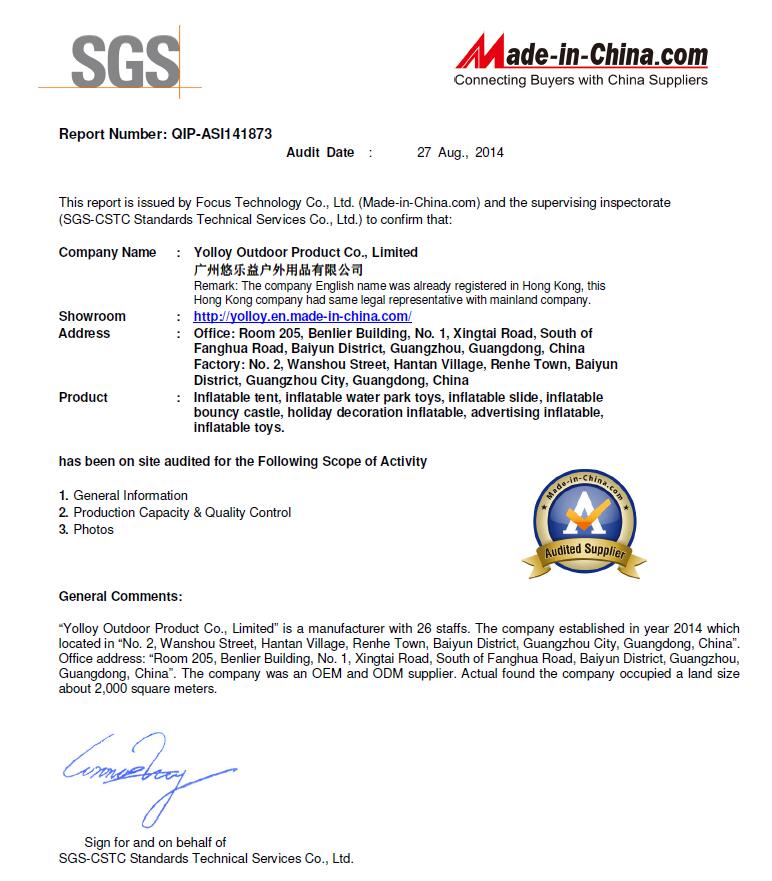
The difference between the two designs comes down to one question: does the tent need to float? If the answer is yes, look for a supplier that builds the base from drop-stitch material, reinforces the anchor points, and tests its products against recognised safety standards. YOLLOY, an inflatable manufacturer in Guangzhou, China, produces custom inflatable dome tent and floating tent solutions with a minimum order of just one piece, a typical production time of 6 to 15 days, and a stated 95% on-time delivery rate. Every inflatable is supplied with a repair kit, and the company answers enquiries within 24 hours.
Whether you need a regular inflatable camping tent for land or a floating platform for the water, the key is to match the design to the environment. Understand how the base is built, how it is anchored, and how it is certified, and you will end up with a product that performs exactly as expected, season after season.