If you have hosted a birthday party, a school fair, or a neighborhood picnic in the past few years, you have almost certainly seen one: a bright, puffy structure that children climb into and bounce around inside for hours. It is usually the first thing kids run toward and the last thing parents can get them to leave. That structure is a kids inflatable bounce house, and it has become a staple of children's entertainment worldwide.
Yet for all its popularity, many people cannot say exactly what a bounce house is, how it stays inflated, or what separates a safe, durable unit from a short-lived one. This guide explains what a kids inflatable bounce house is, how it works, and what to look for when buying one for home use or for a rental business.
What Is a Kids Inflatable Bounce House?
A kids inflatable bounce house is a portable, air-filled play structure made from reinforced PVC or similar coated fabric. It is designed for children to jump, slide, and play inside an enclosed space. The structure stays upright and bouncy through a continuous flow of air supplied by an electric blower, rather than through solid frames, poles, or springs.
The feature that separates a bounce house from other inflatables is the bouncing surface. Air pressure inside the floor absorbs a child's weight and pushes back as they land, creating a soft, springy effect that is gentler on young joints than a trampoline. Because kids are surrounded by padded air-filled walls, a well-designed bounce house keeps most of the play inside a protected area.
Bounce houses come in many forms. Simple models are single-room jumping areas. Larger units add climbing walls, slides, and ball pits, while themed designs such as castles, pirate ships, tropical scenes, and forest settings turn the structure itself into part of the fun. A common upgrade is an inflatable bounce house with slide, which combines jumping space with a built-in slide for more varied play.
How Does a Bounce House Work?
A bounce house stays inflated through constant airflow rather than sealed air. The blower pushes air into the structure through an inlet, while small openings in the seams let some air escape. This creates a steady internal pressure that keeps the walls firm without overinflating and stressing the fabric.
When a child jumps, their weight compresses the air inside the floor. The compressed air pushes back, producing a safe, controlled rebound. If the blower stops, the structure softens gradually instead of collapsing instantly, which is an important safety feature. For this reason, the blower must remain on for the entire time children are playing.
Quality matters a great deal here. Seams must be reinforced, fabric must hold air pressure consistently, and anchoring points must be built in so the unit stays in place on windy days. On commercial units, D-ring or round metal anchor systems are commonly used to secure the structure to the ground.
What Makes a Bounce House Safe?
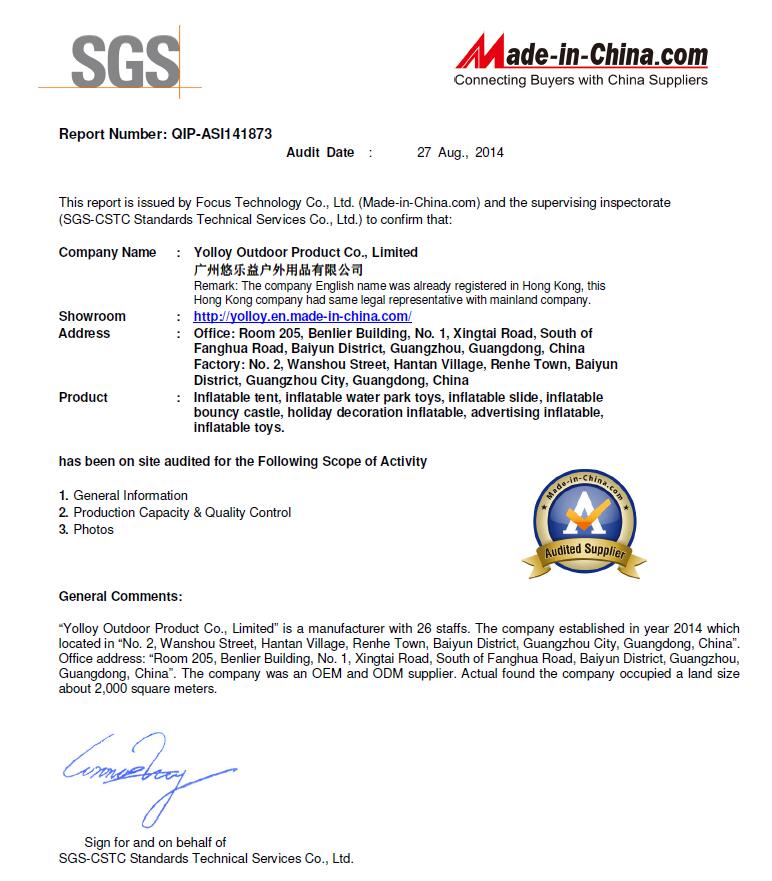
Safety begins with materials and construction. Reputable manufacturers use commercial-grade PVC tarpaulin, reinforced seams sewn with waterproof nylon thread, and high-temperature welded joints in airtight areas. They also test their products against recognized standards. YOLLOY, an inflatable manufacturer based in Guangzhou, China, states that its materials have passed EN71, EN14960, and RoHS-related testing, with inflatable toys associated with kids inflatable bounce house games referencing EN 14960 standards.
Equally important is how the product is used. Age and size limits should be respected, and an adult should supervise at all times. More children in a unit does not make it more fun if the structure exceeds its recommended capacity. Anchoring the unit properly, keeping the blower away from water, and checking the fabric for damage before each use all contribute to a safe experience.
What to Consider Before Buying
Before making a purchase, consider where the unit will be set up and how it will be used. Home buyers typically want something that inflates quickly, fits the backyard, and is easy to store. Event and rental businesses need larger, tougher units that can withstand daily use and many cycles of setup and takedown.
Material thickness, blower power, seam quality, and the presence of anchor points are the main durability factors to compare. It is also worth asking about the blower voltage, since requirements vary by region and YOLLOY can supply blowers for 110V, 220V, or 380V. A spare blower and a repair kit can save an event from disruption.
Does Buying from a Manufacturer Matter?
For businesses and frequent users, buying directly from a factory usually makes sense. A manufacturer can customize sizes, colors, and artwork, printing your logo or chosen theme directly on the product. Custom units can be developed from a description, drawing, sketch, photograph, or design plan, with simulation renderings prepared for approval before production begins.
A manufacturer also tends to be better positioned on quality and service. YOLLOY reports a typical production time of 6 to 15 days for one regular inflatable product, a three-year service life expectation when products are used and maintained correctly, a repair kit supplied with each unit, and a 95% on-time delivery rate. The company accepts a minimum order quantity of one piece, which makes factory-direct sourcing practical even for first-time buyers of an inflatable bounce house.
A Worthwhile Investment in Fun
A kids inflatable bounce house is more than a novelty toy. It is an air-supported play structure that turns a backyard, field, or event hall into an instant activity zone. When it is built from quality materials, supplied with the right blower, and used with supervision, it offers a combination of exercise, excitement, and safety that keeps children coming back.
If you are considering a bounce house for home or commercial use and want it built to your requirements, contact YOLLOY to discuss sizes, themes, custom printing, and delivery options.