If you have ever priced an international shipment of large, lightweight goods, you already know the dilemma: air freight gets there fast but costs a fortune per kilogram, while sea freight is slow but dramatically cheaper. For inflatable tents, the answer is almost always the same, no matter where you are buying from. Sea freight is the standard, and for good reason. This article explains what inflatable tent sea freight actually is, how it works, and what a buyer should expect when ordering from a factory such as YOLLOY.
What is inflatable tent sea freight?
Inflatable tent sea freight simply means transporting inflatable tents from the manufacturer's factory to the buyer's destination port by ocean container, rather than by air or land. A deflated inflatable tent folds down into a surprisingly compact package, but it is still bulky and light at the same time. That combination makes it an ideal candidate for sea shipping, because ocean carriers charge mainly for the space a shipment occupies, and a folded tent takes up far less space than its inflated size would suggest.
For anyone importing inflatable tents from China, sea freight is the default choice. It keeps the per-unit cost low enough that a whole container of tents can be shipped for a fraction of what air freight would cost, and it works well for both small trial orders and large commercial quantities.
FCL or LCL: two ways to ship by sea
When you book sea freight for inflatable tents, you will be offered two basic options. Full Container Load (FCL) means your goods fill an entire container on their own, which gives you exclusive use of the space and the simplest handling at both ends. Less than Container Load (LCL) means your tents share a container with other shippers' goods, and you pay only for the cubic meters you use. LCL is a good starting point for a first order of a few tents, while FCL becomes more attractive once your order grows large enough to justify a full container.
A reliable inflatable tent manufacturer will usually help you decide which option fits your order. Because YOLLOY works with a minimum order quantity of just one piece, buyers can test the waters with a small LCL shipment first, then move to FCL as their business grows.
Why sea freight is the right choice for inflatable tents
The main reason buyers choose sea freight is cost. Inflatable tents are large when inflated but light when folded, so their shipping cost is driven by volume rather than weight. Sea containers give you a large amount of space for a relatively small price, which means the freight cost per tent drops sharply as your order grows. The trade-off is time: a sea shipment from China typically takes about 15 to 30 days or more depending on the route, while air freight can arrive in 5 to 7 days. For most tent buyers, the savings are worth the wait.
There are also practical reasons sea freight suits tents. The large, flat panels of a folded tent stack neatly inside a container, and the flexible PVC or Oxford fabric used for most tents tolerates the movement of an ocean voyage well when packed properly. With careful loading, a single container can hold a surprisingly large number of tents.
How YOLLOY prepares inflatable tents for sea freight
Good sea freight starts at the factory, before the container is even loaded. YOLLOY, an inflatable product manufacturer based in Guangzhou, China, follows a preparation routine that protects tents during a long ocean journey. Each product is deflated and folded to its smallest practical size, then packed with soft carpet protection, sealed in a waterproof PVC bag, and wrapped in an outer PE film. Larger products may be secured on steel pallets so they can be handled safely and stacked efficiently inside the container.
Blowers are an important part of any inflatable tent order, and they travel with the shipment. YOLLOY can supply blowers for 110V, 220V, or 380V power requirements, so you can match the equipment to the electrical standard of your country. Every inflatable product also comes with a repair kit, which is handy to have on hand after a long trip.
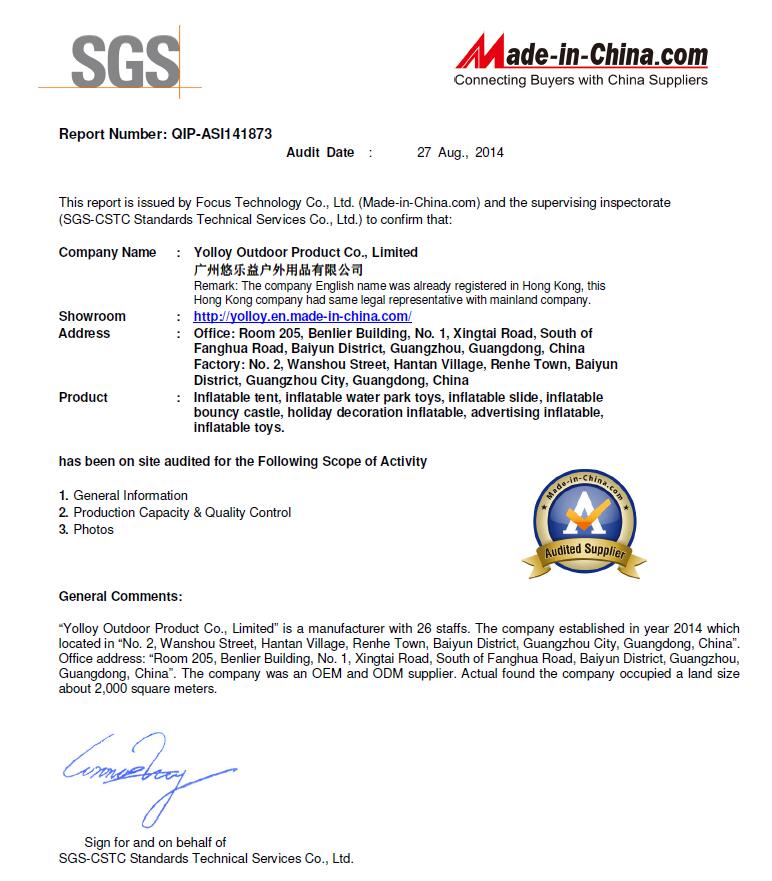
Quality control matters just as much as packaging. The company states that its materials have passed EN71, EN14960, and RoHS-related testing, and products are inspected and tested before shipment. Knowing the tents are checked at the factory reduces the chance of discovering problems only after they arrive at your port.
Container sizes and what they can hold
Understanding container capacity helps you plan an order and estimate freight costs. The three container types most commonly used for inflatable tents are the 20-foot standard, the 40-foot standard, and the 40-foot high-cube. As a rough guide, a 20-foot container offers around 28 cubic meters of usable space, a 40-foot standard around 58 cubic meters, and a 40-foot high-cube around 68 cubic meters. Because folded tents are light, containers almost always run out of space before they run out of weight, so the number of tents you can fit depends mainly on how tightly they are folded and packed.
The exact number of tents per container varies with the model and size. A 40-foot high-cube, for example, might hold a dozen or more medium inflatable tents along with their blowers and accessories, while a 20-foot container suits smaller orders. Your supplier can calculate the cubic meters of your specific order and recommend the most economical container size, which is one of the practical benefits of working with a factory that ships inflatable products every day.
Documentation for sea freight shipments
Sea freight runs on paperwork, and getting it right keeps your shipment moving through customs without delays. The essential documents for an inflatable tent shipment are the bill of lading, the packing list, and the commercial invoice. The packing list should show the dimensions and weight of each package, since customs uses it to verify the volume you declared. The commercial invoice records the value of the goods and the Incoterms agreed between buyer and seller.
Inflatable tents are usually classified under the Harmonized System heading for tents and shelters, but the exact code can vary by country and product type, so it is worth confirming the correct code with your customs broker before booking. Safety certificates are also worth preparing in advance. YOLLOY's inflatable products are associated with standards such as EN 14960 for inflatable play equipment and EN 15649 for water park products, and having these certificates ready can smooth the way at the destination.
Transit times, delivery, and after-sales support
Once your tents are loaded, the main thing left to do is wait for the vessel. Sea transit from China typically takes 15 to 30 days or more depending on the destination port, and YOLLOY reports a 95% on-time delivery rate for its shipments. For urgent needs, air freight remains an option at a higher cost, and the company can advise on the best balance of speed and budget for your situation.
After-sales service is part of the sea freight experience too. YOLLOY states that emails and faxes are answered within 24 hours, and products are expected to provide a three-year service life when used and maintained correctly. If anything arrives damaged or needs attention, having a responsive supplier makes the whole import process far less stressful.
Getting started with your first sea freight order
If you are new to importing inflatable dome tents or other inflatable structures, the process is simpler than it looks. Start by describing the tent you need, including size, color, and any custom printing. YOLLOY's design team prepares simulation renderings from your proposal, revises them until you approve, and then releases the design for production. A typical regular inflatable product takes about 6 to 15 days to produce, after which the order is packed and booked for sea freight.
Because the minimum order is one piece, you can order a single tent to check quality and shipping before committing to a larger quantity. Once you are satisfied, scaling up to a full container is straightforward, and the per-unit freight cost drops as the container fills. Whether you need a single inflatable tent for an event or a container load for a commercial project, understanding how sea freight works puts you in control of your costs and your delivery schedule.
In short, inflatable tent sea freight is the economical, practical way to move tents from factory to destination, and it is the method YOLLOY uses to serve customers across Europe, Asia, South America, Africa, the Middle East, and Latin America. If you are planning an order, contact the YOLLOY team with your requirements and they will help you work out the right product, the right packaging, and the right shipping method for your needs.