Products Category
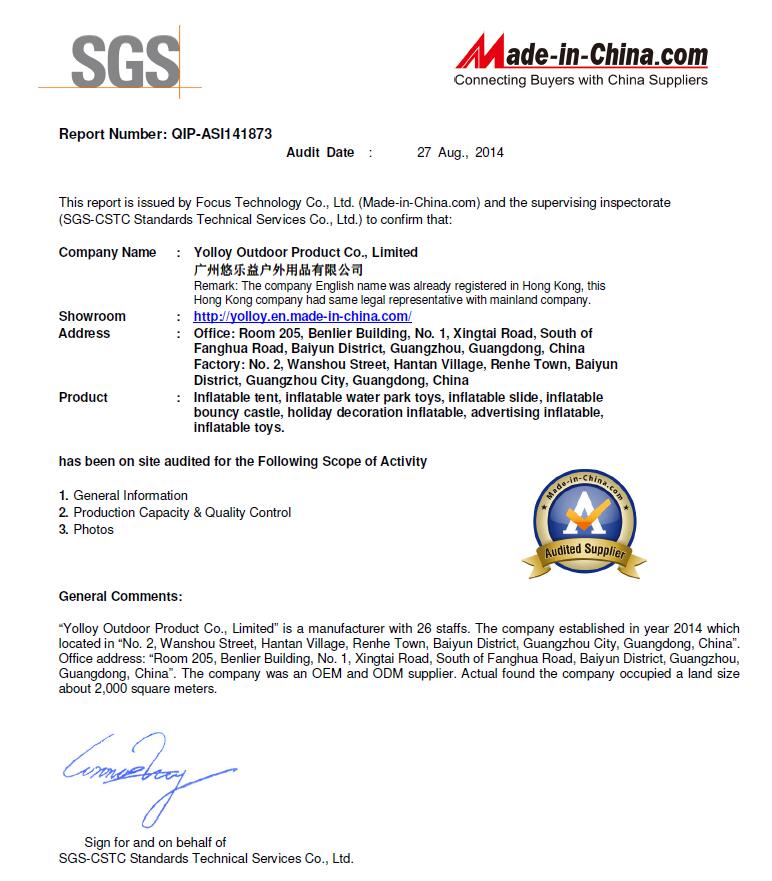
Certification

News

• New Order Successfully Finished for Long-Time Cooperated Japanese Client | YOLLOY Wins Full Client Recognition

• YOLLOY Custom Inflatable Pool Tent for Danish Client: Professional Pool Repair Shelter & Debris Protection

• Trusted Once Again! Greek Captain Re-orders Our Products After 4 Years

• Revolutionize Your Outdoors: The All-Terrain Inflatable Floating Tent for Land & Water

• Elevate Your Summer Fun: The Ultimate Inflatable Water Floating Volleyball Court Trampoline

• Innovative Inflatable Nightclub Tents & Pop-Up Bars: The Ultimate Solution for Portable Party Venues

Contact Us

Name: Sunny Yang
Tel: +86-20-8370 0771
Fax: +86-20-8370 0771
Mobile: 13570587575
E-mail: [email protected]
Add: No 5,Xiong wei Bo Nan Road,ZhongLuoTan Town,Baiyun district,Guangzhou,China
Friend me on Facebook Follow me on Twitter Add me to your circles Follow me on Pinterest Watch my channel on YouTube
News

How to choose inflatable bounce house rental business equipment?

Author:yolloy Date:2026/8/17 6:24:06

Starting a bounce house rental business is one of the most accessible ways to enter the event and entertainment industry. The equipment you buy in the first few months decides whether you build a steady, profitable fleet or spend your weekends patching seams and refunding bookings. This guide walks through the practical points to check before you buy, from material grade and blowers to safety standards and supplier reliability.

Commercial-grade or residential: the first decision

The single biggest mistake new operators make is buying residential inflatables and hoping they survive commercial use. Residential units are built for a handful of kids in a backyard a few times a year. A rental unit goes out every weekend, carries dozens of children, gets dragged across driveways, and sits in the sun for hours. That kind of punishment needs commercial-grade construction: thicker PVC tarpaulin, reinforced seams, and hardware designed for continuous operation. If a unit is priced like a toy, it will perform like one. When you are ready to buy, working with an experienced inflatable bounce house manufacturer makes a real difference to the quality you receive.

Material and construction quality

The material is the heart of any bounce house. Commercial units are typically made from PVC tarpaulin around 0.5mm or thicker, with a woven base fabric that resists punctures and tearing. Look for double-stitched seams and extra reinforcement at high-stress points such as corners, anchor tabs, and slide transitions. Sewn products should use waterproof nylon thread and precision stitching, while airtight sections are usually joined with high-temperature fusion or welding equipment. These details are what keep a unit airtight and safe after hundreds of rentals.

Blowers and hardware

A bounce house stays rigid because a blower keeps feeding it air. Commercial units need continuous-run blowers that can operate for hours without overheating, not the small on-off units that come with backyard toys. Check that the blower matches your local power supply, whether 110V, 220V, or 380V, and that it meets CE or UL requirements. Hardware matters just as much: heavy-duty zippers that seal tightly, and stainless steel D-rings or round metal anchor systems that hold the unit down in wind. Cheap zippers and rusting anchors are the fastest way to turn a rental into a refund.

Size and features that rent well

Standard 15x15 bounce houses fit most backyards and are the bread and butter of the rental business. Combo units with attached slides pull higher rental fees and pay for themselves faster. Water slides and obstacle courses are seasonal gold in warm climates, but they need more space, more water, and more setup time. Think about your local market: what do parents and event planners in your area actually book? Start with one or two versatile units, learn what rents, then grow the fleet. If you are comparing commercial inflatable bounce house for sale, judge units on material, blower, and safety certification rather than price alone.

Safety standards and certifications

Safety is not optional in this business. Buy from suppliers whose materials have passed recognized testing such as EN14960 for inflatable toys, EN71 for toy safety, and RoHS for restricted substances. Blowers should meet CE or UL electrical standards. These certifications are also a selling point: venues and event planners increasingly ask for proof of compliance, and insurance is easier to arrange when your equipment meets recognized standards.

Customization and supplier reliability

For a rental business, a supplier that offers customization is a real advantage. Custom sizes and colors let you stand out in a crowded market, and printed logos and artwork turn every rental into free advertising. Look for a manufacturer that can work from a description, drawing, sketch, or photograph, and that offers a sensible minimum order quantity, ideally a single piece so you can test a design before committing. Lead time matters too. A typical production window of 6 to 15 days per regular unit, with air freight arriving in about a week and sea freight in two to four weeks, lets you plan your season without surprises.

Maintenance and lifespan

Even the best equipment needs care. Choose units that come with a repair kit, and build a simple routine: wipe down after every event, dry thoroughly before storage, and check seams and anchors regularly. With proper use and maintenance, a commercial-grade unit can serve a rental business for years. A supplier that answers questions within 24 hours and ships on time makes the whole operation run smoother, so it is worth checking delivery records and asking about on-time performance before you place a large order.

Final thoughts

Choosing inflatable bounce house rental business equipment comes down to a few fundamentals: commercial-grade materials, continuous-run blowers, solid hardware, recognized safety standards, and a supplier you can rely on. Get those right and your equipment becomes a revenue-generating asset instead of a maintenance headache. Whether you buy a single unit or a full fleet, sourcing inflatable bounce house wholesale from a factory that controls its own production keeps costs predictable and quality consistent.

Frequently asked questions

How long does a commercial bounce house last? With correct use and maintenance, three years or more is a reasonable expectation for commercial-grade units, depending on the product type and how often it is used.

What is the minimum order quantity? Many manufacturers accept orders of a single piece, which is ideal for testing a new design before scaling up your fleet.

How long does production take? A regular inflatable typically takes 6 to 15 days to produce, excluding transit time. Complex or large custom products may take longer, so plan ahead for peak season.

Do units come with blowers? Yes, products are supplied with appropriately powered blowers matched to your voltage requirements, so you do not need to source them separately.


How to choose inflatable bounce house rental business equipment?

Author:yolloy Date:2026/8/17 6:24:06

Starting a bounce house rental business is one of the most accessible ways to enter the event and entertainment industry. The equipment you buy in the first few months decides whether you build a steady, profitable fleet or spend your weekends patching seams and refunding bookings. This guide walks through the practical points to check before you buy, from material grade and blowers to safety standards and supplier reliability.

Commercial-grade or residential: the first decision

The single biggest mistake new operators make is buying residential inflatables and hoping they survive commercial use. Residential units are built for a handful of kids in a backyard a few times a year. A rental unit goes out every weekend, carries dozens of children, gets dragged across driveways, and sits in the sun for hours. That kind of punishment needs commercial-grade construction: thicker PVC tarpaulin, reinforced seams, and hardware designed for continuous operation. If a unit is priced like a toy, it will perform like one. When you are ready to buy, working with an experienced inflatable bounce house manufacturer makes a real difference to the quality you receive.

Material and construction quality

The material is the heart of any bounce house. Commercial units are typically made from PVC tarpaulin around 0.5mm or thicker, with a woven base fabric that resists punctures and tearing. Look for double-stitched seams and extra reinforcement at high-stress points such as corners, anchor tabs, and slide transitions. Sewn products should use waterproof nylon thread and precision stitching, while airtight sections are usually joined with high-temperature fusion or welding equipment. These details are what keep a unit airtight and safe after hundreds of rentals.

Blowers and hardware

A bounce house stays rigid because a blower keeps feeding it air. Commercial units need continuous-run blowers that can operate for hours without overheating, not the small on-off units that come with backyard toys. Check that the blower matches your local power supply, whether 110V, 220V, or 380V, and that it meets CE or UL requirements. Hardware matters just as much: heavy-duty zippers that seal tightly, and stainless steel D-rings or round metal anchor systems that hold the unit down in wind. Cheap zippers and rusting anchors are the fastest way to turn a rental into a refund.

Size and features that rent well

Standard 15x15 bounce houses fit most backyards and are the bread and butter of the rental business. Combo units with attached slides pull higher rental fees and pay for themselves faster. Water slides and obstacle courses are seasonal gold in warm climates, but they need more space, more water, and more setup time. Think about your local market: what do parents and event planners in your area actually book? Start with one or two versatile units, learn what rents, then grow the fleet. If you are comparing commercial inflatable bounce house for sale, judge units on material, blower, and safety certification rather than price alone.

Safety standards and certifications

Safety is not optional in this business. Buy from suppliers whose materials have passed recognized testing such as EN14960 for inflatable toys, EN71 for toy safety, and RoHS for restricted substances. Blowers should meet CE or UL electrical standards. These certifications are also a selling point: venues and event planners increasingly ask for proof of compliance, and insurance is easier to arrange when your equipment meets recognized standards.

Customization and supplier reliability

For a rental business, a supplier that offers customization is a real advantage. Custom sizes and colors let you stand out in a crowded market, and printed logos and artwork turn every rental into free advertising. Look for a manufacturer that can work from a description, drawing, sketch, or photograph, and that offers a sensible minimum order quantity, ideally a single piece so you can test a design before committing. Lead time matters too. A typical production window of 6 to 15 days per regular unit, with air freight arriving in about a week and sea freight in two to four weeks, lets you plan your season without surprises.

Maintenance and lifespan

Even the best equipment needs care. Choose units that come with a repair kit, and build a simple routine: wipe down after every event, dry thoroughly before storage, and check seams and anchors regularly. With proper use and maintenance, a commercial-grade unit can serve a rental business for years. A supplier that answers questions within 24 hours and ships on time makes the whole operation run smoother, so it is worth checking delivery records and asking about on-time performance before you place a large order.

Final thoughts

Choosing inflatable bounce house rental business equipment comes down to a few fundamentals: commercial-grade materials, continuous-run blowers, solid hardware, recognized safety standards, and a supplier you can rely on. Get those right and your equipment becomes a revenue-generating asset instead of a maintenance headache. Whether you buy a single unit or a full fleet, sourcing inflatable bounce house wholesale from a factory that controls its own production keeps costs predictable and quality consistent.

Frequently asked questions

How long does a commercial bounce house last? With correct use and maintenance, three years or more is a reasonable expectation for commercial-grade units, depending on the product type and how often it is used.

What is the minimum order quantity? Many manufacturers accept orders of a single piece, which is ideal for testing a new design before scaling up your fleet.

How long does production take? A regular inflatable typically takes 6 to 15 days to produce, excluding transit time. Complex or large custom products may take longer, so plan ahead for peak season.

Do units come with blowers? Yes, products are supplied with appropriately powered blowers matched to your voltage requirements, so you do not need to source them separately.