Products Category
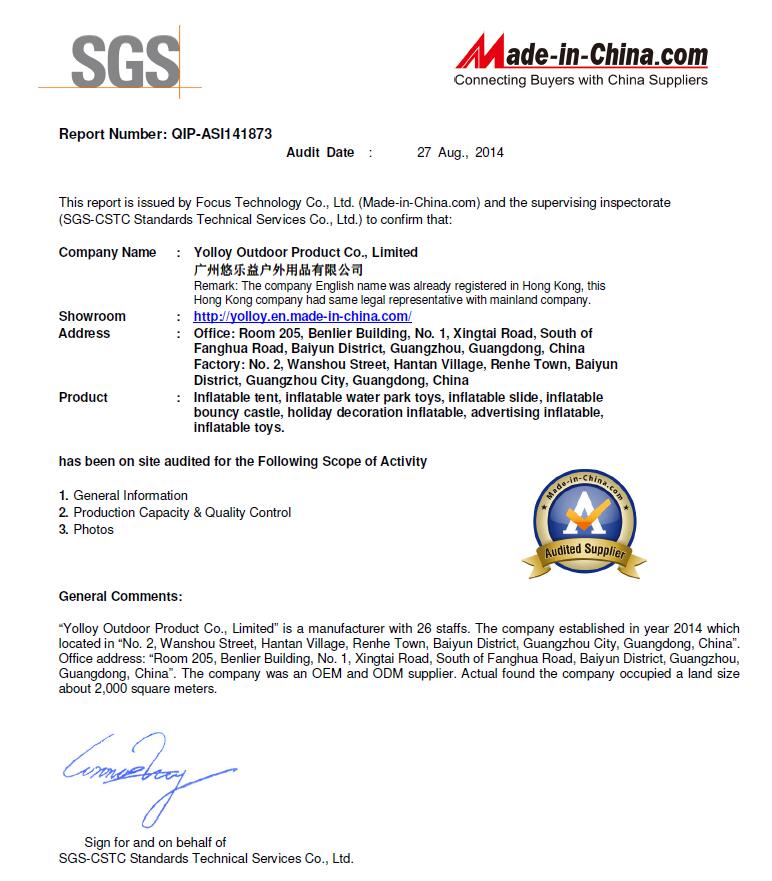
Certification

News

• New Order Successfully Finished for Long-Time Cooperated Japanese Client | YOLLOY Wins Full Client Recognition

• YOLLOY Custom Inflatable Pool Tent for Danish Client: Professional Pool Repair Shelter & Debris Protection

• Trusted Once Again! Greek Captain Re-orders Our Products After 4 Years

• Revolutionize Your Outdoors: The All-Terrain Inflatable Floating Tent for Land & Water

• Elevate Your Summer Fun: The Ultimate Inflatable Water Floating Volleyball Court Trampoline

• Innovative Inflatable Nightclub Tents & Pop-Up Bars: The Ultimate Solution for Portable Party Venues

Contact Us

Name: Sunny Yang
Tel: +86-20-8370 0771
Fax: +86-20-8370 0771
Mobile: 13570587575
E-mail: [email protected]
Add: No 5,Xiong wei Bo Nan Road,ZhongLuoTan Town,Baiyun district,Guangzhou,China
Friend me on Facebook Follow me on Twitter Add me to your circles Follow me on Pinterest Watch my channel on YouTube
News

How does a china inflatable tent compare to other options?

Author:yolloy Date:2026/8/17 7:15:15

Anyone shopping for an inflatable tent quickly notices that many of the options on the market come from China. That raises a fair question: how does a china inflatable tent actually compare with tents made elsewhere, or with traditional pole tents? The honest answer is that a China inflatable tent can match the quality of tents from other countries at a noticeably lower price, as long as you work with the right manufacturer. This article breaks down the comparison so you can decide with confidence.

Before comparing, it helps to understand what an inflatable tent is. Instead of rigid poles, it uses airtight air beams that are inflated with a blower. Once pressurized, those beams form the frame that holds the fabric up. Deflate them and the whole tent folds flat, which is why these shelters have become popular for camping, events, emergency response, and commercial use.

What makes a China inflatable tent different

China is home to the world's largest inflatable manufacturing cluster. That concentration matters for buyers, because it means mature supply chains for PVC tarpaulin, Oxford fabric, blowers, valves, and welding equipment all sit close together. A factory such as YOLLOY, based in Guangzhou, can source every component without long shipping delays between suppliers, and that integration shows up in both price and lead time.

The other big difference is the design-to-production service that Chinese manufacturers typically offer. Rather than buying only from a fixed catalog, you can describe what you need and have a custom inflatable tent engineered around it. YOLLOY, for example, prepares simulation renderings from a customer's description, drawing, sketch, photograph, or site plan, revises the design until it is approved, and only then releases it for production. For buyers who need a specific size, color, or printed logo, this flexibility is hard to find elsewhere.

China inflatable tent vs. traditional pole tent

The most common comparison is between an inflatable tent and a traditional pole tent, and the differences are practical rather than theoretical.

Setup speed is where inflatable tents win clearly. With a blower, one person can have a tent standing in minutes, while a pole tent usually takes two people fifteen minutes or more to assemble. That speed matters for event organizers who move between venues, and for emergency teams who need shelter up fast.

Interior space is another advantage. Pole tents lose usable room to the frame, and the poles themselves create awkward bumps along the walls. An inflatable tent keeps its beams at the edges, so the floor stays open and you can often stand upright inside. For a family campsite or a temporary workspace, that extra headroom changes the feel of the space completely.

Storage is simpler too. Deflate the beams and the tent folds into a compact bag, which is easier to carry and cheaper to ship than a rigid-framed shelter of the same size.

Durability is the area where buyers tend to worry, and it comes down to materials and construction. Commercial-grade inflatable tents use PVC tarpaulin with reinforced seams, high-temperature fusion welding for airtight joints, and waterproof nylon thread. YOLLOY adds extra reinforcement at high-load areas and incorporates D-ring or round metal anchor systems where needed for wind resistance. Materials used in their products have passed EN71, EN14960, and RoHS-related testing, and their blowers meet CE or UL requirements. A well-built inflatable tent is not a fragile product; it is engineered for repeated commercial use.

The trade-offs are real but manageable. An inflatable tent depends on a blower, so you need power on site. Air pressure responds to temperature, so a tent that feels taut in the afternoon can soften overnight. And a puncture, while rare with quality material, needs a patch. YOLLOY supplies a repair kit with every inflatable product, and a small repair is a ten-minute job rather than a reason to replace the tent.

China inflatable tent vs. inflatable tents from other regions

If you are comparing inflatable tents made in China with those from Europe or North America, the gap is narrower than most people expect, and it is mostly about price and customization.

On price, a China inflatable tent is typically a fraction of the cost of an equivalent model from a Western brand. The savings come from an integrated supply chain and lower production overhead, not from skimping on material. The same commercial-grade PVC tarpaulin and certified blowers cost far less when sourced through a Chinese factory.

On customization, Chinese manufacturers lead. Many Western brands sell fixed models with limited options, while a factory like YOLLOY will build to your exact specification, with a minimum order quantity as low as one piece. Custom sizes, custom colors, and printed logos are standard. If you run an event company that needs a branded shelter, or a water park that needs a bespoke inflatable, this is a decisive advantage.

On quality, the difference is not geography but the individual factory. China has both excellent manufacturers and poor ones, so the smart approach is to vet the supplier rather than the country. Check that the factory can show certifications, ask about materials and testing, request production photos or a sample, and confirm the warranty and delivery terms before ordering.

What to look for in a China inflatable tent manufacturer

If you decide a China inflatable tent is right for you, the next step is choosing a manufacturer you can trust. A few checks will separate a serious factory from a reseller:

  • Materials: commercial-grade PVC tarpaulin as standard, with Oxford fabric, nylon, or TPU available for tent projects that need them.
  • Construction: precision sewing, reinforced seams, waterproof nylon thread, and high-temperature fusion welding for airtight products.
  • Certifications: EN71, EN14960, and RoHS-related testing for materials, with CE or UL compliance for blowers.
  • Blower options: 110V, 220V, or 380V supply so the tent works in your market.
  • Service: a repair kit with each product, a stated warranty, and a sales team that answers within 24 hours.
  • Delivery: confirmed shipping options by air or sea, with realistic transit times.

YOLLOY, for example, exports to Europe, Asia, South America, Africa, the Middle East, and Latin America, and reports a 95% on-time delivery rate. That kind of track record, combined with a three-year service expectation when products are used and maintained correctly, gives buyers a clear picture of what to expect.

When a China inflatable tent makes sense

A China inflatable tent is the stronger choice when you need custom sizing, fast delivery, and competitive pricing without compromising on materials or safety. It suits event and rental businesses that set up and tear down frequently, campers who value quick setup and standing room, and organizations that need deployable shelters for emergency or field use.

A traditional pole tent still makes sense for remote expeditions where you want maximum field repairability and no reliance on power. And if you only need a standard size with no customization, a local brand may be more convenient. But for most commercial and family applications, a custom inflatable tent from a proven inflatable tent manufacturer delivers the best balance of price, flexibility, and quality.

The comparison is not about which option is universally better. It is about matching the shelter to how you actually use it. If you want a tent that goes up in minutes, packs small, and can be built exactly to your specification, a China inflatable tent is worth serious consideration.


How does a china inflatable tent compare to other options?

Author:yolloy Date:2026/8/17 7:15:15

Anyone shopping for an inflatable tent quickly notices that many of the options on the market come from China. That raises a fair question: how does a china inflatable tent actually compare with tents made elsewhere, or with traditional pole tents? The honest answer is that a China inflatable tent can match the quality of tents from other countries at a noticeably lower price, as long as you work with the right manufacturer. This article breaks down the comparison so you can decide with confidence.

Before comparing, it helps to understand what an inflatable tent is. Instead of rigid poles, it uses airtight air beams that are inflated with a blower. Once pressurized, those beams form the frame that holds the fabric up. Deflate them and the whole tent folds flat, which is why these shelters have become popular for camping, events, emergency response, and commercial use.

What makes a China inflatable tent different

China is home to the world's largest inflatable manufacturing cluster. That concentration matters for buyers, because it means mature supply chains for PVC tarpaulin, Oxford fabric, blowers, valves, and welding equipment all sit close together. A factory such as YOLLOY, based in Guangzhou, can source every component without long shipping delays between suppliers, and that integration shows up in both price and lead time.

The other big difference is the design-to-production service that Chinese manufacturers typically offer. Rather than buying only from a fixed catalog, you can describe what you need and have a custom inflatable tent engineered around it. YOLLOY, for example, prepares simulation renderings from a customer's description, drawing, sketch, photograph, or site plan, revises the design until it is approved, and only then releases it for production. For buyers who need a specific size, color, or printed logo, this flexibility is hard to find elsewhere.

China inflatable tent vs. traditional pole tent

The most common comparison is between an inflatable tent and a traditional pole tent, and the differences are practical rather than theoretical.

Setup speed is where inflatable tents win clearly. With a blower, one person can have a tent standing in minutes, while a pole tent usually takes two people fifteen minutes or more to assemble. That speed matters for event organizers who move between venues, and for emergency teams who need shelter up fast.

Interior space is another advantage. Pole tents lose usable room to the frame, and the poles themselves create awkward bumps along the walls. An inflatable tent keeps its beams at the edges, so the floor stays open and you can often stand upright inside. For a family campsite or a temporary workspace, that extra headroom changes the feel of the space completely.

Storage is simpler too. Deflate the beams and the tent folds into a compact bag, which is easier to carry and cheaper to ship than a rigid-framed shelter of the same size.

Durability is the area where buyers tend to worry, and it comes down to materials and construction. Commercial-grade inflatable tents use PVC tarpaulin with reinforced seams, high-temperature fusion welding for airtight joints, and waterproof nylon thread. YOLLOY adds extra reinforcement at high-load areas and incorporates D-ring or round metal anchor systems where needed for wind resistance. Materials used in their products have passed EN71, EN14960, and RoHS-related testing, and their blowers meet CE or UL requirements. A well-built inflatable tent is not a fragile product; it is engineered for repeated commercial use.

The trade-offs are real but manageable. An inflatable tent depends on a blower, so you need power on site. Air pressure responds to temperature, so a tent that feels taut in the afternoon can soften overnight. And a puncture, while rare with quality material, needs a patch. YOLLOY supplies a repair kit with every inflatable product, and a small repair is a ten-minute job rather than a reason to replace the tent.

China inflatable tent vs. inflatable tents from other regions

If you are comparing inflatable tents made in China with those from Europe or North America, the gap is narrower than most people expect, and it is mostly about price and customization.

On price, a China inflatable tent is typically a fraction of the cost of an equivalent model from a Western brand. The savings come from an integrated supply chain and lower production overhead, not from skimping on material. The same commercial-grade PVC tarpaulin and certified blowers cost far less when sourced through a Chinese factory.

On customization, Chinese manufacturers lead. Many Western brands sell fixed models with limited options, while a factory like YOLLOY will build to your exact specification, with a minimum order quantity as low as one piece. Custom sizes, custom colors, and printed logos are standard. If you run an event company that needs a branded shelter, or a water park that needs a bespoke inflatable, this is a decisive advantage.

On quality, the difference is not geography but the individual factory. China has both excellent manufacturers and poor ones, so the smart approach is to vet the supplier rather than the country. Check that the factory can show certifications, ask about materials and testing, request production photos or a sample, and confirm the warranty and delivery terms before ordering.

What to look for in a China inflatable tent manufacturer

If you decide a China inflatable tent is right for you, the next step is choosing a manufacturer you can trust. A few checks will separate a serious factory from a reseller:

  • Materials: commercial-grade PVC tarpaulin as standard, with Oxford fabric, nylon, or TPU available for tent projects that need them.
  • Construction: precision sewing, reinforced seams, waterproof nylon thread, and high-temperature fusion welding for airtight products.
  • Certifications: EN71, EN14960, and RoHS-related testing for materials, with CE or UL compliance for blowers.
  • Blower options: 110V, 220V, or 380V supply so the tent works in your market.
  • Service: a repair kit with each product, a stated warranty, and a sales team that answers within 24 hours.
  • Delivery: confirmed shipping options by air or sea, with realistic transit times.

YOLLOY, for example, exports to Europe, Asia, South America, Africa, the Middle East, and Latin America, and reports a 95% on-time delivery rate. That kind of track record, combined with a three-year service expectation when products are used and maintained correctly, gives buyers a clear picture of what to expect.

When a China inflatable tent makes sense

A China inflatable tent is the stronger choice when you need custom sizing, fast delivery, and competitive pricing without compromising on materials or safety. It suits event and rental businesses that set up and tear down frequently, campers who value quick setup and standing room, and organizations that need deployable shelters for emergency or field use.

A traditional pole tent still makes sense for remote expeditions where you want maximum field repairability and no reliance on power. And if you only need a standard size with no customization, a local brand may be more convenient. But for most commercial and family applications, a custom inflatable tent from a proven inflatable tent manufacturer delivers the best balance of price, flexibility, and quality.

The comparison is not about which option is universally better. It is about matching the shelter to how you actually use it. If you want a tent that goes up in minutes, packs small, and can be built exactly to your specification, a China inflatable tent is worth serious consideration.