Products Category
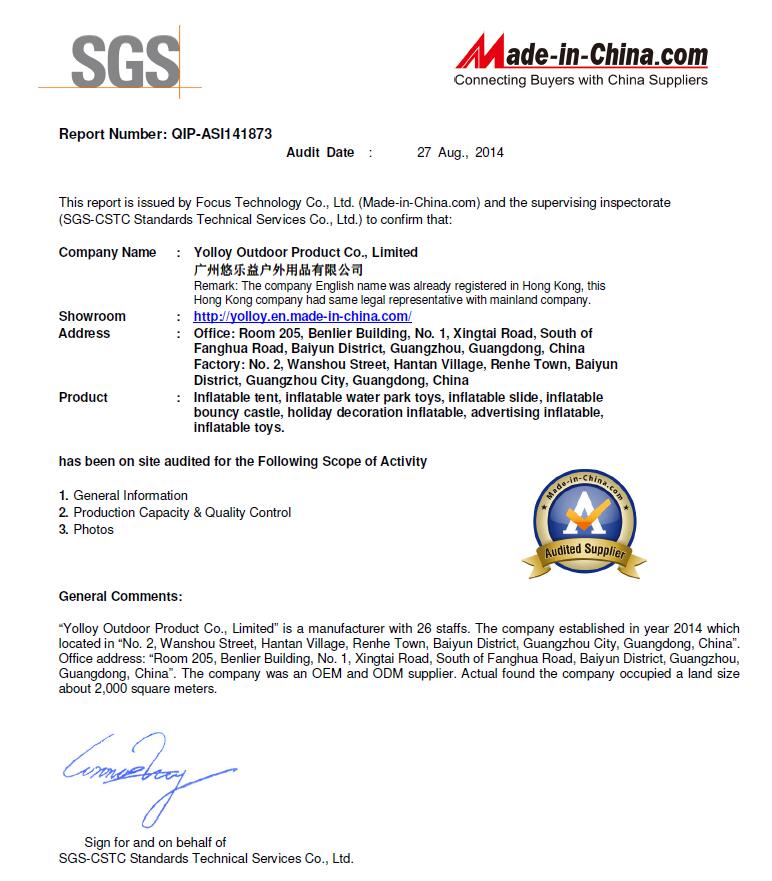
Certification

News

• New Order Successfully Finished for Long-Time Cooperated Japanese Client | YOLLOY Wins Full Client Recognition

• YOLLOY Custom Inflatable Pool Tent for Danish Client: Professional Pool Repair Shelter & Debris Protection

• Trusted Once Again! Greek Captain Re-orders Our Products After 4 Years

• Revolutionize Your Outdoors: The All-Terrain Inflatable Floating Tent for Land & Water

• Elevate Your Summer Fun: The Ultimate Inflatable Water Floating Volleyball Court Trampoline

• Innovative Inflatable Nightclub Tents & Pop-Up Bars: The Ultimate Solution for Portable Party Venues

Contact Us

Name: Sunny Yang
Tel: +86-20-8370 0771
Fax: +86-20-8370 0771
Mobile: 13570587575
E-mail: [email protected]
Add: No 5,Xiong wei Bo Nan Road,ZhongLuoTan Town,Baiyun district,Guangzhou,China
Friend me on Facebook Follow me on Twitter Add me to your circles Follow me on Pinterest Watch my channel on YouTube
News

Is commercial inflatable water slides safe for children?

Author:yolloy Date:2026/8/12 17:25:30

On a hot summer day, few things delight children more than racing down a colorful inflatable water slide and splashing into a pool of cool water. These towering structures have become a staple at birthday parties, community events, and resort water parks. But as a parent, event organizer, or business owner, one question naturally comes to mind: Is commercial inflatable water slides safe for children?

The short answer is yes — when they are properly designed, manufactured, installed, and supervised. Commercial inflatable water slides are engineered with safety as a primary concern, far exceeding the quality of typical residential models. This article examines what makes these structures safe, what risks exist, and how to ensure every child has a fun and injury-free experience.

1. What Makes Commercial Inflatable Water Slides Safe

1.1 Commercial-Grade Materials

The single most important factor in a slide's safety is the material it is built from. Residential-grade inflatables often use thin nylon or polyester that can tear, puncture, and degrade under prolonged sun exposure. In contrast, commercial-grade slides are manufactured using heavy-duty PVC tarpaulin — a multi-layered fabric with an internal woven scrim that provides exceptional tensile strength. This material is waterproof, tear-resistant, and treated with anti-UV coating to prevent sun damage over multiple seasons of use.

Reputable inflatable water slide manufacturers source PVC materials that meet international safety standards such as EN71 for toy safety and EN14960 for inflatable play equipment. These certifications confirm that the materials are non-toxic, fire-retardant, and free of harmful chemicals — essential when children spend hours in direct contact with the slide surface.

1.2 Superior Construction and Reinforcement

High-quality materials alone are not enough — how the slide is assembled matters equally. Commercial-grade slides use advanced heat-welding technology that fuses PVC panels together at the molecular level, creating airtight bonds that are often stronger than the material itself. In high-stress zones — such as the base of climbing walls, slide lane edges, and anchor points — manufacturers apply double, triple, or even quadruple stitching with industrial-strength nylon thread. An additional layer of vinyl stripping is glued and welded over each seam for extra reinforcement.

Before any unit leaves the factory, it undergoes rigorous quality testing. A standard practice is a 24-hour inflation leak test, where the entire structure is kept fully inflated and monitored for pressure loss. Only products that pass this inspection are packed and shipped.

1.3 Safety-First Design Features

A well-designed commercial water slide anticipates how children actually play. Key safety features include:

  • High slide walls (berms): The sides of the slide lane are tall and firm enough to keep a child securely inside, even at speed.
  • Enclosed climbing platforms: The top of the slide is fully enclosed with high mesh safety netting, preventing any temptation to jump from the top.
  • Non-slip landing zones: The splash pool at the bottom features a cushioned, non-slip base that absorbs impact and prevents falls when children stand up.
  • Multiple anchor points: A wide base with numerous heavy-duty D-ring anchors ensures the structure remains stable even during active group play.
  • Gradual angle climbing walls: Instead of vertical walls, the climbing surface is slightly angled with sturdy handholds and footholds spaced for children.

1.4 Safety Certifications and Standards

Certifications provide independent verification of a product's safety. For inflatable water slides, the most relevant standards include:

  • EN71: European safety standard for toys, covering mechanical and physical properties, flammability, and chemical migration. It confirms that the product is safe for children under 14 years old.
  • EN14960: Specifically addresses inflatable play equipment, covering structural integrity, anchoring, and operational safety.
  • EN15649: Safety standard for floating leisure articles and water park inflatables used on or in water.
  • CE / UL for blowers: The electric blowers that keep the slide inflated should meet CE or UL certification requirements for continuous-duty operation.

2. Common Risks and How to Prevent Them

Even the safest commercial slide can become hazardous if not used correctly. Understanding common risks allows you to prevent them proactively.

2.1 Slip-and-Fall Injuries

Wet PVC surfaces are naturally slick. Children often sprint toward ladders in excitement, and the combination of water, bare feet, and smooth vinyl creates ideal conditions for slips. The highest-risk areas are entrance zones, ladder bases, and the edges of splash pools. Simple measures — establishing walking-only rules, placing non-slip mats at entry and exit points, and clearing runoff channels regularly — dramatically reduce slip-related injuries.

2.2 Collisions and Overcrowding

Most serious inflatable injuries involve multiple participants colliding at the bottom of the slide. When riders do not wait for the previous person to clear the splash zone, pile-ups occur. This risk increases when children of different sizes and speeds share the same lane. Dual-lane slides help reduce congestion, but only when an attendant actively enforces lane discipline. A timed release system — where one rider goes per lane at a time — is the most effective control measure.

2.3 Structural Failures from Poor Maintenance

Inflatable water slides face constant exposure to UV radiation, water saturation, stretching forces, and surface abrasion. Over time, these factors slowly weaken vinyl fibers and stitching. Failure may appear sudden, but damage accumulates quietly for months. Warning signs include fading color, wrinkled surfaces, loose seams, and weak air pressure. Any unit showing repeated pressure loss, visible tears, or seam separation should be taken out of service immediately for professional repair. Blowers should also be inspected regularly, as a blower failure during operation can cause rapid deflation.

3. Age-Specific Safety Guidelines

Safety requirements vary significantly by age group due to differences in body weight, balance, reaction time, and risk awareness. Matching the slide size to the user group is essential.

Age Group Recommended Slide Type Key Safety Focus
2–4 years Low-height slides (under 10 ft), gentle slopes, shallow splash zones Close adult supervision within arm's reach; soft landing base
5–8 years Mid-height slides (13–18 ft), dual lanes, moderate slopes One child per lane at a time; feet-first seated sliding
9–12 years Taller slides (13–16 ft+), racing lanes, steeper drops Weight limits per rider; clear splash zone before next ride
13–17 years High slides (16–27 ft), dual/triple lanes, thrill features No roughhousing or diving; dedicated adult slide captain

4. Proper Installation and Anchoring

Many serious accidents stem from improper setup rather than from rider behavior. Anchoring errors often remain invisible until a strong gust of wind appears. When anchors fail, entire slides can tilt, drag, or collapse — and at that point, riders have almost no time to react.

Proper anchoring uses every tie-down point the manufacturer provides. On grass, heavy-duty steel stakes at least 18 inches long must be fully driven into firm soil at each anchor point. On concrete or asphalt, sandbags or water barrel counterweights must match the unit's height and weight. Partial anchoring offers only false confidence.

Inflation pressure is equally important. Under-inflated slides fold and crease, trapping riders. Over-inflated slides stretch seams beyond design tolerance. The blower should be connected to a dedicated GFCI-protected circuit, and long extension cords should be avoided as they reduce blower efficiency. Standing water near power connections must be eliminated to prevent electrical hazards.

Weather monitoring is a non-negotiable part of safe operation. Most manufacturers recommend shutting down when wind speeds reach 15 mph (25 km/h) or higher. Lightning, heavy rain, or any sign of an approaching storm means immediate deflation and evacuation.

5. Routine Inspection and Maintenance

Inflatable water slide safety depends on disciplined routine inspection more than on advanced technology. Catching small issues early prevents them from becoming large failures.

Inspection Item What to Check Action if Fault Found
Exterior vinyl Cuts, abrasions, fading, discoloration Remove from service; schedule professional repair
Seams and stitching Loose threads, gaps, separation Professional repair; do not use until fixed
Anchors Presence, tightness, corrosion Reinstall or replace anchors immediately
Blower Noise level, consistent airflow, cord condition Repair or replace blower before use
Water system Leaks, loose fittings, sprayer function Tighten or replace hoses and fittings

After each use, the slide should be rinsed clean, fully dried, and stored in a cool, dry environment away from direct sunlight. Trapped moisture causes mold and mildew, which degrade materials and pose skin health risks. Proper storage extends the product's service life and maintains its structural integrity across multiple seasons.

6. Choosing a Reliable Manufacturer

The safety and longevity of a commercial inflatable water slide ultimately depend on the manufacturer that builds it. When evaluating suppliers, consider these key factors:

  • Material transparency: A trustworthy manufacturer openly states the type and grade of materials used and can provide independent lab test certifications (such as EN71, EN14960, and RoHS compliance).
  • Quality control processes: Look for multi-stage inspection, including 100% leak testing before shipment. Every unit should be fully inflated and monitored for at least 24 hours.
  • Customization capability: A manufacturer with OEM/ODM experience can design slides to your exact specifications — size, color, theme, and branding — giving you a product that fits your setting and audience perfectly.
  • After-sales support: A repair kit should be included with every product. The manufacturer should also offer guidance on maintenance and simple repairs to maximize the product's usable life.
  • Delivery reliability: Consistent, on-time delivery and professional international shipping experience indicate a well-organized operation.

As a professional inflatable water park manufacturer based in Guangzhou, China, YOLLOY offers a complete range of commercial inflatable water slides, commercial inflatable water slides, bounce houses, interactive sports games, and water park toys. All products are built with commercial-grade PVC tarpaulin, reinforced with heat-welded and multi-stitched seams, and tested to meet EN71 and EN14960 standards. With a minimum order quantity of just one piece and full customization available, YOLLOY serves event companies, resorts, water parks, and rental businesses worldwide.

Conclusion

Commercial inflatable water slides are safe for children when four conditions are met: they are built with certified, high-grade materials by a reputable manufacturer; they are correctly installed on a suitable surface with proper anchoring; they are used under active adult supervision with clear rules enforced; and they receive regular inspection and maintenance. None of these conditions is optional — each forms a layer of protection, and together they create a safe environment where children can enjoy the thrill of water sliding without unnecessary risk. By choosing quality equipment and following established safety protocols, parents, event organizers, and business owners can confidently offer children the unforgettable summer experience they deserve.


Is commercial inflatable water slides safe for children?

Author:yolloy Date:2026/8/12 17:25:30

On a hot summer day, few things delight children more than racing down a colorful inflatable water slide and splashing into a pool of cool water. These towering structures have become a staple at birthday parties, community events, and resort water parks. But as a parent, event organizer, or business owner, one question naturally comes to mind: Is commercial inflatable water slides safe for children?

The short answer is yes — when they are properly designed, manufactured, installed, and supervised. Commercial inflatable water slides are engineered with safety as a primary concern, far exceeding the quality of typical residential models. This article examines what makes these structures safe, what risks exist, and how to ensure every child has a fun and injury-free experience.

1. What Makes Commercial Inflatable Water Slides Safe

1.1 Commercial-Grade Materials

The single most important factor in a slide's safety is the material it is built from. Residential-grade inflatables often use thin nylon or polyester that can tear, puncture, and degrade under prolonged sun exposure. In contrast, commercial-grade slides are manufactured using heavy-duty PVC tarpaulin — a multi-layered fabric with an internal woven scrim that provides exceptional tensile strength. This material is waterproof, tear-resistant, and treated with anti-UV coating to prevent sun damage over multiple seasons of use.

Reputable inflatable water slide manufacturers source PVC materials that meet international safety standards such as EN71 for toy safety and EN14960 for inflatable play equipment. These certifications confirm that the materials are non-toxic, fire-retardant, and free of harmful chemicals — essential when children spend hours in direct contact with the slide surface.

1.2 Superior Construction and Reinforcement

High-quality materials alone are not enough — how the slide is assembled matters equally. Commercial-grade slides use advanced heat-welding technology that fuses PVC panels together at the molecular level, creating airtight bonds that are often stronger than the material itself. In high-stress zones — such as the base of climbing walls, slide lane edges, and anchor points — manufacturers apply double, triple, or even quadruple stitching with industrial-strength nylon thread. An additional layer of vinyl stripping is glued and welded over each seam for extra reinforcement.

Before any unit leaves the factory, it undergoes rigorous quality testing. A standard practice is a 24-hour inflation leak test, where the entire structure is kept fully inflated and monitored for pressure loss. Only products that pass this inspection are packed and shipped.

1.3 Safety-First Design Features

A well-designed commercial water slide anticipates how children actually play. Key safety features include:

  • High slide walls (berms): The sides of the slide lane are tall and firm enough to keep a child securely inside, even at speed.
  • Enclosed climbing platforms: The top of the slide is fully enclosed with high mesh safety netting, preventing any temptation to jump from the top.
  • Non-slip landing zones: The splash pool at the bottom features a cushioned, non-slip base that absorbs impact and prevents falls when children stand up.
  • Multiple anchor points: A wide base with numerous heavy-duty D-ring anchors ensures the structure remains stable even during active group play.
  • Gradual angle climbing walls: Instead of vertical walls, the climbing surface is slightly angled with sturdy handholds and footholds spaced for children.

1.4 Safety Certifications and Standards

Certifications provide independent verification of a product's safety. For inflatable water slides, the most relevant standards include:

  • EN71: European safety standard for toys, covering mechanical and physical properties, flammability, and chemical migration. It confirms that the product is safe for children under 14 years old.
  • EN14960: Specifically addresses inflatable play equipment, covering structural integrity, anchoring, and operational safety.
  • EN15649: Safety standard for floating leisure articles and water park inflatables used on or in water.
  • CE / UL for blowers: The electric blowers that keep the slide inflated should meet CE or UL certification requirements for continuous-duty operation.

2. Common Risks and How to Prevent Them

Even the safest commercial slide can become hazardous if not used correctly. Understanding common risks allows you to prevent them proactively.

2.1 Slip-and-Fall Injuries

Wet PVC surfaces are naturally slick. Children often sprint toward ladders in excitement, and the combination of water, bare feet, and smooth vinyl creates ideal conditions for slips. The highest-risk areas are entrance zones, ladder bases, and the edges of splash pools. Simple measures — establishing walking-only rules, placing non-slip mats at entry and exit points, and clearing runoff channels regularly — dramatically reduce slip-related injuries.

2.2 Collisions and Overcrowding

Most serious inflatable injuries involve multiple participants colliding at the bottom of the slide. When riders do not wait for the previous person to clear the splash zone, pile-ups occur. This risk increases when children of different sizes and speeds share the same lane. Dual-lane slides help reduce congestion, but only when an attendant actively enforces lane discipline. A timed release system — where one rider goes per lane at a time — is the most effective control measure.

2.3 Structural Failures from Poor Maintenance

Inflatable water slides face constant exposure to UV radiation, water saturation, stretching forces, and surface abrasion. Over time, these factors slowly weaken vinyl fibers and stitching. Failure may appear sudden, but damage accumulates quietly for months. Warning signs include fading color, wrinkled surfaces, loose seams, and weak air pressure. Any unit showing repeated pressure loss, visible tears, or seam separation should be taken out of service immediately for professional repair. Blowers should also be inspected regularly, as a blower failure during operation can cause rapid deflation.

3. Age-Specific Safety Guidelines

Safety requirements vary significantly by age group due to differences in body weight, balance, reaction time, and risk awareness. Matching the slide size to the user group is essential.

Age Group Recommended Slide Type Key Safety Focus
2–4 years Low-height slides (under 10 ft), gentle slopes, shallow splash zones Close adult supervision within arm's reach; soft landing base
5–8 years Mid-height slides (13–18 ft), dual lanes, moderate slopes One child per lane at a time; feet-first seated sliding
9–12 years Taller slides (13–16 ft+), racing lanes, steeper drops Weight limits per rider; clear splash zone before next ride
13–17 years High slides (16–27 ft), dual/triple lanes, thrill features No roughhousing or diving; dedicated adult slide captain

4. Proper Installation and Anchoring

Many serious accidents stem from improper setup rather than from rider behavior. Anchoring errors often remain invisible until a strong gust of wind appears. When anchors fail, entire slides can tilt, drag, or collapse — and at that point, riders have almost no time to react.

Proper anchoring uses every tie-down point the manufacturer provides. On grass, heavy-duty steel stakes at least 18 inches long must be fully driven into firm soil at each anchor point. On concrete or asphalt, sandbags or water barrel counterweights must match the unit's height and weight. Partial anchoring offers only false confidence.

Inflation pressure is equally important. Under-inflated slides fold and crease, trapping riders. Over-inflated slides stretch seams beyond design tolerance. The blower should be connected to a dedicated GFCI-protected circuit, and long extension cords should be avoided as they reduce blower efficiency. Standing water near power connections must be eliminated to prevent electrical hazards.

Weather monitoring is a non-negotiable part of safe operation. Most manufacturers recommend shutting down when wind speeds reach 15 mph (25 km/h) or higher. Lightning, heavy rain, or any sign of an approaching storm means immediate deflation and evacuation.

5. Routine Inspection and Maintenance

Inflatable water slide safety depends on disciplined routine inspection more than on advanced technology. Catching small issues early prevents them from becoming large failures.

Inspection Item What to Check Action if Fault Found
Exterior vinyl Cuts, abrasions, fading, discoloration Remove from service; schedule professional repair
Seams and stitching Loose threads, gaps, separation Professional repair; do not use until fixed
Anchors Presence, tightness, corrosion Reinstall or replace anchors immediately
Blower Noise level, consistent airflow, cord condition Repair or replace blower before use
Water system Leaks, loose fittings, sprayer function Tighten or replace hoses and fittings

After each use, the slide should be rinsed clean, fully dried, and stored in a cool, dry environment away from direct sunlight. Trapped moisture causes mold and mildew, which degrade materials and pose skin health risks. Proper storage extends the product's service life and maintains its structural integrity across multiple seasons.

6. Choosing a Reliable Manufacturer

The safety and longevity of a commercial inflatable water slide ultimately depend on the manufacturer that builds it. When evaluating suppliers, consider these key factors:

  • Material transparency: A trustworthy manufacturer openly states the type and grade of materials used and can provide independent lab test certifications (such as EN71, EN14960, and RoHS compliance).
  • Quality control processes: Look for multi-stage inspection, including 100% leak testing before shipment. Every unit should be fully inflated and monitored for at least 24 hours.
  • Customization capability: A manufacturer with OEM/ODM experience can design slides to your exact specifications — size, color, theme, and branding — giving you a product that fits your setting and audience perfectly.
  • After-sales support: A repair kit should be included with every product. The manufacturer should also offer guidance on maintenance and simple repairs to maximize the product's usable life.
  • Delivery reliability: Consistent, on-time delivery and professional international shipping experience indicate a well-organized operation.

As a professional inflatable water park manufacturer based in Guangzhou, China, YOLLOY offers a complete range of commercial inflatable water slides, commercial inflatable water slides, bounce houses, interactive sports games, and water park toys. All products are built with commercial-grade PVC tarpaulin, reinforced with heat-welded and multi-stitched seams, and tested to meet EN71 and EN14960 standards. With a minimum order quantity of just one piece and full customization available, YOLLOY serves event companies, resorts, water parks, and rental businesses worldwide.

Conclusion

Commercial inflatable water slides are safe for children when four conditions are met: they are built with certified, high-grade materials by a reputable manufacturer; they are correctly installed on a suitable surface with proper anchoring; they are used under active adult supervision with clear rules enforced; and they receive regular inspection and maintenance. None of these conditions is optional — each forms a layer of protection, and together they create a safe environment where children can enjoy the thrill of water sliding without unnecessary risk. By choosing quality equipment and following established safety protocols, parents, event organizers, and business owners can confidently offer children the unforgettable summer experience they deserve.