Two event planners stand in an empty field at 6 a.m. One is staring at a truckload of aluminum poles, canvas panels, and a crew of six who will need four hours to assemble a traditional frame tent. The other is watching a single blower inflate a fully structured venue in under fifteen minutes. By the time the first structure is halfway up, the second event is already arranging furniture inside. The difference is not effort — it is equipment.
The outdoor event industry has been quietly undergoing a structural shift. Traditional frame and pole tents, while familiar, carry a set of logistical burdens that event organizers have long accepted as unavoidable: heavy components, long assembly times, large storage footprints, and significant labor costs. A growing number of professional event companies, festival organizers, and hospitality operators are now turning to
inflatable tent for events as a faster, more flexible, and visually striking alternative. This article walks through why that shift is happening — and what it means for anyone who plans outdoor gatherings at scale.
The Speed Advantage: Minutes, Not Hours
Time is the scarcest resource at any event. A traditional tent setup for a mid-sized wedding or corporate function typically requires a team of four to six people working for two to four hours — and that is before interior decoration begins. An
outdoor inflatable tent, by contrast, can be deployed by two people in under twenty minutes. The structure relies on continuously pressurized air beams rather than rigid frames, so once the blower is connected and switched on, the tent essentially erects itself.
This speed advantage compounds across every stage of the event lifecycle. Setup is faster. Takedown is faster — deflate the air beams, fold the fabric, and the entire structure packs into a fraction of the space a frame tent occupies. For event rental companies that run back-to-back bookings across a weekend, the time saved per event directly translates into more bookings per season.
One Structure, Many Event Types
A common misconception is that inflatable tents are suitable only for casual or recreational settings. In practice, the product category has matured to cover a remarkably wide range of professional applications. An
inflatable party tent can serve as a wedding reception hall on Saturday, a corporate product-launch pavilion on Sunday, and a VIP hospitality suite at a sports tournament the following weekend.
Beyond celebrations, the same air-beam technology is being used for trade-show exhibition booths, temporary retail pop-ups, emergency response shelters, mobile medical triage units, and even climate-controlled automotive spray-painting enclosures. The common thread is a structure that arrives compact, deploys quickly, and performs reliably — then disappears without leaving a trace on the venue.
Customization That Makes Your Brand Unmistakable
Off-the-shelf tents come in standard sizes and a limited palette of white, beige, or blue. For event professionals who want their structure to be part of the brand experience — not just a functional shelter — a
custom inflatable tent opens up creative possibilities that rigid-frame tents simply cannot match.
Customization begins with size and shape: cube, tunnel, dome, or fully bespoke geometries tailored to a specific site plan. It extends to colour — exact Pantone-matched fabrics for brand consistency — and to printed graphics, logos, and artwork embedded directly into the tent skin. Some clients request transparent PVC panels for 360-degree views, LED-integrated walls for nighttime visibility, or themed exteriors that turn the tent itself into a visual attraction. The design process is collaborative: a client shares a brief, sketch, or reference image; the design team produces a 3D simulation rendering; and production begins only after the client approves every detail.
Built to Withstand the Weather — and the Schedule
An outdoor event lives or dies by the weather forecast. The materials that go into a commercial-grade inflatable tent are selected with this reality in mind. The primary fabric is typically commercial-grade PVC tarpaulin, chosen for its combination of waterproofing, UV resistance, and tear strength. For projects that demand lighter weight or different surface properties, manufacturers can also work with Oxford fabric, nylon, or TPU.
Construction quality is equally important. Reinforced seams are sewn with waterproof nylon thread, and high-load stress points receive additional reinforcement. Airtight structures are manufactured using high-temperature fusion welding equipment rather than adhesives, which creates a more durable seal. D-ring and round metal anchor systems are integrated into the design to secure the tent against wind. The difference between a tent that survives a gusty afternoon and one that does not often comes down to these details — details that are invisible to guests but critical to the operator.
The Economics of Inflatable Event Structures
For event rental businesses, the financial case for inflatable tents rests on several factors that compound over time. Lower labor costs per setup mean thinner margins on staffing. Faster turnaround between events means higher asset utilization — a tent that can be deployed, used, and packed in a single day can be booked more frequently than one that requires a full day for setup and another for takedown.
Storage and transport costs also shrink. A deflated tent occupies a fraction of the truck and warehouse space of a rigid-frame equivalent. For event companies operating in urban areas where storage real estate is expensive, this reduction in cubic footage can be a meaningful line item on the annual budget.
On the procurement side, the minimum order quantity is one piece — a policy that lowers the barrier for smaller operators who want to test the product category before committing to a fleet. Production timelines for a standard inflatable tent typically run between six and fifteen days, with air freight delivery adding approximately five to seven days. For event planners working on tight seasonal deadlines, this predictability is as valuable as the price point.
What to Look for in a Manufacturing Partner
Not all inflatable tents are made the same way, and the difference between a tent that performs reliably across three seasons and one that develops seam leaks after three events often traces back to the factory floor. When evaluating a supplier, several signals matter more than a polished website.
First, material certification. Ask whether the fabrics used have been tested to relevant standards. For inflatable toys and recreational products, EN 14960 is the applicable European norm. For water-park products, EN 15649 applies. For blowers, CE or UL compliance indicates the electrical components have been independently assessed. If a supplier cannot name the specific standards their materials meet, that is a red flag.
Second, production transparency. A credible manufacturer should be able to walk you through their production workflow: how designs are translated from renderings to patterns, what sewing and welding equipment is used, how quality inspections are conducted before packing, and what packaging materials protect the product during transit. The best suppliers include a repair kit with every order — a small gesture that signals confidence in the product and respect for the customer's long-term use.
Third, communication. In an industry where event dates are fixed and delays are costly, the responsiveness of a supplier matters. A 24-hour reply window for emails, a 95% on-time delivery track record, and a willingness to provide honest updates when delays occur — these are not luxury services; they are the baseline for a professional partnership.
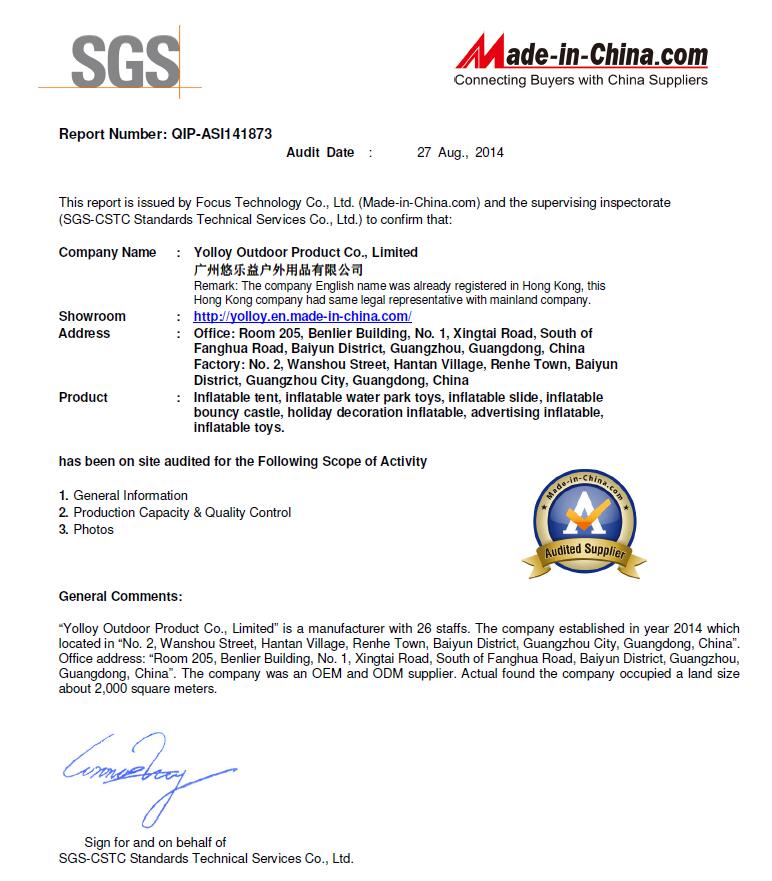
Ready to bring inflatable event structures into your lineup? YOLLOY Outdoor Product Co., Limited designs and manufactures custom inflatable tents, clear domes, and event structures from its facility in Guangzhou, China. Every project begins with a conversation about your requirements — size, shape, colour, branding, and intended use. From there, you receive a 3D simulation rendering before a single piece of fabric is cut. Products are manufactured with certified materials, inspected before shipment, and supplied with matched blowers, repair kits, and protective packaging. To start a discussion about your next event structure, reach out to the team at
[email protected] or call
+86-20-8370 0771. Visit
www.yolloy.net to browse the full product range.