Products Category
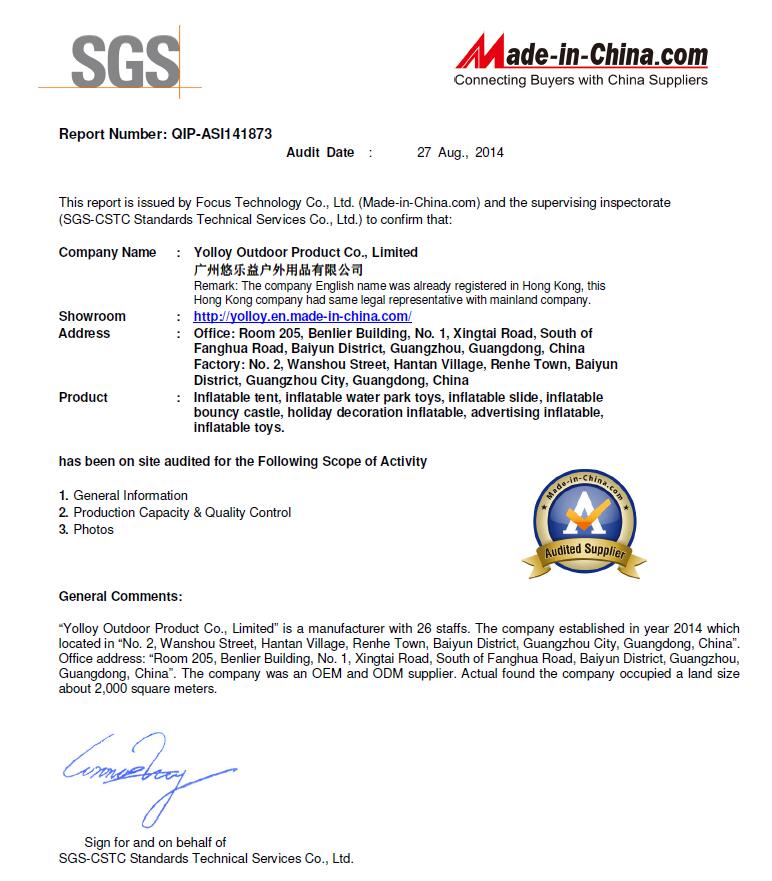
Certification

News

• New Order Successfully Finished for Long-Time Cooperated Japanese Client | YOLLOY Wins Full Client Recognition

• YOLLOY Custom Inflatable Pool Tent for Danish Client: Professional Pool Repair Shelter & Debris Protection

• Trusted Once Again! Greek Captain Re-orders Our Products After 4 Years

• Revolutionize Your Outdoors: The All-Terrain Inflatable Floating Tent for Land & Water

• Elevate Your Summer Fun: The Ultimate Inflatable Water Floating Volleyball Court Trampoline

• Innovative Inflatable Nightclub Tents & Pop-Up Bars: The Ultimate Solution for Portable Party Venues

Contact Us

Name: Sunny Yang
Tel: +86-20-8370 0771
Fax: +86-20-8370 0771
Mobile: 13570587575
E-mail: sales@yolloy.com
Add: No 5,Xiong wei Bo Nan Road,ZhongLuoTan Town,Baiyun district,Guangzhou,China
Friend me on Facebook Follow me on Twitter Add me to your circles Follow me on Pinterest Watch my channel on YouTube
News

Inflatable Bubble Tents: The Complete Guide for Commercial Buyers and Event Planners

Author:yolloy Date:2026/7/15 11:52:15

How the inflatable bubble tent went from a viral sensation to a serious asset for glamping resorts, outdoor hospitality, and branded events 鈥?and what to look for when sourcing from a manufacturer.

If you have spent any time on Instagram or Pinterest lately, you have almost certainly come across a transparent dome glowing against a night sky, furnished with a bed and fairy lights, pitched somewhere impossibly scenic. That is the inflatable bubble tent 鈥?a product category that has moved far beyond novelty status and into serious commercial territory. Glamping operators, event companies, hotel chains, and restaurateurs are all discovering that these structures deliver something traditional tents and permanent buildings cannot: a 360-degree connection to the outdoors, with next to no setup time and a fraction of the footprint of a fixed structure.

Yet the market is uneven. Consumer-grade bubble tents sold on Amazon are a different species from the commercial-grade units used by a five-star desert camp or a branded activation at a music festival. This guide is written for buyers who need to understand that difference 鈥?and who want to source directly from a manufacturer rather than a middleman.

What Separates a Commercial-Grade Bubble Tent from a Backyard Toy

Walk through a trade show or scroll through a B2B marketplace and you will see bubble tents at every price point, from a few hundred dollars to several thousand. The price difference is not arbitrary 鈥?it reflects meaningful differences in material, engineering, and longevity. Here is what actually matters when you are spending company money:

Material quality is non-negotiable. A inflatable dome tent used for commercial hospitality needs to survive wind gusts, overnight dew, afternoon UV exposure, and repeated setup and teardown. The PVC or TPU membrane must be thick enough to resist punctures, treated for UV stability so it does not yellow after one season, and welded 鈥?not glued 鈥?at the seams. Cheaper tents use thinner material and rely on adhesives that degrade, particularly in heat. A professionally manufactured unit uses high-temperature fusion welding equipment that bonds the material at a molecular level, creating a seam that is actually stronger than the surrounding fabric.

The blower system matters more than most buyers realize. An underpowered or poorly sealed blower will cause the tent to sag, particularly in windy conditions. Commercial-grade units should ship with a blower matched to the tent's volume and certified to CE or UL standards. The blower needs to run continuously while the tent is in use, so noise level and energy efficiency become real operational concerns for a hospitality operator.

Entrance design affects everything. Single-bubble tents without a tunnel entrance will partially deflate every time someone goes in or out, then need a moment to reinflate. For a glamping guest, this is a mild inconvenience. For a restaurant with constant foot traffic, it is a dealbreaker. A tunnel entrance 鈥?ideally with an inner doorway 鈥?keeps the main chamber pressurized and stable regardless of how many people come and go. It also creates a natural vestibule for shoes and coats.


Where Bubble Tents Are Actually Making Money

The most compelling business case for bubble tents is not camping 鈥?it is hospitality. Across Europe, the Middle East, and Southeast Asia, resorts and eco-lodges are installing clusters of transparent domes as premium accommodation units that command room rates comparable to luxury suites. The appeal is straightforward: guests get the Instagram-worthy experience they are chasing, and the operator avoids the cost and permitting complexity of permanent construction. A well-made dome can be deployed in hours, relocated with the seasons, and packed away during the off months.

The inflatable tent for events market is another growth area. Brand activations, product launches, festival VIP areas, and pop-up dining experiences all benefit from the visual drama of a transparent dome. Unlike a standard frame tent, a bubble tent is inherently photogenic 鈥?and in an age where every event lives a second life on social media, that matters to the bottom line. Marketing agencies and event production companies are placing repeat orders because the structures photograph as well as they perform.

Other proven commercial applications include outdoor restaurant extensions during colder months, planetarium-style educational domes for schools and science centres, and portable showrooms for real estate developers showcasing model units on site. The versatility of the format means that a single dome design can serve multiple revenue streams across a calendar year.

Commercial Use Cases at a Glance

  • Glamping & eco-resorts 鈥?premium accommodation with panoramic views, deployable in remote locations without heavy machinery
  • Outdoor dining 鈥?weather-protected private dining pods for restaurants and hotels, extending outdoor seating capacity year-round
  • Brand activations & festivals 鈥?visually striking spaces that guarantee social media visibility for sponsors and organizers
  • Educational domes 鈥?portable planetariums and immersive projection spaces for schools, museums, and travelling exhibitions
  • Seasonal retail & holiday markets 鈥?eye-catching pop-up shops and winter village attractions

Why Buying Direct from the Manufacturer Changes What Is Possible

Most off-the-shelf bubble tents are designed for the lowest common denominator 鈥?a generic backyard consumer. When you buy direct from a inflatable tent manufacturer, you gain access to customization that transforms the product from a commodity into a strategic asset.

Size is the most obvious variable. A standard 3-metre dome sleeps two guests comfortably; a 6-metre or 8-metre dome can accommodate a family, a dining party, or a small exhibition. But beyond dimensions, a capable manufacturer can adapt the layout entirely: add connecting corridors between domes to create multi-room suites, integrate opaque privacy panels or curtain tracks for changing areas, incorporate branded printing on the exterior or interior surfaces, and supply blowers configured for the local voltage standard, whether that is 110V, 220V, or 380V.

Colour and finish options extend well beyond crystal-clear PVC. A manufacturer working with commercial-grade materials can offer tinted panels for solar control, frosted sections for privacy, and coloured accent panels that match a brand palette. For the hospitality sector, printed logos and artwork on the tent body itself turn a generic dome into a branded environment 鈥?a detail that matters enormously for resort operators trying to differentiate their property.

The minimum order quantity is another differentiator. Many factories enforce high MOQs that lock out smaller operators or first-time buyers testing a concept. A manufacturer that accepts orders starting from a single unit 鈥?ideally one that works from your description, sketch, or site plan rather than forcing you into a predefined template 鈥?gives you room to prototype and iterate before committing to volume.


How to Evaluate an Inflatable Tent Supplier

Sourcing a custom inflatable tent from an overseas manufacturer involves more than comparing price sheets. Here are the factors that separate reliable long-term partners from transactional factories:

Evaluation Factor What to Look For
Material certifications EN71, EN14960, RoHS compliance on PVC/TPU materials; CE or UL certification on blowers
Production capability High-temperature fusion welding, precision sewing with reinforced seams, waterproof nylon thread
Design service In-house team that produces simulation renderings before production begins; ability to work from sketches or photos
Quality control Full inflation testing and inspection before shipment; repair kit supplied with every unit
Lead time transparency Realistic timelines (typically 6鈥?5 days for standard units) with clear communication on custom or large orders
Packaging & shipping Protective packaging with carpet layer, waterproof PVC bag, and outer PE film; air and sea freight options
After-sales support Responsive communication within 24 hours; repair guidance; spare parts availability

A manufacturer that can show you these things 鈥?certifications, a design workflow, a quality-control process, and responsive communication 鈥?is worth a premium over the lowest bidder. The cost of a failed tent at a paying guest's accommodation or a sponsored event far exceeds any upfront saving on a cheaper unit.


What a Full-Service Inflatable Manufacturer Brings to the Table

YOLLOY Outdoor Product Co., Limited, based in Guangzhou, China, operates as a design-to-production inflatable solution provider. The company's workflow starts with a proposal from the client 鈥?a description, a rough sketch, a photograph of the site, or a detailed specification 鈥?and moves through simulation rendering, client review and revision, and finally factory production. This means the client sees a visual representation of the finished product before any material is cut.

The company's product range covers far more than bubble tents: it includes outdoor inflatable tents for emergency and military use, clear dome tents for hospitality, portable planetarium domes, inflatable water parks and floating platforms, interactive sports games, commercial slides, bounce houses, paintball bunkers, air mattresses, and advertising inflatables. This breadth matters for commercial buyers who may start with one product category and expand into others as their business grows 鈥?a single supplier relationship scales with them.

On the quality side, YOLLOY states that its materials have passed EN71, EN14960, and RoHS testing, with blowers meeting CE or UL requirements. Sewn products use precision equipment, reinforced seams with waterproof nylon thread, and additional reinforcement at high-stress areas. Airtight products are manufactured with high-temperature fusion welding. Every unit is inspected and tested before it leaves the factory, and a repair kit is included with each order.

For buyers concerned about minimum order quantities, the stated MOQ is one piece 鈥?useful for prototyping, market testing, or small-scale deployments. Typical production time for a standard inflatable product is 6 to 15 days, excluding transit. The company reports a 95% on-time delivery rate and offers both air freight (5鈥? days transit) and sea freight (15鈥?0 days or more, depending on destination).

Key Manufacturer Capabilities

  • Custom sizes, colours, and layouts designed from your brief
  • Logo and artwork printing for branded environments
  • Blower options for 110V, 220V, and 380V requirements
  • Materials: PVC tarpaulin, Oxford fabric, nylon, TPU 鈥?selected per application
  • MOQ: 1 piece 鈥?ideal for prototyping and small pilots
  • Repair kit, protective packaging, and anchor systems included

Ready to Explore Custom Inflatable Solutions?

Whether you are planning a glamping resort, organizing a branded event, or adding outdoor dining capacity to a restaurant, the right inflatable structure can deliver visual impact and practical performance in equal measure. YOLLOY works with clients across Europe, Asia, South America, Africa, the Middle East, and Latin America 鈥?and the design process starts with a conversation about what you need.

Visit www.yolloy.net to browse the full product range, or contact the team directly at sales@yolloy.com to discuss a custom project. Inquiries are answered within 24 hours, and a design proposal with simulation renderings is the standard first step 鈥?no commitment required.


Inflatable Bubble Tents: The Complete Guide for Commercial Buyers and Event Planners

Author:yolloy Date:2026/7/15 11:52:15

How the inflatable bubble tent went from a viral sensation to a serious asset for glamping resorts, outdoor hospitality, and branded events 鈥?and what to look for when sourcing from a manufacturer.

If you have spent any time on Instagram or Pinterest lately, you have almost certainly come across a transparent dome glowing against a night sky, furnished with a bed and fairy lights, pitched somewhere impossibly scenic. That is the inflatable bubble tent 鈥?a product category that has moved far beyond novelty status and into serious commercial territory. Glamping operators, event companies, hotel chains, and restaurateurs are all discovering that these structures deliver something traditional tents and permanent buildings cannot: a 360-degree connection to the outdoors, with next to no setup time and a fraction of the footprint of a fixed structure.

Yet the market is uneven. Consumer-grade bubble tents sold on Amazon are a different species from the commercial-grade units used by a five-star desert camp or a branded activation at a music festival. This guide is written for buyers who need to understand that difference 鈥?and who want to source directly from a manufacturer rather than a middleman.

What Separates a Commercial-Grade Bubble Tent from a Backyard Toy

Walk through a trade show or scroll through a B2B marketplace and you will see bubble tents at every price point, from a few hundred dollars to several thousand. The price difference is not arbitrary 鈥?it reflects meaningful differences in material, engineering, and longevity. Here is what actually matters when you are spending company money:

Material quality is non-negotiable. A inflatable dome tent used for commercial hospitality needs to survive wind gusts, overnight dew, afternoon UV exposure, and repeated setup and teardown. The PVC or TPU membrane must be thick enough to resist punctures, treated for UV stability so it does not yellow after one season, and welded 鈥?not glued 鈥?at the seams. Cheaper tents use thinner material and rely on adhesives that degrade, particularly in heat. A professionally manufactured unit uses high-temperature fusion welding equipment that bonds the material at a molecular level, creating a seam that is actually stronger than the surrounding fabric.

The blower system matters more than most buyers realize. An underpowered or poorly sealed blower will cause the tent to sag, particularly in windy conditions. Commercial-grade units should ship with a blower matched to the tent's volume and certified to CE or UL standards. The blower needs to run continuously while the tent is in use, so noise level and energy efficiency become real operational concerns for a hospitality operator.

Entrance design affects everything. Single-bubble tents without a tunnel entrance will partially deflate every time someone goes in or out, then need a moment to reinflate. For a glamping guest, this is a mild inconvenience. For a restaurant with constant foot traffic, it is a dealbreaker. A tunnel entrance 鈥?ideally with an inner doorway 鈥?keeps the main chamber pressurized and stable regardless of how many people come and go. It also creates a natural vestibule for shoes and coats.


Where Bubble Tents Are Actually Making Money

The most compelling business case for bubble tents is not camping 鈥?it is hospitality. Across Europe, the Middle East, and Southeast Asia, resorts and eco-lodges are installing clusters of transparent domes as premium accommodation units that command room rates comparable to luxury suites. The appeal is straightforward: guests get the Instagram-worthy experience they are chasing, and the operator avoids the cost and permitting complexity of permanent construction. A well-made dome can be deployed in hours, relocated with the seasons, and packed away during the off months.

The inflatable tent for events market is another growth area. Brand activations, product launches, festival VIP areas, and pop-up dining experiences all benefit from the visual drama of a transparent dome. Unlike a standard frame tent, a bubble tent is inherently photogenic 鈥?and in an age where every event lives a second life on social media, that matters to the bottom line. Marketing agencies and event production companies are placing repeat orders because the structures photograph as well as they perform.

Other proven commercial applications include outdoor restaurant extensions during colder months, planetarium-style educational domes for schools and science centres, and portable showrooms for real estate developers showcasing model units on site. The versatility of the format means that a single dome design can serve multiple revenue streams across a calendar year.

Commercial Use Cases at a Glance

  • Glamping & eco-resorts 鈥?premium accommodation with panoramic views, deployable in remote locations without heavy machinery
  • Outdoor dining 鈥?weather-protected private dining pods for restaurants and hotels, extending outdoor seating capacity year-round
  • Brand activations & festivals 鈥?visually striking spaces that guarantee social media visibility for sponsors and organizers
  • Educational domes 鈥?portable planetariums and immersive projection spaces for schools, museums, and travelling exhibitions
  • Seasonal retail & holiday markets 鈥?eye-catching pop-up shops and winter village attractions

Why Buying Direct from the Manufacturer Changes What Is Possible

Most off-the-shelf bubble tents are designed for the lowest common denominator 鈥?a generic backyard consumer. When you buy direct from a inflatable tent manufacturer, you gain access to customization that transforms the product from a commodity into a strategic asset.

Size is the most obvious variable. A standard 3-metre dome sleeps two guests comfortably; a 6-metre or 8-metre dome can accommodate a family, a dining party, or a small exhibition. But beyond dimensions, a capable manufacturer can adapt the layout entirely: add connecting corridors between domes to create multi-room suites, integrate opaque privacy panels or curtain tracks for changing areas, incorporate branded printing on the exterior or interior surfaces, and supply blowers configured for the local voltage standard, whether that is 110V, 220V, or 380V.

Colour and finish options extend well beyond crystal-clear PVC. A manufacturer working with commercial-grade materials can offer tinted panels for solar control, frosted sections for privacy, and coloured accent panels that match a brand palette. For the hospitality sector, printed logos and artwork on the tent body itself turn a generic dome into a branded environment 鈥?a detail that matters enormously for resort operators trying to differentiate their property.

The minimum order quantity is another differentiator. Many factories enforce high MOQs that lock out smaller operators or first-time buyers testing a concept. A manufacturer that accepts orders starting from a single unit 鈥?ideally one that works from your description, sketch, or site plan rather than forcing you into a predefined template 鈥?gives you room to prototype and iterate before committing to volume.


How to Evaluate an Inflatable Tent Supplier

Sourcing a custom inflatable tent from an overseas manufacturer involves more than comparing price sheets. Here are the factors that separate reliable long-term partners from transactional factories:

Evaluation Factor What to Look For
Material certifications EN71, EN14960, RoHS compliance on PVC/TPU materials; CE or UL certification on blowers
Production capability High-temperature fusion welding, precision sewing with reinforced seams, waterproof nylon thread
Design service In-house team that produces simulation renderings before production begins; ability to work from sketches or photos
Quality control Full inflation testing and inspection before shipment; repair kit supplied with every unit
Lead time transparency Realistic timelines (typically 6鈥?5 days for standard units) with clear communication on custom or large orders
Packaging & shipping Protective packaging with carpet layer, waterproof PVC bag, and outer PE film; air and sea freight options
After-sales support Responsive communication within 24 hours; repair guidance; spare parts availability

A manufacturer that can show you these things 鈥?certifications, a design workflow, a quality-control process, and responsive communication 鈥?is worth a premium over the lowest bidder. The cost of a failed tent at a paying guest's accommodation or a sponsored event far exceeds any upfront saving on a cheaper unit.


What a Full-Service Inflatable Manufacturer Brings to the Table

YOLLOY Outdoor Product Co., Limited, based in Guangzhou, China, operates as a design-to-production inflatable solution provider. The company's workflow starts with a proposal from the client 鈥?a description, a rough sketch, a photograph of the site, or a detailed specification 鈥?and moves through simulation rendering, client review and revision, and finally factory production. This means the client sees a visual representation of the finished product before any material is cut.

The company's product range covers far more than bubble tents: it includes outdoor inflatable tents for emergency and military use, clear dome tents for hospitality, portable planetarium domes, inflatable water parks and floating platforms, interactive sports games, commercial slides, bounce houses, paintball bunkers, air mattresses, and advertising inflatables. This breadth matters for commercial buyers who may start with one product category and expand into others as their business grows 鈥?a single supplier relationship scales with them.

On the quality side, YOLLOY states that its materials have passed EN71, EN14960, and RoHS testing, with blowers meeting CE or UL requirements. Sewn products use precision equipment, reinforced seams with waterproof nylon thread, and additional reinforcement at high-stress areas. Airtight products are manufactured with high-temperature fusion welding. Every unit is inspected and tested before it leaves the factory, and a repair kit is included with each order.

For buyers concerned about minimum order quantities, the stated MOQ is one piece 鈥?useful for prototyping, market testing, or small-scale deployments. Typical production time for a standard inflatable product is 6 to 15 days, excluding transit. The company reports a 95% on-time delivery rate and offers both air freight (5鈥? days transit) and sea freight (15鈥?0 days or more, depending on destination).

Key Manufacturer Capabilities

  • Custom sizes, colours, and layouts designed from your brief
  • Logo and artwork printing for branded environments
  • Blower options for 110V, 220V, and 380V requirements
  • Materials: PVC tarpaulin, Oxford fabric, nylon, TPU 鈥?selected per application
  • MOQ: 1 piece 鈥?ideal for prototyping and small pilots
  • Repair kit, protective packaging, and anchor systems included

Ready to Explore Custom Inflatable Solutions?

Whether you are planning a glamping resort, organizing a branded event, or adding outdoor dining capacity to a restaurant, the right inflatable structure can deliver visual impact and practical performance in equal measure. YOLLOY works with clients across Europe, Asia, South America, Africa, the Middle East, and Latin America 鈥?and the design process starts with a conversation about what you need.

Visit www.yolloy.net to browse the full product range, or contact the team directly at sales@yolloy.com to discuss a custom project. Inquiries are answered within 24 hours, and a design proposal with simulation renderings is the standard first step 鈥?no commitment required.