From outdoor weddings and corporate exhibitions to emergency shelters and pop-up retail spaces, the demand for flexible, portable, and visually impactful temporary structures has never been greater. Traditional rigid-frame tents, while functional, often require hours of setup, a dedicated crew, and substantial transport logistics. This is why more event planners, hospitality operators, and commercial buyers are turning to the outdoor inflatable tent as a modern alternative — one that combines rapid deployment, striking aesthetics, and reliable structural performance.
Unlike conventional tents that rely on metal poles and complex assembly, inflatable tents use air beams to maintain their shape. A continuous blower keeps the structure rigid, and setup can often be completed by one or two people in a matter of minutes. The result is a spacious, stable shelter that packs down compactly for storage and transport — a genuine advantage for businesses that run events in multiple locations or need to deploy quickly under time pressure.
What Sets Inflatable Tents Apart from Traditional Tents
The core difference lies in the support system. A traditional tent depends on a skeleton of aluminum or steel poles that must be assembled piece by piece. An outdoor inflatable tent replaces that framework with pressurized air tubes sewn into the fabric. Once the blower is switched on, the tent rises into shape on its own.
This design brings several practical benefits. First, setup time drops dramatically — many models can be fully operational within five to ten minutes. Second, the absence of rigid poles means fewer pinch points and no risk of bent or snapped frame components. Third, the inflated beams absorb wind gusts more gracefully than a rigid frame, which can be an important consideration for outdoor venues in exposed locations. The curved, dome-like profiles of many inflatable tents also shed wind more effectively than flat-walled structures.
Transport is another area where inflatables shine. A tent that accommodates 20–30 guests can be deflated and folded into a carry bag that fits in the trunk of a standard car. For businesses that ship equipment to trade shows, festivals, or remote job sites, this reduction in packed volume translates directly into lower freight costs.
Applications That Go Well Beyond Camping
While many people first encounter inflatable tents in a camping or glamping context, their commercial use has expanded rapidly. An inflatable party tent can serve as a branded activation space at a festival, a VIP lounge at a sporting event, or a temporary dining pavilion for a restaurant expanding its outdoor seating. The visual impact of a large, smoothly curved inflatable structure naturally draws attention — exactly the kind of organic foot traffic that event marketers want.
Beyond hospitality and events, inflatable tents have found serious utility in commercial and industrial contexts. Spray-painting and auto-detailing businesses use ventilated inflatable booths to create controlled workspaces on site. Golf simulator operators deploy inflatable enclosures that provide enough height and width for a full swing. Emergency response teams and military units rely on inflatable shelters for rapid-deployment field hospitals, command posts, and equipment storage. The common thread across all these use cases is the need for a structure that goes up fast, stays stable, and can be relocated without hassle.
Material Quality and Safety: What to Check Before You Buy
Not all inflatable tents are created equal, and the material is the single most important determinant of how the tent will perform over time. High-quality models use commercial-grade PVC tarpaulin, which offers a strong balance of tear resistance, water resistance, and UV stability. For certain applications — such as lightweight backpacking tents or transparent dome experiences — manufacturers may use Oxford fabric, nylon, TPU, or clear PVC panels instead.
Seam construction is equally critical. The best tents feature reinforced stitching with waterproof nylon thread, and high-stress areas such as anchor points and blower connections should be double- or triple-stitched with additional reinforcement patches. For airtight sections like inflatable beams, high-temperature fusion welding is the preferred method — it creates a bond that is actually stronger than the surrounding material.
When evaluating a tent, ask about material certifications. Reputable inflatable tent manufacturer factories will have their materials tested against standards such as EN71 (toy safety), EN14960 (inflatable play equipment), and RoHS (hazardous substance restrictions). For water-park inflatables, the relevant standard is EN15649. Blower units should carry CE or UL marks to confirm electrical safety compliance.
Customization: How to Get a Tent That Reflects Your Brand
One of the greatest strengths of working directly with a custom inflatable tent producer is the ability to tailor nearly every aspect of the design. Size, shape, color, and printed artwork can all be adapted to match the client's requirements. A corporate buyer might want a tent in brand colors with a large logo printed on the side panels. An event company might need a modular tunnel system that connects multiple domes for a festival village layout. A hotel might request a clear bubble tent with opaque privacy panels for a rooftop dining experience.
The customization process typically begins with a design brief — a description, sketch, photograph, or site plan that communicates what the client has in mind. The manufacturer's design team produces simulation renderings that show how the finished tent will look, allowing adjustments before production begins. Once the design is approved, the tent moves into the factory for cutting, sewing, welding, printing, and assembly.
Many suppliers require large minimum order quantities, but some factories — particularly those with a focus on bespoke work — will accept orders for a single piece. This is worth confirming early in your conversation, especially if you are testing a new concept or only need one or two units for a specific project.
What Comes with Your Tent: Blowers, Anchoring, and After-Sales Support
A complete inflatable tent package should include everything needed for safe operation: the tent body, an appropriately sized electric blower (available in 110V, 220V, or 380V configurations depending on your region), anchor points with D-rings or round metal rings, and a repair kit for minor punctures. The blower runs continuously while the tent is in use — the gentle, constant airflow compensates for minor air loss around zippers and seams and keeps the structure firm.
Packaging matters too, particularly for international buyers. Quality manufacturers wrap the tent in soft protective layers before placing it in a waterproof PVC bag with an outer PE film cover. Large or heavy orders may ship on steel pallets for added protection. Typical production time for a standard custom inflatable runs between 6 and 15 working days, with air freight taking roughly 5–7 days and sea freight 15–30 days or longer depending on the destination port.
After-sales support is another factor to weigh. A manufacturer that provides a repair kit, answers technical queries within 24 hours, and stands behind its products with a meaningful warranty period gives buyers confidence that the tent will remain in service for multiple seasons. Many quality inflatable tents, when properly used and stored, can deliver three or more years of reliable use across hundreds of events.
Working with YOLLOY: A Direct-from-Factory Approach
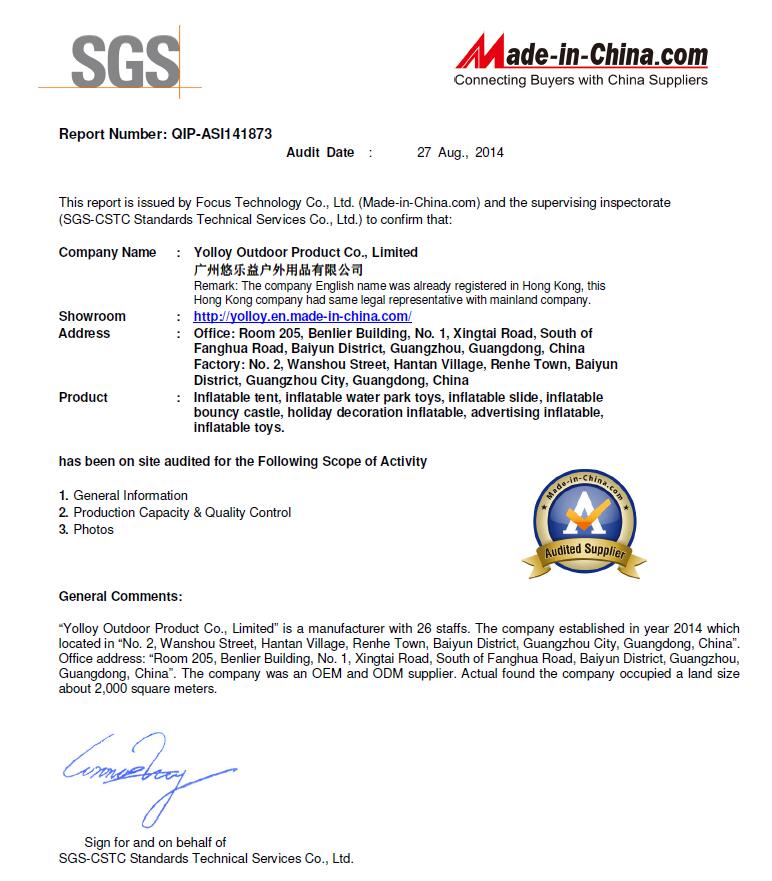
YOLLOY Outdoor Product Co., Limited, based in Guangzhou, China, is a specialized inflatable tent manufacturer with a product catalog spanning outdoor inflatable tents, clear dome tents, planetarium domes, water park inflatables, interactive sports games, commercial slides, bounce houses, paintball bunkers, air mattresses, and advertising inflatables. The company serves clients across Europe, Asia, South America, Africa, the Middle East, and Latin America.
YOLLOY's workflow is built around a design-to-delivery model: clients submit their requirements, the in-house design team creates renderings, revisions are made until the client approves, and production begins. Materials are sourced from suppliers whose products have passed EN71, EN14960, and RoHS testing. Sewing is performed on precision equipment with reinforced seams, and high-temperature welding is used for airtight components. Every product is inspected and tested before it leaves the factory, which reports a 95% on-time delivery rate.
For buyers seeking custom inflatable tent solutions — whether a single branded inflatable party tent or a fleet of commercial event structures — YOLLOY offers single-piece minimum orders, custom sizes, custom colors, and full logo printing. The company supplies appropriately powered blowers, anchor hardware, and a repair kit with each unit, and it backs its products with responsive after-sales support.
Ready to explore what an outdoor inflatable tent can do for your business? Contact Sunny Yang at [email protected] or call +86-20-8370 0771 to discuss your project. Visit www.yolloy.net to browse the full product catalog and submit a custom inquiry — the team responds to emails and faxes within 24 hours.