Products Category
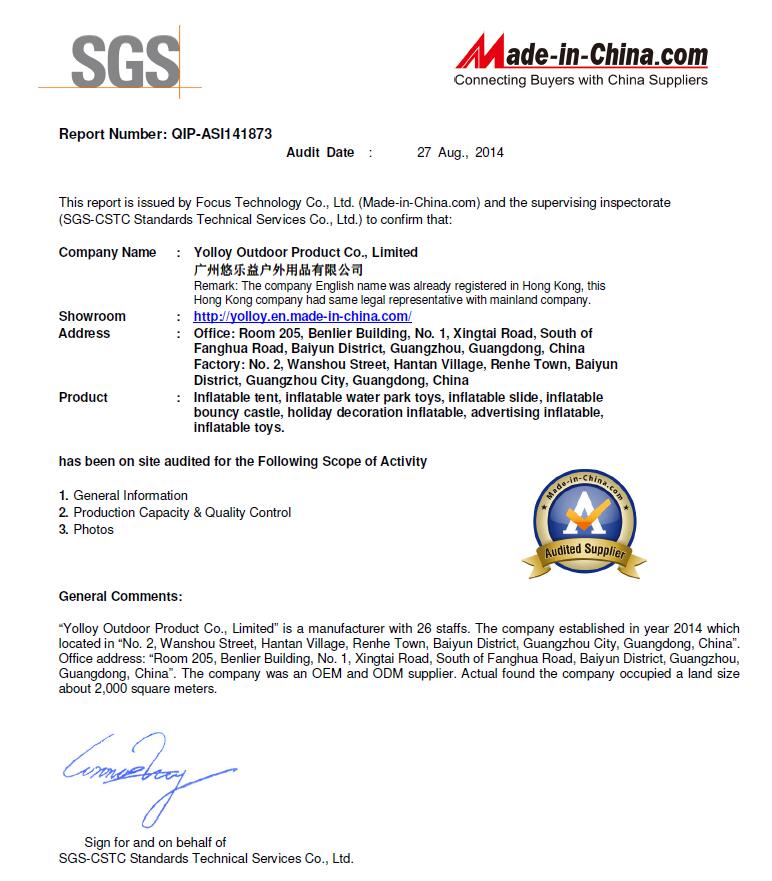
Certification

News

• New Order Successfully Finished for Long-Time Cooperated Japanese Client | YOLLOY Wins Full Client Recognition

• YOLLOY Custom Inflatable Pool Tent for Danish Client: Professional Pool Repair Shelter & Debris Protection

• Trusted Once Again! Greek Captain Re-orders Our Products After 4 Years

• Revolutionize Your Outdoors: The All-Terrain Inflatable Floating Tent for Land & Water

• Elevate Your Summer Fun: The Ultimate Inflatable Water Floating Volleyball Court Trampoline

• Innovative Inflatable Nightclub Tents & Pop-Up Bars: The Ultimate Solution for Portable Party Venues

Contact Us

Name: Sunny Yang
Tel: +86-20-8370 0771
Fax: +86-20-8370 0771
Mobile: 13570587575
E-mail: [email protected]
Add: No 5,Xiong wei Bo Nan Road,ZhongLuoTan Town,Baiyun district,Guangzhou,China
Friend me on Facebook Follow me on Twitter Add me to your circles Follow me on Pinterest Watch my channel on YouTube
News

How to choose inflatable bouncer for kids?

Author:yolloy Date:2026/8/13 23:05:33

Choosing the right inflatable bouncer for your kids is more than just picking the brightest color or the biggest size. A well-chosen bounce house keeps children safe, matches their developmental stage, and delivers years of backyard fun. Whether you are a parent buying for home use or a business owner stocking up for rental operations, understanding the key factors — age, safety, materials, size, and features — will help you make a confident decision.

Key takeaway: The safest and most enjoyable kids inflatable bounce house is the one that fits your child's age, your available space, and your quality expectations — not necessarily the most expensive one on the market.

Match the Bouncer to Your Child's Age

Age is the single most important factor when selecting an inflatable bouncer. A unit that works perfectly for a 9-year-old can be dangerous for a 2-year-old. Motor skills, balance, and body weight all determine what a child can safely use. According to CPSC data, most bounce house injuries are preventable and are primarily caused by overcrowding, mixing age groups, and absent adult supervision.

Toddlers (Ages 1–3)

For the youngest children, only a dedicated toddler bouncer is appropriate. Look for walls under 3 feet, soft padded surfaces, mesh netting on all sides, and padded entrance ramps. Capacity should be strictly limited to 3 to 4 children of similar size and age. Never allow toddlers and older children to share the same inflatable at the same time — the size and energy gap creates a direct collision risk.

Preschoolers (Ages 4–6)

A standard bounce house measuring approximately 13' x 13' is the right step up for this age group. The bounce area should be large enough to prevent overcrowding, which is the primary cause of collision injuries. Simple, enclosed designs with low walls and secure netting work best.

School-Age Children (Ages 7–12)

This is the sweet spot for bounce house use. Combo units measuring 15' x 15' or larger, with total weight capacities of 600 to 800 lbs, are ideal. An inflatable bounce house with slide, climbing walls, or basketball hoops delivers the variety and challenge that school-age children want. The multi-activity design keeps kids engaged longer and reduces congestion at any single feature.

Preteens and Teens (Ages 13+)

Standard bounce houses stop working for kids around age 11. Teens want competition, challenge, and scale. Commercial-grade obstacle courses, large water slides with multiple lanes, and competitive inflatables like jousting arenas are the right fit. These units must support weight capacities of 800 lbs or more, with commercial-grade construction.

Safety: What to Look For

Safety should never be compromised. When evaluating a bounce house, check these essential safety features:

  • Enclosed mesh walls: Full-height safety netting on all sides prevents falls while allowing parents to supervise from outside.
  • Reinforced seams: Double or triple stitching at high-stress areas prevents tears during active play. YOLLOY products use precision sewing equipment, reinforced seams, and waterproof nylon thread with additional reinforcement at high-load areas.
  • Secure anchoring: D-ring or round metal anchor systems keep the unit stable even in moderate wind. Always stake down on grass or use sandbags on hard surfaces.
  • Safety certifications: Look for products that meet recognized standards. YOLLOY's inflatable toys are tested to EN 14960 and EN71 standards, while water park products reference EN 15649. Blowers meet CE or UL requirements.
  • Emergency exits: Multiple entry and exit points allow quick evacuation if needed.
  • Adequate blower: A reliable blower that provides consistent air pressure is essential. YOLLOY supplies appropriately powered blowers compatible with 110V, 220V, or 380V requirements.

Material Quality Makes the Difference

The material used in a bounce house directly affects its durability, safety, and lifespan. The two most common materials are PVC tarpaulin and nylon Oxford fabric.

MaterialDurabilityPuncture ResistanceUV ResistanceBest For
Commercial PVC TarpaulinExcellentHighHighCommercial use, frequent play, outdoor exposure
Nylon / Oxford FabricModerateModerateModerateLight residential use, indoor play

PVC tarpaulin is superior in every dimension that matters for long-term use. It is more durable, more puncture-resistant, holds its shape better under load, and resists UV degradation. YOLLOY uses commercial-grade PVC tarpaulin for many products, while also offering Oxford fabric, nylon, and TPU options according to specific requirements. All materials have passed EN71, EN14960, and RoHS-related testing, ensuring they are non-toxic and free from harmful chemicals.

For airtight products like inflatable slides and water park items, high-temperature fusion welding equipment is used instead of stitching, creating stronger, more reliable seams that prevent air leakage over time.

Size and Space Requirements

Before purchasing, measure your available space carefully. The setup area must be larger than the bounce house itself to accommodate a safety perimeter.

Bouncer SizeTypical DimensionsChild CapacityRecommended Setup Area
Small / Toddler8' x 6' to 10' x 10'3–4 kidsUnder 20' x 20'
Medium12' x 12' to 13' x 13'6–8 kids20' x 20' to 25' x 25'
Large / Combo15' x 15' and above8–10 kids25' x 25' and above
Obstacle Course15' x 25' and above6–12 kidsLarge open areas

Always allow for 3 to 5 feet of clearance on all sides. Position the unit on flat, grassy ground, away from fences, trees, and power lines. Indoor setups require checking ceiling height — many commercial inflatables are taller than standard room heights. Also, make sure you have a power outlet within 50 to 100 feet of the setup area on a dedicated circuit.

Features and Themes That Kids Love

The right theme can turn a simple bounce house into the centerpiece of a child's party. Popular themes include princess castles, pirate ships, dinosaur adventures, superhero training camps, and tropical jungle designs. YOLLOY offers a wide range of themed options, from Disney princess party inflatable castles to forest-themed bouncy houses and 3D tropical combos.

For families with multiple children of different ages, combo units are the strongest long-term investment. These combine a bounce area with slides, climbing walls, and interactive features. They deliver the most consistent suitability across the widest age span of any product category. Children naturally rotate through different zones without adult direction, keeping everyone engaged.

Customization: Get Exactly What You Need

One of the biggest advantages of working with a professional inflatable bounce house manufacturer like YOLLOY is the ability to customize your order. Custom sizes, colors, and printed logos are available. Products can be designed from a description, drawing, sketch, photograph, or site plan. The minimum order quantity is just one piece, making YOLLOY accessible to both individual buyers and commercial operators.

Each product is supplied with a repair kit, and blowers can be configured for 110V, 220V, or 380V power requirements depending on your region. Products are packed using soft carpet protection, waterproof PVC bags, and outer PE film, with steel pallets used for large items. Air and sea shipping are available, with typical transit times of 5 to 7 days by air and 15 to 30 days by sea, allowing YOLLOY to serve customers across Europe, Asia, South America, Africa, the Middle East, and Latin America.

Maintenance and Longevity

A well-maintained inflatable bouncer can last 3 to 5 years of regular use. Follow these maintenance practices to extend the life of your investment:

  • Clean after each use: Use mild, non-abrasive cleaners and a soft cloth. Avoid harsh chemicals that can degrade the PVC material.
  • Dry completely before storage: Moisture trapped during storage leads to mildew and material degradation. Store in a cool, dry location at a minimum of 50°F in winter to prevent vinyl cracking.
  • Inspect regularly: Check seams, anchor points, and the blower before each use. Repair punctures immediately using the manufacturer's repair kit — YOLLOY includes one with every inflatable product.
  • Follow weight limits: Exceeding the manufacturer's weight capacity stresses seams and increases the risk of tears and injuries.

Conclusion: Choosing the right inflatable bouncer for kids comes down to matching the product to the child's age, ensuring robust safety features, selecting high-quality materials like commercial-grade PVC tarpaulin, and verifying that the size fits your space. For families with children at different developmental stages, a combo unit offers the best value across multiple age groups. For businesses, choosing a reliable manufacturer with customization capabilities, international certifications, and flexible shipping options is essential.

YOLLOY Outdoor Product Co., Limited, based in Guangzhou, China, brings over a decade of inflatable manufacturing expertise to every order. With EN71, EN14960, and RoHS-tested materials, CE/UL-compliant blowers, a 95% on-time delivery rate, and custom design-to-production service, YOLLOY is a trusted partner for parents, event planners, and rental businesses worldwide. Visit the inflatable bounce house collection to explore the full range of products, or contact the team at [email protected] to discuss a custom design for your specific needs.

How to choose inflatable bouncer for kids?

Author:yolloy Date:2026/8/13 23:05:33

Choosing the right inflatable bouncer for your kids is more than just picking the brightest color or the biggest size. A well-chosen bounce house keeps children safe, matches their developmental stage, and delivers years of backyard fun. Whether you are a parent buying for home use or a business owner stocking up for rental operations, understanding the key factors — age, safety, materials, size, and features — will help you make a confident decision.

Key takeaway: The safest and most enjoyable kids inflatable bounce house is the one that fits your child's age, your available space, and your quality expectations — not necessarily the most expensive one on the market.

Match the Bouncer to Your Child's Age

Age is the single most important factor when selecting an inflatable bouncer. A unit that works perfectly for a 9-year-old can be dangerous for a 2-year-old. Motor skills, balance, and body weight all determine what a child can safely use. According to CPSC data, most bounce house injuries are preventable and are primarily caused by overcrowding, mixing age groups, and absent adult supervision.

Toddlers (Ages 1–3)

For the youngest children, only a dedicated toddler bouncer is appropriate. Look for walls under 3 feet, soft padded surfaces, mesh netting on all sides, and padded entrance ramps. Capacity should be strictly limited to 3 to 4 children of similar size and age. Never allow toddlers and older children to share the same inflatable at the same time — the size and energy gap creates a direct collision risk.

Preschoolers (Ages 4–6)

A standard bounce house measuring approximately 13' x 13' is the right step up for this age group. The bounce area should be large enough to prevent overcrowding, which is the primary cause of collision injuries. Simple, enclosed designs with low walls and secure netting work best.

School-Age Children (Ages 7–12)

This is the sweet spot for bounce house use. Combo units measuring 15' x 15' or larger, with total weight capacities of 600 to 800 lbs, are ideal. An inflatable bounce house with slide, climbing walls, or basketball hoops delivers the variety and challenge that school-age children want. The multi-activity design keeps kids engaged longer and reduces congestion at any single feature.

Preteens and Teens (Ages 13+)

Standard bounce houses stop working for kids around age 11. Teens want competition, challenge, and scale. Commercial-grade obstacle courses, large water slides with multiple lanes, and competitive inflatables like jousting arenas are the right fit. These units must support weight capacities of 800 lbs or more, with commercial-grade construction.

Safety: What to Look For

Safety should never be compromised. When evaluating a bounce house, check these essential safety features:

  • Enclosed mesh walls: Full-height safety netting on all sides prevents falls while allowing parents to supervise from outside.
  • Reinforced seams: Double or triple stitching at high-stress areas prevents tears during active play. YOLLOY products use precision sewing equipment, reinforced seams, and waterproof nylon thread with additional reinforcement at high-load areas.
  • Secure anchoring: D-ring or round metal anchor systems keep the unit stable even in moderate wind. Always stake down on grass or use sandbags on hard surfaces.
  • Safety certifications: Look for products that meet recognized standards. YOLLOY's inflatable toys are tested to EN 14960 and EN71 standards, while water park products reference EN 15649. Blowers meet CE or UL requirements.
  • Emergency exits: Multiple entry and exit points allow quick evacuation if needed.
  • Adequate blower: A reliable blower that provides consistent air pressure is essential. YOLLOY supplies appropriately powered blowers compatible with 110V, 220V, or 380V requirements.

Material Quality Makes the Difference

The material used in a bounce house directly affects its durability, safety, and lifespan. The two most common materials are PVC tarpaulin and nylon Oxford fabric.

MaterialDurabilityPuncture ResistanceUV ResistanceBest For
Commercial PVC TarpaulinExcellentHighHighCommercial use, frequent play, outdoor exposure
Nylon / Oxford FabricModerateModerateModerateLight residential use, indoor play

PVC tarpaulin is superior in every dimension that matters for long-term use. It is more durable, more puncture-resistant, holds its shape better under load, and resists UV degradation. YOLLOY uses commercial-grade PVC tarpaulin for many products, while also offering Oxford fabric, nylon, and TPU options according to specific requirements. All materials have passed EN71, EN14960, and RoHS-related testing, ensuring they are non-toxic and free from harmful chemicals.

For airtight products like inflatable slides and water park items, high-temperature fusion welding equipment is used instead of stitching, creating stronger, more reliable seams that prevent air leakage over time.

Size and Space Requirements

Before purchasing, measure your available space carefully. The setup area must be larger than the bounce house itself to accommodate a safety perimeter.

Bouncer SizeTypical DimensionsChild CapacityRecommended Setup Area
Small / Toddler8' x 6' to 10' x 10'3–4 kidsUnder 20' x 20'
Medium12' x 12' to 13' x 13'6–8 kids20' x 20' to 25' x 25'
Large / Combo15' x 15' and above8–10 kids25' x 25' and above
Obstacle Course15' x 25' and above6–12 kidsLarge open areas

Always allow for 3 to 5 feet of clearance on all sides. Position the unit on flat, grassy ground, away from fences, trees, and power lines. Indoor setups require checking ceiling height — many commercial inflatables are taller than standard room heights. Also, make sure you have a power outlet within 50 to 100 feet of the setup area on a dedicated circuit.

Features and Themes That Kids Love

The right theme can turn a simple bounce house into the centerpiece of a child's party. Popular themes include princess castles, pirate ships, dinosaur adventures, superhero training camps, and tropical jungle designs. YOLLOY offers a wide range of themed options, from Disney princess party inflatable castles to forest-themed bouncy houses and 3D tropical combos.

For families with multiple children of different ages, combo units are the strongest long-term investment. These combine a bounce area with slides, climbing walls, and interactive features. They deliver the most consistent suitability across the widest age span of any product category. Children naturally rotate through different zones without adult direction, keeping everyone engaged.

Customization: Get Exactly What You Need

One of the biggest advantages of working with a professional inflatable bounce house manufacturer like YOLLOY is the ability to customize your order. Custom sizes, colors, and printed logos are available. Products can be designed from a description, drawing, sketch, photograph, or site plan. The minimum order quantity is just one piece, making YOLLOY accessible to both individual buyers and commercial operators.

Each product is supplied with a repair kit, and blowers can be configured for 110V, 220V, or 380V power requirements depending on your region. Products are packed using soft carpet protection, waterproof PVC bags, and outer PE film, with steel pallets used for large items. Air and sea shipping are available, with typical transit times of 5 to 7 days by air and 15 to 30 days by sea, allowing YOLLOY to serve customers across Europe, Asia, South America, Africa, the Middle East, and Latin America.

Maintenance and Longevity

A well-maintained inflatable bouncer can last 3 to 5 years of regular use. Follow these maintenance practices to extend the life of your investment:

  • Clean after each use: Use mild, non-abrasive cleaners and a soft cloth. Avoid harsh chemicals that can degrade the PVC material.
  • Dry completely before storage: Moisture trapped during storage leads to mildew and material degradation. Store in a cool, dry location at a minimum of 50°F in winter to prevent vinyl cracking.
  • Inspect regularly: Check seams, anchor points, and the blower before each use. Repair punctures immediately using the manufacturer's repair kit — YOLLOY includes one with every inflatable product.
  • Follow weight limits: Exceeding the manufacturer's weight capacity stresses seams and increases the risk of tears and injuries.

Conclusion: Choosing the right inflatable bouncer for kids comes down to matching the product to the child's age, ensuring robust safety features, selecting high-quality materials like commercial-grade PVC tarpaulin, and verifying that the size fits your space. For families with children at different developmental stages, a combo unit offers the best value across multiple age groups. For businesses, choosing a reliable manufacturer with customization capabilities, international certifications, and flexible shipping options is essential.

YOLLOY Outdoor Product Co., Limited, based in Guangzhou, China, brings over a decade of inflatable manufacturing expertise to every order. With EN71, EN14960, and RoHS-tested materials, CE/UL-compliant blowers, a 95% on-time delivery rate, and custom design-to-production service, YOLLOY is a trusted partner for parents, event planners, and rental businesses worldwide. Visit the inflatable bounce house collection to explore the full range of products, or contact the team at [email protected] to discuss a custom design for your specific needs.