When you start looking for inflatable zorb balls for your business, event, or rental operation, you will quickly face a choice: buy from a general inflatable supplier who sells everything from bounce houses to pool floats, or go with a specialized inflatable zorb ball supplier who focuses on this specific product category. The difference is bigger than you might think, and it affects everything from product quality to your long-term profitability.
1. Material Knowledge and Product Expertise
A general supplier may stock zorb balls alongside hundreds of unrelated products. They often lack deep knowledge about the materials that make a zorb ball safe and durable. Ask them about the difference between standard PVC and high-grade TPU, and you might get a blank stare.
A dedicated inflatable zorb ball manufacturer lives and breathes this product. They understand that TPU (thermoplastic polyurethane) offers superior UV resistance, hydrolysis resistance, and flexibility compared to basic PVC. They know which material thickness works best for commercial-grade use vs. casual backyard play. This expertise translates directly into a product that lasts longer and performs better under real-world conditions.
For example, a specialized supplier will use commercial-grade PVC tarpaulin or eco-friendly TPU that has passed EN71 safety standard testing. This means the material has been rigorously tested for toxins, flammability, and mechanical durability — something a general supplier may not even be aware of, let alone verify.
2. Manufacturing Quality and Production Control
General suppliers often act as middlemen. They purchase products from various factories, warehouse them, and resell. They have limited control over how the zorb balls are actually made. If a batch has weak seams or inconsistent inflation, they may not even know until customers complain.
A specialized inflatable zorb ball wholesaler that operates its own factory has complete oversight of the production process. Every zorb ball goes through multiple quality checkpoints: material inspection upon arrival, seam strength testing during production, airtightness verification after assembly, and a final pre-shipment inspection. High-temperature fusion welding equipment ensures airtight seals, and reinforced stitching with waterproof nylon thread adds durability at stress points.
This level of quality control is simply not possible when you are buying from a reseller who never touches the product before it reaches your door.
3. Customization Capabilities
Want a zorb ball in your brand colors with your logo printed on the side? A general supplier typically offers whatever is in stock: standard sizes, standard colors, no customization. You get what they have, not what you need.
A dedicated supplier with in-house design and manufacturing capabilities can customize virtually every aspect of your zorb ball. Custom sizes to fit your specific age group or activity. Custom colors that match your brand identity. Logo printing and artwork application. Even functional add-ons like LED lights, specialized harnesses, or reinforced entry points. The design team works from your description, sketch, or photo and produces simulation renderings for your approval before production begins.
This customization capability means your zorb balls stand out in a crowded market rather than looking identical to every competitor who bought from the same generic catalog.
4. Safety Standards and Compliance
Safety is not optional when you are putting people inside an inflatable ball and sending them rolling down a hill or across a field. General suppliers often cannot provide meaningful safety documentation. They may claim compliance but cannot back it up with actual test reports.
A reputable specialized supplier provides verifiable safety certifications. Their materials pass EN71 testing, the European safety standard for toys that covers mechanical and physical properties, flammability, and migration of certain elements. Blowers meet CE or UL requirements. These certifications are not just stickers on a box — they represent documented testing by independent laboratories, and the supplier should be able to share the reports upon request.
For commercial operators, having this documentation is essential for insurance purposes and liability protection. A general supplier simply cannot provide this level of compliance assurance.
5. Order Flexibility and Minimum Quantities
Many general suppliers and trading companies impose high minimum order quantities (MOQs). They want you to buy container loads because that is how their business model works. If you are a small business testing the market or need just a few units for a specific event, this can be a dealbreaker.
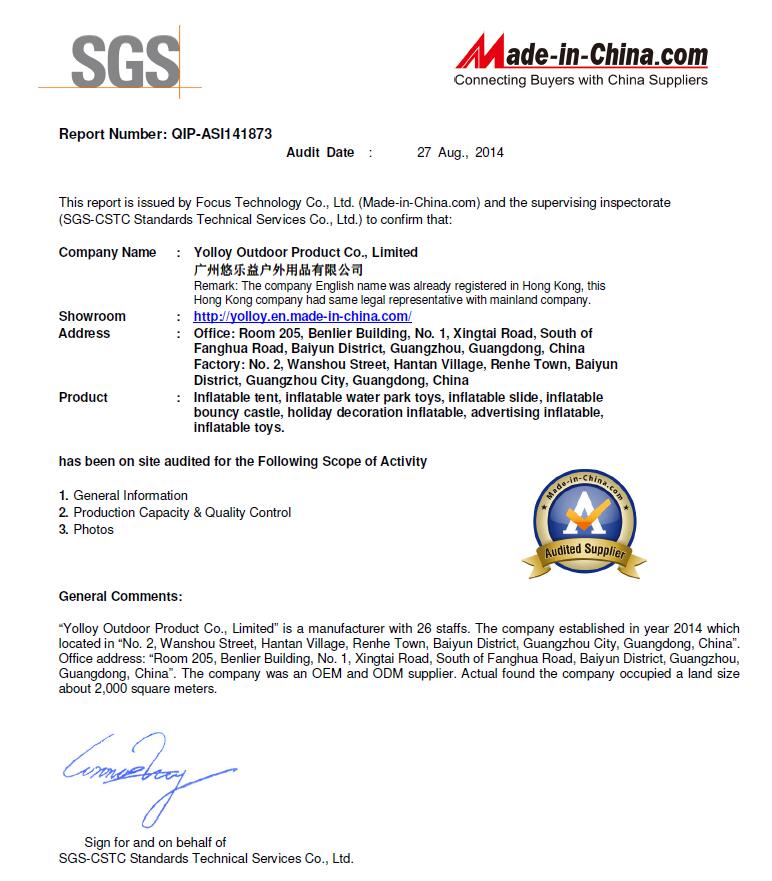
A factory-direct specialized supplier often operates with much more flexibility. Some, like Yolloy Outdoor Product Co., Limited, accept orders starting from just one piece. This low MOQ is a game-changer for startups, event planners, and rental businesses that need to manage cash flow carefully. You can order exactly what you need, test the product in your market, and scale up when you are ready.
6. After-Sales Support and Warranty
What happens when a zorb ball develops a leak or a seam starts to separate after months of use? With a general supplier, you may find yourself emailing into a void. Their responsibility often ends the moment the package leaves their warehouse.
A specialized supplier stands behind their products. They provide repair kits with every inflatable product, so minor punctures and seam issues can be fixed on-site without sending the product back. They offer warranties that reflect confidence in their manufacturing quality. They respond to inquiries within 24 hours and maintain a track record of reliable delivery — aiming for a 95% on-time delivery rate.
This ongoing support relationship means you are not just buying a product; you are building a supply partnership that can grow with your business.
7. Pricing Transparency and Value
At first glance, a general supplier may appear cheaper. But that lower price often hides costs that emerge later: shorter product lifespan, no repair support, replacement shipping costs, and lost revenue from downtime.
A factory-direct specialized supplier eliminates middleman markups. You pay for the product and the manufacturing expertise, not for a chain of intermediaries each taking their cut. The upfront price may be comparable or slightly higher, but the total cost of ownership — factoring in durability, warranty coverage, and reliable performance — is almost always lower. When a zorb ball lasts for years instead of months, the math speaks for itself.
8. Shipping and Logistics Experience
Shipping inflatable products internationally requires specific packaging know-how. Zorb balls need proper folding, protective wrapping, and appropriate carton sizing to arrive in good condition. A general supplier may use generic packaging that leaves the product vulnerable to damage during transit.
An experienced specialized supplier uses layered packaging: soft carpet protection for the product surface, waterproof PVC bags to prevent moisture damage, and outer PE film for additional protection. Large orders may ship on steel pallets for maximum security. They also offer both air and sea shipping options, with air freight typically taking 5-7 days and sea freight around 15-30 days depending on the destination.
This shipping expertise means fewer damaged deliveries, fewer returns, and less hassle for your business.
Making the Right Choice for Your Business
The difference between a specialized inflatable zorb ball supplier and a regular supplier comes down to more than just the product catalog. It is about material expertise, manufacturing quality, customization ability, safety compliance, order flexibility, after-sales support, and long-term value.
When you choose a specialized supplier, you are choosing a partner who understands your business needs and has the manufacturing capability to meet them. You get a product built to last, backed by real certifications, supported by responsive service, and customized to your specifications.
For businesses serious about quality, safety, and long-term profitability, the choice is clear: work with a supplier who specializes in what you need, not one who treats your order as just another line item in a vast catalog.