Products Category
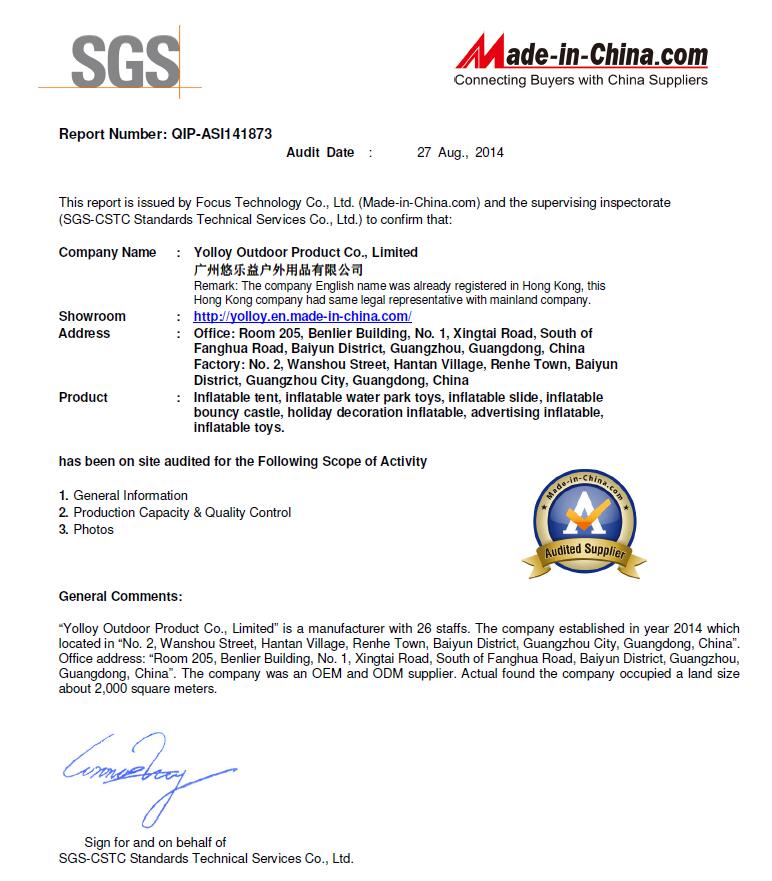
Certification

News

• New Order Successfully Finished for Long-Time Cooperated Japanese Client | YOLLOY Wins Full Client Recognition

• YOLLOY Custom Inflatable Pool Tent for Danish Client: Professional Pool Repair Shelter & Debris Protection

• Trusted Once Again! Greek Captain Re-orders Our Products After 4 Years

• Revolutionize Your Outdoors: The All-Terrain Inflatable Floating Tent for Land & Water

• Elevate Your Summer Fun: The Ultimate Inflatable Water Floating Volleyball Court Trampoline

• Innovative Inflatable Nightclub Tents & Pop-Up Bars: The Ultimate Solution for Portable Party Venues

Contact Us

Name: Sunny Yang
Tel: +86-20-8370 0771
Fax: +86-20-8370 0771
Mobile: 13570587575
E-mail: [email protected]
Add: No 5,Xiong wei Bo Nan Road,ZhongLuoTan Town,Baiyun district,Guangzhou,China
Friend me on Facebook Follow me on Twitter Add me to your circles Follow me on Pinterest Watch my channel on YouTube
News

How does a small inflatable slide differ from a regular inflatable slide?

Author:yolloy Date:2026/8/18 1:35:04
Not every bouncy tower you see towering over a backyard or a fairground is the same product. In the inflatable world, a small inflatable slide and a regular, full-size inflatable slide serve two completely different jobs, and confusing the two can mean buying something that is either too flimsy for serious play or far bigger than your space can hold. Understanding the real differences between them is the first step toward choosing the unit that actually matches your audience, your venue, and your budget.
Size, height, and footprint
The most obvious difference is physical scale. A small inflatable slide is built for tight spaces such as backyards, nurseries, and small event corners. It has a short, gentle slope, a modest climbing height, and typically a single lane, so it can be set up in a compact area and supervised easily. A regular inflatable slide is a far larger installation. It usually features one or more tall lanes, an elevated climbing platform, and sometimes an added splash pool or bounce section, which means it needs a much bigger footprint and more open clearance around it.
Because the small unit is lighter and more compact, it inflates faster, is easier for one person to handle, and takes up little room in storage once deflated. The regular unit, by contrast, is designed to become a centerpiece attraction and demands a flat, debris-free ground area plus a more powerful continuous air supply to hold its shape through hours of use.
Who each one is really for
Audience is where the two designs really split. A small inflatable slide is aimed at young children, usually toddlers and kids up to about primary school age. Its low height and gentle slope keep the landing soft and the ride gentle, which is why it works so well for family gatherings and kid-focused parties. A regular inflatable slide is built for bigger children, teenagers, and even adults, and it is frequently used as a commercial rental piece at fairs, school carnivals, and public events where higher drop and faster speed are part of the fun.
Material and build quality are not the same
Many buyers assume a small slide is simply a smaller version of a big one, but the materials often differ just as much as the dimensions. Lightweight, low-cost models intended for occasional home use are frequently made with thinner vinyl that inflates quickly but is more vulnerable to punctures and UV wear. A regular, commercial-grade inflatable slide is manufactured with heavy-duty commercial PVC tarpaulin, precision sewn and heat-sealed seams, and extra reinforcement at high-load areas, because it has to survive constant use, rough handling, and repeated inflation cycles.
This is a crucial point for anyone buying commercially. A small slide that uses home-quality material is fine for a birthday party that happens a few times a year, but it will not hold up as a daily rental item. YOLLOY manufactures both styles, and the commercial inflatable slides are produced to the kind of durability and safety expectations that operators rely on, with relevant materials passing EN 14960 and related testing before shipment.
Safety features and certification
Safety engineering changes with size too. A small slide concentrates on soft landings, a wide base, and low fall risk, which is what protection for very young riders mainly requires. A regular slide adds features that suit faster, higher play, such as sturdy guardrails, firmer anchoring and wind-resistance points, and carefully padded landing zones. Anchor points matter more on a tall, large unit, which is more affected by wind, so D-ring or round metal anchor systems are built into bigger models where needed.
Certification is a practical guide here: playground and indoor bounce equipment is commonly associated with EN 14960, while inflatable water play references EN 15649. When you are purchasing, ask which standard a specific model meets instead of assuming all slides are certified the same way.
Blowers, setup, and upkeep
Operationally, a small slide runs on a modest blower, sets up in minutes, and handles light seasonal use with quick deflation and storage. A regular slide demands a stronger, continuous-duty blower to keep multi-lane sections firm, and it needs more routine care such as drying, seam inspection, and site preparation. Every YOLLOY slide is supplied with an appropriately powered blower, and blowers can be provided for 110V, 220V, or 380V supply depending on your region.
Which one should you choose
The right inflatable slide depends less on picking the smaller or the taller one and more on matching the unit to the job. Family homes with young children, limited space, and occasional use should lean toward a compact small slide. Anyone planning to rent, run an event venue, or attract heavy daily traffic should invest in a regular commercial-grade model with reinforced construction and proper certification.
A real manufacturer can help you bridge the gap. YOLLOY designs and builds both sizes to order, supports custom dimensions and colors, prints customer logos and artwork, and can work from a description, drawing, sketch, photograph, site plan, and budget. With a minimum order quantity of just one piece and a typical production time of six to fifteen days for a regular inflatable product, you are not forced to accept an off-the-shelf choice between small and large.
In short, a small inflatable slide and a regular one differ in footprint, target age, material grade, safety engineering, and operational load. Define your audience and your usage first, and the correct size will follow naturally.


How does a small inflatable slide differ from a regular inflatable slide?

Author:yolloy Date:2026/8/18 1:35:04

Not every bouncy tower you see towering over a backyard or a fairground is the same product. In the inflatable world, a small inflatable slide and a regular, full-size inflatable slide serve two completely different jobs, and confusing the two can mean buying something that is either too flimsy for serious play or far bigger than your space can hold. Understanding the real differences between them is the first step toward choosing the unit that actually matches your audience, your venue, and your budget.
Size, height, and footprint
The most obvious difference is physical scale. A small inflatable slide is built for tight spaces such as backyards, nurseries, and small event corners. It has a short, gentle slope, a modest climbing height, and typically a single lane, so it can be set up in a compact area and supervised easily. A regular inflatable slide is a far larger installation. It usually features one or more tall lanes, an elevated climbing platform, and sometimes an added splash pool or bounce section, which means it needs a much bigger footprint and more open clearance around it.
Because the small unit is lighter and more compact, it inflates faster, is easier for one person to handle, and takes up little room in storage once deflated. The regular unit, by contrast, is designed to become a centerpiece attraction and demands a flat, debris-free ground area plus a more powerful continuous air supply to hold its shape through hours of use.
Who each one is really for
Audience is where the two designs really split. A small inflatable slide is aimed at young children, usually toddlers and kids up to about primary school age. Its low height and gentle slope keep the landing soft and the ride gentle, which is why it works so well for family gatherings and kid-focused parties. A regular inflatable slide is built for bigger children, teenagers, and even adults, and it is frequently used as a commercial rental piece at fairs, school carnivals, and public events where higher drop and faster speed are part of the fun.
Material and build quality are not the same
Many buyers assume a small slide is simply a smaller version of a big one, but the materials often differ just as much as the dimensions. Lightweight, low-cost models intended for occasional home use are frequently made with thinner vinyl that inflates quickly but is more vulnerable to punctures and UV wear. A regular, commercial-grade inflatable slide is manufactured with heavy-duty commercial PVC tarpaulin, precision sewn and heat-sealed seams, and extra reinforcement at high-load areas, because it has to survive constant use, rough handling, and repeated inflation cycles.
This is a crucial point for anyone buying commercially. A small slide that uses home-quality material is fine for a birthday party that happens a few times a year, but it will not hold up as a daily rental item. YOLLOY manufactures both styles, and the commercial inflatable slides are produced to the kind of durability and safety expectations that operators rely on, with relevant materials passing EN 14960 and related testing before shipment.
Safety features and certification
Safety engineering changes with size too. A small slide concentrates on soft landings, a wide base, and low fall risk, which is what protection for very young riders mainly requires. A regular slide adds features that suit faster, higher play, such as sturdy guardrails, firmer anchoring and wind-resistance points, and carefully padded landing zones. Anchor points matter more on a tall, large unit, which is more affected by wind, so D-ring or round metal anchor systems are built into bigger models where needed.
Certification is a practical guide here: playground and indoor bounce equipment is commonly associated with EN 14960, while inflatable water play references EN 15649. When you are purchasing, ask which standard a specific model meets instead of assuming all slides are certified the same way.
Blowers, setup, and upkeep
Operationally, a small slide runs on a modest blower, sets up in minutes, and handles light seasonal use with quick deflation and storage. A regular slide demands a stronger, continuous-duty blower to keep multi-lane sections firm, and it needs more routine care such as drying, seam inspection, and site preparation. Every YOLLOY slide is supplied with an appropriately powered blower, and blowers can be provided for 110V, 220V, or 380V supply depending on your region.
Which one should you choose
The right inflatable slide depends less on picking the smaller or the taller one and more on matching the unit to the job. Family homes with young children, limited space, and occasional use should lean toward a compact small slide. Anyone planning to rent, run an event venue, or attract heavy daily traffic should invest in a regular commercial-grade model with reinforced construction and proper certification.
A real manufacturer can help you bridge the gap. YOLLOY designs and builds both sizes to order, supports custom dimensions and colors, prints customer logos and artwork, and can work from a description, drawing, sketch, photograph, site plan, and budget. With a minimum order quantity of just one piece and a typical production time of six to fifteen days for a regular inflatable product, you are not forced to accept an off-the-shelf choice between small and large.
In short, a small inflatable slide and a regular one differ in footprint, target age, material grade, safety engineering, and operational load. Define your audience and your usage first, and the correct size will follow naturally.