If you have been shopping for an inflatable arch, you have probably noticed something confusing: quotes for what looks like the same product can range from a few hundred dollars to several thousand. That is not a pricing mistake. An inflatable arch is a made-to-order product, and its cost is calculated from a set of clear components. Once you understand how those components add up, you can read any quote with confidence, compare suppliers fairly, and budget for your event without surprises.
In this guide, we break down what actually goes into the price of an inflatable arch, how manufacturers calculate it, and the questions to ask before you place an order. We also share how Yolloy, an experienced inflatable arches manufacturer, prices its custom arches so you know exactly what you are paying for.
The main cost components of an inflatable arch
A manufacturer does not pull a price out of thin air. Every arch is quoted from the same building blocks. Here are the components that make up the final number:
- Materials. The fabric is the single largest material cost. Commercial-grade PVC tarpaulin is the most common choice because it is waterproof, durable, and holds its shape under continuous air pressure. Oxford fabric, nylon, and TPU are used for lighter or specialty projects. Heavier and higher-grade fabric costs more per square meter, but it is also what keeps the arch standing season after season.
- Size. Size drives material usage more than anything else. An arch that is twice as wide and twice as tall does not use twice the fabric, it uses roughly four times the surface area. That is why large event arches cost several times more than small entrance arches.
- Printing and artwork. A single-color logo on two sides is inexpensive to print. Full-color, photo-quality printing on all sides, UV-resistant inks, and complex artwork all add to the cost. Your logo and colors are usually the second biggest price driver after size.
- Shape and design complexity. A simple round arch is straightforward to cut and weld. A custom shape, such as a themed gateway, a product replica, or a holiday design, requires more pattern work, more seams, and more labor.
- Blower and accessories. Every arch needs a blower to stay inflated. Blowers are available for 110V, 220V, or 380V power supplies, and larger arches need more powerful units. Anchor kits, sandbags, storage bags, and a repair kit are common add-ons.
- Labor and production. Cutting, printing, sewing or welding, reinforcing high-load areas, and final inspection all take skilled labor. Reinforced seams and waterproof nylon thread are standard on well-made arches and are part of the production cost.
- Packaging and shipping. Arches are packed with soft carpet protection, waterproof PVC bags, and outer PE film. Large arches may need steel pallets and freight shipping, which is heavier and more expensive to transport than a small folded arch.
How the price is actually calculated
In practice, most manufacturers estimate a quote using a simple logic: they add up the cost of materials, printing, accessories, and labor, then add packaging, shipping, and a reasonable margin. The biggest variable in the whole equation is fabric area, so it is a good idea to understand how it scales.
As a rough way to think about it, the surface area of an arch grows with its width and height. A small entrance arch of about 2 meters wide might use only a fraction of the fabric that a 6-meter race arch needs. Because material cost is proportional to area, doubling the dimensions of an arch can roughly triple or quadruple the material cost. Printing, blower size, and reinforcement scale up with it. This is why a quote for a large custom arch is always a multiple of a small standard one, not just a little more.
To make this concrete, here is an indicative breakdown of where the money goes on a typical custom arch. The exact figures vary by supplier, size, and specification, but the proportions are representative:
| Cost component |
Share of total (indicative) |
What changes it |
| Fabric and materials |
Roughly 30-40% |
Fabric grade, weight, size, special materials |
| Printing and artwork |
Roughly 15-25% |
Number of colors, print coverage, UV inks |
| Labor and production |
Roughly 20-30% |
Shape complexity, seams, reinforcement, QC |
| Blower and accessories |
Roughly 10-15% |
Blower power, voltage, anchor kits, repair kit |
| Packaging and shipping |
Roughly 5-15% |
Size, weight, destination, air vs. sea freight |
Keep in mind that these percentages are an illustration, not a fixed rule. The best way to get an accurate number for your project is to send a clear specification to a manufacturer and ask for an itemized quote.
Why the cheapest quote is not always the cheapest
You will find very low-priced arches online, and some of them are tempting. The catch is usually the fabric. Thin vinyl is cheap to buy and cheap to print, but it tears easily, fades in the sun, and can collapse in a gust of wind. A poor-quality arch may only survive a couple of events before it needs patching or replacement.
A well-made arch uses commercial-grade PVC, reinforced seams, waterproof nylon thread, and extra reinforcement at high-load areas. Quality materials and workmanship cost more at the start, but they change the math over time: a durable arch that lasts through many events has a much lower cost per use than a cheap one you replace every season. When you compare quotes, compare the specification, not just the number.
Hidden costs to watch for
Some suppliers quote a low base price and add charges later. Before you commit, ask about these common extras:
- Design fees. Some suppliers charge separately for artwork and proofing. A good manufacturer will usually include design work and send a simulation rendering for your approval before production.
- Minimum order quantities. Some factories require several pieces per order. If you only need one arch, confirm that the supplier accepts single-piece orders.
- Setup or installation fees. Ask whether the quoted price covers delivery only, or also setup support and anchoring.
- Shipping and rush fees. Freight for large arches can be significant, and expedited production usually costs extra. Ask for a delivery quote that matches your timeline.
At Yolloy, the stated minimum order quantity is one piece, and quotes are transparent: materials, basic customization, blower, and standard shipping are laid out clearly, with any extras such as LED lighting or rush delivery itemized upfront.
How to get an accurate quote for your inflatable arch
The more detail you provide, the more accurate and useful the quote will be. A good brief includes:
- The size you need, such as width and height, or the width of the opening the arch must span.
- The shape and style, whether a simple round arch, a themed gateway, or a custom design.
- Your logo and artwork, plus the colors you want to use.
- The power supply available at your venue, so the right blower (110V, 220V, or 380V) can be included.
- The quantity you need and your destination, so packaging and shipping can be quoted correctly.
- Your target date, so the supplier can confirm whether the production timeline works.
Yolloy works from a description, drawing, sketch, photograph, site plan, or budget. The design team prepares a simulation rendering, you review and revise it until it is approved, and only then does production begin. Typical production time for one regular inflatable product is 6-15 days, excluding transit, and the company answers emails within 24 hours with a reported 95% on-time delivery rate.
Frequently asked questions
Does the price include the blower? Usually yes. Most manufacturers, including Yolloy, supply the arch with an appropriately powered blower. Confirm the blower voltage matches your local power supply.
Can I order just one arch? Yes. Yolloy's minimum order quantity is one piece, so you do not need to buy in bulk to get a custom design.
How long does production take? For a regular inflatable product, typically 6-15 days excluding transit. Complex or very large custom products may take longer, so it is worth confirming your timeline before ordering.
What is included with the arch? A repair kit is supplied with each inflatable product, along with the blower. Anchor kits, storage bags, and LED lighting can be added as needed.
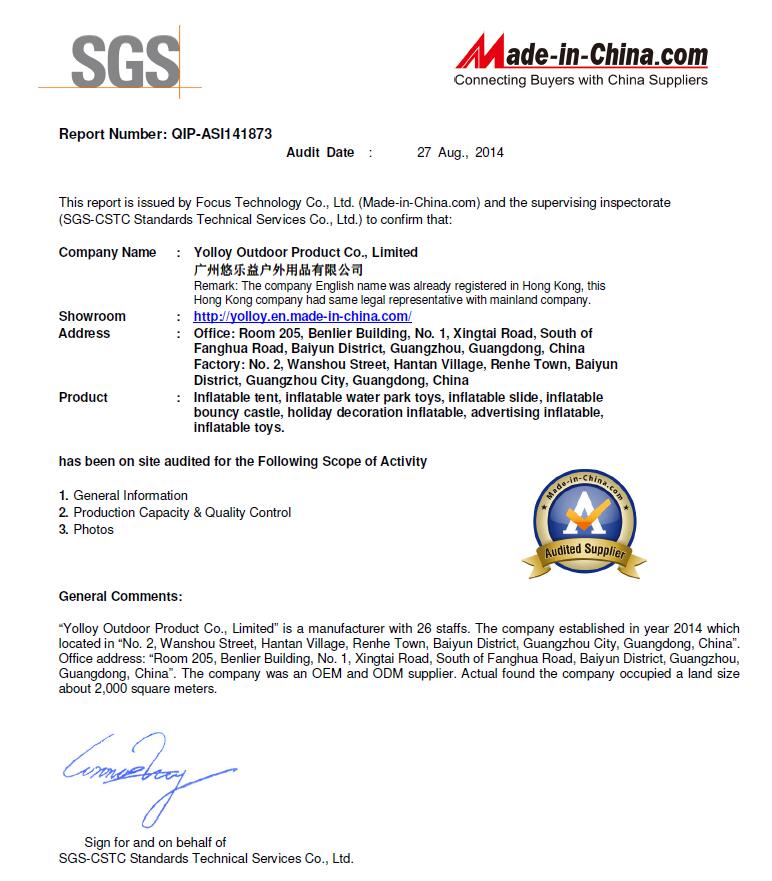
How do I know the quality is good enough? Ask about the fabric grade and construction. Yolloy uses commercial-grade PVC tarpaulin, reinforced seams, and waterproof nylon thread, and relevant materials have passed EN71, EN14960, and RoHS-related testing, with blowers meeting CE or UL requirements.
Final thoughts
The cost of an inflatable arch is not a mystery once you know how it is calculated. Materials, size, printing, accessories, labor, and shipping all add up in predictable ways, and the biggest driver is almost always size. Understanding these components lets you compare quotes fairly, avoid hidden fees, and choose a custom inflatable arch that fits both your event and your budget.
If you are ready to get a clear, itemized quote for your next event, contact Yolloy with your size, design, and timeline. Their team will walk you through the inflatable arch cost for your specific project, show you a design rendering before production, and help you make an entrance worth remembering.