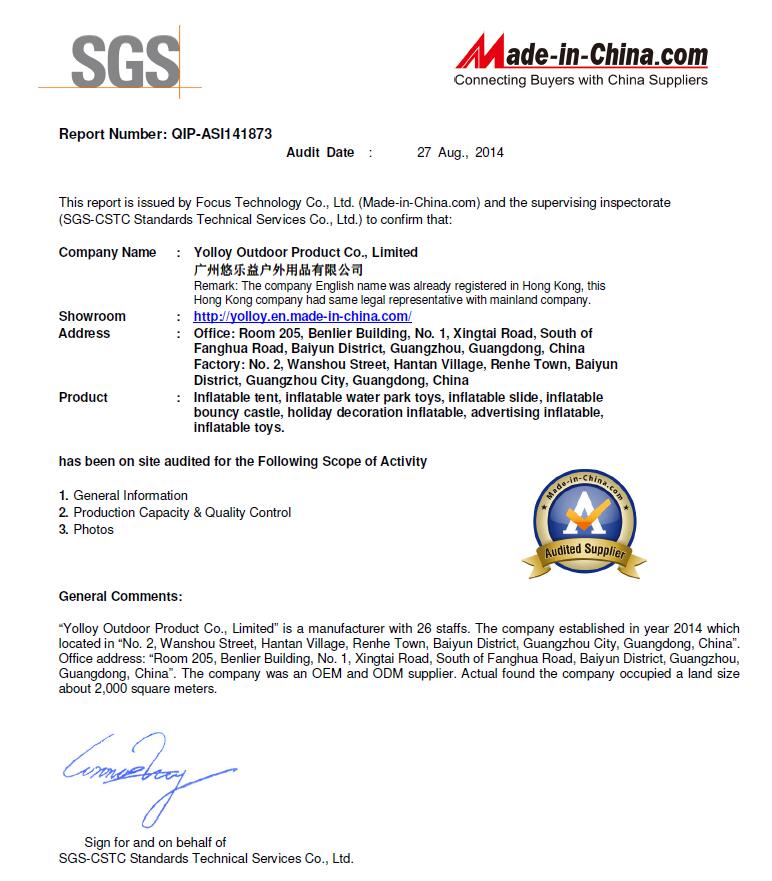
Investing in a commercial inflatable water slide is a significant decision for any rental business, water park operator, or resort manager. The right slide can generate steady revenue for years, while the wrong one can become a maintenance headache that drains your budget and damages your reputation. The key lies not just in the product itself, but in the manufacturer behind it. This guide walks you through the essential factors to evaluate when selecting a commercial inflatable water slide manufacturer that meets your needs for quality, safety, and long-term reliability.
1. Material Quality: The Foundation of Durability
A commercial water slide endures intense conditions: direct sunlight, constant water exposure, chlorine or saltwater contact, and repeated impact from users of all ages. Substandard materials will show their weakness within a single season. The industry standard for professional-grade equipment is commercial-grade PVC tarpaulin with UV-resistant, waterproof, and flame-retardant properties. This material resists fading, cracking, and delamination far better than the thinner PVC used in residential products.
Beyond the base material, pay attention to how the product is assembled. High-temperature fusion welding creates airtight, waterproof seams that are significantly stronger than glued or stitched alternatives. Reinforced stress points, double or quadruple stitching at anchor locations, and non-slip surface treatments on climbing and sliding areas are all indicators of a manufacturer that builds for commercial use rather than occasional backyard fun.
Key questions to ask: What is the weight and denier of the PVC tarpaulin? Are seams high-frequency welded or glued? Does the material have independent UV-resistance and flame-retardancy test reports?
2. Safety Certifications: Non-Negotiable for Commercial Use
For operators in North America, Europe, Australia, and the Middle East, safety certifications are not optional — they are frequently required by insurers and local regulators. A reputable inflatable water slide factory should readily provide current certification documentation covering the specific product categories you intend to purchase. Look for compliance with EN71 (toy safety), EN14960 (inflatable play equipment), CE marking, and RoHS (hazardous substance restrictions). These certifications confirm that materials are free of harmful substances, structural designs meet established safety benchmarks, and manufacturing processes follow consistent quality protocols.
Be wary of manufacturers who claim to be "certified" but cannot produce verifiable documentation. A credible supplier will have certificates ready — not scramble to produce them after you ask. The blowers supplied with the slide should also carry CE or UL approval, ensuring electrical safety across different voltage requirements (110V, 220V, or 380V).
3. Customization Capabilities: Does the Manufacturer Build for Your Business?
Off-the-shelf products rarely fit every operator's exact needs. Your venue has specific space constraints, your target audience has particular preferences, and your brand identity deserves to be reflected in your equipment. A strong inflatable water slide china manufacturer should offer genuine OEM/ODM customization covering shape, color, size, theme, branding, and logo placement.
The customization workflow should be transparent: you communicate your requirements, the design team prepares 3D renderings or technical drawings for your approval, revisions are made until you are satisfied, and only then does production begin. This process ensures that what arrives at your dock matches what you signed off on. A manufacturer that can design from a simple sketch, photograph, or site plan — and deliver a product that fits your specific operating environment — is worth far more than one selling catalog items at the lowest price.
4. Production Capacity and Lead Time Transparency
Honest manufacturers give realistic lead times. For a standard commercial inflatable water slide, expect production to take approximately 6 to 15 working days, depending on product complexity and order volume. Be skeptical of any supplier promising unusually fast turnaround on custom units — this often signals corner-cutting or relabeling of stock inventory.
Also confirm the manufacturer's minimum order quantity (MOQ). A flexible MOQ — such as one piece for most products — is particularly valuable for smaller operators who want to start with a single unit and expand their fleet gradually. This approach lets you evaluate build quality firsthand before committing to a larger production order.
5. Quality Control: What Happens Before Your Slide Ships
A manufacturer's quality control process reveals whether they stand behind their work or simply push products out the door. Strong manufacturers perform checks at multiple stages: material cutting, seam welding, full inflation testing (typically 24 hours or more to verify air retention), dimensional verification against approved specifications, and final packaging inspection to prevent crease damage during transit.
Every commercial unit should be fully inflated and inspected before packaging. Ask whether the manufacturer documents these tests and whether they can provide inflation test records for your specific order. Products that are inspected and tested before shipment dramatically reduce the risk of receiving a unit with hidden defects.
6. Warranty and After-Sales Support
A warranty is only as good as the manufacturer's willingness to honor it. Look for coverage in the range of two to three years on manufacturing defects, with clear terms about what is and is not covered. Equally important is the after-sales infrastructure: does the manufacturer supply a repair kit with each product? Are replacement parts and compatible electric air pumps available from a single source? Can you reach technical support when you need troubleshooting help during peak season?
A manufacturer that responds to inquiries within 24 hours, provides repair guidance (including instructional videos), and maintains a reliable supply of spare parts demonstrates a commitment to your long-term operational success rather than a one-time transaction.
7. Red Flags to Watch For
Certain warning signs should give any buyer pause. Here are the most critical ones to recognize before you commit:
No factory photos or virtual tour available — Legitimate manufacturers are proud of their facilities and production lines.
Prices significantly below the market range — Sustainable manufacturing with quality materials has a real cost floor. If a price seems too good to be true, the materials or workmanship are likely compromised.
Reluctance to provide material test reports or certification documents — This is non-negotiable for commercial use. A manufacturer that hesitates is hiding something.
No inflation test documentation — Every commercial unit should be fully inflated and tested before shipping. No exceptions.
Pressure to pay 100% upfront — Standard terms in the industry are a 30% to 50% deposit to begin production, with the balance due before shipment.
Generic stock photos with no original product photography — This suggests a reseller or trading company rather than an actual manufacturer.
8. Evaluating the Manufacturer's Track Record
A manufacturer's claims about quality and reliability mean little without evidence. When comparing suppliers, look for concrete indicators of experience and stability:
| Evaluation Criterion | What to Look For |
|---|
| Years in business | 10+ years indicates stability and accumulated expertise |
| Export markets served | Presence in multiple regions (Europe, Americas, Middle East, Asia) shows broad market acceptance |
| Completed projects | A portfolio of thousands of delivered projects demonstrates consistent delivery capability |
| On-time delivery rate | 95% or higher is a strong indicator of reliable production scheduling |
| Patents and innovation | Investment in product design and manufacturing patents signals ongoing R&D commitment |
| Client references | Ask for references from buyers in your market — rental operators, event companies, or park managers |
9. Structuring Your First Order to Minimize Risk
You do not need to go all-in on your first purchase. A phased approach reduces risk and lets you validate quality before scaling up:
- Start with one or two units — evaluate material quality, stitching, print clarity, and inflation performance under real operating conditions.
- Use the product for at least 15 to 20 rental events or operating days — this gives you a meaningful picture of durability and customer feedback.
- Test the after-sales response — order a small replacement part or ask a technical question to see how quickly and thoroughly the manufacturer responds.
- Scale with confidence — once the initial units prove themselves, place larger orders knowing you have validated the manufacturer's quality and service.
10. Shipping and Logistics Considerations
Commercial inflatable water slides are bulky items, and shipping costs can significantly affect your total landed cost. A manufacturer should offer flexible shipping options: air freight for urgent orders (typically 5–7 days transit), sea freight for cost-sensitive bulk shipments (15–30 days or more), and express courier for smaller items. Confirm whether the manufacturer provides proper packaging — soft carpet protection, waterproof PVC bags, and outer PE film are standard for quality suppliers, with steel pallets used for larger products.
Also verify the payment structure. Industry-standard terms involve a deposit (commonly 30% to 50%) to begin production, with the remaining balance paid before the goods are shipped. This arrangement protects both parties and aligns incentives for quality and timely delivery.
Making the Right Choice
Choosing a commercial inflatable water slide manufacturer is a decision that affects your guest experience, your operational costs, and your brand reputation for years to come. By focusing on material quality, verifiable safety certifications, genuine customization capability, transparent production timelines, documented quality control processes, and meaningful after-sales support, you can identify suppliers that treat your project as a long-term partnership rather than a one-time transaction.
Take the time to evaluate manufacturers against these criteria. Request samples, verify certifications, test communication responsiveness, and start with a small order before scaling up. The manufacturers that welcome this level of scrutiny are the ones worth building your business around.