Two hospitality operators sit in the same trade show audience, watching the same presentation on outdoor accommodation trends. One walks out with a notebook full of ideas and a shortlist of suppliers. The other walks out convinced that the market is too crowded and the margins too thin.
The difference is not optimism. The difference is knowing what to look for — and where to look.
Over the past five years, inflatable bubble tent structures have moved from novelty Instagram props to serious revenue-generating assets for glamping resorts, event companies, and outdoor hospitality brands. North America, Europe, and Asia-Pacific are all seeing strong demand, driven by the rise of experiential travel and eco-tourism. But the supply side is fragmented. Dozens of manufacturers compete for attention, and the gap between a well-built commercial dome and a disposable consumer-grade bubble is wider than most buyers realize.
What Makes an Inflatable Bubble Tent a Business Asset, Not a Toy
A transparent dome that inflates in minutes sounds simple. The engineering behind a commercial-grade version is anything but.
A proper inflatable dome tent built for business use must withstand repeated setup and teardown, resist UV degradation over hundreds of outdoor hours, maintain internal climate comfort across temperature ranges, and meet safety standards that vary by market. That requires more than a PVC shell and a blower. It requires precision-sewn reinforced seams, waterproof nylon thread, high-temperature fusion-welded airtight sections, and anchoring systems engineered for wind loads — not just stakes in the ground.
The material choice alone tells you a lot. Commercial-grade PVC tarpaulin is the baseline for most inflatable tent products, but Oxford fabric, nylon, TPU, and other materials come into play depending on the use case. A dome destined for a ski resort lounge in sub-zero temperatures needs different material specifications than one headed for a beachside wedding venue in the tropics.
Beyond Glamping: The Expanding Use Cases
If your mental image of a bubble tent stops at "romantic camping under the stars," you are leaving money on the table. The market has evolved well beyond glamping.
Event companies now deploy clear inflatable domes as pop-up dining rooms, cocktail lounges, and VIP hospitality suites at festivals and corporate gatherings. Hotels use them as poolside cabanas, spa treatment rooms, and outdoor restaurant extensions. Planetarium operators and educational institutions use inflatable projection domes for immersive learning experiences — a category that has grown alongside the demand for portable, turnkey presentation environments.
Custom inflatable tent solutions are also finding traction in specialized niches: inflatable spray booths for automotive detailing, golf simulator enclosures, altitude training chambers, and even inflatable snow globes with artificial snowfall for holiday markets and winter festivals. The common thread is that each application demands a different size, material, ventilation layout, and blower configuration — which is why off-the-shelf products rarely fit.
The Four Questions Every Buyer Should Ask Before Placing an Order
1. Can the manufacturer customize to your actual site and use case?
A supplier that only offers fixed sizes and standard configurations is selling inventory, not solutions. The right partner takes your site plan, your climate conditions, your branding requirements, and your budget — then produces simulation renderings before cutting a single panel. Custom sizes, custom colors, and customer logos printed directly on the product should be standard offerings, not premium add-ons.
2. What materials and certifications back the product?
Look for documented material testing — EN71, EN14960, and RoHS compliance are common benchmarks for inflatable products. For water park applications, EN 15649 becomes relevant. Blowers should meet CE or UL requirements, and the manufacturer should be able to supply appropriately powered blowers for your local voltage (110V, 220V, or 380V). If a supplier cannot produce batch-level certificates or test reports, treat that as a red flag.
3. What is the actual production and delivery timeline?
A typical regular inflatable product takes 6 to 15 days to produce, not including transit. Complex custom orders take longer. Air shipping can deliver in 5 to 7 days; sea freight takes 15 to 30 days or more. A manufacturer that reports a 95% on-time delivery rate and answers inquiries within 24 hours is one that runs a disciplined operation — not a workshop that overpromises and underdelivers.
4. What happens after the sale?
Every inflatable product should ship with a repair kit. The warranty expectation for commercial products used and maintained correctly is typically around three years, though terms vary by product type. The manufacturer should pack products with soft carpet protection, waterproof PVC bags, and outer PE film — and for large products, steel pallets — to ensure they arrive in sellable condition.
Why the Right China Inflatable Manufacturer Changes the Equation
China is the global production hub for inflatable products. That is not news. What is news is the growing tier of manufacturers that operate more like design-and-engineering partners than order-takers.
A capable China inflatable manufacturer brings in-house design capability, precision sewing and high-temperature welding equipment, documented quality control procedures, and experience exporting to Europe, Asia, South America, Africa, the Middle East, and Latin America. The minimum order quantity should be one piece — because if you are testing a new concept, you should not have to commit to a container load.
YOLLOY operates from this model. The company's workflow starts with a customer proposal — a description, a drawing, a sketch, a photograph, or a site plan — and moves through design simulation, client revision, approval, and then factory production. Products are inspected and tested before shipment. D-ring and round metal anchor systems are incorporated for wind resistance and installation stability. The materials have passed EN71, EN14960, and RoHS testing, and blowers meet CE or UL requirements.
YOLLOY at a Glance
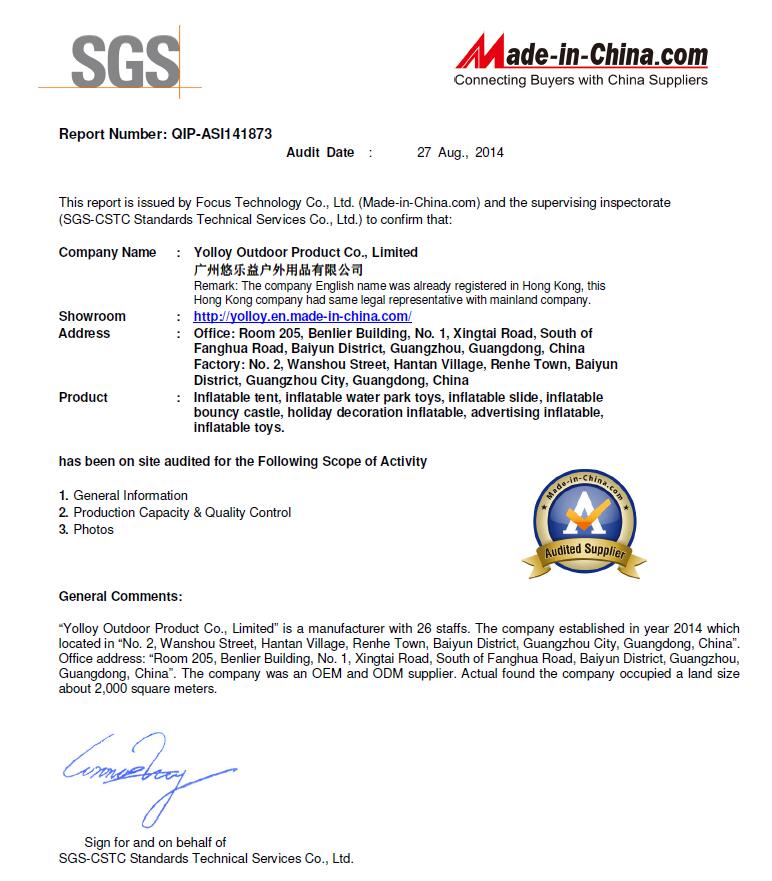
YOLLOY Outdoor Product Co., Limited designs and manufactures custom inflatable tents, clear domes, planetarium domes, water park products, interactive sports games, commercial slides, bounce houses, paintball bunkers, air mattresses, and advertising inflatables. Based in Guangzhou, China, the company exports to markets across Europe, Asia, South America, Africa, the Middle East, and Latin America. Every product ships with a repair kit, and the company maintains a 95% on-time delivery rate with 24-hour inquiry response.
The Bottom Line
The inflatable bubble tent market is growing — and it is fragmenting at the same time. More suppliers mean more choice, but also more variance in quality, customization capability, and after-sales support. The operators who come out ahead are the ones who treat the purchase as a partnership decision, not a commodity transaction. They ask about materials and certifications. They expect design renderings before production. They verify delivery track records. And they choose a manufacturer that designs from their requirements, not from a catalog.
Ready to Discuss Your Project?
Whether you need a single custom inflatable bubble tent for a pilot glamping site or a full set of branded event domes, YOLLOY's design team starts from your vision — not from a price list. Browse the product catalog to explore categories and specifications, or contact us directly with your requirements, drawings, or site plans. Emails are answered within 24 hours.
|