A festival organizer unpacks a stack of canvas and poles. Two hours later, the crew is still threading poles through sleeves under a hot sun. Across the field, another team presses a switch on a blower. In under ten minutes, their dome is fully inflated and ready for guests. One team is building a shelter. The other is running an event.
That difference in minutes is the difference between a tent and a solution. And it is why more event planners, rental businesses, camp operators, and commercial buyers are turning to inflatable dome tents 鈥?not just because they are faster, but because they are changing what a temporary structure can do.
What Makes an Inflatable Dome Different
A traditional tent is a frame wrapped in fabric. An inflatable dome tent is a structure sustained by air pressure. Remove the rigid poles, and you remove the assembly bottleneck. The air beams 鈥?typically made of commercial-grade PVC tarpaulin or TPU 鈥?are precision-welded at high temperature to form airtight chambers. When the blower starts, the entire structure rises evenly, distributing tension across the dome rather than concentrating it at a handful of joints.
This design brings three practical advantages. First, the dome shape is naturally wind-resistant: there is no flat face for gusts to push against. Second, the interior is column-free, meaning every square meter of floor space is usable 鈥?no poles to work around, no sightlines blocked. Third, the setup and takedown cycle is dramatically shorter. For a rental business that sets up and strikes a tent five times a week, that speed turns into revenue.
Beyond the Backyard: Where Dome Tents Earn Their Keep
The inflatable dome has moved far beyond the campsite. Today you will find these structures at:
- Outdoor weddings and private parties, where a clear dome creates a weatherproof dining room with a glass-wall view of the landscape.
- Corporate product launches and exhibitions, where a branded dome becomes a self-contained showroom that draws foot traffic.
- Music festivals and sporting events, where domes serve as VIP lounges, medical stations, or backstage green rooms.
- Glamping resorts and eco-lodges, where a transparent dome offers guests an immersive overnight experience under the stars.
- Planetarium shows and educational roadshows, where a projection-ready dome turns a parking lot into a portable theater.
- Emergency response and field hospitals, where a rapidly deployable shelter is not a convenience but a necessity.
The common thread is versatility. An outdoor inflatable tent built to commercial standards should adapt to the buyer's purpose, not force the buyer to adapt to the tent.
What to Look for When Sourcing an Inflatable Dome
Not all inflatable domes are built to the same standard. Here are the factors that separate a reliable structure from a short-term purchase:
Material quality. Commercial-grade PVC tarpaulin is the workhorse material for most inflatable tents, offering a balance of strength, weather resistance, and printability. For clear domes, TPU or transparent PVC should maintain optical clarity over repeated inflation cycles. For lightweight applications, Oxford fabric or nylon may be appropriate. The right material depends on the use case, and a manufacturer should be able to recommend the best option rather than pushing a one-size-fits-all solution.
Manufacturing precision. Airtight products require high-temperature fusion welding equipment, not just stitching. Sewn products 鈥?where seams are necessary 鈥?should use precision sewing machinery, reinforced seams, waterproof nylon thread, and additional reinforcement at high-load areas. D-ring or round metal anchor systems should be integrated where wind resistance is a concern.
Certification and testing. Ask whether the materials and finished products have been tested to relevant standards. For inflatable toys, EN 14960 is the applicable European norm. For inflatable water park products, EN 15649 applies. Blowers should meet CE or UL requirements. Materials should have passed EN71 and RoHS-related testing where applicable. These are not just paperwork 鈥?they are evidence that the manufacturer has subjected its products to third-party scrutiny.
Customization capability. A custom inflatable tent should not be limited to picking a size from a catalog. The manufacturer should be able to work from a description, a drawing, a photograph, a site plan, and a budget 鈥?producing simulation renderings for approval before production begins. Custom sizes, colors, logos, and artwork should be standard offerings, not premium add-ons.
Blower compatibility. The blower is the heart of any inflatable structure. It should be appropriately sized for the tent volume and available in the voltage required by the buyer's market 鈥?110V, 220V, or 380V. A blower that is underpowered will work harder and wear faster; one that is oversized will waste energy.
Why the Manufacturer Behind the Tent Matters
In the inflatable industry, the distance between a factory and a buyer can be measured in oceans, but the distance between a good purchase and a bad one is measured in the manufacturer's process discipline.
A manufacturer that operates with a design-to-production workflow 鈥?designers prepare renderings, revise until approval, then release to production 鈥?gives the buyer visibility and control. A manufacturer that inspects and tests every product before shipment, packs with soft carpet protection and waterproof PVC bags, and supplies a repair kit with each inflatable gives the buyer peace of mind. A manufacturer that reports a 95% on-time delivery rate and answers emails within 24 hours gives the buyer a partner, not just a supplier.
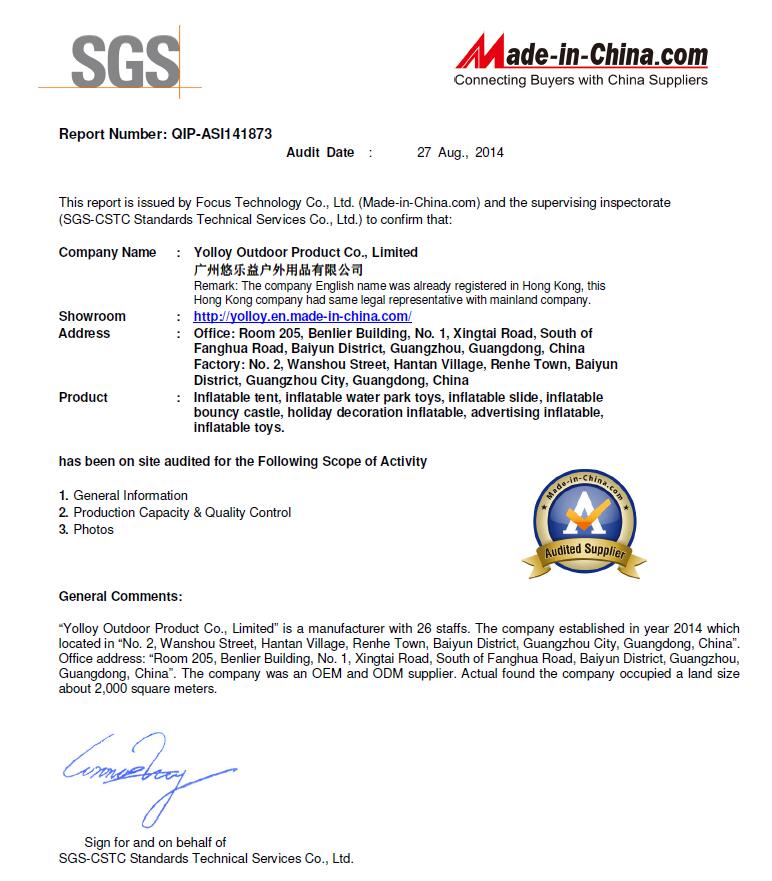
YOLLOY Outdoor Product Co., Limited, based in Guangzhou, China, builds its inflatable tent for events and commercial applications on exactly this model. The product range covers dome tents, clear bubble tents, snow globes, cube tents, tunnel tents, party tents, sports tents, car tents, emergency shelters, and workshop tents 鈥?spanning camping, hospitality, exhibitions, sports, emergency response, and advertising. The stated minimum order quantity is one piece, and a typical production cycle runs 6 to 15 days for a regular inflatable, with air and sea shipping options available.
A Tent Is a System, Not a Shell
The people who get the most value from an inflatable dome tent are the ones who treat it as a system: the right material for the climate, the right blower for the voltage, the right anchors for the wind load, the right certification for the regulatory environment, and the right manufacturer relationship for the long term.
The tent is the visible part. The quality of the decisions behind it 鈥?the ones you make before the blower ever turns on 鈥?is what determines whether that tent becomes a reliable asset or a recurring headache.
Ready to explore a custom inflatable solution for your next project? Visit YOLLOY to browse the full product range, or contact the team directly at [email protected] to discuss your requirements.