Military training programs demand equipment that is tough, flexible, and above all, safe. Inflatable obstacle courses have rapidly become the go-to solution for defense forces around the world, offering a practical alternative to traditional steel and concrete structures. But with more manufacturers entering the market, a critical question arises: Which inflatable military obstacle course is best for a military training program?
The answer isn't one-size-fits-all. The best inflatable obstacle course for your program depends on a combination of factors: material quality, design flexibility, safety certifications, and the manufacturer's ability to deliver on time and on budget. This article breaks down what to look for and highlights why Yolloy has earned its reputation as a top-tier supplier.
What to Look for in an Inflatable Military Obstacle Course
When evaluating courses for military training, procurement teams should focus on five key criteria:
1. Material Quality and Durability
Military training puts equipment through extreme stress. Boots, gear, repeated impacts, and harsh weather all take their toll. A good course uses commercial-grade PVC tarpaulin with reinforced seams and high-temperature fusion welding at stress points. Look for materials that resist UV degradation, tearing, and abrasion. The best courses also hold safety certifications such as EN71 and EN14960, which confirm the materials are non-toxic and structurally sound.
2. Realistic Obstacle Variety
A course that only offers one or two obstacle types won't prepare soldiers for the complexity of real-world scenarios. The best courses include climbing walls, low-crawl tunnels, balance beams, vertical ladders, and hurdle sections. This variety tests endurance, upper-body strength, agility, and teamwork in a single training session.
3. Safety Engineering
Injuries during training undermine readiness. Inflatable courses inherently reduce impact forces compared to rigid structures, but the best ones go further: rounded edges, non-slip surfaces, pressure relief valves to prevent over-inflation, and secure anchoring systems. These features protect personnel during high-intensity drills without sacrificing the challenge.
4. Portability and Rapid Deployment
Military operations rarely stay in one place. A course that weighs 500 kg and requires a crane is useless for field deployments. The best inflatable courses deflate to a compact size, fit in a standard transport vehicle, and inflate in under 10 minutes with an electric blower. This mobility allows training to happen anywhere: a desert base, a forest clearing, or even a ship's deck.
5. Customization and Manufacturer Support
Every unit has unique training objectives. A paratrooper company needs different obstacles than a mechanized infantry battalion. The best manufacturers offer custom design services: adjustable obstacle heights, modular layouts, and the ability to add unit insignias or camouflage patterns. Equally important is responsive support — when a course is deployed in the field, you need a supplier who answers emails within 24 hours and can ship replacement parts quickly.
Why Yolloy Stands Out Among Inflatable Military Obstacle Course Manufacturers
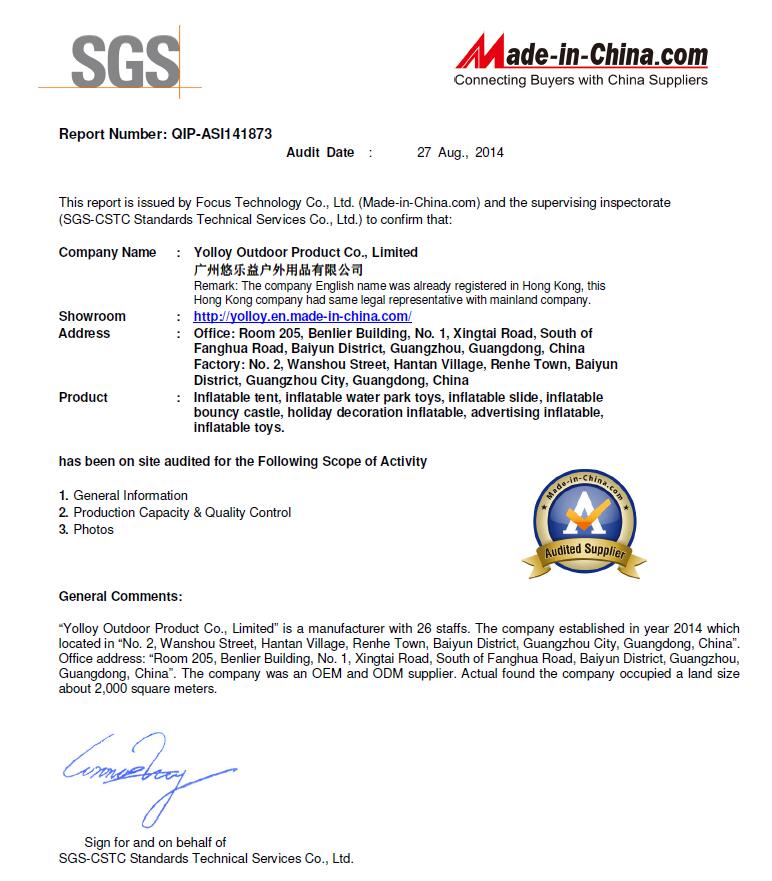
Yolloy Outdoor Product Co., Limited, based in Guangzhou, China, has spent over a decade refining its craft as a specialized inflatable military obstacle course manufacturer. What sets Yolloy apart is not just the quality of its products, but the depth of its customization and service capabilities.
Custom Design from Concept to Completion
Yolloy doesn't just sell off-the-shelf products. Their design team works from your description, drawing, or site plan to create simulation renderings before production begins. Revisions continue until you approve the final design. Whether you need a compact course for shipboard use or a full-scale 50-meter layout for a forward operating base, Yolloy builds to your exact specifications — including custom sizes, colors, and printed logos.
Proven Production and Delivery Track Record
With a 95% on-time delivery rate and a typical production time of 6-15 days for standard products, Yolloy understands that military schedules don't wait. The company supplies blowers compatible with 110V, 220V, or 380V requirements, and offers both air shipping (5-7 days) and sea freight (15-30 days) to reach customers across Europe, Asia, the Middle East, Africa, and the Americas. Every product includes a repair kit, and the company backs its work with a three-year service life expectation under proper use.
Comprehensive Product Range for Military Applications
Beyond obstacle courses, Yolloy's product line includes several categories relevant to military training: inflatable tents for field command posts and medical stations, inflatable paintball bunkers for tactical drills, interactive sport games for team building, and inflatable air mattresses for stunt training and safety applications. This breadth allows defense organizations to source multiple training solutions from a single inflatable obstacle course supplier, simplifying procurement and logistics.
Comparing Inflatable Courses to Traditional Obstacles: A Practical Breakdown
| Feature |
Traditional Rigid Course |
Inflatable Course |
| Setup Time |
Hours to days; requires construction |
Under 10 minutes with electric blower |
| Transportability |
Requires trucks and cranes |
Fits in standard military vehicles when deflated |
| Injury Risk |
High — hard surfaces cause fractures and sprains |
Low — cushioned surfaces absorb impact |
| Maintenance |
Rust, corrosion, ongoing repairs |
Minimal; repair kit included for field fixes |
| Customization |
Fixed layout; expensive to modify |
Modular components; easy to reconfigure |
| Terrain Flexibility |
Requires flat, prepared ground |
Works on sand, gravel, grass, concrete |
| Cost Over Time |
High upfront cost plus ongoing maintenance |
Lower upfront cost; minimal maintenance expense |
Making the Right Choice for Your Training Program
The best inflatable military obstacle course is one that matches your specific training environment, personnel needs, and operational tempo. A course that works for a permanent base may not suit a rapid-deployment unit. When evaluating options, ask manufacturers these questions:
- What materials are used, and what certifications do they hold?
- Can the course be customized to our specific obstacle requirements and terrain?
- What is the minimum order quantity, and what are typical production and shipping timelines?
- Is a repair kit included, and what warranty or service life is offered?
- What voltage options are available for the blower system?
Yolloy addresses all of these questions clearly: commercial-grade PVC with EN71 and EN14960 certifications, fully custom design capabilities, a minimum order quantity of just one piece, 6-15 day production times, an included repair kit, a three-year service life expectation, and blower compatibility with 110V, 220V, and 380V systems. The company's 95% on-time delivery rate and 24-hour email response policy provide the reliability that military procurement teams require.
Ultimately, the answer to "which inflatable military obstacle course is best" depends on finding a manufacturer that combines product quality with operational reliability. For defense forces seeking a partner who understands both, Yolloy offers a compelling combination of custom engineering, certified materials, and proven logistics — making it a strong choice for any military training program looking to upgrade its obstacle course capabilities.