Products Category
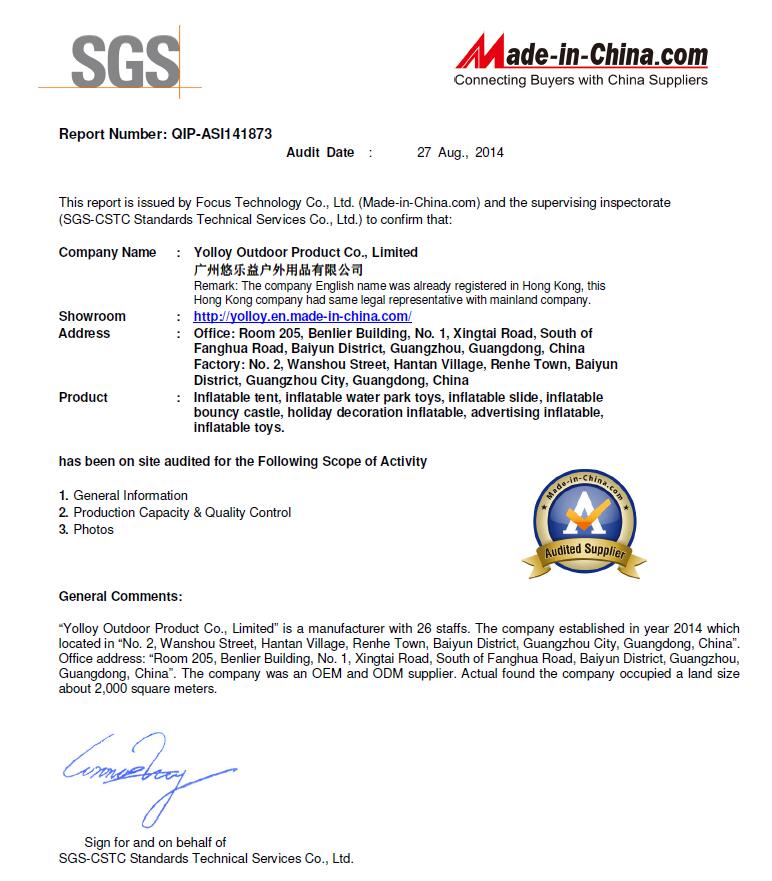
Certification

News

• New Order Successfully Finished for Long-Time Cooperated Japanese Client | YOLLOY Wins Full Client Recognition

• YOLLOY Custom Inflatable Pool Tent for Danish Client: Professional Pool Repair Shelter & Debris Protection

• Trusted Once Again! Greek Captain Re-orders Our Products After 4 Years

• Revolutionize Your Outdoors: The All-Terrain Inflatable Floating Tent for Land & Water

• Elevate Your Summer Fun: The Ultimate Inflatable Water Floating Volleyball Court Trampoline

• Innovative Inflatable Nightclub Tents & Pop-Up Bars: The Ultimate Solution for Portable Party Venues

Contact Us

Name: Sunny Yang
Tel: +86-20-8370 0771
Fax: +86-20-8370 0771
Mobile: 13570587575
E-mail: [email protected]
Add: No 5,Xiong wei Bo Nan Road,ZhongLuoTan Town,Baiyun district,Guangzhou,China
Friend me on Facebook Follow me on Twitter Add me to your circles Follow me on Pinterest Watch my channel on YouTube
News

What is the best inflatable projection screen for outdoor use?

Author:yolloy Date:2026/8/18 22:00:14

A backyard movie night, a school fundraiser, a church community event, or a large music festival — an inflatable projection screen is one of the fastest ways to turn any open space into an outdoor cinema. The question most organizers and buyers ask, though, is the same: what is actually the best inflatable projection screen for outdoor use? The honest answer is that there is no single "best" screen for everyone. The right choice depends on your audience size, the brightness of your projector, the wind conditions at your venue, and how often you plan to set it up. This guide walks through the factors that matter most, so you can buy a screen that performs year after year instead of one that struggles after a season.

Before we compare any specific products, a useful rule of thumb is that the ideal screen size goes hand in hand with your audience and your projector. For a small backyard gathering of up to thirty people, a screen between 12 and 16 feet diagonal generally offers the best balance of immersion and projector compatibility. For community parks, school fields, and corporate functions with larger crowds, you step up to 18 to 25 feet or more. As a practical guideline, viewers get the clearest image within roughly three times the screen width, so a 20-foot-wide screen suits audiences seated up to about 60 feet away. If you are planning on bigger screens, expect to pair them with brighter projectors so the image stays sharp in low ambient light.

Screen material: the heart of durability

The material is what separates a good outdoor screen from a short-lived one. Most commercial inflatable projection screens are built from a strong, airtight fabric that keeps its shape under continuous airflow. High-quality units use commercial-grade PVC tarpaulin or coated Oxford and nylon fabrics that resist tearing, ultraviolet damage, and moisture. What many first-time buyers overlook is the seamwork. A screen is only as strong as its weakest seam, so look for reinforced, double-stitched seams with waterproof thread and extra layering at high-load areas such as the anchor points. Reputable manufacturers also add D-ring or round metal anchor systems so the screen can be staked or weighted down in open-air conditions. If materials and workmanship matter to you, materials that have passed EN71, EN14960, and RoHS-related testing are worth prioritizing, because those certifications reflect a level of quality control you can actually trust.

Blowers and power: the engine behind the image

An inflatable screen does not stand on its own; it is held taut by a dedicated blower that runs continuously for the whole event. The blower is where many setups fail before the film even starts. Most screens in the 16 to 25 foot range work well with a 0.5 to 1.0 horsepower blower, while larger units need a more powerful one. Before you buy, confirm the blower matches your local voltage, because suppliers can supply blowers for 110V, 220V, or 380V depending on the region. It is also worth checking that the blower meets CE or UL requirements for safety. Keep in mind that the screen needs reliable AC power nearby, so plan your power source and extension routing before guests arrive. A good supplier can pair the right blower with your screen, which saves you the guesswork of matching a third-party unit yourself.

Setup, stability, and wind

One of the biggest advantages of an outdoor inflatable projection screen is how quickly it deploys. Most professional screens inflate fully in under a couple of minutes, which is far faster than assembling a frame-based screen. The trade-off is that inflation time is only the beginning. You still need a flat, level, open area free of obstructions, and you need to anchor the screen properly. In windy conditions, ground stakes, sandbags, or water bags around the base make a real difference, and screens with strong anchor points hold up far better than ones that rely on stakes alone. When positioning, face the screen so the projection surface is not directly struck by wind, and place your projector and audience on the correct side of the screen for a clear, unwrinkled image.

Who makes the best inflatable projection screen?

Once you know the technical factors, the next question is where to source a screen that meets them. It is surprisingly common to end up with a cheap screen that wrinkles easily, uses thin fabric, or ships with an underpowered blower. To avoid that, buy from a manufacturer you can talk to directly. A good inflatable projection screen manufacturer will ask about your venue, audience size, and projector before recommending a model, and will happily explain the fabric, seam, and blower details behind the price. Suppliers that offer portable planetarium dome and projection screen custom sizes and printed logos are a strong signal that they are a real factory rather than a reseller. It is worth checking the minimum order quantity, too: many buyers assume they must order in bulk, but flexible manufacturers can accommodate single-piece orders for a first test. Ask about typical production time as well, since a standard inflatable product often takes about one to two weeks to produce before shipping, while custom and complex builds take longer.

Longevity, warranty, and after-sales support

A screen purchased for a single event still needs to survive packing, transport, and storage, so durability and support matter more than the sticker price. Expect to store the screen folded or rolled in its carry bag and to protect it from prolonged sun and sharp objects. A repair kit, which most reputable suppliers include with every inflatable product, lets you patch small punctures quickly instead of retiring the screen. With proper use and maintenance, a well-built screen can deliver years of reliable service, and the best manufacturers stand behind that with a reasonable warranty. Look for a supplier that answers inquiries quickly and has clear policies on replacement parts like blowers and fabric, because that is what keeps your setup running season after season.

Wrap-up: choosing your screen

To summarize, the best inflatable projection screen for outdoor use is the one that matches your audience size, uses durable commercial fabric with reinforced seams, is paired with the right blower for your voltage, and can be anchored solidly at your venue. Weigh the material and craftsmanship just as heavily as the price, confirm the manufacturer is a genuine factory that can customize size and branding, and make sure after-sales support exists for the long term. If you are planning an outdoor movie event and want a screen engineered for real-world conditions, YOLLOY designs and manufactures inflatable projection screens, planetarium domes, and outdoor inflatable tents at its factory in Guangzhou, China, with custom sizing, logo printing, and single-piece orders available. Reach out through the YOLLOY website to discuss your venue and get a recommendation tailored to your next screening.


What is the best inflatable projection screen for outdoor use?

Author:yolloy Date:2026/8/18 22:00:14

A backyard movie night, a school fundraiser, a church community event, or a large music festival — an inflatable projection screen is one of the fastest ways to turn any open space into an outdoor cinema. The question most organizers and buyers ask, though, is the same: what is actually the best inflatable projection screen for outdoor use? The honest answer is that there is no single "best" screen for everyone. The right choice depends on your audience size, the brightness of your projector, the wind conditions at your venue, and how often you plan to set it up. This guide walks through the factors that matter most, so you can buy a screen that performs year after year instead of one that struggles after a season.

Before we compare any specific products, a useful rule of thumb is that the ideal screen size goes hand in hand with your audience and your projector. For a small backyard gathering of up to thirty people, a screen between 12 and 16 feet diagonal generally offers the best balance of immersion and projector compatibility. For community parks, school fields, and corporate functions with larger crowds, you step up to 18 to 25 feet or more. As a practical guideline, viewers get the clearest image within roughly three times the screen width, so a 20-foot-wide screen suits audiences seated up to about 60 feet away. If you are planning on bigger screens, expect to pair them with brighter projectors so the image stays sharp in low ambient light.

Screen material: the heart of durability

The material is what separates a good outdoor screen from a short-lived one. Most commercial inflatable projection screens are built from a strong, airtight fabric that keeps its shape under continuous airflow. High-quality units use commercial-grade PVC tarpaulin or coated Oxford and nylon fabrics that resist tearing, ultraviolet damage, and moisture. What many first-time buyers overlook is the seamwork. A screen is only as strong as its weakest seam, so look for reinforced, double-stitched seams with waterproof thread and extra layering at high-load areas such as the anchor points. Reputable manufacturers also add D-ring or round metal anchor systems so the screen can be staked or weighted down in open-air conditions. If materials and workmanship matter to you, materials that have passed EN71, EN14960, and RoHS-related testing are worth prioritizing, because those certifications reflect a level of quality control you can actually trust.

Blowers and power: the engine behind the image

An inflatable screen does not stand on its own; it is held taut by a dedicated blower that runs continuously for the whole event. The blower is where many setups fail before the film even starts. Most screens in the 16 to 25 foot range work well with a 0.5 to 1.0 horsepower blower, while larger units need a more powerful one. Before you buy, confirm the blower matches your local voltage, because suppliers can supply blowers for 110V, 220V, or 380V depending on the region. It is also worth checking that the blower meets CE or UL requirements for safety. Keep in mind that the screen needs reliable AC power nearby, so plan your power source and extension routing before guests arrive. A good supplier can pair the right blower with your screen, which saves you the guesswork of matching a third-party unit yourself.

Setup, stability, and wind

One of the biggest advantages of an outdoor inflatable projection screen is how quickly it deploys. Most professional screens inflate fully in under a couple of minutes, which is far faster than assembling a frame-based screen. The trade-off is that inflation time is only the beginning. You still need a flat, level, open area free of obstructions, and you need to anchor the screen properly. In windy conditions, ground stakes, sandbags, or water bags around the base make a real difference, and screens with strong anchor points hold up far better than ones that rely on stakes alone. When positioning, face the screen so the projection surface is not directly struck by wind, and place your projector and audience on the correct side of the screen for a clear, unwrinkled image.

Who makes the best inflatable projection screen?

Once you know the technical factors, the next question is where to source a screen that meets them. It is surprisingly common to end up with a cheap screen that wrinkles easily, uses thin fabric, or ships with an underpowered blower. To avoid that, buy from a manufacturer you can talk to directly. A good inflatable projection screen manufacturer will ask about your venue, audience size, and projector before recommending a model, and will happily explain the fabric, seam, and blower details behind the price. Suppliers that offer portable planetarium dome and projection screen custom sizes and printed logos are a strong signal that they are a real factory rather than a reseller. It is worth checking the minimum order quantity, too: many buyers assume they must order in bulk, but flexible manufacturers can accommodate single-piece orders for a first test. Ask about typical production time as well, since a standard inflatable product often takes about one to two weeks to produce before shipping, while custom and complex builds take longer.

Longevity, warranty, and after-sales support

A screen purchased for a single event still needs to survive packing, transport, and storage, so durability and support matter more than the sticker price. Expect to store the screen folded or rolled in its carry bag and to protect it from prolonged sun and sharp objects. A repair kit, which most reputable suppliers include with every inflatable product, lets you patch small punctures quickly instead of retiring the screen. With proper use and maintenance, a well-built screen can deliver years of reliable service, and the best manufacturers stand behind that with a reasonable warranty. Look for a supplier that answers inquiries quickly and has clear policies on replacement parts like blowers and fabric, because that is what keeps your setup running season after season.

Wrap-up: choosing your screen

To summarize, the best inflatable projection screen for outdoor use is the one that matches your audience size, uses durable commercial fabric with reinforced seams, is paired with the right blower for your voltage, and can be anchored solidly at your venue. Weigh the material and craftsmanship just as heavily as the price, confirm the manufacturer is a genuine factory that can customize size and branding, and make sure after-sales support exists for the long term. If you are planning an outdoor movie event and want a screen engineered for real-world conditions, YOLLOY designs and manufactures inflatable projection screens, planetarium domes, and outdoor inflatable tents at its factory in Guangzhou, China, with custom sizing, logo printing, and single-piece orders available. Reach out through the YOLLOY website to discuss your venue and get a recommendation tailored to your next screening.