If you have ever watched children sprint through tunnels, scramble over low walls, and tumble down a slide at a school fair or a family fun day, you have already seen an inflatable obstacle course in action. These bright, air-filled structures have become one of the most popular attractions at parties, festivals, and sports events, and they are just as common in commercial rental fleets as they are in backyards. But what exactly is an inflatable obstacle course, and how does it actually work? This article explains the basics, the technology behind the fun, and what to look for when you buy one.
What is an inflatable obstacle course?
An inflatable obstacle course is a large, air-supported structure made up of a series of connected challenges. Instead of offering one repeated activity like a standard bounce house, it strings together several different elements, such as crawl-through tunnels, pop-up walls, climbing panels, balance beams, and a slide at the end. Participants work their way from the start to the finish, racing against the clock or against each other. Because the whole course is soft and cushioned, it gives people a safe way to run, jump, climb, and slide, which is why it appeals to everyone from toddlers to adults.
The concept grew out of the classic bounce house, which first appeared in the late 1950s. Over the decades, manufacturers added more elements and longer layouts, and today courses range from compact backyard models around 20 feet long to large commercial installations that stretch well beyond 100 feet. Some are designed for dry land, while others are built for water parks, where the obstacles sit on or beside splash pools.
How does an inflatable obstacle course work?
The principle behind every inflatable product is simple: air pressure gives the structure its shape and its bounce. A continuous-duty blower feeds air into the course through an inlet tube, and the material keeps the air inside, so the whole structure stays firm while people play on it. The blower has to keep running for the entire session, because the course is constantly losing a small amount of air through seams and openings. When the event is over, the operator opens the deflation ports, the air rushes out, and the course folds down flat for storage.
The material matters just as much as the blower. Most commercial courses are made from heavy-duty PVC tarpaulin, a puncture-resistant fabric that can handle rough play and repeated use. Seams are one of the weakest points on any inflatable, so reputable factories reinforce them with precision sewing, waterproof nylon thread, and extra layers at high-load areas. Airtight chambers are joined using high-temperature fusion or welding equipment, which creates strong, leak-resistant connections. Around the base, D-ring or round metal anchor points are sewn in so the course can be staked into grass or weighted down on hard surfaces, keeping it stable even when several children are bouncing at once.
What is inside a typical course?
A course is only as good as the obstacles it contains. Most designs combine a mix of the following elements:
- Tunnels and crawl tubes that force participants to duck and crawl, slowing the pace and adding variety.
- Pop-up walls and hurdles that need to be climbed over or jumped across.
- Climbing panels and short walls with grips and footholds that build upper-body strength.
- Bounce zones that give participants a chance to catch their breath or add speed.
- A slide or drop-off at the finish, which is usually the most popular part of the whole course.
In water versions, the same layout is placed over a splash pool, with slippery surfaces, water cannons, and floating elements adding an extra challenge. Water courses are especially popular at summer events and water parks, where the combination of obstacles and cooling splashes keeps participants coming back for another round.
Types of inflatable obstacle courses
Not all courses are the same, and choosing the right type depends on where it will be used and who will use it.
- Backyard courses are smaller and simpler, designed for home use and family gatherings. They are easy to set up, store, and maintain.
- Commercial courses are larger and built from tougher materials to survive daily rental use at events, festivals, and amusement venues. They are the workhorses of the rental industry.
- Water courses are designed for pools and water parks, combining obstacles with splash zones for summer entertainment.
- Dual-lane courses feature two identical lanes side by side, making them perfect for head-to-head races and relay competitions.
Why businesses and families choose them
For event planners and rental companies, a commercial inflatable obstacle course is a smart investment. One structure entertains a crowd for hours, draws attention to a booth or venue, and can be rented out again and again, which makes it one of the higher-return items in an inflatable fleet. For parents, a backyard course turns an ordinary afternoon into active play, helping children build coordination, balance, and strength without them ever feeling like they are exercising.
The social side matters too. Because a course naturally creates a queue and a finish line, it encourages turn-taking and friendly competition. That makes it a great fit for school field days, corporate team-building events, community fundraisers, and birthday parties, where the goal is to keep a mixed-age group engaged at the same time.
Safety and quality: what to check before buying
Safety should be the first consideration when buying any inflatable. Look for courses made from commercial-grade PVC tarpaulin with reinforced seams and secure anchor points. Check whether the materials meet relevant safety standards; for example, inflatable play equipment is commonly associated with EN 14960, while inflatable water parks reference EN 15649. Reputable suppliers also test blowers to CE or UL requirements, and they inspect and test every product before shipment.
On the day of use, a few simple habits keep everyone safe. Set the course up on a flat, level surface away from sharp objects and overhead hazards, and anchor it properly according to the surface, using stakes on grass or weights on hard ground. Keep the blower connected to a reliable power source, and check the D-rings and tethers during the event. Most manufacturers advise taking the course down if wind speeds get too high. Participants should remove shoes, jewelry, and anything sharp before entering, and an adult should supervise at all times.
Customization: getting a course built for your needs
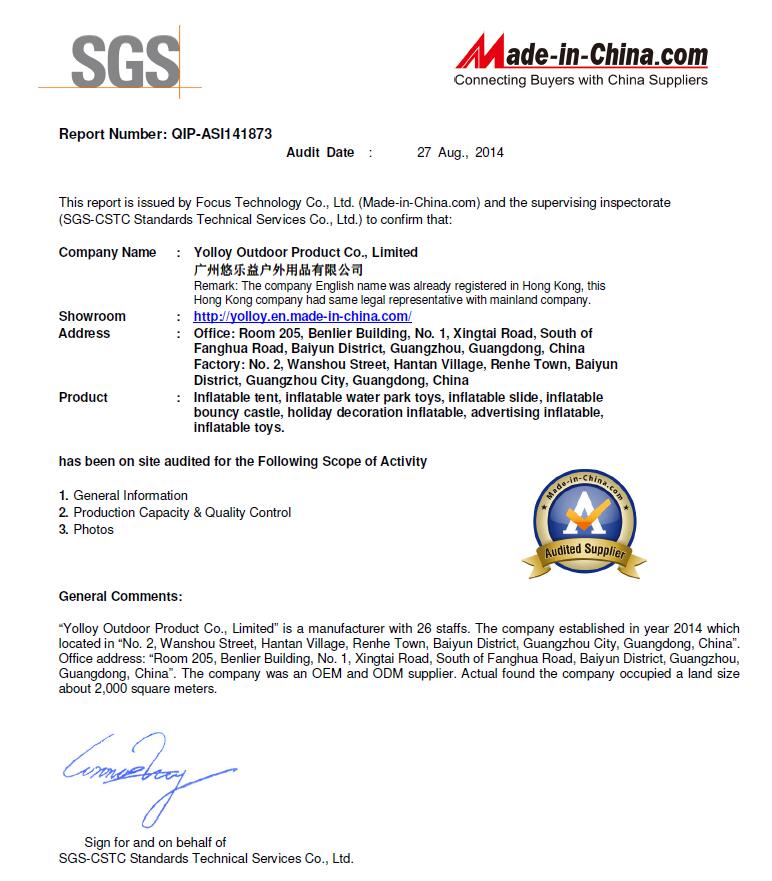
One of the biggest advantages of working with a factory directly is customization. YOLLOY, an inflatable manufacturer based in Guangzhou, China, designs and produces custom inflatable products for customers around the world. The process starts with your idea: a description, a drawing, a sketch, a photograph, or even just a site plan and a budget. The design team prepares simulation renderings, revises them until you approve the layout, colors, and artwork, and then releases the design for production. Custom sizes, colors, and printed logos are all available, and the minimum order quantity is one piece, so even a single custom course can be made to your specification.
Production times are reasonable for a custom product. The typical lead time for one regular inflatable is around 6 to 15 days, excluding transit, with complex or very large designs taking longer. Blowers can be supplied for 110V, 220V, or 380V requirements, so the course works with the power supply in your region. Every product ships with a repair kit, and the company reports a 95% on-time delivery rate, with air freight taking roughly 5 to 7 days and sea freight 15 to 30 days or more depending on the destination.
Working with an experienced inflatable obstacle course manufacturer also means you get honest advice on materials, safety, and sizing. A good supplier will tell you which fabric weight suits your usage level, how many blowers your layout needs, and how to maintain the course so it lasts. YOLLOY, for example, describes a three-year service life expectation when products are used and maintained correctly, and it answers emails within 24 hours, which matters when you are coordinating a delivery or a repair.
Frequently asked questions
What age groups can use an inflatable obstacle course?
Most courses are designed for children aged 3 and up, with specific models and layouts available for teenagers and adults. Always check the manufacturer's recommendations for age and weight limits before use.
How long does it take to set up an inflatable obstacle course?
With a continuous-duty blower, most courses inflate in a matter of minutes. Larger commercial layouts naturally take a little longer, but the process is straightforward: lay the course flat, connect the blower, and let the air do the work.
How do I clean and store an inflatable obstacle course?
Clean the surface with mild soap and water, and make sure it is completely dry before folding and storing it in a cool, dry place away from direct sunlight. Regular inspection of seams and anchor points will help the course last longer.
Can I get a course made in my own colors and with my logo?
Yes. Custom colors, sizes, and printed logos are standard services at most inflatable factories, including YOLLOY. You can send a sketch or description, approve a simulation rendering, and have a one-of-a-kind course produced to your specification.
Conclusion
An inflatable obstacle course is more than just a bounce house with extra parts. It is a complete, air-supported play system that combines climbing, crawling, bouncing, and sliding into one engaging experience, powered by nothing more than a blower and a well-made fabric shell. Whether you are a parent looking for backyard fun, an event planner adding an attraction, or a rental business building a fleet, understanding how these courses work and what makes them safe will help you choose the right one. And if you want a course built exactly to your design, a custom inflatable manufacturer like YOLLOY can take your idea from a simple sketch to a finished, ready-to-ship product.