Products Category
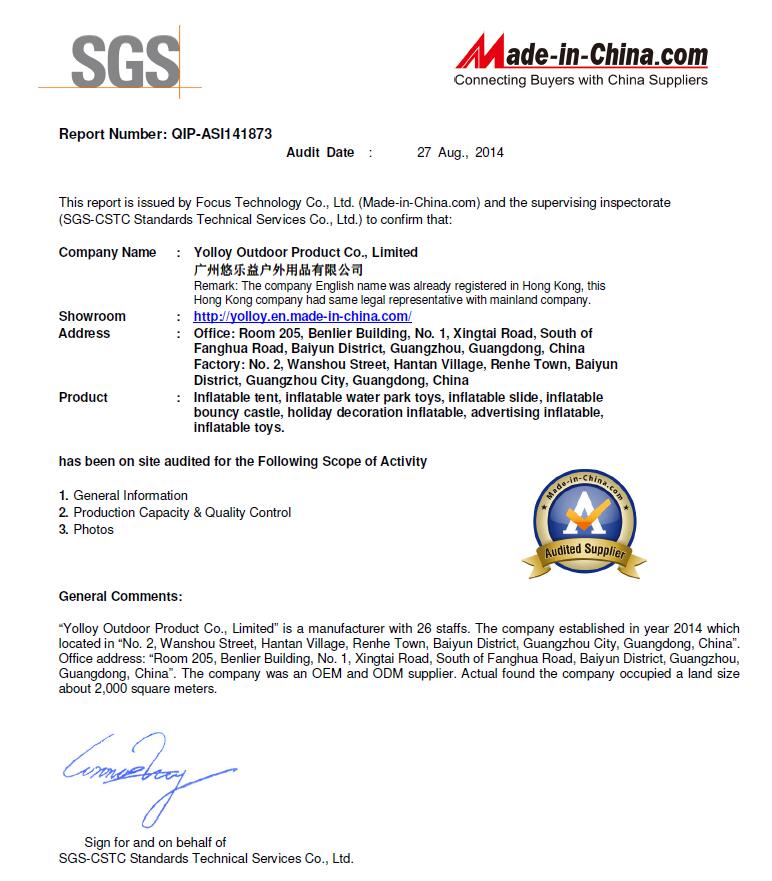
Certification

News

• New Order Successfully Finished for Long-Time Cooperated Japanese Client | YOLLOY Wins Full Client Recognition

• YOLLOY Custom Inflatable Pool Tent for Danish Client: Professional Pool Repair Shelter & Debris Protection

• Trusted Once Again! Greek Captain Re-orders Our Products After 4 Years

• Revolutionize Your Outdoors: The All-Terrain Inflatable Floating Tent for Land & Water

• Elevate Your Summer Fun: The Ultimate Inflatable Water Floating Volleyball Court Trampoline

• Innovative Inflatable Nightclub Tents & Pop-Up Bars: The Ultimate Solution for Portable Party Venues

Contact Us

Name: Sunny Yang
Tel: +86-20-8370 0771
Fax: +86-20-8370 0771
Mobile: 13570587575
E-mail: [email protected]
Add: No 5,Xiong wei Bo Nan Road,ZhongLuoTan Town,Baiyun district,Guangzhou,China
Friend me on Facebook Follow me on Twitter Add me to your circles Follow me on Pinterest Watch my channel on YouTube
News

What are bouncy castles made of?

Author:yolloy Date:2026/8/18 4:36:04

Bouncy castles, also known as inflatable castles or bounce houses, are a familiar sight at children's parties, school fairs, and commercial play centres. But have you ever wondered what actually goes into making one? The answer matters more than you might think. The materials and workmanship inside a bouncy castle determine how safe it is, how long it lasts, and how much it costs to run. In this guide, we break down the fabrics, seams, and construction techniques used by professional inflatable manufacturers, and we point out what to check before you buy.

The main material: PVC-coated fabric

Most commercial bouncy castles are made from PVC (polyvinyl chloride) tarpaulin. A typical PVC fabric is built in layers: a strong polyester scrim, a woven mesh in the middle, is coated on both sides with PVC. The polyester scrim gives the fabric its tear strength, while the PVC coating makes it airtight, waterproof, and resistant to UV light and abrasion. This combination is why PVC has become the industry standard for bounce houses and other commercial inflatables that need to survive daily use.

Commercial-grade PVC tarpaulin is the material used by many professional suppliers for their inflatable bounce house products. Because the fabric is smooth and non-porous, it is easy to wipe clean between events, which is a real advantage for rental businesses and play centres that run sessions back to back.

Other materials: Oxford fabric, nylon, and TPU

Not every inflatable is made from PVC. Oxford fabric is lighter and generally more affordable, which makes it a popular choice for budget products and smaller inflatables. Nylon is lightweight and flexible, but it is usually less durable than PVC and is better suited to lighter-duty items. For some tent and specialty projects, manufacturers may also use TPU or other engineered materials depending on the requirements. The right material really depends on how the product will be used, how often, and in what conditions.

Seams and construction: where quality really shows

The fabric is only half the story. A bouncy castle is only as strong as its seams. Quality manufacturers reinforce high-stress areas such as corners, joints, and anchor points with extra stitching, and they use waterproof nylon thread so the seams do not rot over time. Airtight products are usually joined with high-temperature fusion or welding equipment, which creates a stronger and smoother bond than simple stitching alone. When you compare products, look for double or triple stitching and reinforced seams if you want something that will survive years of bouncing.

Safety standards and certification

Safety is non-negotiable when children are involved. Reputable manufacturers test their materials against recognised standards. For example, inflatable toys are commonly associated with EN 14960, while inflatable water parks reference EN 15649, and materials are often tested to EN71 and RoHS requirements. Blowers should meet CE or UL requirements. Before you place an order, always ask the supplier which standards their products and materials comply with, and ask for the relevant documentation.

Anchoring and setup

A well-made castle also needs to stay put. Many commercial inflatables are fitted with D-ring or round metal anchor systems so they can be securely pegged down. Combined with a correctly sized blower, proper anchoring is one of the most important safety features of any inflatable. A reliable supplier will also supply the right blower for your local voltage, whether that is 110V, 220V, or 380V.

How to choose the right material for your needs

There is no single best material, only the right material for the job. Here are a few practical guidelines:

  • For frequent or commercial use, choose heavy-duty PVC or reinforced vinyl, which handle high traffic best.
  • For outdoor use, PVC resists moisture and UV rays better than most alternatives.
  • If budget is the main concern, Oxford fabric offers a lower-cost option with reasonable durability.
  • For unusual or creative shapes, nylon is flexible and easy to form into custom designs.

Choosing a manufacturer

When you buy from a manufacturer rather than a reseller, you get more control over the final product. Look for a supplier that offers custom sizes, colours, and printed artwork, and that can design from a description, drawing, sketch, or photograph. A good inflatable bounce house manufacturer will also give you a clear production time, provide a repair kit with each product, and answer your questions quickly. These details make a big difference when you are planning an event or building a rental fleet.

Conclusion

Bouncy castles are made from carefully selected materials, most commonly PVC-coated polyester fabric, combined with reinforced seams, safety-tested construction, and proper anchoring. Understanding these details helps you choose a product that is safe, durable, and good value for money. Whether you need a classic castle, a themed design, or an inflatable bouncy castle with slide, working with an experienced manufacturer makes all the difference in quality, safety, and long-term cost.


What are bouncy castles made of?

Author:yolloy Date:2026/8/18 4:36:04

Bouncy castles, also known as inflatable castles or bounce houses, are a familiar sight at children's parties, school fairs, and commercial play centres. But have you ever wondered what actually goes into making one? The answer matters more than you might think. The materials and workmanship inside a bouncy castle determine how safe it is, how long it lasts, and how much it costs to run. In this guide, we break down the fabrics, seams, and construction techniques used by professional inflatable manufacturers, and we point out what to check before you buy.

The main material: PVC-coated fabric

Most commercial bouncy castles are made from PVC (polyvinyl chloride) tarpaulin. A typical PVC fabric is built in layers: a strong polyester scrim, a woven mesh in the middle, is coated on both sides with PVC. The polyester scrim gives the fabric its tear strength, while the PVC coating makes it airtight, waterproof, and resistant to UV light and abrasion. This combination is why PVC has become the industry standard for bounce houses and other commercial inflatables that need to survive daily use.

Commercial-grade PVC tarpaulin is the material used by many professional suppliers for their inflatable bounce house products. Because the fabric is smooth and non-porous, it is easy to wipe clean between events, which is a real advantage for rental businesses and play centres that run sessions back to back.

Other materials: Oxford fabric, nylon, and TPU

Not every inflatable is made from PVC. Oxford fabric is lighter and generally more affordable, which makes it a popular choice for budget products and smaller inflatables. Nylon is lightweight and flexible, but it is usually less durable than PVC and is better suited to lighter-duty items. For some tent and specialty projects, manufacturers may also use TPU or other engineered materials depending on the requirements. The right material really depends on how the product will be used, how often, and in what conditions.

Seams and construction: where quality really shows

The fabric is only half the story. A bouncy castle is only as strong as its seams. Quality manufacturers reinforce high-stress areas such as corners, joints, and anchor points with extra stitching, and they use waterproof nylon thread so the seams do not rot over time. Airtight products are usually joined with high-temperature fusion or welding equipment, which creates a stronger and smoother bond than simple stitching alone. When you compare products, look for double or triple stitching and reinforced seams if you want something that will survive years of bouncing.

Safety standards and certification

Safety is non-negotiable when children are involved. Reputable manufacturers test their materials against recognised standards. For example, inflatable toys are commonly associated with EN 14960, while inflatable water parks reference EN 15649, and materials are often tested to EN71 and RoHS requirements. Blowers should meet CE or UL requirements. Before you place an order, always ask the supplier which standards their products and materials comply with, and ask for the relevant documentation.

Anchoring and setup

A well-made castle also needs to stay put. Many commercial inflatables are fitted with D-ring or round metal anchor systems so they can be securely pegged down. Combined with a correctly sized blower, proper anchoring is one of the most important safety features of any inflatable. A reliable supplier will also supply the right blower for your local voltage, whether that is 110V, 220V, or 380V.

How to choose the right material for your needs

There is no single best material, only the right material for the job. Here are a few practical guidelines:

  • For frequent or commercial use, choose heavy-duty PVC or reinforced vinyl, which handle high traffic best.
  • For outdoor use, PVC resists moisture and UV rays better than most alternatives.
  • If budget is the main concern, Oxford fabric offers a lower-cost option with reasonable durability.
  • For unusual or creative shapes, nylon is flexible and easy to form into custom designs.

Choosing a manufacturer

When you buy from a manufacturer rather than a reseller, you get more control over the final product. Look for a supplier that offers custom sizes, colours, and printed artwork, and that can design from a description, drawing, sketch, or photograph. A good inflatable bounce house manufacturer will also give you a clear production time, provide a repair kit with each product, and answer your questions quickly. These details make a big difference when you are planning an event or building a rental fleet.

Conclusion

Bouncy castles are made from carefully selected materials, most commonly PVC-coated polyester fabric, combined with reinforced seams, safety-tested construction, and proper anchoring. Understanding these details helps you choose a product that is safe, durable, and good value for money. Whether you need a classic castle, a themed design, or an inflatable bouncy castle with slide, working with an experienced manufacturer makes all the difference in quality, safety, and long-term cost.