The event industry is constantly evolving, and one of the most exciting innovations in recent years has been the rise of inflatable dome tents. These versatile, eye-catching structures have transformed how event organizers think about temporary venues — from weddings and corporate gatherings to music festivals and brand activations. Unlike traditional pole or frame tents, inflatable dome tents offer a unique combination of rapid setup, striking aesthetics, and remarkable structural integrity that makes them ideal for a wide range of commercial applications.
Whether you are an event rental business looking to expand your inventory, a venue operator seeking a distinctive outdoor space, or an entrepreneur entering the event industry, understanding what makes a quality inflatable event tent is essential. This guide walks you through the key considerations — from tent types and materials to customization, certification, and sourcing strategies.
What Makes Inflatable Dome Tents Different
An inflatable dome tent is a temporary structure supported entirely by air-filled beams rather than traditional metal poles or frames. A continuous-flow blower maintains internal air pressure within the structural tubes, keeping the tent upright and stable. This design eliminates the need for rigid internal supports, creating a completely open interior space free of obstructing columns.
The dome shape itself is not just an aesthetic choice — it is an engineering advantage. The curved geometry naturally distributes wind loads evenly across the surface, making these structures more resistant to gusty conditions than many conventional tents. Combined with properly anchored D-ring or round metal anchor systems, a well-built inflatable dome tent can remain stable in challenging outdoor environments.
Key Advantage: Inflatable dome tents can be set up by a small team far more quickly than traditional frame tents of comparable size. With no rigid poles or complex frame assemblies to manage, the setup process is straightforward — simply unfold the tent, connect the blower, and secure the anchors. This speed translates directly into lower labor costs and greater operational flexibility for event businesses.
Popular Applications for Inflatable Event Tents
The versatility of inflatable dome structures means they are finding their way into an ever-expanding range of commercial uses. Here are some of the most common applications where an inflatable party tent or dome structure excels:
Weddings and Private Celebrations: The elegant curved silhouette of a dome tent creates a memorable setting for ceremonies and receptions. Clear panels can be incorporated to provide panoramic views of the surrounding landscape while protecting guests from the elements.
Corporate Events and Product Launches: The futuristic appearance of an inflatable dome draws attention and creates a sense of occasion. Custom branding can be printed directly onto the tent surface, turning the structure itself into a marketing asset.
Music Festivals and Entertainment: Dome tents serve as VIP lounges, performance stages, and immersive experience spaces at festivals. Their weatherproof construction and customizable interior make them ideal for audio-visual installations and themed environments.
Nightclubs and Pop-Up Bars: The enclosed, climate-controlled environment of an inflatable dome makes it perfect for temporary nightlife venues. LED lighting can be integrated into the structure for dramatic visual effects that enhance the guest experience.
Sports and Fitness: Inflatable domes are increasingly used as covered training facilities, golf simulator enclosures, and temporary sports halls. The column-free interior provides unobstructed playing space for a variety of activities.
Emergency and Relief Operations: Beyond commercial events, inflatable tents serve critical roles in disaster response, providing rapidly deployable shelter, medical triage stations, and temporary housing.
Types of Inflatable Dome Tents
When sourcing an inflatable dome tent for your business, understanding the different styles available helps you match the right product to your target market. The main categories include:
Standard Opaque Dome Tents: Constructed from commercial-grade PVC tarpaulin or Oxford fabric, these tents provide full weather protection and privacy. They are the workhorse of the event rental industry — durable, reliable, and suitable for year-round use in most climates.
Clear Inflatable Dome Tents: Also known as clear inflatable tents or bubble tents, these feature transparent PVC panels that create a greenhouse-like environment with unobstructed views. They are particularly popular for outdoor dining experiences, luxury camping (glamping), and winter events where guests want to enjoy the scenery while staying warm.
Inflatable Snow Globes: A specialized subcategory of clear domes, snow globe tents are designed to create a magical, festive atmosphere — often incorporating artificial snow effects and themed decorations. They are a hit at Christmas markets, winter festivals, and holiday-themed corporate events.
Planetarium and Projection Domes: These domes feature a reflective interior surface optimized for 360-degree projection. Used in educational settings, planetariums, and immersive brand experiences, they require specialized manufacturing to achieve the optical quality needed for projection mapping.
Cube and Tunnel Tents: Not strictly dome-shaped, but part of the broader inflatable tent family. Cube tents offer a modern, geometric aesthetic ideal for trade show booths and exhibition spaces. Tunnel tents provide elongated covered walkways and connectors between larger structures.
What to Look for When Buying Inflatable Dome Tents
Investing in commercial inflatable tents is a significant decision that affects your business's reputation and bottom line. Here are the critical factors to evaluate before making a purchase:
Material Quality: The fabric is the foundation of any inflatable tent. Look for commercial-grade PVC tarpaulin with high tensile strength and tear resistance. For tent applications where weight is a concern, Oxford fabric, nylon, or TPU materials may be appropriate alternatives. The material should be waterproof, UV-resistant, and capable of withstanding repeated inflation and deflation cycles without degrading.
Seam Construction: The seams are the most vulnerable points on any inflatable structure. High-quality manufacturers use precision sewing equipment with reinforced seams and waterproof nylon thread. For airtight sections, high-temperature fusion welding equipment creates bonds that are as strong as the surrounding material. Additional reinforcement at high-load areas — such as anchor points and blower connections — is a hallmark of quality construction.
Blower System: The blower is the heart of an inflatable tent. It must be appropriately sized for the tent's volume and capable of continuous operation for extended periods. Quality blowers should meet CE or UL requirements. Confirm that the manufacturer can supply blowers compatible with your local voltage requirements — 110V, 220V, or 380V.
Anchoring and Wind Resistance: Even the best inflatable tent is only as secure as its anchoring system. Look for D-ring or round metal anchor points integrated into the structure at regular intervals. The number and placement of anchors should correspond to the tent's size and the wind conditions it is likely to encounter.
Certifications and Safety Standards: Reputable inflatable tent manufacturers should provide documentation showing their materials have passed relevant safety testing. For inflatable tents used as toys or amusement products, EN 14960 certification applies. For water park applications, EN 15649 is the relevant standard. Materials should also comply with EN71 and RoHS requirements where applicable.
Pro Tip: Always ask potential suppliers about their quality control process. A manufacturer that inspects and tests every product before shipment — including inflation testing, seam inspection, and blower verification — is far more likely to deliver a reliable product than one that skips these steps.
Why Source from YOLLOY: A China-Based Manufacturer with Global Reach
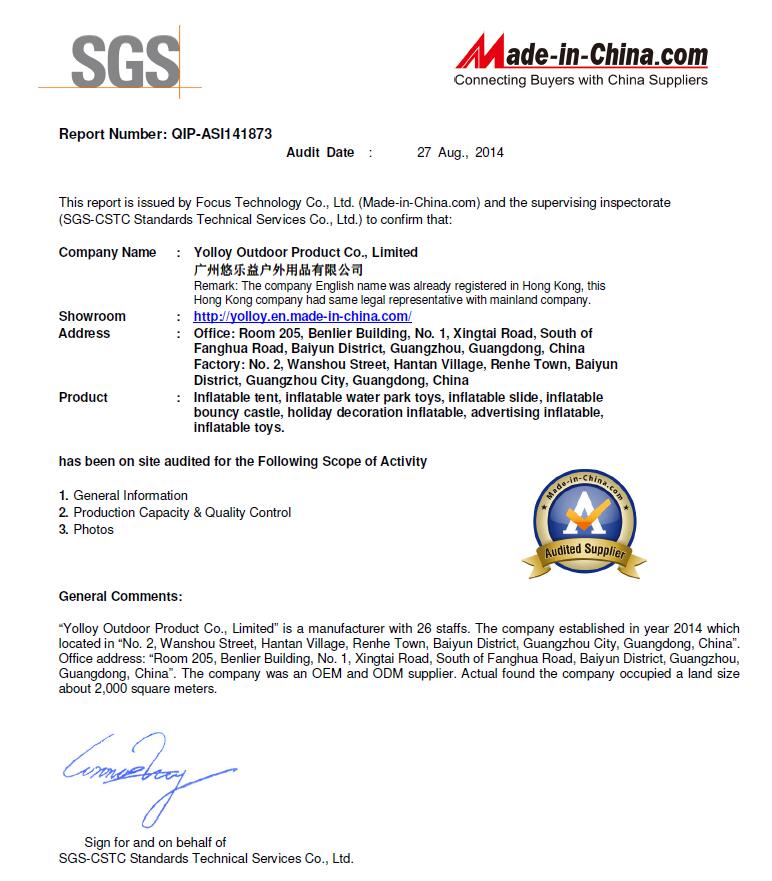
China has become the world's leading production hub for inflatable products, and for good reason. Chinese manufacturers combine advanced production capabilities with competitive pricing that is difficult to match elsewhere. Among the many options available, Yolloy Outdoor Product Co., Limited — operating through its website at yolloy.net — stands out as a comprehensive solution provider for businesses seeking quality inflatable dome tents and related products.
Based in Guangzhou, YOLLOY specializes in custom-designed inflatable products across a broad range of categories. The company's product portfolio spans outdoor inflatable tents, clear dome tents, portable planetarium domes, water park products, interactive sports games, commercial slides, bounce houses, paintball bunkers, air mattresses, and advertising inflatables. This breadth of expertise means YOLLOY can handle diverse project requirements under one roof.
What sets YOLLOY apart is its commitment to the custom design-to-production workflow. The process begins with a client's concept — whether it is a detailed CAD drawing, a rough sketch, a photograph of an existing structure, or simply a written description of requirements. YOLLOY's design team prepares simulation renderings for client review and revises the design until approval is secured. Only then does the project move to the factory floor for production. This iterative approach ensures that the final product aligns precisely with the client's vision.
Customization Without Compromise
One of the strongest arguments for sourcing from a specialized manufacturer like YOLLOY is the level of customization available. Off-the-shelf tents may work for some applications, but businesses that want to differentiate themselves in a competitive market need products that reflect their unique brand identity and operational requirements.
YOLLOY offers customization across virtually every dimension of an inflatable tent project:
Size and Dimensions: Tents can be manufactured to precise specifications — from compact domes for intimate dining experiences to large-scale structures for major events and exhibitions. Custom sizes ensure the tent fits your intended site and usage scenario perfectly.
Colors and Branding: Custom colors are available across the entire product range. Company logos, artwork, and branding elements can be printed directly onto the tent surface using durable, weather-resistant printing techniques. This turns every tent into a mobile billboard for your brand.
Material Selection: Depending on the intended use case, YOLLOY can recommend and supply the optimal material — from heavy-duty PVC tarpaulin for permanent installations to lightweight Oxford fabric for portable applications, or TPU for clear panels that require optical clarity.
Blower Configuration: Blowers are supplied to match local electrical standards — 110V for North America, 220V for Europe and Asia, or 380V for industrial applications. This eliminates the need for external voltage converters.
Accessories and Add-Ons: Doors, windows, flooring systems, lighting integration, ventilation panels, and connecting tunnels can all be incorporated into the design. The minimum order quantity is just one piece, making it feasible to order a single customized prototype before committing to a larger production run.
Quality Assurance and Material Standards
Quality control is a cornerstone of YOLLOY's manufacturing philosophy. Every product undergoes inspection and testing before shipment, ensuring that what arrives at your door meets the specifications agreed upon during the design phase.
The company's materials have passed EN71, EN14960, and RoHS-related testing, with inflatable water park products referencing EN 15649. Blowers supplied with YOLLOY products are described as meeting CE or UL requirements. These certifications provide assurance that the products meet internationally recognized safety and environmental standards — a critical consideration for businesses operating in regulated markets.
The manufacturing process itself combines precision sewing equipment for fabric assembly with high-temperature fusion welding for airtight sections. Seams are reinforced with waterproof nylon thread, and additional reinforcement is applied at high-load areas. Each product is supplied with a repair kit, and the company states a three-year service life expectation when products are used and maintained correctly.
Production and Delivery: Typical production time for a regular inflatable product is 6–15 days, excluding transit. Air shipping takes 5–7 days, while sea shipping requires 15–30 days or more. YOLLOY reports a 95% on-time delivery rate and responds to emails and faxes within 24 hours.
Packaging, Shipping, and After-Sales Support
International buyers know that how a product is packed and shipped is nearly as important as how it is made. YOLLOY uses a multi-layer packaging approach: soft carpet protection directly against the product surface, waterproof PVC bags for moisture protection, and outer PE film wrapping. Large or heavy products are shipped on steel pallets for additional protection during transit.
Every inflatable product includes a repair kit, enabling on-site maintenance that extends the product's usable life. The company's stated three-year warranty coverage — subject to proper use and maintenance — provides peace of mind for businesses making a significant capital investment in their inflatable tent inventory.
With exports to Europe, Asia, South America, Africa, the Middle East, and Latin America, YOLLOY has established logistics channels and experience navigating international shipping requirements. The company's Guangzhou location provides convenient access to major Chinese shipping ports and international air freight hubs.
Getting Started with Your Inflatable Dome Tent Project
Launching or expanding an inflatable tent business requires careful planning and the right manufacturing partner. Here is a recommended approach to getting started:
1. Define Your Requirements: Determine the primary use case, target market, required sizes, preferred materials, and any special features you need. Having a clear brief — even a rough sketch or description — helps manufacturers provide accurate quotations.
2. Request Design Renderings: Work with the manufacturer's design team to create simulation renderings of your proposed tent. This visualization step helps identify potential issues and refine the design before production begins.
3. Start with a Sample: With a minimum order quantity of just one piece, you can order a single unit to evaluate quality, setup time, and customer response before scaling up. This low-risk approach is particularly valuable for businesses testing a new product category.
4. Plan Your Logistics: Factor in production time (6–15 days) and shipping transit time when planning your inventory. For seasonal businesses, ordering well in advance of peak season ensures your products arrive when you need them.
5. Build Your Marketing: High-quality inflatable dome tents are visually striking products that practically market themselves. Use professional photography and video of your tents in action to attract clients and build your brand presence.
Ready to Explore Inflatable Dome Tents for Your Business?
Whether you need a single custom dome for a signature event or a full inventory of inflatable tents for your rental business, YOLLOY offers the design expertise, manufacturing quality, and responsive service to bring your vision to life. With custom sizes, colors, branding, and materials available — plus CE/UL-compliant blowers and internationally recognized safety certifications — YOLLOY is a reliable partner for businesses worldwide.
Contact YOLLOY today at [email protected] or call +86-20-8370 0771 to discuss your project requirements. Visit www.yolloy.net to browse the complete product range and learn more about how custom inflatable solutions can elevate your event business.