Products Category
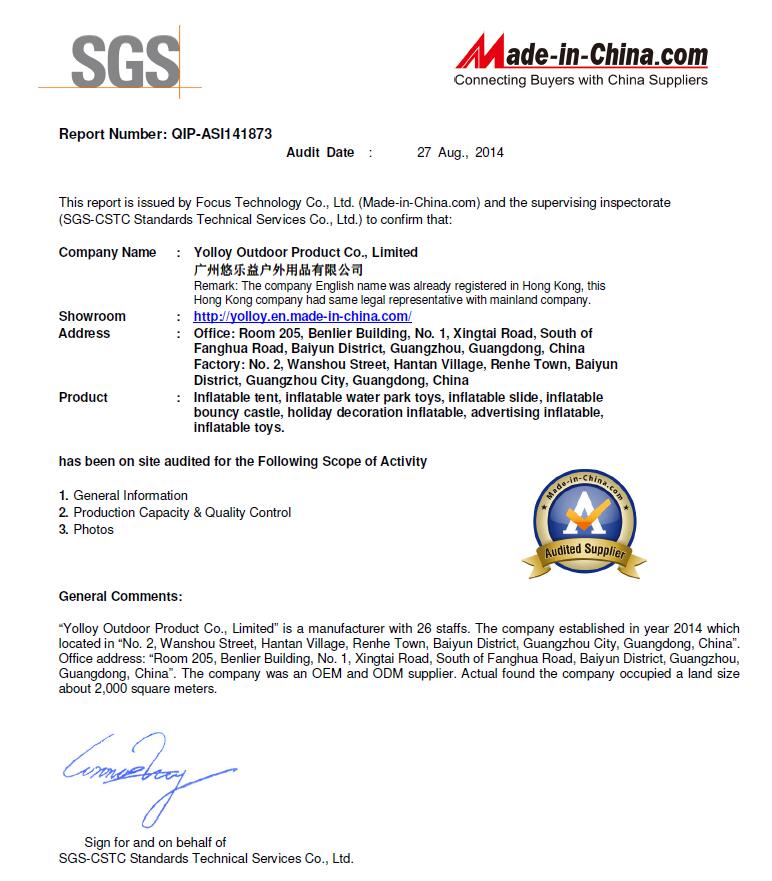
Certification

News

• New Order Successfully Finished for Long-Time Cooperated Japanese Client | YOLLOY Wins Full Client Recognition

• YOLLOY Custom Inflatable Pool Tent for Danish Client: Professional Pool Repair Shelter & Debris Protection

• Trusted Once Again! Greek Captain Re-orders Our Products After 4 Years

• Revolutionize Your Outdoors: The All-Terrain Inflatable Floating Tent for Land & Water

• Elevate Your Summer Fun: The Ultimate Inflatable Water Floating Volleyball Court Trampoline

• Innovative Inflatable Nightclub Tents & Pop-Up Bars: The Ultimate Solution for Portable Party Venues

Contact Us

Name: Sunny Yang
Tel: +86-20-8370 0771
Fax: +86-20-8370 0771
Mobile: 13570587575
E-mail: [email protected]
Add: No 5,Xiong wei Bo Nan Road,ZhongLuoTan Town,Baiyun district,Guangzhou,China
Friend me on Facebook Follow me on Twitter Add me to your circles Follow me on Pinterest Watch my channel on YouTube
News

How to Choose the Right Inflatable Obstacle Course for Your Business: A Complete Buying Guide

Author:yolloy Date:2026/8/10 7:28:09
Investing in an inflatable obstacle course is one of the smartest moves a rental business, event organizer, or amusement park operator can make. These versatile attractions draw crowds at festivals, corporate team-building days, school sports events, and public fun runs. But not all obstacle courses are built the same — and making the wrong choice can lead to costly repairs, safety incidents, and disappointed customers. This guide walks you through everything you need to know before placing an order, from material selection and safety certifications to customization options and supplier vetting. Whether you are expanding your rental fleet or launching a new entertainment venue, the right knowledge will help you secure a product that delivers returns for years.
1. Define Your Business Use Case First Before browsing catalogs, clarify how and where the obstacle course will be used. The requirements differ significantly across scenarios: Rental Business If you operate a party rental or event hire company, you need a unit that sets up and packs down quickly — ideally within 15 to 20 minutes. Modular designs that can be reconfigured for different venues give you more booking flexibility. Durability is non-negotiable since the unit will be transported, inflated, and deflated repeatedly. Fixed Amusement Venue For a permanent installation at a water park, trampoline park, or family entertainment center, throughput capacity matters most. You want wide lanes and multi-entry designs that keep queues moving. The unit will stay inflated for hours daily, so blower reliability and energy efficiency become key considerations. Special Events and Fun Runs For inflatable 5K races, corporate team-building days, or school sports carnivals, you need a mix of obstacle types — climbing walls, crawl tunnels, slides, and agility challenges. The course should accommodate a wide age range and fitness level. Event organizers should also consider branding: can you print your sponsor's logo on the side walls?
2. Material Quality: What Separates Commercial Grade from Consumer Grade The material used in your obstacle course directly determines how long it will last and how safe it will be. Commercial-grade inflatable obstacle course units are built from heavy-duty PVC tarpaulin — not the lightweight nylon found in backyard toys. Look for the following specifications when evaluating a supplier: • PVC Tarpaulin: Commercial-grade PVC resists tearing, abrasion, and UV degradation. This is the standard material for professional inflatables exposed to outdoor conditions and heavy foot traffic. • Reinforced Seams: High-stress areas — slide bottoms, climbing wall bases, anchor points, and pillar connections — should feature double or quadruple stitching with waterproof nylon thread. Ask your supplier about additional webbing reinforcement at load-bearing zones. • High-Temperature Welding: For airtight sections, high-frequency fusion welding creates stronger, more reliable seals than stitching alone. This is especially important for water-contact components and inflatable structures that must maintain constant pressure. • Anchor Systems: D-ring or round metal anchor points should be integrated at both base and mid-height positions. Stainless steel hardware resists rust and maintains integrity through repeated outdoor use.
3. Safety Certifications and Testing Standards Safety is not just a feature — it is a legal requirement and a business reputation issue. When sourcing from an inflatable obstacle course manufacturer, verify that their products meet recognized international standards:
Key Certifications to Look For • EN 14960 — European standard for inflatable play equipment, covering structural integrity, anchoring, and entrapment hazards
• EN 71 — Safety of toys standard, relevant for units used by children
• RoHS — Restriction of hazardous substances in materials
• CE / UL Blowers — Blowers should carry CE or UL certification for electrical safety
Beyond certifications, a responsible manufacturer conducts pre-shipment inspection and testing on every unit. Ask about their quality control process: do they inflate and inspect each product before packing? Do they test blower output, seam integrity, and anchor strength? These practices separate serious manufacturers from commodity suppliers.
4. Customization: Making the Course Your Own One of the biggest advantages of working directly with a factory is the ability to customize your obstacle course. A good manufacturer can design a unit from a description, a rough sketch, a photograph of a venue, or even a site plan and budget. Customization options typically include: • Size and Layout: Adjust the length, width, lane count, and obstacle configuration to fit your venue dimensions and throughput targets. • Color Scheme: Match your brand colors or event theme. Solid vinyl colors hold up better than full digital printing under prolonged sun exposure, but both options are available. • Logo and Artwork Printing: Print your company logo, event sponsor branding, or custom artwork directly onto the inflatable. This turns the obstacle course into a mobile billboard. • Blower Configuration: Blowers can be supplied for 110V, 220V, or 380V power requirements depending on your local electrical standards.
5. Minimum Order Quantity, Lead Time, and Shipping When you buy inflatable obstacle course units from a manufacturer, understanding the production and logistics timeline is critical for event planning: • Minimum Order Quantity (MOQ): Some factories require bulk orders of 5 or 10 units. Others accept a single piece. If you are testing a new product category or placing a custom order for a specific event, a low MOQ of one piece gives you flexibility without overcommitting capital. • Production Time: A standard inflatable product typically takes 6 to 15 days to manufacture. Complex custom designs or large multi-piece courses may require additional time. Plan your procurement at least 2 to 3 months ahead of your event date. • Shipping Options: Air freight delivers in approximately 5 to 7 days, while sea freight takes 15 to 30 days or more. Choose based on your timeline and budget. Large units may ship on steel pallets for protection. • Packaging: Quality packaging matters. Expect soft carpet protection, waterproof PVC bags, and outer PE film. This multi-layer approach prevents damage during transit and extends the product's shelf life in storage.
6. After-Sales Support: What You Should Expect The relationship with your manufacturer should not end when the shipment leaves the factory. Before placing an order, confirm the following after-sales provisions: • Repair Kit: Every inflatable product should ship with a repair kit containing patches, adhesive, and thread for on-site fixes. This keeps your unit in service while you arrange for professional repairs. • Warranty: A reasonable expectation is a service life of around three years with proper use and maintenance. Clarify what the warranty covers — stitching, material defects, blower failure — and for how long. • Response Time: A reliable supplier answers inquiries within 24 hours. When you have a question about setup, a repair, or a reorder, you should not be left waiting for days. • On-Time Delivery Track Record: Ask about the manufacturer's delivery performance. A consistent on-time delivery rate of 95% or higher is a strong indicator of a well-run operation.
7. Complementary Products to Maximize Your Investment An obstacle course rarely stands alone at an event. Consider bundling your purchase with complementary inflatables to create a complete entertainment package. Products that pair well with obstacle courses include: • Inflatable Slides: A giant slide serves as the signature attraction and draws crowds from across the venue. • Bounce Houses: Classic inflatable bouncers keep younger children entertained while older kids and adults tackle the obstacle course. • Interactive Sports Games: Inflatable football arenas, zorb balls, and bumper ball courts add variety and encourage repeat visits. • Water Park Toys: For summer events, inflatable water slides, floating platforms, and splash pools turn a dry obstacle course into a multi-zone water adventure. • Advertising Inflatables: Custom arches, sky dancers, and branded inflatable models promote your event and attract foot traffic.
Frequently Asked Questions How long does it take to set up an inflatable obstacle course? A typical commercial unit inflates in 10 to 20 minutes with the correct blower. Anchoring adds another 10 to 15 minutes depending on the surface type. With practice, a two-person team can have a course fully operational in under 30 minutes. Can inflatable obstacle courses be used on hard surfaces? Yes. While grass is the most common surface, hard surfaces like parking lots, gym floors, and concrete plazas are also suitable. On hard ground, you replace ground stakes with sandbags or water ballast weights. Ensure the manufacturer provides sufficient D-ring anchor points for this configuration. What maintenance is required? Clean the unit after each use with mild soap and water, and always dry it completely before storage to prevent mold and mildew. Inspect seams, anchor points, and blower connections before each event. Store the deflated unit in a cool, dry place away from direct sunlight and rodents. What is the typical lifespan of a commercial obstacle course? With proper care, a commercial-grade PVC inflatable obstacle course can serve reliably for three years or more in a rental rotation. High-traffic public events accelerate wear, so regular inspection and timely patch repairs are essential to maximize longevity.
Ready to Bring an Inflatable Obstacle Course to Your Business? YOLLOY Outdoor Product Co., Limited designs and manufactures custom inflatable obstacle courses, interactive sports games, water park products, commercial slides, bounce houses, and more from our factory in Guangzhou, China. With customizable sizing, logo printing, international safety certifications, a low MOQ of one piece, and a 95% on-time delivery rate, we are the partner you can count on. Contact us today at [email protected] or call +86-20-8370 0771 to discuss your project. We respond within 24 hours.

How to Choose the Right Inflatable Obstacle Course for Your Business: A Complete Buying Guide

Author:yolloy Date:2026/8/10 7:28:09

Investing in an inflatable obstacle course is one of the smartest moves a rental business, event organizer, or amusement park operator can make. These versatile attractions draw crowds at festivals, corporate team-building days, school sports events, and public fun runs. But not all obstacle courses are built the same — and making the wrong choice can lead to costly repairs, safety incidents, and disappointed customers. This guide walks you through everything you need to know before placing an order, from material selection and safety certifications to customization options and supplier vetting. Whether you are expanding your rental fleet or launching a new entertainment venue, the right knowledge will help you secure a product that delivers returns for years.
1. Define Your Business Use Case First Before browsing catalogs, clarify how and where the obstacle course will be used. The requirements differ significantly across scenarios: Rental Business If you operate a party rental or event hire company, you need a unit that sets up and packs down quickly — ideally within 15 to 20 minutes. Modular designs that can be reconfigured for different venues give you more booking flexibility. Durability is non-negotiable since the unit will be transported, inflated, and deflated repeatedly. Fixed Amusement Venue For a permanent installation at a water park, trampoline park, or family entertainment center, throughput capacity matters most. You want wide lanes and multi-entry designs that keep queues moving. The unit will stay inflated for hours daily, so blower reliability and energy efficiency become key considerations. Special Events and Fun Runs For inflatable 5K races, corporate team-building days, or school sports carnivals, you need a mix of obstacle types — climbing walls, crawl tunnels, slides, and agility challenges. The course should accommodate a wide age range and fitness level. Event organizers should also consider branding: can you print your sponsor's logo on the side walls?
2. Material Quality: What Separates Commercial Grade from Consumer Grade The material used in your obstacle course directly determines how long it will last and how safe it will be. Commercial-grade inflatable obstacle course units are built from heavy-duty PVC tarpaulin — not the lightweight nylon found in backyard toys. Look for the following specifications when evaluating a supplier: • PVC Tarpaulin: Commercial-grade PVC resists tearing, abrasion, and UV degradation. This is the standard material for professional inflatables exposed to outdoor conditions and heavy foot traffic. • Reinforced Seams: High-stress areas — slide bottoms, climbing wall bases, anchor points, and pillar connections — should feature double or quadruple stitching with waterproof nylon thread. Ask your supplier about additional webbing reinforcement at load-bearing zones. • High-Temperature Welding: For airtight sections, high-frequency fusion welding creates stronger, more reliable seals than stitching alone. This is especially important for water-contact components and inflatable structures that must maintain constant pressure. • Anchor Systems: D-ring or round metal anchor points should be integrated at both base and mid-height positions. Stainless steel hardware resists rust and maintains integrity through repeated outdoor use.
3. Safety Certifications and Testing Standards Safety is not just a feature — it is a legal requirement and a business reputation issue. When sourcing from an inflatable obstacle course manufacturer, verify that their products meet recognized international standards:
Key Certifications to Look For • EN 14960 — European standard for inflatable play equipment, covering structural integrity, anchoring, and entrapment hazards
• EN 71 — Safety of toys standard, relevant for units used by children
• RoHS — Restriction of hazardous substances in materials
• CE / UL Blowers — Blowers should carry CE or UL certification for electrical safety
Beyond certifications, a responsible manufacturer conducts pre-shipment inspection and testing on every unit. Ask about their quality control process: do they inflate and inspect each product before packing? Do they test blower output, seam integrity, and anchor strength? These practices separate serious manufacturers from commodity suppliers.
4. Customization: Making the Course Your Own One of the biggest advantages of working directly with a factory is the ability to customize your obstacle course. A good manufacturer can design a unit from a description, a rough sketch, a photograph of a venue, or even a site plan and budget. Customization options typically include: • Size and Layout: Adjust the length, width, lane count, and obstacle configuration to fit your venue dimensions and throughput targets. • Color Scheme: Match your brand colors or event theme. Solid vinyl colors hold up better than full digital printing under prolonged sun exposure, but both options are available. • Logo and Artwork Printing: Print your company logo, event sponsor branding, or custom artwork directly onto the inflatable. This turns the obstacle course into a mobile billboard. • Blower Configuration: Blowers can be supplied for 110V, 220V, or 380V power requirements depending on your local electrical standards.
5. Minimum Order Quantity, Lead Time, and Shipping When you buy inflatable obstacle course units from a manufacturer, understanding the production and logistics timeline is critical for event planning: • Minimum Order Quantity (MOQ): Some factories require bulk orders of 5 or 10 units. Others accept a single piece. If you are testing a new product category or placing a custom order for a specific event, a low MOQ of one piece gives you flexibility without overcommitting capital. • Production Time: A standard inflatable product typically takes 6 to 15 days to manufacture. Complex custom designs or large multi-piece courses may require additional time. Plan your procurement at least 2 to 3 months ahead of your event date. • Shipping Options: Air freight delivers in approximately 5 to 7 days, while sea freight takes 15 to 30 days or more. Choose based on your timeline and budget. Large units may ship on steel pallets for protection. • Packaging: Quality packaging matters. Expect soft carpet protection, waterproof PVC bags, and outer PE film. This multi-layer approach prevents damage during transit and extends the product's shelf life in storage.
6. After-Sales Support: What You Should Expect The relationship with your manufacturer should not end when the shipment leaves the factory. Before placing an order, confirm the following after-sales provisions: • Repair Kit: Every inflatable product should ship with a repair kit containing patches, adhesive, and thread for on-site fixes. This keeps your unit in service while you arrange for professional repairs. • Warranty: A reasonable expectation is a service life of around three years with proper use and maintenance. Clarify what the warranty covers — stitching, material defects, blower failure — and for how long. • Response Time: A reliable supplier answers inquiries within 24 hours. When you have a question about setup, a repair, or a reorder, you should not be left waiting for days. • On-Time Delivery Track Record: Ask about the manufacturer's delivery performance. A consistent on-time delivery rate of 95% or higher is a strong indicator of a well-run operation.
7. Complementary Products to Maximize Your Investment An obstacle course rarely stands alone at an event. Consider bundling your purchase with complementary inflatables to create a complete entertainment package. Products that pair well with obstacle courses include: • Inflatable Slides: A giant slide serves as the signature attraction and draws crowds from across the venue. • Bounce Houses: Classic inflatable bouncers keep younger children entertained while older kids and adults tackle the obstacle course. • Interactive Sports Games: Inflatable football arenas, zorb balls, and bumper ball courts add variety and encourage repeat visits. • Water Park Toys: For summer events, inflatable water slides, floating platforms, and splash pools turn a dry obstacle course into a multi-zone water adventure. • Advertising Inflatables: Custom arches, sky dancers, and branded inflatable models promote your event and attract foot traffic.
Frequently Asked Questions How long does it take to set up an inflatable obstacle course? A typical commercial unit inflates in 10 to 20 minutes with the correct blower. Anchoring adds another 10 to 15 minutes depending on the surface type. With practice, a two-person team can have a course fully operational in under 30 minutes. Can inflatable obstacle courses be used on hard surfaces? Yes. While grass is the most common surface, hard surfaces like parking lots, gym floors, and concrete plazas are also suitable. On hard ground, you replace ground stakes with sandbags or water ballast weights. Ensure the manufacturer provides sufficient D-ring anchor points for this configuration. What maintenance is required? Clean the unit after each use with mild soap and water, and always dry it completely before storage to prevent mold and mildew. Inspect seams, anchor points, and blower connections before each event. Store the deflated unit in a cool, dry place away from direct sunlight and rodents. What is the typical lifespan of a commercial obstacle course? With proper care, a commercial-grade PVC inflatable obstacle course can serve reliably for three years or more in a rental rotation. High-traffic public events accelerate wear, so regular inspection and timely patch repairs are essential to maximize longevity.
Ready to Bring an Inflatable Obstacle Course to Your Business? YOLLOY Outdoor Product Co., Limited designs and manufactures custom inflatable obstacle courses, interactive sports games, water park products, commercial slides, bounce houses, and more from our factory in Guangzhou, China. With customizable sizing, logo printing, international safety certifications, a low MOQ of one piece, and a 95% on-time delivery rate, we are the partner you can count on. Contact us today at [email protected] or call +86-20-8370 0771 to discuss your project. We respond within 24 hours.