Products Category
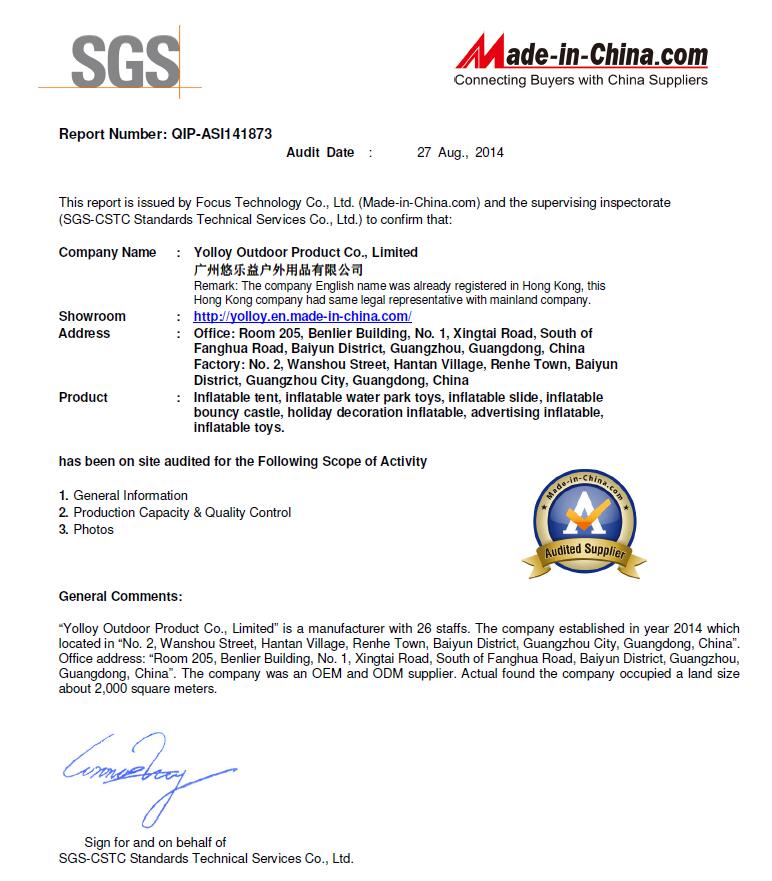
Certification

News

• New Order Successfully Finished for Long-Time Cooperated Japanese Client | YOLLOY Wins Full Client Recognition

• YOLLOY Custom Inflatable Pool Tent for Danish Client: Professional Pool Repair Shelter & Debris Protection

• Trusted Once Again! Greek Captain Re-orders Our Products After 4 Years

• Revolutionize Your Outdoors: The All-Terrain Inflatable Floating Tent for Land & Water

• Elevate Your Summer Fun: The Ultimate Inflatable Water Floating Volleyball Court Trampoline

• Innovative Inflatable Nightclub Tents & Pop-Up Bars: The Ultimate Solution for Portable Party Venues

Contact Us

Name: Sunny Yang
Tel: +86-20-8370 0771
Fax: +86-20-8370 0771
Mobile: 13570587575
E-mail: [email protected]
Add: No 5,Xiong wei Bo Nan Road,ZhongLuoTan Town,Baiyun district,Guangzhou,China
Friend me on Facebook Follow me on Twitter Add me to your circles Follow me on Pinterest Watch my channel on YouTube
News

How to Source from Reliable Inflatable Tent Manufacturers: A Practical Guide for Business Buyers

Author:yolloy Date:2026/8/6 1:41:51
How to Source from Reliable Inflatable Tent Manufacturers: A Practical Guide for Business Buyers
Whether you operate an event rental company, run a glamping site, organize outdoor exhibitions, or manage emergency response logistics, finding the right inflatable tent manufacturers is one of the most consequential supply-chain decisions you will make. The wrong supplier means delayed shipments, substandard materials, and disappointed customers. The right partner means consistent quality, on-time delivery, and products that perform reliably across hundreds of deployments. This guide walks through exactly what to look for, what questions to ask, and how to evaluate a manufacturer before placing your first order.
Why the Manufacturer Matters More Than the Product Spec Sheet
A product specification sheet tells you what a tent should be. A manufacturer tells you what it will actually be. Two factories can produce an inflatable dome tent with identical dimensions on paper, yet deliver wildly different results in terms of seam strength, material longevity, and safety compliance. The difference comes down to the production process: the grade of PVC tarpaulin sourced, the precision of the sewing equipment, the quality of high-temperature fusion welding, and the rigor of pre-shipment inspection. When you evaluate inflatable tent manufacturers, you are evaluating their commitment to every step of that chain.
Material Quality: The Foundation of a Durable Inflatable Tent
Commercial-grade inflatable tents are built from materials that consumer camping tents simply cannot match. The most common base material is commercial PVC tarpaulin, selected for its waterproof properties, tear resistance, and UV stability. Depending on the application, manufacturers may also use Oxford fabric, nylon, or TPU. Each material has its own performance profile: Oxford fabric offers excellent breathability for event tents, TPU provides superior cold-weather flexibility, and PVC tarpaulin delivers the all-around durability required for high-frequency commercial use.
Beyond the base material, look for manufacturers whose fabrics have passed relevant safety and environmental testing. Standards such as EN71 (toy safety), EN14960 (inflatable play equipment), EN15649 (floating leisure articles), and RoHS (hazardous substance restriction) are important indicators that a manufacturer takes compliance seriously. The blowers supplied with the tent should carry CE or UL certification, confirming they meet electrical safety requirements for your target market.
Production Capabilities: What Happens Inside the Factory
A well-equipped inflatable tent factory operates two distinct production lines: one for sewn products and one for airtight welded products. Sewn products such as tent bodies, sidewalls, and fabric accessories use precision sewing equipment with reinforced seams and waterproof nylon thread. Additional reinforcement is applied at high-load areas where stress concentrates during inflation and wind exposure. Airtight products, such as inflatable beams and sealed chambers, are manufactured using high-temperature fusion welding equipment that creates seamless, leak-proof bonds.
This dual capability matters because it means the factory can handle both the structural frame (welded) and the fabric shell (sewn) under one roof. When these processes are split across different facilities, quality control becomes fragmented and lead times lengthen. A vertically integrated manufacturer who controls both workflows can deliver a more consistent product in a shorter timeframe.
Customization: Turning Your Idea Into a Finished Product
One of the strongest arguments for working directly with a manufacturer rather than buying off-the-shelf is the ability to customize. A custom inflatable tent can be designed from a description, a rough sketch, a photograph, a site plan, or even a budget. The design team produces simulation renderings based on your proposal, iterates on the design until you approve it, and then releases the final version for production.
Customization extends beyond dimensions. You can specify colors to match your brand identity, have your company logo printed directly on the tent panels, and request specific blower voltage configurations (110V, 220V, or 380V) to match the electrical infrastructure at your deployment locations. D-ring and round metal anchor systems are integrated into the design for wind resistance and installation stability. The goal is not just a tent that fits your space it is a tent that fits your entire operational workflow.
The Product Range: Tents Are Just the Beginning
While inflatable tents are the core product category, the best manufacturers offer a much broader portfolio. This matters because many business buyers start with tents and later expand into complementary products. A single reliable supplier who can provide outdoor inflatable tents, clear inflatable dome tents and bubble tents, portable planetarium domes, inflatable water parks and pools, interactive sports games, commercial inflatable slides, bounce houses, paintball bunkers, inflatable air mattresses, and advertising inflatables simplifies procurement, reduces shipping costs through consolidated orders, and builds a supplier relationship that grows with your business.
Key Evaluation Criteria for Choosing a Manufacturer
1. Minimum Order Quantity
A minimum order quantity (MOQ) of one piece is a strong signal that the manufacturer is willing to work with businesses at every stage from startups testing a new product category to established operators placing bulk orders. A high MOQ requirement may lock you into inventory you cannot move, so clarify this upfront.
2. Production and Delivery Timeline
Typical production time for a regular inflatable product is 6 to 15 days, excluding transit. Complex or large custom products may take longer. For shipping, air freight generally takes 5 to 7 days, while sea freight takes 15 to 30 days or more. Ask the manufacturer for a realistic timeline based on your specific order, and factor in seasonal demand fluctuations that can affect production capacity.
3. Quality Control and Inspection
Every product should be inspected and tested before shipment. Ask about the manufacturer's quality control process: Do they inflate and test each tent? Do they check seam integrity, air retention, and blower performance? A manufacturer who can describe their inspection workflow in detail is far more reliable than one who offers vague assurances.
4. Repair Kit and After-Sales Support
A repair kit should be supplied with each inflatable product, allowing you to patch minor punctures in the field. The manufacturer should also provide guidance on proper maintenance: inspect after each use, clean before storage, ensure complete drying to prevent mildew, and periodically check blowers for dust buildup and cord wear. A three-year service life expectation is a reasonable benchmark when products are used and maintained correctly.
5. Packaging and Shipping
Proper packaging protects your investment during transit. Look for manufacturers who use soft carpet protection, waterproof PVC bags, and outer PE film for standard products, with steel pallets for large or heavy items. Ask about their shipping partnerships and whether they handle customs documentation for your target markets.
6. Communication and Responsiveness
A manufacturer who responds to emails and inquiries within 24 hours demonstrates the kind of reliability you need when timelines are tight. A stated 95% on-time delivery rate is a solid benchmark. The best manufacturers treat communication as part of the product, not an afterthought.
Certifications That Matter
Safety certifications are not just paperwork they are evidence that a manufacturer's products have been independently tested and verified. For inflatable tents, the most relevant certifications include EN71 for toy safety (applicable to products used by children), EN14960 for inflatable play equipment, EN15649 for floating leisure articles used in water parks, and RoHS for restriction of hazardous substances in materials. Blowers should carry CE marking for the European market or UL listing for the North American market. These certifications are particularly important if you operate in regulated markets where non-compliant products can result in liability issues or denied entry at customs.
Global Export Experience: Why It Matters
A manufacturer with experience exporting to Europe, Asia, South America, Africa, the Middle East, and Latin America has already navigated the logistical challenges you would otherwise face alone. They understand regional voltage requirements, packaging standards for long-distance shipping, and the documentation needed for smooth customs clearance. When you choose a supplier with established global distribution channels, you reduce the risk of shipping delays, damaged goods, and compliance surprises.
Making the Final Decision
After evaluating material quality, production capabilities, customization options, certifications, minimum order quantities, delivery timelines, and communication standards, you should have a clear picture of which manufacturer is the right fit. The ideal partner is one who can grow with your business starting with a single custom tent order and expanding into a full product line as your operations scale. The relationship you build with your manufacturer is one of the most valuable assets in your supply chain, so invest the time to choose wisely.
Ready to Partner with an Experienced Inflatable Tent Manufacturer?
YOLLOY Outdoor Product Co., Limited is a custom inflatable product manufacturer based in Guangzhou, China, serving clients across Europe, Asia, the Americas, the Middle East, and beyond. With a minimum order quantity of just one piece, a 95% on-time delivery rate, and a design-to-production workflow that turns your concept into a finished product, YOLLOY supports businesses at every stage of growth. Every order includes a repair kit, and products are built from commercial-grade PVC tarpaulin with materials tested to EN71, EN14960, EN15649, and RoHS standards. For inquiries about custom designs, pricing, or lead times, contact us at [email protected] or call +86-20-8370 0771.

How to Source from Reliable Inflatable Tent Manufacturers: A Practical Guide for Business Buyers

Author:yolloy Date:2026/8/6 1:41:51

How to Source from Reliable Inflatable Tent Manufacturers: A Practical Guide for Business Buyers
Whether you operate an event rental company, run a glamping site, organize outdoor exhibitions, or manage emergency response logistics, finding the right inflatable tent manufacturers is one of the most consequential supply-chain decisions you will make. The wrong supplier means delayed shipments, substandard materials, and disappointed customers. The right partner means consistent quality, on-time delivery, and products that perform reliably across hundreds of deployments. This guide walks through exactly what to look for, what questions to ask, and how to evaluate a manufacturer before placing your first order.
Why the Manufacturer Matters More Than the Product Spec Sheet
A product specification sheet tells you what a tent should be. A manufacturer tells you what it will actually be. Two factories can produce an inflatable dome tent with identical dimensions on paper, yet deliver wildly different results in terms of seam strength, material longevity, and safety compliance. The difference comes down to the production process: the grade of PVC tarpaulin sourced, the precision of the sewing equipment, the quality of high-temperature fusion welding, and the rigor of pre-shipment inspection. When you evaluate inflatable tent manufacturers, you are evaluating their commitment to every step of that chain.
Material Quality: The Foundation of a Durable Inflatable Tent
Commercial-grade inflatable tents are built from materials that consumer camping tents simply cannot match. The most common base material is commercial PVC tarpaulin, selected for its waterproof properties, tear resistance, and UV stability. Depending on the application, manufacturers may also use Oxford fabric, nylon, or TPU. Each material has its own performance profile: Oxford fabric offers excellent breathability for event tents, TPU provides superior cold-weather flexibility, and PVC tarpaulin delivers the all-around durability required for high-frequency commercial use.
Beyond the base material, look for manufacturers whose fabrics have passed relevant safety and environmental testing. Standards such as EN71 (toy safety), EN14960 (inflatable play equipment), EN15649 (floating leisure articles), and RoHS (hazardous substance restriction) are important indicators that a manufacturer takes compliance seriously. The blowers supplied with the tent should carry CE or UL certification, confirming they meet electrical safety requirements for your target market.
Production Capabilities: What Happens Inside the Factory
A well-equipped inflatable tent factory operates two distinct production lines: one for sewn products and one for airtight welded products. Sewn products such as tent bodies, sidewalls, and fabric accessories use precision sewing equipment with reinforced seams and waterproof nylon thread. Additional reinforcement is applied at high-load areas where stress concentrates during inflation and wind exposure. Airtight products, such as inflatable beams and sealed chambers, are manufactured using high-temperature fusion welding equipment that creates seamless, leak-proof bonds.
This dual capability matters because it means the factory can handle both the structural frame (welded) and the fabric shell (sewn) under one roof. When these processes are split across different facilities, quality control becomes fragmented and lead times lengthen. A vertically integrated manufacturer who controls both workflows can deliver a more consistent product in a shorter timeframe.
Customization: Turning Your Idea Into a Finished Product
One of the strongest arguments for working directly with a manufacturer rather than buying off-the-shelf is the ability to customize. A custom inflatable tent can be designed from a description, a rough sketch, a photograph, a site plan, or even a budget. The design team produces simulation renderings based on your proposal, iterates on the design until you approve it, and then releases the final version for production.
Customization extends beyond dimensions. You can specify colors to match your brand identity, have your company logo printed directly on the tent panels, and request specific blower voltage configurations (110V, 220V, or 380V) to match the electrical infrastructure at your deployment locations. D-ring and round metal anchor systems are integrated into the design for wind resistance and installation stability. The goal is not just a tent that fits your space it is a tent that fits your entire operational workflow.
The Product Range: Tents Are Just the Beginning
While inflatable tents are the core product category, the best manufacturers offer a much broader portfolio. This matters because many business buyers start with tents and later expand into complementary products. A single reliable supplier who can provide outdoor inflatable tents, clear inflatable dome tents and bubble tents, portable planetarium domes, inflatable water parks and pools, interactive sports games, commercial inflatable slides, bounce houses, paintball bunkers, inflatable air mattresses, and advertising inflatables simplifies procurement, reduces shipping costs through consolidated orders, and builds a supplier relationship that grows with your business.
Key Evaluation Criteria for Choosing a Manufacturer
1. Minimum Order Quantity
A minimum order quantity (MOQ) of one piece is a strong signal that the manufacturer is willing to work with businesses at every stage from startups testing a new product category to established operators placing bulk orders. A high MOQ requirement may lock you into inventory you cannot move, so clarify this upfront.
2. Production and Delivery Timeline
Typical production time for a regular inflatable product is 6 to 15 days, excluding transit. Complex or large custom products may take longer. For shipping, air freight generally takes 5 to 7 days, while sea freight takes 15 to 30 days or more. Ask the manufacturer for a realistic timeline based on your specific order, and factor in seasonal demand fluctuations that can affect production capacity.
3. Quality Control and Inspection
Every product should be inspected and tested before shipment. Ask about the manufacturer's quality control process: Do they inflate and test each tent? Do they check seam integrity, air retention, and blower performance? A manufacturer who can describe their inspection workflow in detail is far more reliable than one who offers vague assurances.
4. Repair Kit and After-Sales Support
A repair kit should be supplied with each inflatable product, allowing you to patch minor punctures in the field. The manufacturer should also provide guidance on proper maintenance: inspect after each use, clean before storage, ensure complete drying to prevent mildew, and periodically check blowers for dust buildup and cord wear. A three-year service life expectation is a reasonable benchmark when products are used and maintained correctly.
5. Packaging and Shipping
Proper packaging protects your investment during transit. Look for manufacturers who use soft carpet protection, waterproof PVC bags, and outer PE film for standard products, with steel pallets for large or heavy items. Ask about their shipping partnerships and whether they handle customs documentation for your target markets.
6. Communication and Responsiveness
A manufacturer who responds to emails and inquiries within 24 hours demonstrates the kind of reliability you need when timelines are tight. A stated 95% on-time delivery rate is a solid benchmark. The best manufacturers treat communication as part of the product, not an afterthought.
Certifications That Matter
Safety certifications are not just paperwork they are evidence that a manufacturer's products have been independently tested and verified. For inflatable tents, the most relevant certifications include EN71 for toy safety (applicable to products used by children), EN14960 for inflatable play equipment, EN15649 for floating leisure articles used in water parks, and RoHS for restriction of hazardous substances in materials. Blowers should carry CE marking for the European market or UL listing for the North American market. These certifications are particularly important if you operate in regulated markets where non-compliant products can result in liability issues or denied entry at customs.
Global Export Experience: Why It Matters
A manufacturer with experience exporting to Europe, Asia, South America, Africa, the Middle East, and Latin America has already navigated the logistical challenges you would otherwise face alone. They understand regional voltage requirements, packaging standards for long-distance shipping, and the documentation needed for smooth customs clearance. When you choose a supplier with established global distribution channels, you reduce the risk of shipping delays, damaged goods, and compliance surprises.
Making the Final Decision
After evaluating material quality, production capabilities, customization options, certifications, minimum order quantities, delivery timelines, and communication standards, you should have a clear picture of which manufacturer is the right fit. The ideal partner is one who can grow with your business starting with a single custom tent order and expanding into a full product line as your operations scale. The relationship you build with your manufacturer is one of the most valuable assets in your supply chain, so invest the time to choose wisely.
Ready to Partner with an Experienced Inflatable Tent Manufacturer?
YOLLOY Outdoor Product Co., Limited is a custom inflatable product manufacturer based in Guangzhou, China, serving clients across Europe, Asia, the Americas, the Middle East, and beyond. With a minimum order quantity of just one piece, a 95% on-time delivery rate, and a design-to-production workflow that turns your concept into a finished product, YOLLOY supports businesses at every stage of growth. Every order includes a repair kit, and products are built from commercial-grade PVC tarpaulin with materials tested to EN71, EN14960, EN15649, and RoHS standards. For inquiries about custom designs, pricing, or lead times, contact us at [email protected] or call +86-20-8370 0771.