The outdoor recreation industry is experiencing a wave of innovation, and at the center of this transformation is the
inflatable water park. Once seen as simple backyard accessories, inflatable water parks have evolved into sophisticated commercial attractions that draw crowds to resorts, campgrounds, municipal parks, and entertainment venues around the world. If you are a business owner or investor looking for a high-return, low-barrier entry into the recreation market, an inflatable water park deserves serious consideration.
Why Inflatable Water Parks Are Outperforming Traditional Attractions
Traditional water parks require massive capital investment, years of construction, and ongoing maintenance of concrete structures, filtration systems, and permanent plumbing. A
commercial inflatable water park flips this model entirely. These structures are manufactured from commercial-grade PVC tarpaulin, fabricated with high-temperature fusion welding equipment, and reinforced with waterproof nylon thread at every seam. The result is a durable, safe, and visually striking attraction that can be deployed in a fraction of the time and at a fraction of the cost of a permanent installation.
The portability factor is a game-changer. An inflatable water park can be set up on a lake, a beachfront, or a flat piece of land, operated for a season, then deflated and stored during the off-season. This flexibility means operators can test different locations, move with seasonal demand, or even operate at multiple sites with a single set of equipment. For campgrounds, resorts, and municipal recreation departments, this adaptability translates directly into higher utilization rates and faster return on investment.
Materials and Safety: What Sets Commercial-Grade Products Apart
Not all inflatable water parks are created equal. The difference between a consumer-grade backyard product and a commercial attraction lies in materials, engineering, and certification. Professional-grade products from established
inflatable water park manufacturers use multi-layer PVC fabrics that have passed EN71, EN14960, and RoHS testing standards. For water park products specifically, EN 15649 certification is the relevant safety benchmark that governs floating leisure products used on water.
Blowers — the electric fans that keep the structures inflated — are another critical component. Commercial blowers should meet CE or UL requirements and be available in 110V, 220V, or 380V configurations to match local power infrastructure. D-ring and round metal anchor systems are integrated into the design to secure the structures against wind and water movement, ensuring safety during operation.
Quality manufacturers also include a repair kit with every product. A properly maintained inflatable product can deliver a service life of approximately three years under normal commercial use. Products are inspected and tested before shipment, and precision sewing equipment with additional reinforcement at high-load areas helps prevent seam failure during peak usage.
What You Can Expect from a Full-Scale Inflatable Water Park
A comprehensive inflatable water park installation can include a wide range of components. Floating platforms, climbing walls, trampolines, slides, obstacle courses, balance beams, and splash zones can all be integrated into a single layout. Many operators start with a core set of modules and expand their park over time, adding new attractions each season to keep visitors coming back.
The product range from a well-equipped inflatable water park factory typically includes inflatable water parks, floating platforms, water balls, zorb balls, inflatable pools, boats, and aquatic play products. Some manufacturers also produce complementary items like inflatable slides, bounce houses, and interactive sports games, allowing operators to create a complete entertainment destination from a single supplier.
Customization is another key advantage. An inflatable water park can be designed from a description, drawing, sketch, photograph, or site plan. Custom sizes, colors, and printed logos are available. The stated minimum order quantity from some manufacturers is just one piece, making it feasible to test a concept before committing to a full-scale installation.
The Business Case: Investment, Timeline, and Returns
The economics of operating an inflatable water park are compelling. The initial investment is significantly lower than a permanent water park, and the operational timeline from order to opening can be measured in weeks rather than years. Typical production time for a regular inflatable product is 6 to 15 days, excluding transit. Air shipping adds approximately 5 to 7 days, while sea shipping takes 15 to 30 days or more.
Operational costs are manageable. A water park requires staff for supervision, ticketing, and basic maintenance. The blowers run on standard electricity, and the structures themselves require minimal day-to-day upkeep beyond regular cleaning and inspection. The included repair kit handles minor punctures, and replacement parts are available from the manufacturer.
Revenue potential varies by location and scale, but the fundamentals are strong. A well-positioned inflatable water park on a popular lake or beachfront can charge admission fees, offer season passes, and generate additional revenue through concessions, merchandise, and private event rentals. The portability of the equipment means the operator is not locked into a single location — if one site underperforms, the entire park can be relocated.
How to Choose the Right Inflatable Water Park Manufacturer
Selecting the right supplier is the single most important decision in this process. Here are the key factors to evaluate:
Certifications and material quality: Verify that the manufacturer uses commercial-grade PVC tarpaulin and that materials have passed EN71, EN14960, EN15649, and RoHS testing. Blowers should carry CE or UL certification.
Customization capability: Can the supplier produce custom designs, sizes, and colors? Can they print your logo and branding on the products? Can they design from a concept rather than a catalog?
Production capacity and delivery: Look for suppliers with a stated 95% on-time delivery rate and the ability to handle both small and large orders. Confirm transit times for air and sea shipping to your location.
Minimum order quantity: A minimum order of one piece is ideal for initial testing. Some suppliers impose higher minimums, so clarify this upfront.
After-sales support: A repair kit should be included with every product. The manufacturer should be responsive to inquiries — a 24-hour email response time is a reasonable expectation.
Export experience: Suppliers with experience shipping to Europe, Asia, South America, Africa, the Middle East, and Latin America understand the logistics and compliance requirements of different markets.
The Future of Outdoor Recreation Is Inflatable
The inflatable water park market is still in its growth phase. As more operators discover the advantages of low upfront costs, rapid deployment, and operational flexibility, demand for quality products continues to rise. For entrepreneurs, resort operators, and municipal recreation directors, the window of opportunity is open.
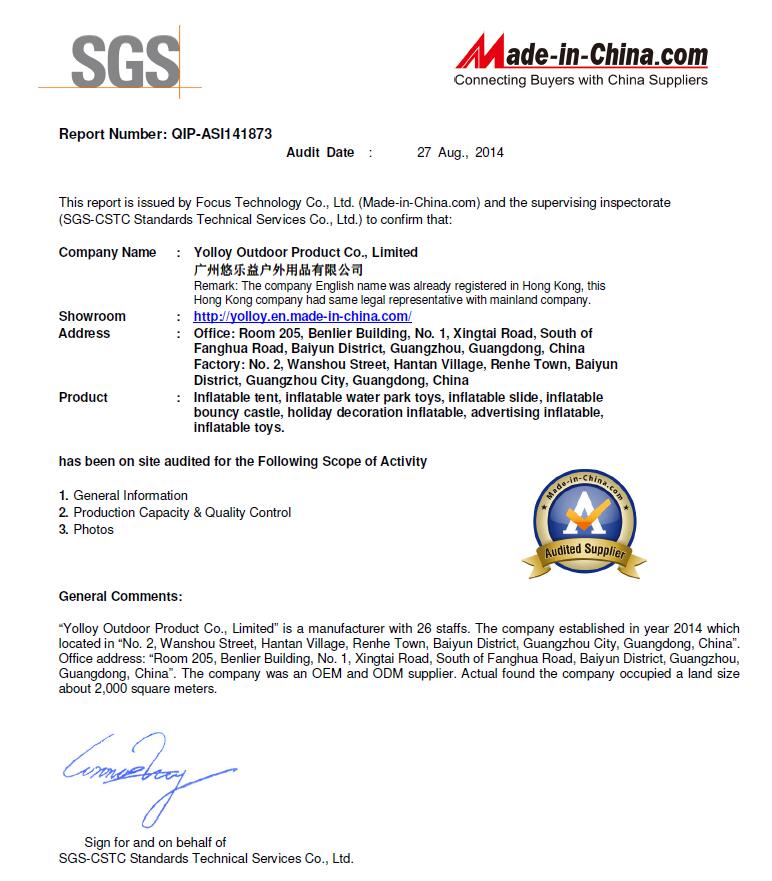
Whether you are looking to launch a new attraction, expand an existing venue, or diversify your entertainment portfolio, the right manufacturing partner makes all the difference. YOLLOY Outdoor Product Co., Limited designs and manufactures custom inflatable water parks, floating platforms, slides, and aquatic play products from its production base in Guangzhou, China. With a minimum order quantity of one piece, a stated 95% on-time delivery rate, and products exported to markets worldwide, YOLLOY provides a complete solution from design to delivery. For inquiries about custom designs, pricing, or lead times, reach out at
[email protected] or call
+86-20-8370 0771.