Products Category
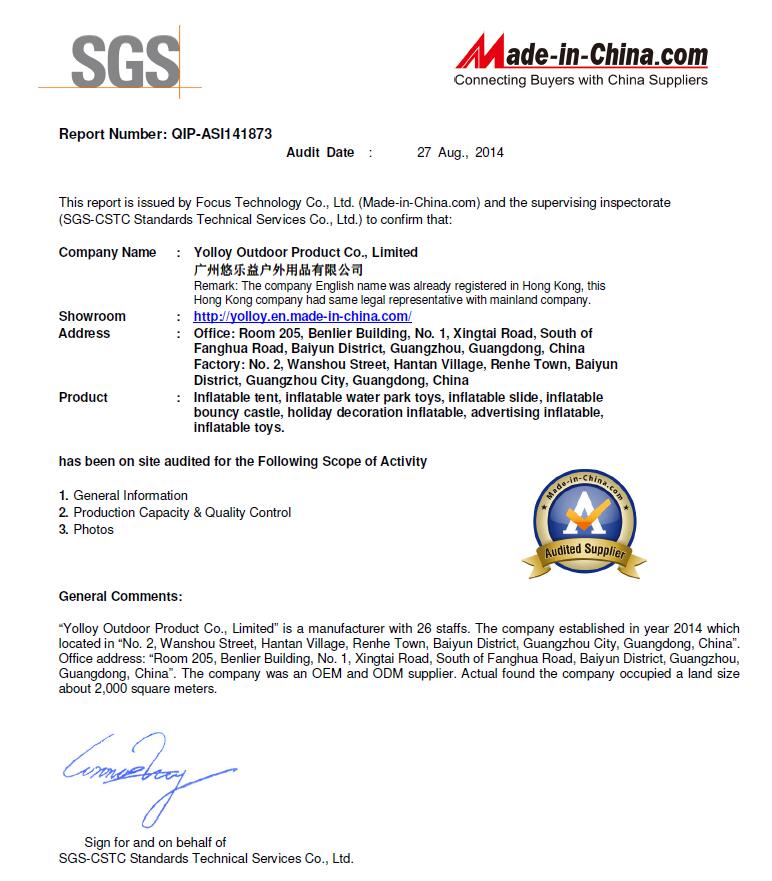
Certification

News

• New Order Successfully Finished for Long-Time Cooperated Japanese Client | YOLLOY Wins Full Client Recognition

• YOLLOY Custom Inflatable Pool Tent for Danish Client: Professional Pool Repair Shelter & Debris Protection

• Trusted Once Again! Greek Captain Re-orders Our Products After 4 Years

• Revolutionize Your Outdoors: The All-Terrain Inflatable Floating Tent for Land & Water

• Elevate Your Summer Fun: The Ultimate Inflatable Water Floating Volleyball Court Trampoline

• Innovative Inflatable Nightclub Tents & Pop-Up Bars: The Ultimate Solution for Portable Party Venues

Contact Us

Name: Sunny Yang
Tel: +86-20-8370 0771
Fax: +86-20-8370 0771
Mobile: 13570587575
E-mail: [email protected]
Add: No 5,Xiong wei Bo Nan Road,ZhongLuoTan Town,Baiyun district,Guangzhou,China
Friend me on Facebook Follow me on Twitter Add me to your circles Follow me on Pinterest Watch my channel on YouTube
News

How to choose YOLLOY inflatable training structures?

Author:yolloy Date:2026/8/17 2:44:26

Inflatable training structures have become a practical choice for sports clubs, military and police units, fitness centers, and event organizers. Unlike permanent buildings, they can be set up quickly, moved between locations, and packed away when not in use. But choosing the right one takes more than picking the biggest model you can find. This guide walks through the key points to consider before you place an order, so the structure you invest in actually fits the way you train.

Start with your training goal

The first step is to define what kind of training the structure will support, because different activities demand very different designs. For football and soccer skill drills, an inflatable football arena gives players a contained pitch for passing, shooting, and small-sided games. For fitness and team conditioning, an inflatable obstacle course challenges strength, agility, and coordination. For tactical and shooting practice, inflatable paintball bunkers recreate realistic cover and firing lanes. Endurance and altitude teams may look at inflatable altitude hypoxic training chambers, while stunt and action-sports crews rely on high fall stunt air bags for safe landings. Write down your goal, the number of trainees, and the training frequency first, then match the structure to that plan.

Match the size to your space and audience

Measure the area where the structure will be used, both indoors and outdoors, and leave clearance around the edges for safe entry and exit. Think about how many people need to train at the same time. A small group doing individual drills needs far less floor space than a full team running a conditioned session. YOLLOY offers custom sizes, so you are not forced to accept a standard footprint that wastes space or crowds your trainees.

Check the material and construction quality

Training structures take repeated impact, so the fabric and seams matter more than the shape. Commercial-grade PVC tarpaulin is used for many YOLLOY products, while tent projects may also be made from Oxford fabric, nylon, or TPU depending on the requirement. Sewn products use precision sewing equipment, reinforced seams, and waterproof nylon thread, with extra reinforcement at high-load areas. Airtight products are manufactured with high-temperature fusion and welding equipment so they hold pressure reliably over many sessions.

Look at safety, certification, and anchoring

Safety is non-negotiable when people train inside or on an inflatable. YOLLOY states that relevant materials have passed EN71, EN14960, and RoHS-related testing, with inflatable toys associated with EN 14960 and inflatable water parks referencing EN 15649. Blowers are described as meeting CE or UL requirements and can be supplied for 110V, 220V, or 380V. For outdoor use, D-ring or round metal anchor systems are incorporated where needed for installation and wind resistance, so the structure stays stable even in breezy conditions. Products are inspected and tested before shipment.

Customization and production workflow

A training structure should fit your space, your colors, and your branding. YOLLOY supports custom sizes and colors, and customer logos and artwork can be printed on products. You can design from a description, drawing, sketch, photograph, site plan, and budget. The workflow is straightforward: designers prepare simulation renderings from your proposal, revise the design until you approve it, and then release it for factory production. The stated minimum order quantity is one piece, and the typical production time for one regular inflatable product is 6 to 15 days, excluding transit time; complex or large custom products may take longer.

Plan for after-sales support

Training equipment gets used hard, so support after delivery matters. YOLLOY supplies a repair kit with each inflatable product, and the company describes a three-year service life and warranty expectation when products are used and maintained correctly, subject to product type and actual terms. Emails and faxes are answered within 24 hours, and the website reports a 95% on-time delivery rate. Air and sea shipping are both available, with indicative transit times of 5 to 7 days by air and 15 to 30 days or more by sea.

Make the final decision

Choosing an inflatable training structure comes down to matching the product to your training goal, space, and budget, then confirming the material, safety, and service behind it. A manufacturer that offers custom design, real certifications, and dependable after-sales support will save you from costly replacements later. If you are ready to compare options for your facility, contact YOLLOY with your space details and training requirements to get a tailored recommendation.


How to choose YOLLOY inflatable training structures?

Author:yolloy Date:2026/8/17 2:44:26

Inflatable training structures have become a practical choice for sports clubs, military and police units, fitness centers, and event organizers. Unlike permanent buildings, they can be set up quickly, moved between locations, and packed away when not in use. But choosing the right one takes more than picking the biggest model you can find. This guide walks through the key points to consider before you place an order, so the structure you invest in actually fits the way you train.

Start with your training goal

The first step is to define what kind of training the structure will support, because different activities demand very different designs. For football and soccer skill drills, an inflatable football arena gives players a contained pitch for passing, shooting, and small-sided games. For fitness and team conditioning, an inflatable obstacle course challenges strength, agility, and coordination. For tactical and shooting practice, inflatable paintball bunkers recreate realistic cover and firing lanes. Endurance and altitude teams may look at inflatable altitude hypoxic training chambers, while stunt and action-sports crews rely on high fall stunt air bags for safe landings. Write down your goal, the number of trainees, and the training frequency first, then match the structure to that plan.

Match the size to your space and audience

Measure the area where the structure will be used, both indoors and outdoors, and leave clearance around the edges for safe entry and exit. Think about how many people need to train at the same time. A small group doing individual drills needs far less floor space than a full team running a conditioned session. YOLLOY offers custom sizes, so you are not forced to accept a standard footprint that wastes space or crowds your trainees.

Check the material and construction quality

Training structures take repeated impact, so the fabric and seams matter more than the shape. Commercial-grade PVC tarpaulin is used for many YOLLOY products, while tent projects may also be made from Oxford fabric, nylon, or TPU depending on the requirement. Sewn products use precision sewing equipment, reinforced seams, and waterproof nylon thread, with extra reinforcement at high-load areas. Airtight products are manufactured with high-temperature fusion and welding equipment so they hold pressure reliably over many sessions.

Look at safety, certification, and anchoring

Safety is non-negotiable when people train inside or on an inflatable. YOLLOY states that relevant materials have passed EN71, EN14960, and RoHS-related testing, with inflatable toys associated with EN 14960 and inflatable water parks referencing EN 15649. Blowers are described as meeting CE or UL requirements and can be supplied for 110V, 220V, or 380V. For outdoor use, D-ring or round metal anchor systems are incorporated where needed for installation and wind resistance, so the structure stays stable even in breezy conditions. Products are inspected and tested before shipment.

Customization and production workflow

A training structure should fit your space, your colors, and your branding. YOLLOY supports custom sizes and colors, and customer logos and artwork can be printed on products. You can design from a description, drawing, sketch, photograph, site plan, and budget. The workflow is straightforward: designers prepare simulation renderings from your proposal, revise the design until you approve it, and then release it for factory production. The stated minimum order quantity is one piece, and the typical production time for one regular inflatable product is 6 to 15 days, excluding transit time; complex or large custom products may take longer.

Plan for after-sales support

Training equipment gets used hard, so support after delivery matters. YOLLOY supplies a repair kit with each inflatable product, and the company describes a three-year service life and warranty expectation when products are used and maintained correctly, subject to product type and actual terms. Emails and faxes are answered within 24 hours, and the website reports a 95% on-time delivery rate. Air and sea shipping are both available, with indicative transit times of 5 to 7 days by air and 15 to 30 days or more by sea.

Make the final decision

Choosing an inflatable training structure comes down to matching the product to your training goal, space, and budget, then confirming the material, safety, and service behind it. A manufacturer that offers custom design, real certifications, and dependable after-sales support will save you from costly replacements later. If you are ready to compare options for your facility, contact YOLLOY with your space details and training requirements to get a tailored recommendation.