Whether you run a party rental company, an indoor play center, or a family entertainment venue, finding a reliable inflatable bounce house manufacturer is one of the most important decisions you will make. The quality of your inflatables directly impacts customer safety, repeat business, and your bottom line. With so many suppliers competing in the market, how do you separate the trusted manufacturers from the ones that cut corners? In this guide, we walk through the key factors every buyer should evaluate before placing an order.
1. Start with Material Quality
The durability and safety of a bounce house begin with the raw materials. Commercial-grade inflatables are typically built from PVC tarpaulin, but thickness, coating quality, and certification standards vary widely from one factory to the next.
A reputable inflatable bounce house manufacturer will use 0.55mm or heavier PVC tarpaulin that is both waterproof and fire-resistant. The material should also carry relevant safety certifications such as EN71 and EN14960 for inflatable toys, and RoHS compliance for restricted substances. These standards give you confidence that the product meets European and international safety benchmarks.
Quick Checklist for Material Quality
- 0.55mm or thicker PVC tarpaulin
- Waterproof and flame-retardant coating
- EN71, EN14960, and RoHS test reports available
- Reinforced seams at high-stress points
- Heavy-duty D-rings or anchor points
2. Evaluate Manufacturing Experience and Capability
Experience matters in the inflatable industry. Manufacturers that have been designing and producing commercial inflatables for many years understand how structures behave under real-world use, where failures typically happen, and how to reinforce weak spots before they become problems.
When comparing suppliers, ask about their production capacity, the number of skilled sewing and welding technicians on staff, and their monthly output volume. A factory with a steady production rhythm and trained workers is far more likely to deliver consistent quality and meet your deadlines than a small workshop that relies on temporary labor.
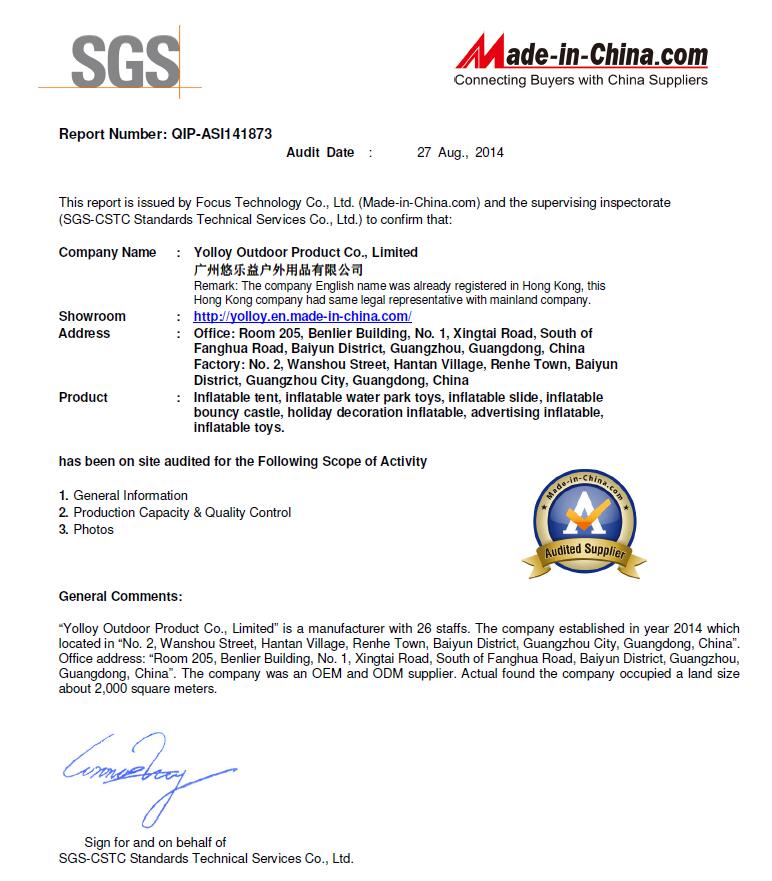
YOLLOY, for example, operates as a full-service custom inflatable solution provider based in Guangzhou, China. The company combines in-house design, precision sewing, and high-temperature fusion welding to produce everything from themed inflatable bounce houses to large-scale water parks and inflatable tents. Their design team creates 3D renderings from customer proposals and revises them until approval before moving into production.
3. Look Beyond the Catalog: Customization Matters
A catalog full of standard designs is a good starting point, but your business will stand out when you offer something unique. The best inflatable manufacturers support custom sizing, custom colors, and full-color logo printing so you can build a rental fleet that matches your brand identity.
Customization goes beyond aesthetics. If you need a bounce house to fit a specific indoor space, match a themed event, or accommodate a particular age group, your manufacturer should be able to adjust dimensions, add or remove features, and integrate accessories like basketball hoops, slides, and obstacle elements. A minimum order quantity of one piece is a strong signal that the factory is set up for custom work rather than only mass production.
For operators looking to expand their offerings, partnering with a manufacturer that also produces commercial inflatable slides, interactive sport games, and obstacle courses can simplify procurement and create cross-selling opportunities.
4. Verify Quality Control and Testing Procedures
Quality control is where many low-cost suppliers fall short. A serious inflatable bounce house manufacturer will inspect every unit before it leaves the factory. This typically includes a full inflation test, seam and weld inspection, blower compatibility testing, and a final check against the order specifications.
Ask whether the factory can provide photos or videos of the finished product before shipment. This simple step gives you a chance to catch mistakes early and avoids the cost and delay of returning a defective unit. Some manufacturers also offer factory video tours or live video calls so you can see your order being built in real time.
In addition to in-factory checks, look for manufacturers whose blowers carry CE or UL certification. The blower is the heart of any inflatable, and a low-quality blower can overheat, fail unexpectedly, or create safety hazards for users.
5. Understand Warranty and After-Sales Support
Even the best-built inflatables need occasional repairs. Before you commit to a supplier, find out what kind of warranty they offer and how they handle after-sales issues.
A standard warranty for commercial inflatables is around three years when products are used and maintained correctly. The manufacturer should supply a repair kit with every unit, including patches and adhesive for quick field repairs. For more significant issues, you want a partner that responds quickly and provides clear guidance rather than leaving you to figure it out on your own.
Responsive communication is part of good after-sales service. Look for manufacturers that answer emails within 24 hours and have dedicated sales or support contacts who can help with replacement parts, reorders, or technical questions.
6. Consider Total Cost, Not Just Price
It is tempting to choose the cheapest quote, but the lowest price rarely gives you the best long-term value. A bounce house that costs 20% less upfront but needs repairs after a few months of use — or worse, fails and causes an injury — will end up costing far more in the long run.
When comparing quotes, consider the full picture: material grade, construction quality, blower brand, warranty coverage, shipping costs, and the manufacturer's track record for on-time delivery. A 95% on-time delivery rate, for instance, means fewer last-minute surprises and better planning for your event calendar.
Also think about shipping options. Air freight is faster (typically 5 to 7 days) but more expensive, while sea freight (15 to 30 days or more) is more economical for large orders. A manufacturer that can accommodate both and provide transparent transit estimates helps you balance speed and budget.
7. Check Packaging and Logistics
Proper packaging protects your investment during transit. Quality manufacturers use multiple layers — soft carpet protection on the inside, waterproof PVC bags in the middle, and outer PE film or steel pallets for larger items. This layered approach prevents scuffs, punctures, and water damage while the product is in transit.
If you are ordering multiple units or large custom structures, ask about consolidation and container loading. A manufacturer experienced with international shipping will know how to pack efficiently to maximize container space and reduce your per-unit shipping cost.
Final Thoughts
Choosing the right inflatable bounce house manufacturer is an investment in the long-term success of your business. By prioritizing material quality, manufacturing experience, customization capability, quality control, after-sales support, and total cost of ownership, you can find a partner that delivers safe, durable products and stands behind what they sell.
If you are ready to explore commercial-grade inflatable bounce houses, slides, interactive games, and more, YOLLOY offers a full catalog backed by custom design services, certified materials, and a responsive support team. With products exported to Europe, Asia, South America, Africa, the Middle East, and Latin America, they have the experience to handle orders of any size and complexity.