How to Choose a Portable Planetarium Dome for Education and Events
A practical guide for schools, museums, event organizers, and entrepreneurs looking to invest in immersive astronomy experiences.
Portable planetarium domes have changed the way schools, museums, and event organizers deliver astronomy education. Instead of building a permanent facility that costs millions, a
portable planetarium dome can be set up in a gymnasium, community hall, or exhibition space in under an hour. The result is an immersive, 360-degree environment where audiences sit inside a darkened dome and watch planets, constellations, and galaxies projected across the curved ceiling above them.
Whether you are launching a mobile planetarium business, expanding a school's STEM curriculum, or adding a signature attraction to science festivals and corporate events, the dome you choose will shape your program for years. This guide covers what to look for in an
inflatable planetarium tent, how to evaluate manufacturers, and why a direct relationship with a factory matters.
What Makes a Portable Planetarium Dome Work
A portable planetarium dome is an inflatable structure kept upright by a continuously running electric blower. Once inflated, a digital projection system inside the dome casts images of the night sky, planets, and astronomical phenomena onto the interior surface. The curved shape wraps the visuals around the audience, creating a sense of actually being under the stars.
Unlike traditional planetariums housed in permanent buildings, these inflatable domes can be packed into carrying bags, loaded into a standard vehicle, and transported between venues. A typical dome requires a floor area of roughly 7 by 7 meters and a ceiling height of at least 3.5 meters. Setup and takedown each take about 50 minutes, making the dome suitable for day-long school visits or weekend events.
Key Factors to Evaluate Before Buying
Not all domes are built the same way. Here are the areas that deserve the most attention when comparing options.
Dome size and audience capacity. A 6-meter dome can comfortably hold around 30 to 40 people seated on the floor. Larger domes accommodate bigger groups but require more space and a more powerful blower. Think about the venues you plan to visit and the typical group sizes you will serve.
Material and construction. The dome fabric should be durable enough for frequent setup and takedown. Commercial-grade PVC tarpaulin is a common choice for its strength and weather resistance. Depending on specific requirements, manufacturers may also use Oxford fabric, nylon, or TPU. Reinforced seams and waterproof nylon thread are essential for longevity, and high-temperature fusion welding equipment is used for airtight sections.
Blower and electrical requirements. The blower runs continuously while the dome is in use, so it needs to be reliable and appropriately powered. A manufacturer should be able to supply blowers in 110V, 220V, or 380V configurations to match local electrical standards. CE or UL certification for the blower is a sign of quality.
Projection system compatibility. The dome should work with the projector you plan to use. Some domes are designed for standard digital projectors with a fisheye lens, while others come with integrated projection surfaces. Clarify this with the manufacturer before placing an order.
Portability and storage. Check how the dome packs down. A well-designed dome fits into reinforced carrying bags with protective carpet lining and waterproof PVC covers. Large domes may ship on steel pallets for secure transport.
Why Work Directly with a Manufacturer
When you buy from a distributor or reseller, you pay a markup and often lose direct access to the people who actually build the product. Working with a
portable planetarium dome company that operates its own factory gives you several advantages.
First, you can communicate your requirements directly to the design team. If you need a specific dome diameter, a particular color scheme, or your organization's logo printed on the exterior, a factory-based manufacturer can handle those requests without routing them through a middleman. Second, direct pricing tends to be more competitive because there is no distributor margin added on top. Third, after-sales support — replacement parts, repair guidance, and technical questions — is faster when you are talking to the same team that built the dome.
A quality
portable planetarium dome manufacturer should also be transparent about its materials and production standards. Ask whether the materials have passed relevant safety testing. For inflatable products, EN71 and EN14960 certifications are common benchmarks, while RoHS compliance addresses hazardous substance restrictions. Blowers that meet CE or UL requirements add another layer of confidence.
Customization: Making the Dome Your Own
A portable planetarium dome is not just a piece of equipment — it is the face of your program. Customization options let you align the dome with your brand or institutional identity. Most manufacturers offer custom sizes and colors, and many can print logos, artwork, and text on the dome exterior. The process typically starts with a design proposal: you share a description, drawing, sketch, or photograph, and the manufacturer prepares simulation renderings for your approval before production begins.
Beyond the dome itself, you may also want to consider an
inflatable planetarium projection dome tent that comes with integrated features such as cable management ports, reinforced anchor points, and entry tunnels that block outside light. These details make a real difference in daily operation.
Questions to Ask Before You Order
Having a clear checklist helps you compare suppliers and avoid surprises. Here are the questions worth asking any manufacturer:
What materials do you use, and what certifications do they hold? Look for commercial-grade PVC tarpaulin, Oxford fabric, nylon, or TPU, with EN71, EN14960, or RoHS testing documentation.
What blower specifications do you offer? Confirm that the blower matches your local voltage and holds CE or UL certification.
What is the production lead time? For a single regular inflatable product, production typically takes 6 to 15 days. Complex or large custom orders may take longer.
What shipping options are available? Air freight generally takes 5 to 7 days, while sea freight takes 15 to 30 days or more, depending on the destination.
Do you include a repair kit? A repair kit should be supplied with every inflatable product, giving you the ability to handle minor punctures or seam issues on site.
What is the minimum order quantity? Some manufacturers require bulk orders. Others, like YOLLOY, accept a minimum order quantity of just one piece.
What warranty or expected service life do you offer? A well-made dome used and maintained correctly should serve reliably for several years. YOLLOY states a three-year service life expectation when products are used and maintained properly, subject to product type and actual terms.
YOLLOY: A Manufacturing Partner for Portable Planetarium Domes
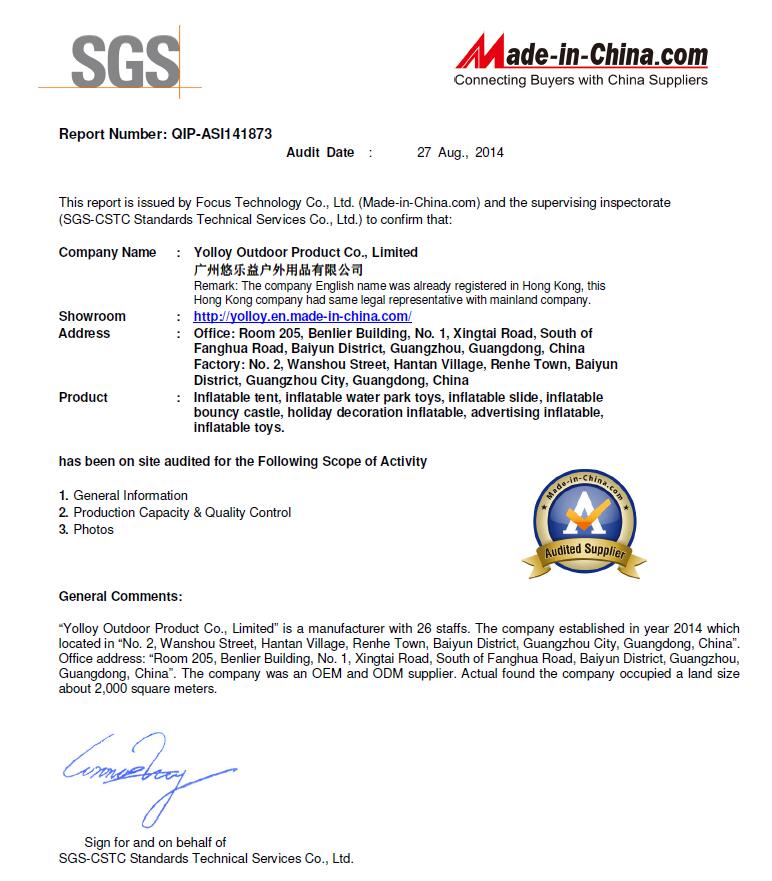
YOLLOY Outdoor Product Co., Limited, based in Guangzhou, China, designs and manufactures a wide range of inflatable products, including portable planetarium domes and inflatable projection screens. The company operates a custom design-to-production workflow: designers prepare simulation renderings from customer proposals, revise the design until it is approved, and then release it for factory production.
YOLLOY uses commercial-grade PVC tarpaulin for many products, with Oxford fabric, nylon, and TPU also available depending on project requirements. The company's materials have passed EN71, EN14960, and RoHS-related testing. Blowers meet CE or UL requirements. Sewn products are made with precision sewing equipment, reinforced seams, waterproof nylon thread, and extra reinforcement at high-load areas. Airtight products are manufactured with high-temperature fusion and welding equipment. Every product is inspected and tested before shipment, and a repair kit is included with each order.
YOLLOY accepts custom sizes, colors, and logo printing, with a minimum order quantity of one piece. The company reports a 95% on-time delivery rate and ships by air and sea worldwide, including to Europe, Asia, South America, Africa, the Middle East, and Latin America. Packaging uses soft carpet protection, waterproof PVC bags, and outer PE film, with steel pallets for larger products. Email and fax inquiries are answered within 24 hours.
Making the Right Investment
A portable planetarium dome is a long-term asset. The upfront cost matters, but so does durability, after-sales support, and the manufacturer's willingness to work with you on custom requirements. A dome that tears easily, takes too long to set up, or cannot be repaired quickly will cost more in lost bookings and frustration than the money saved on a cheaper purchase.
Take the time to talk to manufacturers directly. Ask for material samples, reference photos of completed domes, and clarification on every specification that matters to your program. A responsive manufacturer that answers questions thoroughly and provides clear timelines is a good sign that the partnership will be smooth beyond the initial order.
Ready to Explore Your Options?
If you are looking for a
portable planetarium dome manufacturer with factory-direct pricing, custom design capabilities, and international shipping, visit
YOLLOY Outdoor Product Co., Limited to browse the product range or contact the team at
[email protected] to discuss your requirements. A custom design proposal with simulation renderings can be prepared from your description, drawing, or sketch — with no obligation and a minimum order of just one piece.