From brand activations and trade shows to outdoor dining and emergency shelters — here is everything you need to know before investing in a commercial inflatable tent.
Inflatable tents have quietly reshaped the way businesses think about temporary structures. Walk through any major trade show, outdoor festival, or luxury camping site, and you will likely spot one — a sleek, air-supported dome or cube that went from packed bag to fully functional venue in under half an hour. What was once a niche product for camping enthusiasts has evolved into a serious commercial solution, trusted by event organizers, hospitality brands, sports teams, and industrial operators worldwide.
The appeal is straightforward: a custom inflatable tent delivers the structural integrity of a traditional frame tent without the back-breaking setup, the storage headaches, or the limited design flexibility. But not all inflatable tents are created equal, and choosing the right one for your business involves more than picking a size and a color. This guide walks you through the key considerations — from tent types and material quality to customization options and what to expect from a reliable manufacturer.
Why Inflatable Tents Are Winning Over Traditional Structures
The fundamental difference between an inflatable tent and a conventional pole-and-canvas tent lies in the frame. Instead of aluminum or steel poles, inflatable tents use air-filled beams made from high-strength commercial-grade PVC tarpaulin or Oxford fabric. A quiet, continuously running blower keeps the structure rigid and stable. When the event ends, the blower is switched off, the air escapes, and the entire tent folds into a compact package that fits in the trunk of a car or a small storage closet.
Key advantages over traditional tents: Setup takes 15–30 minutes with one or two people instead of a crew of four. No tools, no ladders, no pinched fingers. The absence of rigid poles means the tent flexes with wind rather than resisting it, which actually improves stability in gusty conditions. And because the structure is soft and seamless, the design possibilities — custom shapes, full-color printing, transparent panels — far exceed what is possible with frame tents.
Types of Outdoor Inflatable Tents
An outdoor inflatable tent is not a single product category — it is a broad family of structures, each optimized for different use cases. Understanding the types available will help you narrow down the right fit for your project.
-
Inflatable Dome Tents — The curved, aerodynamic shape of a dome tent naturally sheds wind and rain, making it one of the most stable inflatable structures. Domes are widely used for exhibition booths, pop-up retail spaces, VIP lounges, and planetarium projections.
-
Inflatable Cube Tents — With straight walls and a flat ceiling, cube tents maximize usable interior floor space. They are ideal for trade show booths, medical triage stations, field command centers, and any application where every square foot counts.
-
Inflatable Tunnel Tents — Long, connected structures designed for walk-through experiences. Common uses include sports team entry tunnels, brand experience corridors, and covered pedestrian walkways at outdoor events.
-
Clear Inflatable Dome Tents — Also known as inflatable bubble tents, these transparent PVC shelters offer 360-degree panoramic views. They have become a signature element in luxury camping (glamping), rooftop dining, and outdoor lounge installations where the surrounding scenery is part of the experience.
-
Inflatable Party Tents — Designed for celebrations, these spacious tents combine generous interior volume with bold visual designs. They are a popular choice for weddings, corporate galas, birthday parties, and seasonal festivals.
-
Inflatable Spray Booths — Specialized ventilated tents for automotive detailing, industrial spray painting, and other applications requiring a controlled, dust-free environment.
Where Businesses Are Using Inflatable Tents
The versatility of inflatable tents means they show up in a surprising range of industries. An inflatable tent for events is probably the most visible application — music festivals, food and wine fairs, product launch parties, and corporate retreats all rely on inflatable structures to create memorable branded environments. But the use cases go much deeper.
-
Hospitality and Dining — Hotels and restaurants deploy inflatable bubble tents as private outdoor dining pods, extending their seating capacity year-round with a unique ambiance that guests actively seek out.
-
Sports and Recreation — Inflatable sport tents serve as sheltered player benches, equipment storage, first-aid stations, and spectator areas. Golf simulator enclosures are another growing niche, allowing year-round practice in a portable, weatherproof setting.
-
Automotive and Industrial — Inflatable spray booths create portable, ventilated environments for car detailing, furniture finishing, and industrial coating applications. The airtight design contains overspray and dust while the blower system maintains clean air circulation.
-
Emergency Response and Military — Rapid-deployment inflatable shelters are used as field hospitals, temporary housing, supply depots, and mobile command posts in disaster relief and military operations.
-
Retail and Brand Activations — Pop-up shops, sampling stations, and branded experience centers use inflatable tents to create immersive environments that can be set up in a parking lot one weekend and a city square the next.
Customization: The Real Competitive Advantage
What separates a generic inflatable tent from a true business asset is the depth of customization. When you work with a manufacturer that offers full design-to-production service, the tent becomes an extension of your brand — not just a shelter, but a statement.
-
Size and Layout — Everything is built to your specifications. Need a 3-meter cube for a trade show booth? A 20-meter tunnel for a festival entrance? Custom dimensions are standard practice, not an upsell.
-
Branding and Graphics — Full-color digital printing places your logo, brand colors, artwork, and messaging directly onto the tent fabric. The entire exterior becomes a billboard.
-
Material Selection — Choose from commercial-grade PVC tarpaulin, Oxford fabric, nylon, or TPU depending on your environment, durability requirements, and budget. Each material has different properties in terms of weight, opacity, UV resistance, and temperature tolerance.
-
Accessories — Add windows, multiple door configurations, transparent panels, flooring systems, internal lighting, HVAC ports, and anchor systems to create a fully functional, turnkey space.
-
Power Compatibility — Blowers are supplied to match your local voltage requirements — 110V, 220V, or 380V.
The design process at YOLLOY starts with your concept — whether that is a detailed CAD file, a hand-drawn sketch, a photograph of something similar, a site plan, or simply a verbal description and a budget. The design team prepares simulation renderings, revises them based on your feedback, and only releases the project for factory production after you sign off.
Quality and Safety: What Separates a Professional Product
Any commercial inflatable products you invest in should meet recognized safety and quality benchmarks. Here are the critical factors to evaluate before placing an order.
-
Material Certifications — Verify that materials have passed relevant testing. For inflatable toys and tents, EN71 and EN14960 are key standards. For water park products, EN 15649 applies. RoHS compliance addresses hazardous substance restrictions.
-
Blower Certification — The blower is the heart of the tent. It should meet CE or UL requirements, ensuring both electrical safety and reliable continuous operation.
-
Seam Construction — Look for precision sewing with waterproof nylon thread and reinforced seams. High-load areas — corners, anchor points, door frames — should receive additional reinforcement layers.
-
Airtight Welding — For products requiring airtight chambers, high-temperature fusion welding equipment creates consistent, durable seals that resist delamination over time.
-
Anchor Systems — D-ring and round metal anchor points should be integrated into the structure for wind resistance and stability, especially important for larger outdoor installations.
-
Pre-Shipment Testing — Every product should be fully inflated, inspected, and tested before it leaves the factory floor.
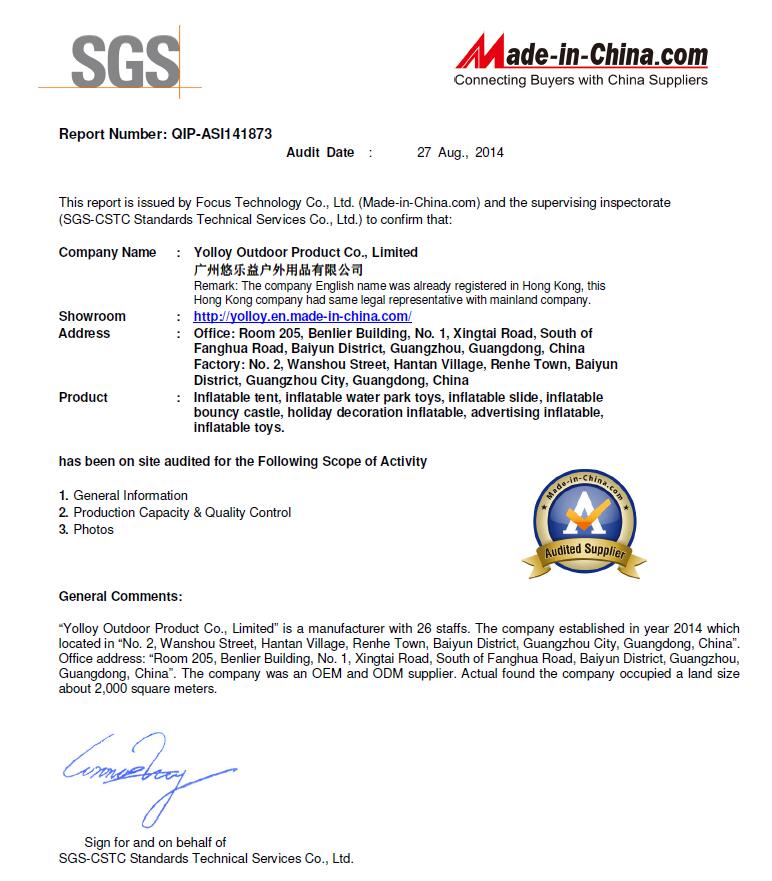
YOLLOY manufactures all products at its facility in Guangzhou, China, using precision sewing equipment and high-temperature fusion welding technology. Each item is inspected before shipment and comes with a repair kit for ongoing maintenance.
What to Expect from a Reliable Manufacturer
The product is only half the equation. The manufacturer's service level — responsiveness, flexibility, delivery reliability, and after-sales support — determines whether your investment pays off over the long term.
-
Responsive Communication — Inquiries should be answered within 24 hours. A dedicated contact person who understands your project from start to finish is preferable to a rotating cast of sales representatives.
-
Realistic Production Timelines — A production window of 6–15 days for standard products is reasonable. Complex or oversized custom projects will naturally take longer. Transparency about the timeline is more important than promises of impossibly fast turnaround.
-
Flexible Minimum Order Quantities — A manufacturer that accepts orders starting from a single piece allows you to test the product quality and market response before committing to volume.
-
Shipping Options — Both air freight (5–7 days transit) and sea freight (15–30+ days transit) should be available. Proper packaging — soft carpet protection, waterproof PVC bags, outer PE film, and steel pallets for large items — protects your investment during transit.
-
After-Sales Support — A repair kit should be included with every product. Clear maintenance guidance extends the service life. A three-year service life expectation, when products are used and maintained correctly, is a reasonable industry benchmark.
YOLLOY reports a 95% on-time delivery rate and supplies products to customers across Europe, Asia, South America, Africa, the Middle East, and Latin America. The company's stated approach — safety, durability, responsive service, reasonable pricing, and honest communication — reflects the priorities that matter most to commercial buyers.
Ready to Bring Your Inflatable Tent Project to Life?
Whether you need a single branded dome for an upcoming trade show or a fleet of custom tents for a multi-city event series, YOLLOY's design-to-production workflow turns your concept into a finished product — from initial sketch to factory delivery. Contact the YOLLOY team today to discuss your requirements, request a quote, or start the design process.