Products Category
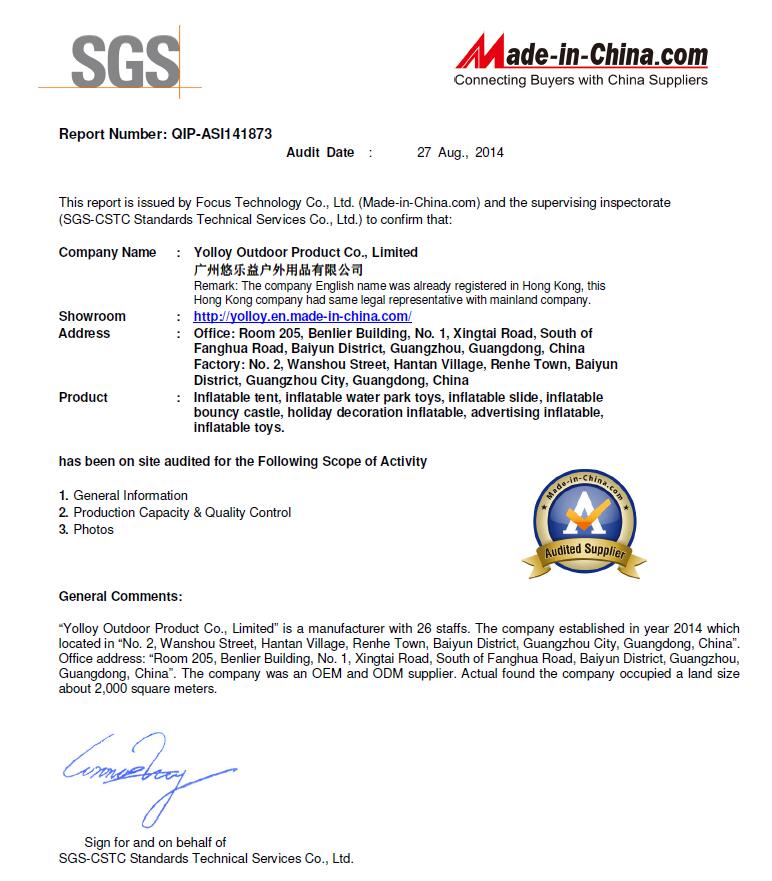
Certification

News

• New Order Successfully Finished for Long-Time Cooperated Japanese Client | YOLLOY Wins Full Client Recognition

• YOLLOY Custom Inflatable Pool Tent for Danish Client: Professional Pool Repair Shelter & Debris Protection

• Trusted Once Again! Greek Captain Re-orders Our Products After 4 Years

• Revolutionize Your Outdoors: The All-Terrain Inflatable Floating Tent for Land & Water

• Elevate Your Summer Fun: The Ultimate Inflatable Water Floating Volleyball Court Trampoline

• Innovative Inflatable Nightclub Tents & Pop-Up Bars: The Ultimate Solution for Portable Party Venues

Contact Us

Name: Sunny Yang
Tel: +86-20-8370 0771
Fax: +86-20-8370 0771
Mobile: 13570587575
E-mail: sales@yolloy.com
Add: No 5,Xiong wei Bo Nan Road,ZhongLuoTan Town,Baiyun district,Guangzhou,China
Friend me on Facebook Follow me on Twitter Add me to your circles Follow me on Pinterest Watch my channel on YouTube
News

Why Inflatable Floating Water Parks Are the Smartest Investment for Waterfront Venues

Author:yolloy Date:2026/7/25 20:02:18
A lakefront resort with a pristine shoreline. A hotel with a sprawling pool that rarely sees more than a handful of swimmers. A campground with waterfront access that guests use only for a quick paddle. These are not rare scenarios — they are missed opportunities happening every day at waterfront properties around the world.
The difference between a body of water that guests glance at and one that becomes the centerpiece of their entire stay often comes down to a single investment: an inflatable floating water park. These modular, action-packed attractions are rapidly reshaping how hotels, resorts, camps, and public beaches drive guest engagement, extend dwell time, and generate new revenue streams — all without the massive construction costs of permanent installations.
What Makes Floating Water Parks Different from Traditional Water Attractions
A traditional water park requires land acquisition, concrete foundations, plumbing infrastructure, and years of permitting. A floating water park, by contrast, can be installed on an existing body of water — a lake, a reservoir, a calm bay, or even a large commercial swimming pool — in a matter of days. The modular design means operators can start small and expand over time, adding new obstacles, slides, and climbing elements as demand grows.
Unlike permanent structures, floating parks are portable. They can be removed during off-seasons, reconfigured for special events, or relocated to a different part of the water. This flexibility is particularly valuable for seasonal businesses that need to maximize summer revenue while minimizing year-round maintenance costs.
Who Benefits Most from an Inflatable Water Park
The appeal of floating water parks spans a remarkably wide range of venues. Lakeside resorts use them to differentiate their property from competitors and justify premium room rates. Campgrounds turn passive waterfronts into aggressive family-booking magnets. Municipal parks departments deploy them to boost public pool attendance and generate rental income. Even private event organizers use portable setups for corporate team-building days and festival activations.
The common thread is this: wherever there is water and a desire to attract more visitors, an inflatable water park delivers a measurable return. Guests stay longer, spend more on food and beverage, and are far more likely to return — and to bring friends.
The Revenue Equation: Low Investment, Fast Payback
One of the most compelling arguments for floating water parks is the financial model. A permanent concrete water slide can cost hundreds of thousands of dollars and take a year or more to complete. A commercial-grade inflatable floating park, by comparison, can be operational within weeks of ordering — and at a fraction of the upfront cost.
Many operators recover their investment within a single summer season. Session fees, day passes, birthday party packages, and group bookings all contribute to a diversified revenue stream. Some venues report that the park itself becomes the primary reason guests book, effectively transforming the water feature from a passive amenity into the main attraction.
What to Look for in a Commercial-Grade Floating Park
Not all inflatable products are built for the demands of commercial use. When evaluating suppliers, operators should look for several key indicators of quality:
Commercial-grade PVC tarpaulin construction with reinforced seams and high-temperature fusion welding for airtight integrity
Materials that have passed relevant safety testing — including EN71, EN14960, and EN15649 standards — to ensure guest safety and regulatory compliance
CE or UL-certified blowers supplied at the correct voltage (110V, 220V, or 380V) for the installation site
Metal anchor systems (D-ring or round) designed to keep the structure stable in wind and water movement
Precision sewing with waterproof nylon thread and extra reinforcement at high-load connection points
A repair kit included with every order, so minor punctures can be addressed immediately without downtime
These are not theoretical checkboxes. They are the difference between a park that operates reliably season after season and one that becomes a maintenance headache. When sourcing commercial inflatable products, it is essential to verify that the manufacturer has documented quality control procedures and pre-shipment inspection protocols.
Customization: Your Park, Your Brand
A floating water park is not just a piece of equipment — it is a branded experience. The best suppliers offer full customization: custom sizes to fit the available water area, custom colors to match brand identity, and custom logos and artwork printed directly onto the products. Some manufacturers can even design an entirely new obstacle or layout from a simple sketch, description, or site plan.
This level of customization is particularly valuable for resorts and hotel chains that want a consistent visual identity across multiple properties, or for event companies that need themed setups for different clients. The minimum order quantity can be as low as one piece, which means even small businesses can get a fully bespoke product without committing to large-volume purchases.
Global Logistics and Delivery: What to Expect
For operators sourcing internationally, logistics matter as much as product quality. A reliable China inflatable manufacturer should offer both air and sea shipping options, with clear transit time estimates. Air freight typically delivers within 5–7 days, while sea freight ranges from 15–30 days or more depending on the destination port. Products should be packed with soft carpet protection, waterproof PVC bags, and outer PE film — with large items secured on steel pallets to prevent transit damage.
Equally important is after-sales support. Operators should confirm that the supplier provides a warranty — typically a three-year service life expectation under proper use and maintenance — and that email inquiries are answered within 24 hours. A manufacturer that reports a 95% on-time delivery rate and supplies repair kits with every product signals a commitment to keeping customers operational.
Beyond the Park: Complementary Products for a Complete Waterfront
A floating water park is often the anchor attraction, but it doesn't have to stand alone. Many operators build a complete aquatic entertainment zone by adding complementary inflatables: floating leisure platforms for lounging, inflatable jet ski docks for mooring, water balls and zorb balls for younger visitors, and inflatable boats for exploring the water. These additions increase the addressable audience — from thrill-seeking teenagers to families with young children — and create more touchpoints for revenue generation.
For venues that want to push even further, inflatable obstacle courses, interactive sports games, and commercial slides can transform a simple waterfront into a full-scale adventure park. The beauty of the modular approach is that operators can phase their investment, starting with a core floating park and expanding as revenue grows.
Key Questions to Ask Before You Buy
Before committing to a supplier, every operator should run through a short checklist of questions:
Can the manufacturer produce custom sizes and colors to match my specific water area and brand identity?
What safety certifications do the materials and blowers carry — and can the supplier provide documentation?
Is a repair kit included with the order, and what does the warranty cover?
What is the typical production timeline for a custom order, and what are the shipping options?
Can the supplier provide references or case studies from previous commercial installations?
Is the minimum order quantity flexible — can I order just one piece to test the market?
The answers to these questions will quickly separate manufacturers who understand commercial operations from those who simply sell products.
Ready to transform your waterfront into a revenue-generating destination? Whether you operate a lakeside resort, a campground, a public beach, or a commercial pool, an inflatable floating water park could be the investment that redefines your guest experience. With custom design, certified materials, global shipping, and a commitment to quality, YOLLOY Outdoor Product Co., Limited has been helping businesses around the world turn water into value. Contact us today at sales@yolloy.com or call +86-20-8370 0771 to discuss your project.

Why Inflatable Floating Water Parks Are the Smartest Investment for Waterfront Venues

Author:yolloy Date:2026/7/25 20:02:18

A lakefront resort with a pristine shoreline. A hotel with a sprawling pool that rarely sees more than a handful of swimmers. A campground with waterfront access that guests use only for a quick paddle. These are not rare scenarios — they are missed opportunities happening every day at waterfront properties around the world.
The difference between a body of water that guests glance at and one that becomes the centerpiece of their entire stay often comes down to a single investment: an inflatable floating water park. These modular, action-packed attractions are rapidly reshaping how hotels, resorts, camps, and public beaches drive guest engagement, extend dwell time, and generate new revenue streams — all without the massive construction costs of permanent installations.
What Makes Floating Water Parks Different from Traditional Water Attractions
A traditional water park requires land acquisition, concrete foundations, plumbing infrastructure, and years of permitting. A floating water park, by contrast, can be installed on an existing body of water — a lake, a reservoir, a calm bay, or even a large commercial swimming pool — in a matter of days. The modular design means operators can start small and expand over time, adding new obstacles, slides, and climbing elements as demand grows.
Unlike permanent structures, floating parks are portable. They can be removed during off-seasons, reconfigured for special events, or relocated to a different part of the water. This flexibility is particularly valuable for seasonal businesses that need to maximize summer revenue while minimizing year-round maintenance costs.
Who Benefits Most from an Inflatable Water Park
The appeal of floating water parks spans a remarkably wide range of venues. Lakeside resorts use them to differentiate their property from competitors and justify premium room rates. Campgrounds turn passive waterfronts into aggressive family-booking magnets. Municipal parks departments deploy them to boost public pool attendance and generate rental income. Even private event organizers use portable setups for corporate team-building days and festival activations.
The common thread is this: wherever there is water and a desire to attract more visitors, an inflatable water park delivers a measurable return. Guests stay longer, spend more on food and beverage, and are far more likely to return — and to bring friends.
The Revenue Equation: Low Investment, Fast Payback
One of the most compelling arguments for floating water parks is the financial model. A permanent concrete water slide can cost hundreds of thousands of dollars and take a year or more to complete. A commercial-grade inflatable floating park, by comparison, can be operational within weeks of ordering — and at a fraction of the upfront cost.
Many operators recover their investment within a single summer season. Session fees, day passes, birthday party packages, and group bookings all contribute to a diversified revenue stream. Some venues report that the park itself becomes the primary reason guests book, effectively transforming the water feature from a passive amenity into the main attraction.
What to Look for in a Commercial-Grade Floating Park
Not all inflatable products are built for the demands of commercial use. When evaluating suppliers, operators should look for several key indicators of quality:
Commercial-grade PVC tarpaulin construction with reinforced seams and high-temperature fusion welding for airtight integrity
Materials that have passed relevant safety testing — including EN71, EN14960, and EN15649 standards — to ensure guest safety and regulatory compliance
CE or UL-certified blowers supplied at the correct voltage (110V, 220V, or 380V) for the installation site
Metal anchor systems (D-ring or round) designed to keep the structure stable in wind and water movement
Precision sewing with waterproof nylon thread and extra reinforcement at high-load connection points
A repair kit included with every order, so minor punctures can be addressed immediately without downtime
These are not theoretical checkboxes. They are the difference between a park that operates reliably season after season and one that becomes a maintenance headache. When sourcing commercial inflatable products, it is essential to verify that the manufacturer has documented quality control procedures and pre-shipment inspection protocols.
Customization: Your Park, Your Brand
A floating water park is not just a piece of equipment — it is a branded experience. The best suppliers offer full customization: custom sizes to fit the available water area, custom colors to match brand identity, and custom logos and artwork printed directly onto the products. Some manufacturers can even design an entirely new obstacle or layout from a simple sketch, description, or site plan.
This level of customization is particularly valuable for resorts and hotel chains that want a consistent visual identity across multiple properties, or for event companies that need themed setups for different clients. The minimum order quantity can be as low as one piece, which means even small businesses can get a fully bespoke product without committing to large-volume purchases.
Global Logistics and Delivery: What to Expect
For operators sourcing internationally, logistics matter as much as product quality. A reliable China inflatable manufacturer should offer both air and sea shipping options, with clear transit time estimates. Air freight typically delivers within 5–7 days, while sea freight ranges from 15–30 days or more depending on the destination port. Products should be packed with soft carpet protection, waterproof PVC bags, and outer PE film — with large items secured on steel pallets to prevent transit damage.
Equally important is after-sales support. Operators should confirm that the supplier provides a warranty — typically a three-year service life expectation under proper use and maintenance — and that email inquiries are answered within 24 hours. A manufacturer that reports a 95% on-time delivery rate and supplies repair kits with every product signals a commitment to keeping customers operational.
Beyond the Park: Complementary Products for a Complete Waterfront
A floating water park is often the anchor attraction, but it doesn't have to stand alone. Many operators build a complete aquatic entertainment zone by adding complementary inflatables: floating leisure platforms for lounging, inflatable jet ski docks for mooring, water balls and zorb balls for younger visitors, and inflatable boats for exploring the water. These additions increase the addressable audience — from thrill-seeking teenagers to families with young children — and create more touchpoints for revenue generation.
For venues that want to push even further, inflatable obstacle courses, interactive sports games, and commercial slides can transform a simple waterfront into a full-scale adventure park. The beauty of the modular approach is that operators can phase their investment, starting with a core floating park and expanding as revenue grows.
Key Questions to Ask Before You Buy
Before committing to a supplier, every operator should run through a short checklist of questions:
Can the manufacturer produce custom sizes and colors to match my specific water area and brand identity?
What safety certifications do the materials and blowers carry — and can the supplier provide documentation?
Is a repair kit included with the order, and what does the warranty cover?
What is the typical production timeline for a custom order, and what are the shipping options?
Can the supplier provide references or case studies from previous commercial installations?
Is the minimum order quantity flexible — can I order just one piece to test the market?
The answers to these questions will quickly separate manufacturers who understand commercial operations from those who simply sell products.
Ready to transform your waterfront into a revenue-generating destination? Whether you operate a lakeside resort, a campground, a public beach, or a commercial pool, an inflatable floating water park could be the investment that redefines your guest experience. With custom design, certified materials, global shipping, and a commitment to quality, YOLLOY Outdoor Product Co., Limited has been helping businesses around the world turn water into value. Contact us today at sales@yolloy.com or call +86-20-8370 0771 to discuss your project.