How to Choose the Right Commercial Inflatable Water Park: A Complete Planning and Sourcing Guide
Investing in a
commercial inflatable water park is one of the most exciting decisions an entertainment business can make. Whether you operate a lakeside resort, a municipal recreation area, a campground, or a standalone attraction, a well-designed inflatable water park draws families, keeps guests on site longer, and generates strong seasonal revenue. But turning that vision into a safe, profitable, and durable installation requires more than picking a few colorful modules from a catalog. It demands a clear understanding of your site, your target audience, and your supplier's engineering and quality control capabilities.
This guide walks through the key factors that separate a successful inflatable water park project from one that struggles with downtime, safety issues, or disappointing guest numbers. It draws on practical experience from the manufacturing side to help buyers ask the right questions before they commit.
Start With Your Site, Not the Product
The single most common mistake first-time buyers make is falling in love with a product image before analyzing their site. Water depth, shoreline access, prevailing wind direction, bottom conditions, and available anchoring points all shape what is possible. A floating park designed for a calm inland lake will not perform the same way in a tidal bay or a river with current. Before requesting a quotation, gather scaled measurements of the usable water area, depth readings across the zone, and information about any seasonal water-level changes. A manufacturer that asks for these details upfront is demonstrating the kind of engineering discipline you want in a partner.
Also consider shore-side infrastructure: where guests will queue, change, and receive safety briefings, and how lifeguards will maintain sightlines across the full layout. The usable footprint is always smaller than the visible water surface because the park needs clearance zones, controlled entry points, and room for emergency access. A good supplier will help you map these constraints onto a layout that maximizes play area without compromising supervision.
Design for Your Guests, Not Just for the Photo
Many manufacturers showcase dramatic hero features — towering slides, climbing walls, giant trampolines — but the best
best inflatable water park layouts balance spectacle with flow. If every module requires a wait, guests will queue instead of play. If every element is aimed at teenagers, families with younger children will leave early. A well-designed park mixes high-energy challenge zones with repeatable activities like balance beams, splash pads, and open bounce areas. This keeps guests of different ages and abilities moving through the space without bottlenecks.
Ask the designer to show circulation paths, not just a static arrangement of modules. Where can guests overtake slower participants? Are there rest areas where people can pause without blocking the flow? Can lifeguards see every zone from the designated observation points? The answers to these questions matter more than the total number of modules listed on the quotation.
Material Quality and Construction: What to Ask For
Inflatable water parks live outdoors, exposed to UV radiation, water, wind, and heavy use. The materials and construction methods directly determine how many seasons the park will operate before repairs become frequent and costly. Commercial-grade PVC tarpaulin remains the workhorse material for most water park structures, but the specification matters. Ask about fabric weight, tensile strength, UV treatment, and whether the material has been tested to relevant standards.
Seam construction is equally important. High-frequency welding creates airtight, waterproof bonds that outperform stitched seams in aquatic environments. Reinforced stress points — at anchor connections, tower bases, and high-load junctions — prevent the kind of progressive damage that shortens service life. A manufacturer that can show you close-up photographs of their seam work and reinforcement details is far more credible than one that only sends marketing images.
Key Material and Construction Checklist
Commercial-grade PVC tarpaulin with documented specifications
High-frequency welded seams for airtight, waterproof construction
Reinforced nylon thread at all sewn connections
Additional reinforcement at anchor points, tower bases, and high-load areas
D-ring or round metal anchor systems for secure installation and wind resistance
Blowers matched to the product with CE or UL compliance
Safety Standards and Certifications
Safety is not a marketing claim; it is a documented, verifiable process. Before committing to a purchase, request evidence that the manufacturer's materials and products have been tested to recognized standards. For inflatable water park products, EN 15649 is the relevant European standard covering safety requirements and test methods for floating leisure articles. Inflatable play equipment should reference EN 14960, and materials should carry documentation such as RoHS compliance and EN71 testing where applicable.
Beyond certificates, ask about the manufacturer's internal quality control process. Do they inspect and test every product before shipment? At what stages of production are checkpoints built in? A factory that pressure-tests completed structures, inspects every seam, and documents its findings gives you confidence that what arrives at your site will perform as expected. The best
inflatable water park manufacturers treat quality control as a production discipline, not a final formality.
Customization: Your Park, Your Brand
Off-the-shelf products rarely fit a specific site or brand identity perfectly. A manufacturer that offers genuine customization — not just a choice of pre-set colors — can help you create a park that looks and feels unique to your venue. Customization options worth asking about include bespoke sizes and layouts, printed logos and artwork, themed modules that match your brand or local culture, and site-specific anchoring solutions. The ability to work from a simple sketch, photograph, or description and turn it into a production-ready design is a sign of an experienced team.
Some manufacturers can produce simulation renderings before the order is finalized, allowing you to visualize the finished park on your actual site. This step is invaluable for stakeholder presentations, permit applications, and marketing materials. When evaluating suppliers, ask whether they provide design renderings as part of the quotation process and how many revision rounds are included.
Production, Packaging, and Delivery
Production timelines vary by project complexity and factory workload. For a typical commercial inflatable water park, you can expect 6 to 15 days of production time for standard products, with larger or more complex custom projects requiring additional time. A manufacturer that communicates its production schedule transparently and meets a documented 95% on-time delivery rate is a reliable partner.
Packaging quality matters more than many buyers anticipate. Inflatable products are heavy and bulky, and they travel long distances by sea or air. Look for a supplier that uses soft carpet protection layers, waterproof PVC bags, and outer PE film wrapping. Large products should be shipped on steel pallets to prevent crushing or deformation during transit. Air freight typically takes 5 to 7 days, while sea freight runs 15 to 30 days or more depending on the destination. Confirm the shipping method, Incoterm, and packed volume before signing the order.
After-Sales Support and Warranty
A commercial inflatable water park is a long-term asset, and the relationship with the manufacturer should continue well beyond delivery. Every inflatable product should arrive with a repair kit, and the supplier should provide clear documentation covering setup, daily inspection, maintenance, and storage procedures. Ask about the warranty period — the industry norm for well-made products is around three years of service life when used and maintained correctly, though exact terms vary by product type and supplier.
Responsive communication is a strong indicator of after-sales quality. A manufacturer that commits to answering emails and inquiries within 24 hours demonstrates the kind of reliability you need when a question or issue arises during peak season. Before placing an order, send a test inquiry and see how quickly and thoroughly the supplier responds. The responsiveness you get before the sale is a good predictor of the support you will receive afterward.
What to Include in Your Request for Quotation
A clear, detailed brief saves time and leads to more accurate quotations. When you reach out to a manufacturer, include the following information:
Site location and dimensions (length, width, water depth)
Water conditions (lake, sea, pool, river) and bottom type
Target user age range and expected capacity per session
Desired module types (slides, climbing walls, trampolines, obstacle courses)
Branding requirements (logos, colors, artwork)
Target opening date and delivery destination
Budget range and preferred shipping method
The more complete your initial inquiry, the faster a qualified manufacturer can return a layout concept, a detailed product list, and a realistic quotation. This is the foundation of a smooth procurement process.
Plan Your Inflatable Water Park with YOLLOY
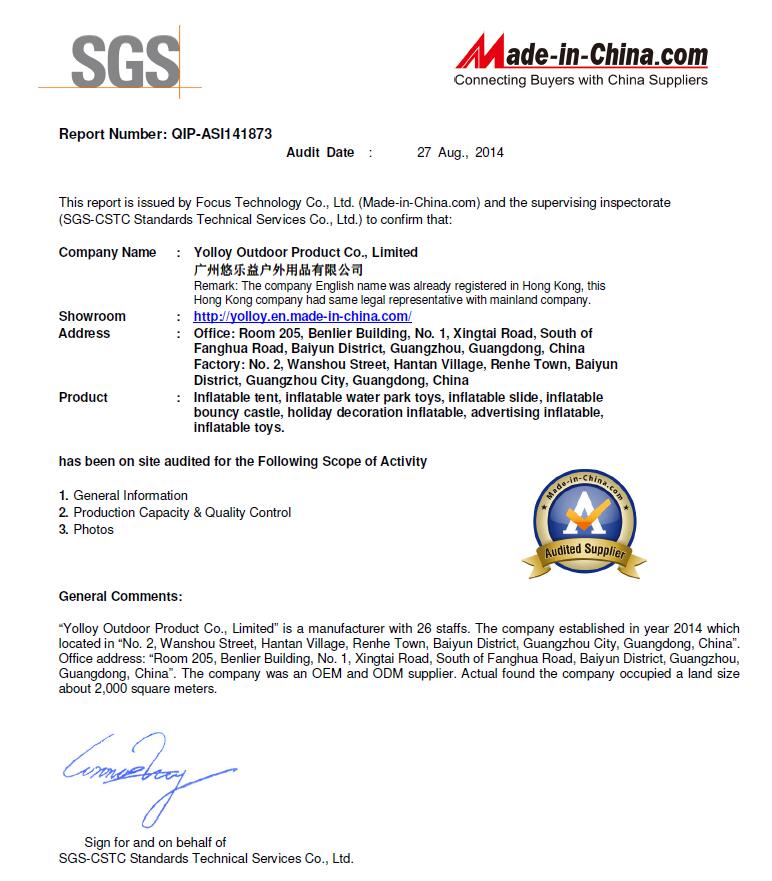
YOLLOY Outdoor Product Co., Limited is a China-based inflatable product manufacturer specializing in custom-designed commercial water parks, interactive sports games, inflatable slides, and a full range of outdoor entertainment products. With in-house design, precision manufacturing, and documented quality control, YOLLOY has supplied durable, safe, and visually striking inflatable products to clients across Europe, Asia, South America, Africa, the Middle East, and Latin America.
Every project starts with your requirements. YOLLOY's design team prepares simulation renderings from your proposal, revises the design until you are satisfied, and then releases it for production using commercial-grade PVC tarpaulin, high-frequency welding, and reinforced seams. Products are inspected and tested before shipment, and each order includes a repair kit, setup documentation, and responsive after-sales support.
To discuss your inflatable water park project, send your site details and requirements to
[email protected] or visit
www.yolloy.net to explore the full product range. A custom design, a competitive quotation, and a reliable production timeline are just one inquiry away.