Products Category
Certification

News

• New Order Successfully Finished for Long-Time Cooperated Japanese Client | YOLLOY Wins Full Client Recognition

• YOLLOY Custom Inflatable Pool Tent for Danish Client: Professional Pool Repair Shelter & Debris Protection

• Trusted Once Again! Greek Captain Re-orders Our Products After 4 Years

• Revolutionize Your Outdoors: The All-Terrain Inflatable Floating Tent for Land & Water

• Elevate Your Summer Fun: The Ultimate Inflatable Water Floating Volleyball Court Trampoline

• Innovative Inflatable Nightclub Tents & Pop-Up Bars: The Ultimate Solution for Portable Party Venues

Contact Us

Name: Sunny Yang
Tel: +86-20-8370 0771
Fax: +86-20-8370 0771
Mobile: 13570587575
E-mail: sales@yolloy.com
Add: No 5,Xiong wei Bo Nan Road,ZhongLuoTan Town,Baiyun district,Guangzhou,China
Friend me on Facebook Follow me on Twitter Add me to your circles Follow me on Pinterest Watch my channel on YouTube
News

Why Inflatable Dome Tents Are the Smart Choice for Modern Outdoor Events and Commercial Spaces

Author:yolloy Date:2026/8/4 17:29:35

Outdoor events have always posed a fundamental challenge: how do you create a sheltered, comfortable, and visually striking space that can be set up quickly and taken down just as fast? Traditional pole-and-canvas tents have served their purpose for decades, but they come with significant drawbacks — heavy frames, complex assembly, limited design flexibility, and substantial labor requirements. Enter the inflatable dome tent, a category of temporary structure that has been quietly transforming the event industry, commercial rental businesses, and even emergency response operations.

Unlike conventional tents that rely on rigid metal or wooden frameworks, an inflatable dome tent uses pressurized air beams to maintain its shape. A continuously running blower keeps the structure inflated, and the result is a freestanding, column-free interior that offers far more usable space than a traditional tent of the same footprint. This design philosophy opens up possibilities that simply do not exist with pole-based alternatives.

What Makes Inflatable Dome Tents Different

The key difference lies in the structural principle. A traditional tent transfers load through a network of poles, connectors, and tensioned fabric — a system that requires careful assembly, creates interior obstructions, and concentrates stress at connection points. An inflatable dome tent distributes load across its entire air-beam framework and fabric membrane. The continuous curvature of the dome shape naturally sheds wind and precipitation, while the absence of internal poles means every square foot of floor space is usable.

This structural advantage translates into practical benefits. Setup times are dramatically shorter — a mid-sized inflatable dome can often be fully deployed by two people in under 30 minutes, compared to the hours required for an equivalent frame tent. The inflation process is straightforward: unroll the tent, stake down the anchor points, connect the blower, and switch it on. The structure rises on its own, requiring no lifting of heavy components or climbing to secure roof panels.

Key Advantage: Because inflatable dome tents have no internal poles or columns, they provide 100% usable interior space. This makes them ideal for applications where clear sightlines and unobstructed floor area are critical — such as wedding receptions, product launches, exhibition booths, and dining setups.

The Rise of the Clear Inflatable Dome

One of the most exciting developments in this space is the growing popularity of transparent and semi-transparent dome structures. A clear inflatable tent combines the practical benefits of air-beam construction with panoramic visibility, creating an immersive experience that connects guests with the surrounding environment while keeping them comfortable and protected from the elements.

Imagine a winter wedding reception held inside a transparent dome, with snowfall visible through the walls while guests dine in warmth. Picture a luxury camping experience where stargazing is possible from the comfort of a climate-controlled bubble. These scenarios are not futuristic concepts — they are happening right now at resorts, glamping sites, and event venues around the world. Clear inflatable bubble tents, dome tents, and snow globe tents have become sought-after attractions for hospitality businesses looking to differentiate themselves.

Commercial Applications Across Industries

The versatility of inflatable dome structures extends far beyond parties and weddings. A growing number of businesses and organizations are discovering their value across a wide range of applications:

Event Rentals: For rental companies, an inflatable party tent represents a high-margin inventory item. Their quick setup and takedown reduce labor costs per event, while the unique visual appeal commands premium rental rates. Event planners increasingly request inflatable domes for their standout aesthetic and Instagram-worthy appearance.

Hospitality and Glamping: Hotels, resorts, and campgrounds use clear inflatable domes to create luxury outdoor accommodations. These structures offer guests a unique stay experience — all the comfort of a hotel room with an unobstructed connection to nature. Some properties install them as semi-permanent suites, dining pods, or spa treatment rooms.

Corporate and Promotional Events: Brands use inflatable dome tents as eye-catching activation spaces at trade shows, product launches, and promotional tours. The distinctive dome shape naturally draws attention, and the customizable exterior can be printed with logos, graphics, and branding messages.

Sports and Recreation: From golf simulator enclosures to portable training facilities, inflatable domes provide covered practice spaces that can be relocated as needed. They are also used as covered spectator areas, first-aid stations, and equipment storage at outdoor sporting events.

Emergency and Relief Operations: The rapid deployment capability of inflatable shelters makes them valuable for disaster response, field hospitals, and temporary housing. Their compact packed size allows for efficient transport and storage in emergency preparedness scenarios.

What to Look for When Sourcing Inflatable Dome Tents

If you are considering adding inflatable dome structures to your business — whether for rental, hospitality, or event use — here are the key factors to evaluate when comparing suppliers:

Factor What to Look For
Material Quality Commercial-grade PVC tarpaulin with high tensile strength; Oxford fabric, nylon, or TPU options for specific applications. Materials should meet recognized safety standards.
Certifications Look for EN71, EN14960, and RoHS compliance for materials; CE or UL certification for blowers. Water park products should reference EN 15649.
Seam Construction Reinforced seams with waterproof nylon thread; high-temperature fusion welding for airtight sections; additional reinforcement at high-load areas.
Anchoring System D-ring or round metal anchor points integrated into the structure for wind resistance and installation stability.
Customization Ability to customize size, color, and print logos or artwork. The supplier should be able to work from your description, sketch, or site plan.
Minimum Order Flexible MOQ policies — ideally, the ability to order a single unit for testing or small-scale deployment.
Production Time Reasonable turnaround — typically 6-15 days for standard products, with clear communication on timelines for custom orders.
After-Sales Support Repair kit included with each product; responsive communication within 24 hours; warranty coverage for manufacturing defects.

Why Partner with a Specialized Manufacturer

The difference between a generic inflatable product and a commercial-grade structure often comes down to the manufacturer behind it. Established inflatable tent manufacturers with dedicated design teams, quality control processes, and export experience bring value that goes far beyond the product itself.

A full-service manufacturer starts with your concept — whether it is a rough sketch, a reference photo, or a detailed specification — and produces simulation renderings for your approval before production begins. This collaborative design process ensures the final product matches your expectations in terms of size, appearance, and functionality. Throughout production, quality inspections at multiple stages catch issues before they become problems. Before shipping, each product is tested to verify structural integrity and proper inflation.

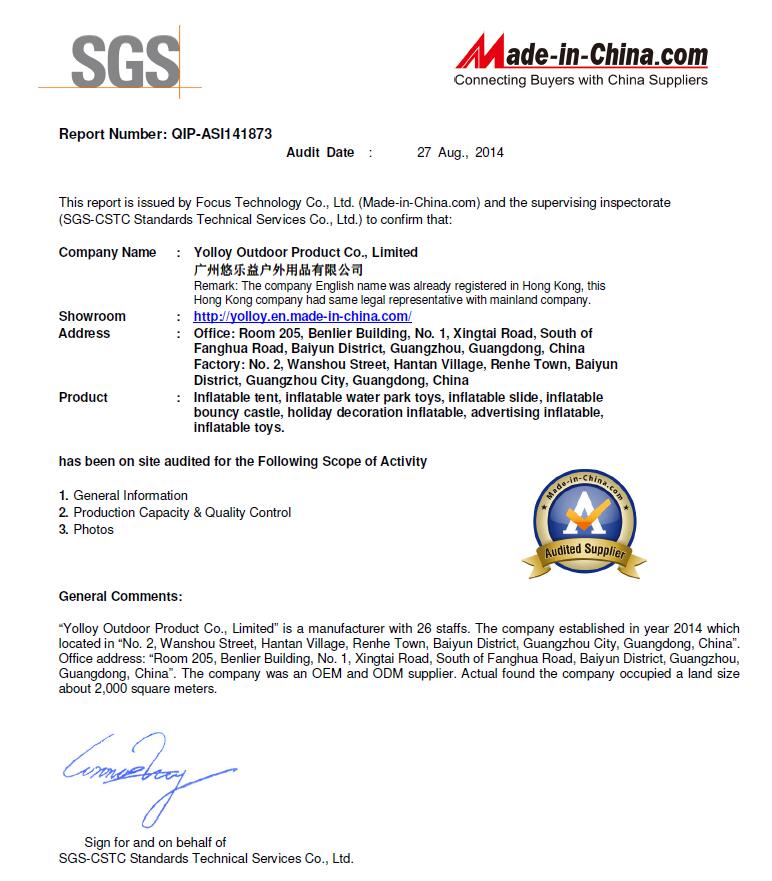
YOLLOY Outdoor Product Co., Limited, based in Guangzhou, China, exemplifies this approach. With a product range spanning outdoor inflatable tents, clear dome tents, portable planetarium domes, inflatable water parks, interactive sports games, commercial slides, bounce houses, paintball bunkers, air mattresses, and advertising inflatables, the company offers custom design-to-production service with a stated minimum order quantity of just one piece. Materials used have passed EN71, EN14960, and RoHS testing, and blowers meet CE or UL requirements. Each product ships with a repair kit, and the company reports a 95% on-time delivery rate with air and sea shipping options available to markets across Europe, Asia, South America, Africa, the Middle East, and Latin America.

Did You Know? YOLLOY uses precision sewing equipment with reinforced seams and waterproof nylon thread for sewn products, and high-temperature fusion welding equipment for airtight products. Additional reinforcement is applied at high-load areas, and D-ring or round metal anchor systems are incorporated for installation stability and wind resistance.

Practical Considerations for First-Time Buyers

If you are new to purchasing inflatable structures, a few practical tips can help you avoid common pitfalls:

Start with a clear use case. Define exactly how the tent will be used — the type of events, expected guest count, indoor or outdoor placement, and frequency of setup and takedown. This clarity helps the manufacturer recommend the right size, material, and configuration.

Consider blower voltage requirements. If you are importing from a manufacturer in a different region, confirm that blowers can be supplied for your local voltage — 110V, 220V, or 380V. A reputable manufacturer will accommodate this without issue.

Plan for shipping and logistics. Inflatable products pack down compactly, but larger domes still require freight shipping. Air freight (5-7 days) offers speed, while sea freight (15-30+ days) offers cost savings for larger orders. Factor transit time into your project timeline.

Budget for accessories. Beyond the tent itself, consider what you will need: blowers, repair kits, anchoring systems, storage bags, lighting solutions, and possibly flooring or interior furnishings. Request a complete quote that covers all essentials.

Test before scaling. If you are building a rental fleet or a hospitality concept, start with one or two units. Learn how they perform in real-world conditions, gather customer feedback, and refine your offering before placing a larger order.

The Future of Inflatable Structures

The inflatable structure market continues to evolve. Advances in material science are producing lighter, stronger, and more weather-resistant fabrics. Improved blower technology offers quieter operation and greater energy efficiency. Digital printing capabilities allow for increasingly detailed and vibrant custom graphics. And growing awareness of the advantages of inflatable designs — speed, portability, unobstructed interiors — is driving adoption across new sectors.

For event professionals, hospitality operators, and entrepreneurs, the question is not whether inflatable dome structures have a place in the market — it is how to take advantage of the opportunity before the space becomes crowded. The combination of visual impact, practical functionality, and rapid deployment makes these structures a compelling investment for anyone in the business of creating memorable experiences.

Ready to Explore Inflatable Dome Solutions?

Whether you need a single custom dome for a flagship venue or a fleet of party tents for your rental business, working with an experienced manufacturer is the first step. YOLLOY offers custom design, flexible order quantities, and international shipping to help bring your vision to life. Visit the product pages to see examples of completed projects, or reach out directly to discuss your specific requirements — the design team can prepare simulation renderings based on your concept, at no obligation.

Contact YOLLOY at sales@yolloy.com or call +86-20-8370 0771 to start the conversation.

Why Inflatable Dome Tents Are the Smart Choice for Modern Outdoor Events and Commercial Spaces

Author:yolloy Date:2026/8/4 17:29:35

Outdoor events have always posed a fundamental challenge: how do you create a sheltered, comfortable, and visually striking space that can be set up quickly and taken down just as fast? Traditional pole-and-canvas tents have served their purpose for decades, but they come with significant drawbacks — heavy frames, complex assembly, limited design flexibility, and substantial labor requirements. Enter the inflatable dome tent, a category of temporary structure that has been quietly transforming the event industry, commercial rental businesses, and even emergency response operations.

Unlike conventional tents that rely on rigid metal or wooden frameworks, an inflatable dome tent uses pressurized air beams to maintain its shape. A continuously running blower keeps the structure inflated, and the result is a freestanding, column-free interior that offers far more usable space than a traditional tent of the same footprint. This design philosophy opens up possibilities that simply do not exist with pole-based alternatives.

What Makes Inflatable Dome Tents Different

The key difference lies in the structural principle. A traditional tent transfers load through a network of poles, connectors, and tensioned fabric — a system that requires careful assembly, creates interior obstructions, and concentrates stress at connection points. An inflatable dome tent distributes load across its entire air-beam framework and fabric membrane. The continuous curvature of the dome shape naturally sheds wind and precipitation, while the absence of internal poles means every square foot of floor space is usable.

This structural advantage translates into practical benefits. Setup times are dramatically shorter — a mid-sized inflatable dome can often be fully deployed by two people in under 30 minutes, compared to the hours required for an equivalent frame tent. The inflation process is straightforward: unroll the tent, stake down the anchor points, connect the blower, and switch it on. The structure rises on its own, requiring no lifting of heavy components or climbing to secure roof panels.

Key Advantage: Because inflatable dome tents have no internal poles or columns, they provide 100% usable interior space. This makes them ideal for applications where clear sightlines and unobstructed floor area are critical — such as wedding receptions, product launches, exhibition booths, and dining setups.

The Rise of the Clear Inflatable Dome

One of the most exciting developments in this space is the growing popularity of transparent and semi-transparent dome structures. A clear inflatable tent combines the practical benefits of air-beam construction with panoramic visibility, creating an immersive experience that connects guests with the surrounding environment while keeping them comfortable and protected from the elements.

Imagine a winter wedding reception held inside a transparent dome, with snowfall visible through the walls while guests dine in warmth. Picture a luxury camping experience where stargazing is possible from the comfort of a climate-controlled bubble. These scenarios are not futuristic concepts — they are happening right now at resorts, glamping sites, and event venues around the world. Clear inflatable bubble tents, dome tents, and snow globe tents have become sought-after attractions for hospitality businesses looking to differentiate themselves.

Commercial Applications Across Industries

The versatility of inflatable dome structures extends far beyond parties and weddings. A growing number of businesses and organizations are discovering their value across a wide range of applications:

Event Rentals: For rental companies, an inflatable party tent represents a high-margin inventory item. Their quick setup and takedown reduce labor costs per event, while the unique visual appeal commands premium rental rates. Event planners increasingly request inflatable domes for their standout aesthetic and Instagram-worthy appearance.

Hospitality and Glamping: Hotels, resorts, and campgrounds use clear inflatable domes to create luxury outdoor accommodations. These structures offer guests a unique stay experience — all the comfort of a hotel room with an unobstructed connection to nature. Some properties install them as semi-permanent suites, dining pods, or spa treatment rooms.

Corporate and Promotional Events: Brands use inflatable dome tents as eye-catching activation spaces at trade shows, product launches, and promotional tours. The distinctive dome shape naturally draws attention, and the customizable exterior can be printed with logos, graphics, and branding messages.

Sports and Recreation: From golf simulator enclosures to portable training facilities, inflatable domes provide covered practice spaces that can be relocated as needed. They are also used as covered spectator areas, first-aid stations, and equipment storage at outdoor sporting events.

Emergency and Relief Operations: The rapid deployment capability of inflatable shelters makes them valuable for disaster response, field hospitals, and temporary housing. Their compact packed size allows for efficient transport and storage in emergency preparedness scenarios.

What to Look for When Sourcing Inflatable Dome Tents

If you are considering adding inflatable dome structures to your business — whether for rental, hospitality, or event use — here are the key factors to evaluate when comparing suppliers:

Factor What to Look For
Material Quality Commercial-grade PVC tarpaulin with high tensile strength; Oxford fabric, nylon, or TPU options for specific applications. Materials should meet recognized safety standards.
Certifications Look for EN71, EN14960, and RoHS compliance for materials; CE or UL certification for blowers. Water park products should reference EN 15649.
Seam Construction Reinforced seams with waterproof nylon thread; high-temperature fusion welding for airtight sections; additional reinforcement at high-load areas.
Anchoring System D-ring or round metal anchor points integrated into the structure for wind resistance and installation stability.
Customization Ability to customize size, color, and print logos or artwork. The supplier should be able to work from your description, sketch, or site plan.
Minimum Order Flexible MOQ policies — ideally, the ability to order a single unit for testing or small-scale deployment.
Production Time Reasonable turnaround — typically 6-15 days for standard products, with clear communication on timelines for custom orders.
After-Sales Support Repair kit included with each product; responsive communication within 24 hours; warranty coverage for manufacturing defects.

Why Partner with a Specialized Manufacturer

The difference between a generic inflatable product and a commercial-grade structure often comes down to the manufacturer behind it. Established inflatable tent manufacturers with dedicated design teams, quality control processes, and export experience bring value that goes far beyond the product itself.

A full-service manufacturer starts with your concept — whether it is a rough sketch, a reference photo, or a detailed specification — and produces simulation renderings for your approval before production begins. This collaborative design process ensures the final product matches your expectations in terms of size, appearance, and functionality. Throughout production, quality inspections at multiple stages catch issues before they become problems. Before shipping, each product is tested to verify structural integrity and proper inflation.

YOLLOY Outdoor Product Co., Limited, based in Guangzhou, China, exemplifies this approach. With a product range spanning outdoor inflatable tents, clear dome tents, portable planetarium domes, inflatable water parks, interactive sports games, commercial slides, bounce houses, paintball bunkers, air mattresses, and advertising inflatables, the company offers custom design-to-production service with a stated minimum order quantity of just one piece. Materials used have passed EN71, EN14960, and RoHS testing, and blowers meet CE or UL requirements. Each product ships with a repair kit, and the company reports a 95% on-time delivery rate with air and sea shipping options available to markets across Europe, Asia, South America, Africa, the Middle East, and Latin America.

Did You Know? YOLLOY uses precision sewing equipment with reinforced seams and waterproof nylon thread for sewn products, and high-temperature fusion welding equipment for airtight products. Additional reinforcement is applied at high-load areas, and D-ring or round metal anchor systems are incorporated for installation stability and wind resistance.

Practical Considerations for First-Time Buyers

If you are new to purchasing inflatable structures, a few practical tips can help you avoid common pitfalls:

Start with a clear use case. Define exactly how the tent will be used — the type of events, expected guest count, indoor or outdoor placement, and frequency of setup and takedown. This clarity helps the manufacturer recommend the right size, material, and configuration.

Consider blower voltage requirements. If you are importing from a manufacturer in a different region, confirm that blowers can be supplied for your local voltage — 110V, 220V, or 380V. A reputable manufacturer will accommodate this without issue.

Plan for shipping and logistics. Inflatable products pack down compactly, but larger domes still require freight shipping. Air freight (5-7 days) offers speed, while sea freight (15-30+ days) offers cost savings for larger orders. Factor transit time into your project timeline.

Budget for accessories. Beyond the tent itself, consider what you will need: blowers, repair kits, anchoring systems, storage bags, lighting solutions, and possibly flooring or interior furnishings. Request a complete quote that covers all essentials.

Test before scaling. If you are building a rental fleet or a hospitality concept, start with one or two units. Learn how they perform in real-world conditions, gather customer feedback, and refine your offering before placing a larger order.

The Future of Inflatable Structures

The inflatable structure market continues to evolve. Advances in material science are producing lighter, stronger, and more weather-resistant fabrics. Improved blower technology offers quieter operation and greater energy efficiency. Digital printing capabilities allow for increasingly detailed and vibrant custom graphics. And growing awareness of the advantages of inflatable designs — speed, portability, unobstructed interiors — is driving adoption across new sectors.

For event professionals, hospitality operators, and entrepreneurs, the question is not whether inflatable dome structures have a place in the market — it is how to take advantage of the opportunity before the space becomes crowded. The combination of visual impact, practical functionality, and rapid deployment makes these structures a compelling investment for anyone in the business of creating memorable experiences.

Ready to Explore Inflatable Dome Solutions?

Whether you need a single custom dome for a flagship venue or a fleet of party tents for your rental business, working with an experienced manufacturer is the first step. YOLLOY offers custom design, flexible order quantities, and international shipping to help bring your vision to life. Visit the product pages to see examples of completed projects, or reach out directly to discuss your specific requirements — the design team can prepare simulation renderings based on your concept, at no obligation.

Contact YOLLOY at sales@yolloy.com or call +86-20-8370 0771 to start the conversation.