Products Category
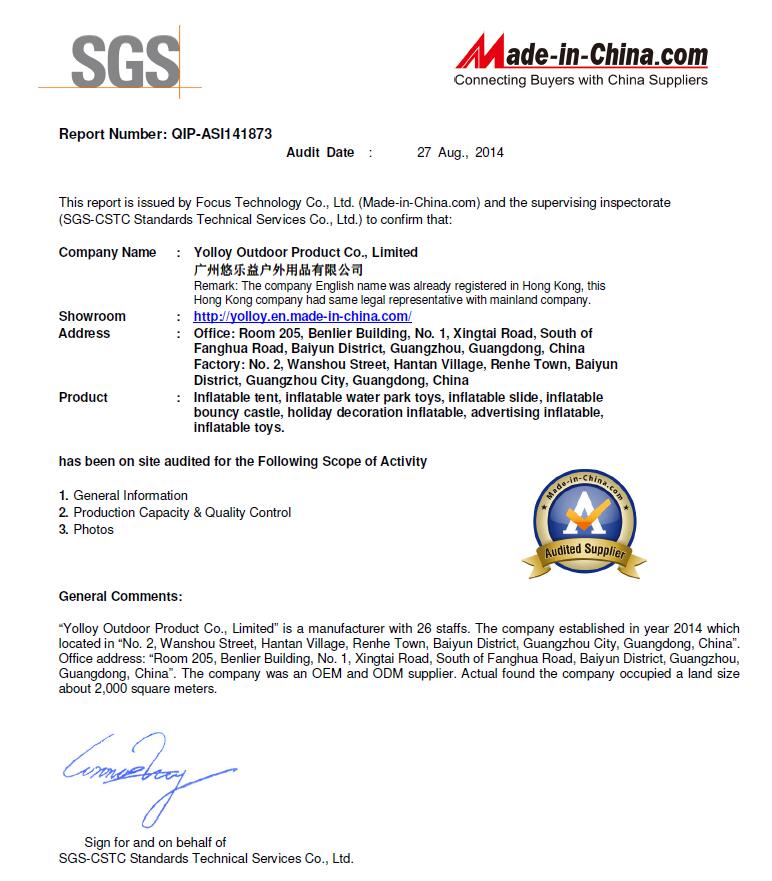
Certification

News

• New Order Successfully Finished for Long-Time Cooperated Japanese Client | YOLLOY Wins Full Client Recognition

• YOLLOY Custom Inflatable Pool Tent for Danish Client: Professional Pool Repair Shelter & Debris Protection

• Trusted Once Again! Greek Captain Re-orders Our Products After 4 Years

• Revolutionize Your Outdoors: The All-Terrain Inflatable Floating Tent for Land & Water

• Elevate Your Summer Fun: The Ultimate Inflatable Water Floating Volleyball Court Trampoline

• Innovative Inflatable Nightclub Tents & Pop-Up Bars: The Ultimate Solution for Portable Party Venues

Contact Us

Name: Sunny Yang
Tel: +86-20-8370 0771
Fax: +86-20-8370 0771
Mobile: 13570587575
E-mail: sales@yolloy.com
Add: No 5,Xiong wei Bo Nan Road,ZhongLuoTan Town,Baiyun district,Guangzhou,China
Friend me on Facebook Follow me on Twitter Add me to your circles Follow me on Pinterest Watch my channel on YouTube
News

The Rise of Inflatable Tents: A Smart Choice for Camping, Events, and Commercial Use

Author:yolloy Date:2026/8/4 17:56:26
Setting up a traditional tent can be a frustrating experience — wrestling with metal poles, deciphering confusing instructions, and spending precious time on assembly instead of enjoying the outdoors. Inflatable tents have changed this entirely. With air-beam technology replacing rigid frames, these structures go up in minutes and offer a level of versatility that conventional tents simply cannot match. Whether you are planning a weekend camping trip, hosting an outdoor wedding, or launching a commercial event, an inflatable camping tent delivers speed, stability, and style in one package.
What Makes Inflatable Tents Different
Unlike traditional tents that rely on a network of metal or fiberglass poles, inflatable tents use air-filled beams as their structural backbone. A high-pressure blower inflates these beams in two to three minutes, creating a rigid frame that holds its shape even in challenging weather conditions. The covering is typically made from commercial-grade PVC tarpaulin, Oxford fabric, nylon, or TPU — materials chosen for their waterproof performance, UV resistance, and durability.
The absence of metal poles means fewer parts to lose, no risk of snapped frames, and a significantly lighter packed weight. When deflated, an inflatable tent folds down to a compact size that fits easily into a carry bag or vehicle trunk. This portability is one of the key reasons why leading inflatable tent manufacturers have seen growing demand from event organizers, rental businesses, and outdoor enthusiasts across Europe, Asia, the Middle East, and the Americas.
Where Inflatable Tents Shine: Key Applications
The versatility of inflatable tents extends far beyond traditional camping. Here are some of the most popular use cases driving their adoption worldwide:
  • Camping and Glamping: From compact two-person models to large family-sized units, inflatable tents offer quick setup and comfortable interiors. Clear dome and bubble tent designs let campers sleep under the stars while staying protected from the elements.
  • Outdoor Events and Parties: Wedding receptions, corporate gatherings, music festivals, and private parties all benefit from the spacious, open interiors of inflatable party tents. These structures can be customized with branded graphics, lighting, and themed interiors.
  • Commercial and Exhibition Use: Trade show booths, product launches, pop-up retail spaces, and promotional roadshows use inflatable tents as eye-catching, portable venues.
  • Sports and Emergency Response: Inflatable shelters serve as field hospitals, first-aid stations, equipment storage, and temporary command centers during disaster relief operations. Sports teams also use them as sideline shelters, changing rooms, and equipment hubs.
  • Automotive and Industrial: Inflatable spray booths, car detailing tents, and golf simulator enclosures are growing niches where temperature control and dust-free environments matter.
What to Look for When Choosing an Inflatable Tent
Not all inflatable tents are built to the same standard. When evaluating options, pay attention to the following factors:
Material quality. The covering fabric should be waterproof, UV-resistant, and fire-retardant. Commercial-grade PVC tarpaulin is a common choice for heavy-duty applications, while Oxford fabric and TPU offer lighter alternatives for specific uses. Always verify that the fabric has been tested against relevant safety standards, such as EN71 and EN14960 for inflatable toys, and EN15649 for water park products.
Construction and seams. Look for precision sewing with reinforced seams and waterproof nylon thread. High-load areas — such as anchor points and beam junctions — should have additional reinforcement. For airtight products, high-temperature fusion welding produces a stronger, more reliable seal than adhesive bonding alone.
Anchoring and wind resistance. A well-designed inflatable tent includes D-ring or round metal anchor points around the base and along guy-line positions. These anchor systems, combined with proper staking and tensioned ropes, allow the tent to remain stable in moderate to high winds.
Blower compatibility. The inflation blower is the heart of the system. Confirm that the blower matches your local voltage requirements — 110V, 220V, or 380V — and that it carries CE or UL certification. A continuous-running blower maintains pressure throughout use, so reliability matters.
Customization: Getting Exactly What You Need
One of the greatest advantages of working directly with a manufacturer is the ability to customize every aspect of your tent. A custom inflatable tent can be designed from a simple description, a rough sketch, a photograph, or even a site plan and budget. You can specify the size, color scheme, door and window placement, ventilation configuration, and interior layout.
Branding is another powerful option. Company logos, artwork, and promotional messages can be printed directly onto the tent fabric, turning the structure into a mobile billboard. This is especially valuable for trade shows, sponsored events, and brand activations where visibility matters.
Some manufacturers also offer accessories such as removable flooring, interior partitions, lighting integration, and custom carry bags. The minimum order quantity can be as low as one piece, making custom projects accessible even for small businesses and individual buyers.
Quality Control and Safety You Can Trust
When purchasing an inflatable tent, safety should never be an afterthought. Reputable manufacturers conduct thorough inspections and testing before shipping. Each product should be inflated and checked for air retention, seam integrity, and overall workmanship. Materials should have passed relevant testing — commercial-grade PVC used in tent construction should meet EN71, EN14960, and RoHS requirements, while blowers should carry CE or UL certification.
It is also worth checking whether the manufacturer includes a repair kit with each order. Inflatables are durable, but punctures can happen in the field. A basic repair kit with PVC patches, specialized glue, and spare valve components allows you to perform quick fixes and keep the tent in service. Many manufacturers offer a warranty period — typically around three years under normal use — along with responsive after-sales support.
Shipping and Delivery: Getting Your Tent to Your Doorstep
Inflatable tents are typically packaged with soft carpet protection, waterproof PVC bags, and an outer PE film layer. Large or heavy orders may be placed on steel pallets for added protection during transit. Air freight generally delivers within 5 to 7 days, while sea freight takes 15 to 30 days or more depending on the destination. Before placing an order, confirm the estimated production time — for a standard inflatable tent, this is usually 6 to 15 days, though complex custom designs may take longer.
Ready to explore inflatable tent solutions for your next project? YOLLOY Outdoor Product Co., Limited designs and manufactures custom inflatable tents, clear domes, and event shelters from its factory in Guangzhou, China. With a focus on safety, durability, and responsive service, YOLLOY delivers products to clients across Europe, Asia, South America, Africa, the Middle East, and beyond. Email sales@yolloy.com or visit www.yolloy.net to discuss your requirements and receive a tailored proposal.

The Rise of Inflatable Tents: A Smart Choice for Camping, Events, and Commercial Use

Author:yolloy Date:2026/8/4 17:56:26

Setting up a traditional tent can be a frustrating experience — wrestling with metal poles, deciphering confusing instructions, and spending precious time on assembly instead of enjoying the outdoors. Inflatable tents have changed this entirely. With air-beam technology replacing rigid frames, these structures go up in minutes and offer a level of versatility that conventional tents simply cannot match. Whether you are planning a weekend camping trip, hosting an outdoor wedding, or launching a commercial event, an inflatable camping tent delivers speed, stability, and style in one package.
What Makes Inflatable Tents Different
Unlike traditional tents that rely on a network of metal or fiberglass poles, inflatable tents use air-filled beams as their structural backbone. A high-pressure blower inflates these beams in two to three minutes, creating a rigid frame that holds its shape even in challenging weather conditions. The covering is typically made from commercial-grade PVC tarpaulin, Oxford fabric, nylon, or TPU — materials chosen for their waterproof performance, UV resistance, and durability.
The absence of metal poles means fewer parts to lose, no risk of snapped frames, and a significantly lighter packed weight. When deflated, an inflatable tent folds down to a compact size that fits easily into a carry bag or vehicle trunk. This portability is one of the key reasons why leading inflatable tent manufacturers have seen growing demand from event organizers, rental businesses, and outdoor enthusiasts across Europe, Asia, the Middle East, and the Americas.
Where Inflatable Tents Shine: Key Applications
The versatility of inflatable tents extends far beyond traditional camping. Here are some of the most popular use cases driving their adoption worldwide:
  • Camping and Glamping: From compact two-person models to large family-sized units, inflatable tents offer quick setup and comfortable interiors. Clear dome and bubble tent designs let campers sleep under the stars while staying protected from the elements.
  • Outdoor Events and Parties: Wedding receptions, corporate gatherings, music festivals, and private parties all benefit from the spacious, open interiors of inflatable party tents. These structures can be customized with branded graphics, lighting, and themed interiors.
  • Commercial and Exhibition Use: Trade show booths, product launches, pop-up retail spaces, and promotional roadshows use inflatable tents as eye-catching, portable venues.
  • Sports and Emergency Response: Inflatable shelters serve as field hospitals, first-aid stations, equipment storage, and temporary command centers during disaster relief operations. Sports teams also use them as sideline shelters, changing rooms, and equipment hubs.
  • Automotive and Industrial: Inflatable spray booths, car detailing tents, and golf simulator enclosures are growing niches where temperature control and dust-free environments matter.
What to Look for When Choosing an Inflatable Tent
Not all inflatable tents are built to the same standard. When evaluating options, pay attention to the following factors:
Material quality. The covering fabric should be waterproof, UV-resistant, and fire-retardant. Commercial-grade PVC tarpaulin is a common choice for heavy-duty applications, while Oxford fabric and TPU offer lighter alternatives for specific uses. Always verify that the fabric has been tested against relevant safety standards, such as EN71 and EN14960 for inflatable toys, and EN15649 for water park products.
Construction and seams. Look for precision sewing with reinforced seams and waterproof nylon thread. High-load areas — such as anchor points and beam junctions — should have additional reinforcement. For airtight products, high-temperature fusion welding produces a stronger, more reliable seal than adhesive bonding alone.
Anchoring and wind resistance. A well-designed inflatable tent includes D-ring or round metal anchor points around the base and along guy-line positions. These anchor systems, combined with proper staking and tensioned ropes, allow the tent to remain stable in moderate to high winds.
Blower compatibility. The inflation blower is the heart of the system. Confirm that the blower matches your local voltage requirements — 110V, 220V, or 380V — and that it carries CE or UL certification. A continuous-running blower maintains pressure throughout use, so reliability matters.
Customization: Getting Exactly What You Need
One of the greatest advantages of working directly with a manufacturer is the ability to customize every aspect of your tent. A custom inflatable tent can be designed from a simple description, a rough sketch, a photograph, or even a site plan and budget. You can specify the size, color scheme, door and window placement, ventilation configuration, and interior layout.
Branding is another powerful option. Company logos, artwork, and promotional messages can be printed directly onto the tent fabric, turning the structure into a mobile billboard. This is especially valuable for trade shows, sponsored events, and brand activations where visibility matters.
Some manufacturers also offer accessories such as removable flooring, interior partitions, lighting integration, and custom carry bags. The minimum order quantity can be as low as one piece, making custom projects accessible even for small businesses and individual buyers.
Quality Control and Safety You Can Trust
When purchasing an inflatable tent, safety should never be an afterthought. Reputable manufacturers conduct thorough inspections and testing before shipping. Each product should be inflated and checked for air retention, seam integrity, and overall workmanship. Materials should have passed relevant testing — commercial-grade PVC used in tent construction should meet EN71, EN14960, and RoHS requirements, while blowers should carry CE or UL certification.
It is also worth checking whether the manufacturer includes a repair kit with each order. Inflatables are durable, but punctures can happen in the field. A basic repair kit with PVC patches, specialized glue, and spare valve components allows you to perform quick fixes and keep the tent in service. Many manufacturers offer a warranty period — typically around three years under normal use — along with responsive after-sales support.
Shipping and Delivery: Getting Your Tent to Your Doorstep
Inflatable tents are typically packaged with soft carpet protection, waterproof PVC bags, and an outer PE film layer. Large or heavy orders may be placed on steel pallets for added protection during transit. Air freight generally delivers within 5 to 7 days, while sea freight takes 15 to 30 days or more depending on the destination. Before placing an order, confirm the estimated production time — for a standard inflatable tent, this is usually 6 to 15 days, though complex custom designs may take longer.
Ready to explore inflatable tent solutions for your next project? YOLLOY Outdoor Product Co., Limited designs and manufactures custom inflatable tents, clear domes, and event shelters from its factory in Guangzhou, China. With a focus on safety, durability, and responsive service, YOLLOY delivers products to clients across Europe, Asia, South America, Africa, the Middle East, and beyond. Email sales@yolloy.com or visit www.yolloy.net to discuss your requirements and receive a tailored proposal.