From rooftop dining and glamping retreats to brand activations and emergency response, inflatable dome structures are quietly reshaping the way we think about temporary architecture.
Walk through any major outdoor festival, luxury camping site, or corporate brand activation in 2026, and you will notice a recurring silhouette on the skyline: the smooth, curved profile of an inflatable dome tent. What was once a niche curiosity has become one of the fastest-growing categories in temporary event structures, and for good reason. These air-supported pavilions deliver a combination of speed, aesthetics, and practicality that traditional pole-and-frame tents simply cannot match.
The shift is not just about novelty. Event planners, hospitality operators, and rental business owners are making calculated decisions to invest in inflatable dome tents because they solve real operational headaches — from labor-intensive setup to limited interior flexibility. The result is a growing global market where demand for these structures continues to climb across Europe, the Middle East, Latin America, and beyond.
What Sets an Inflatable Dome Tent Apart from Traditional Structures
The core difference is deceptively simple. While a conventional tent depends on a rigid framework of aluminum or steel poles to hold its shape, an inflatable dome tent uses pressurized air beams as its structural skeleton. A continuous-running blower keeps these beams firm, creating a self-supporting shell that requires zero internal columns. The dome geometry itself does much of the engineering work: curved surfaces distribute wind loads evenly across the structure, making it inherently more stable in gusty conditions than a flat-walled frame tent.
For the operator, the practical implications are immediate. Setup that once required a crew of four or five people over several hours can now be accomplished by two people in under thirty minutes. When the event ends, the entire structure deflates and packs into bags compact enough for a standard van. There is no truck full of heavy poles, no complicated assembly manual, and no risk of missing components.
Key takeaway: The column-free interior of an inflatable dome tent means 100% of the floor area is usable. For venue operators who charge per square meter, this is a direct revenue advantage over traditional tents, where center poles can render up to 15% of the footprint unusable for seating or displays.
Where Inflatable Dome Tents Are Making the Biggest Impact
The versatility of the dome format has attracted buyers from a remarkably diverse range of industries. Here is where the adoption is accelerating fastest:
-
Outdoor hospitality and dining: Hotels and restaurants are using clear-domed tents to create year-round al fresco dining experiences. The inflatable clear dome tent has become especially popular for rooftop bars and garden restaurants, where guests can enjoy panoramic views while sheltered from wind and rain.
-
Glamping and luxury camping: High-end campgrounds are replacing traditional canvas tents with inflatable domes that offer better insulation, more headroom, and a distinctive design that commands premium nightly rates.
-
Corporate events and brand activations: Marketing agencies value the dome as a blank canvas for immersive brand experiences. The curved interior walls can serve as projection surfaces, while the striking exterior profile naturally draws foot traffic at trade shows and festivals.
-
Weddings and private celebrations: Event rental companies report that couples increasingly request dome tents for their reception venues, drawn by the open-plan layout and the dramatic visual presence in photographs.
-
Emergency response and field operations: The same rapid deployment that appeals to event planners makes dome tents invaluable for disaster relief. Military and humanitarian organizations use them as field hospitals, command centers, and temporary housing in crisis zones.
Inflatable Dome Tent vs. Traditional Frame Tent: A Quick Comparison
| Setup time |
10-30 minutes (2 people) |
1-4 hours (4-6 people) |
| Interior space |
100% usable, column-free |
Obstructed by center poles |
| Portability |
Packs into compact bags |
Requires truck for poles and fabric |
| Wind resistance |
Aerodynamic dome shape distributes load |
Flat walls catch wind; requires heavy ballasting |
| Visual impact |
Striking curved silhouette stands out |
Functional appearance, less distinctive |
| Storage footprint |
Minimal when deflated |
Large volume required for rigid components |
What to Look for When Sourcing an Inflatable Dome Tent
Not all dome tents are created equal. The difference between a structure that lasts through multiple seasons of heavy commercial use and one that develops leaks and seam failures after a few events comes down to manufacturing quality and material selection. Here are the factors that matter most when evaluating suppliers:
Material quality: The industry standard for commercial-grade durability is PVC tarpaulin, but the specific weight and weave density vary significantly between manufacturers. For applications requiring lighter weight or breathability, reputable inflatable tent manufacturers also offer Oxford fabric, nylon, and TPU options. What matters is that the material is matched to the intended use — a tent destined for year-round outdoor hospitality needs different specifications than one used occasionally for indoor exhibitions.
Construction technique: Pay attention to how the tent is assembled at the factory level. High-quality products use precision sewing equipment with reinforced seams and waterproof nylon thread. Critical stress points — where air beams connect to the main body, where anchor points attach — should have additional reinforcement layers. For airtight sections, look for high-temperature fusion welding rather than glued seams, which are prone to separation over time.
Safety certifications: This is non-negotiable for commercial buyers. The materials should have passed testing to recognized standards — EN71 and EN14960 are common references for inflatable products, while RoHS compliance indicates the absence of restricted hazardous substances. Blowers should carry CE or UL certification. These certifications are not just paperwork; they are evidence that the product has been independently verified for safety, which matters for both insurance purposes and customer confidence.
Customization flexibility: A manufacturer that offers only fixed sizes and standard colors is limiting your business potential. The best suppliers work from your description, drawing, sketch, or photograph to create a product tailored to your exact requirements. This includes custom dimensions, printed logos and artwork, and blower configurations for different voltage standards (110V, 220V, or 380V). Customization is particularly important for brand activations, where the tent itself becomes part of the marketing message.
Anchoring and wind safety: Never overlook the anchoring system. Quality dome tents incorporate D-ring or round metal anchor points at strategic locations around the base. Combined with the inherently aerodynamic dome shape, a properly anchored inflatable tent can handle wind conditions that would challenge — or topple — a traditional frame tent. Always confirm with the manufacturer what wind ratings the anchoring system is designed to meet.
The Clear Dome Advantage: A Category Within a Category
Within the broader inflatable dome market, clear domes deserve special attention. An inflatable clear dome tent — often called a bubble tent or transparent igloo — combines the structural benefits of an air-supported dome with floor-to-ceiling visibility. These structures have become breakout stars in the hospitality sector, where they are used for everything from private dining pods at high-end restaurants to stargazing suites at luxury resorts.
The clear dome format also opens creative possibilities for event planners. Imagine a product launch where guests step inside a transparent dome and are surrounded by a 360-degree projection mapping experience. Or a wedding reception where the night sky becomes part of the decor. These are not hypothetical scenarios — they are real-world applications that event professionals are deploying today, and they command premium pricing precisely because the experience feels genuinely unique.
From a practical standpoint, clear domes use the same air-beam technology as opaque versions, which means they share the same setup speed and portability advantages. The transparent panels are typically made from PVC or TPU, and quality manufacturers treat them with UV-resistant coatings to prevent yellowing and maintain clarity over years of outdoor use.
Why Direct Sourcing from an Experienced Manufacturer Matters
The inflatable products industry has a long supply chain, and every intermediary between you and the factory adds cost, communication friction, and potential for error. When you work directly with an experienced manufacturer, your specifications go straight to the design team. There is no middleman interpreting your requirements, no markup for each link in the distribution chain, and no delay while your order passes through multiple hands.
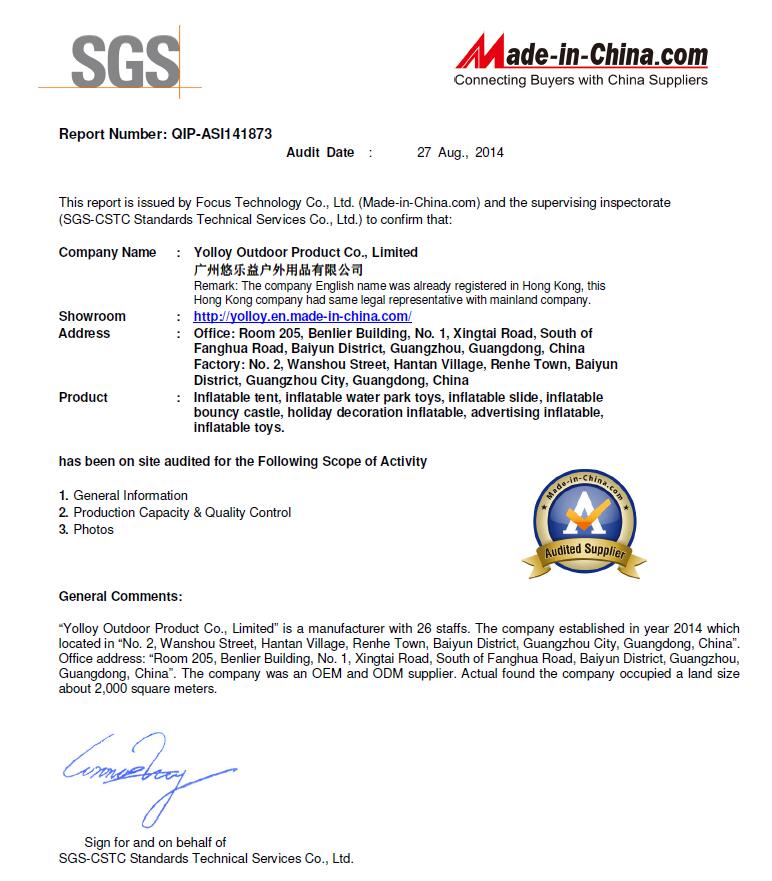
YOLLOY Outdoor Product Co., Limited, based in Guangzhou, China, exemplifies this direct-to-buyer model. The company operates on a design-to-production workflow: clients submit a description, drawing, sketch, or photograph, and the design team produces simulation renderings that are revised until the buyer approves. Only then does the design move to factory production. Every product is inspected and tested before shipment, and every order includes a repair kit — a small detail that speaks to a manufacturer's confidence in their product's long-term durability.
YOLLOY's product range extends across the full spectrum of inflatable categories: outdoor tents of every configuration, clear dome tents and bubble houses, portable planetarium domes, inflatable water parks and floating platforms, interactive sports games, commercial slides, bounce houses, paintball bunkers, air mattresses, and advertising inflatables. For buyers who need multiple product types, sourcing from a single manufacturer simplifies logistics, reduces shipping costs through consolidated orders, and ensures consistent quality across the entire inventory.
The company states a minimum order quantity of just one piece, making it accessible for first-time buyers who want to test a product before committing to a larger order. Typical production time for a standard inflatable product is 6-15 days, with a reported 95% on-time delivery rate. Air and sea shipping options are available, with indicative transit times of 5-7 days by air and 15-30 days or more by sea. These are the kinds of operational details that matter when you are planning around event dates and seasonal demand.
Ready to add an inflatable dome tent to your venue, rental fleet, or event lineup? Contact YOLLOY today to discuss your requirements. The team works from your concept — whether it is a detailed CAD drawing or a rough sketch on a napkin — to create a custom solution that fits your space, your brand, and your budget. Reach out at [email protected] or call +86-20-8370 0771 to start the conversation. With responsive service, competitive pricing, and a commitment to honest communication, YOLLOY makes it straightforward to bring your inflatable dome tent vision to life.