Products Category
Certification

News

• New Order Successfully Finished for Long-Time Cooperated Japanese Client | YOLLOY Wins Full Client Recognition

• YOLLOY Custom Inflatable Pool Tent for Danish Client: Professional Pool Repair Shelter & Debris Protection

• Trusted Once Again! Greek Captain Re-orders Our Products After 4 Years

• Revolutionize Your Outdoors: The All-Terrain Inflatable Floating Tent for Land & Water

• Elevate Your Summer Fun: The Ultimate Inflatable Water Floating Volleyball Court Trampoline

• Innovative Inflatable Nightclub Tents & Pop-Up Bars: The Ultimate Solution for Portable Party Venues

Contact Us

Name: Sunny Yang
Tel: +86-20-8370 0771
Fax: +86-20-8370 0771
Mobile: 13570587575
E-mail: [email protected]
Add: No 5,Xiong wei Bo Nan Road,ZhongLuoTan Town,Baiyun district,Guangzhou,China
Friend me on Facebook Follow me on Twitter Add me to your circles Follow me on Pinterest Watch my channel on YouTube
News

Behind the Seams: What Really Happens Inside a Professional Inflatable Tent Factory

Author:yolloy Date:2026/8/10 10:11:49
When you place an order for a commercial inflatable tent, the product that arrives at your doorstep is the result of dozens of decisions made on a factory floor hundreds or thousands of miles away. The fabric selected, the stitching technique used, the reinforcement added at stress points, and the quality checks performed before packing — every one of these factors determines whether your tent will survive its first season or its hundredth event. Understanding what goes on inside a professional inflatable tent factory is not just helpful background knowledge; it is the difference between making a smart investment and learning an expensive lesson.
The Raw Material Decision: Where Quality Begins
Walk into any serious inflatable tent factory and the first thing you will notice is the material. Not all PVC tarpaulin is the same, and the grade a factory stocks tells you a lot about its target market. Commercial-grade PVC tarpaulin — dense, tear-resistant, and UV-stabilized — is the standard for tents intended for repeated business use. But a versatile factory will also stock Oxford fabric, nylon, and TPU, selecting the right material for each application. A clear inflatable dome tent for a restaurant terrace needs transparent, flexible PVC panels. A heavy-duty inflatable spray booth for automotive work requires a material that resists chemical exposure. A factory that stocks multiple material types and can explain why one is better than another for your project is a factory that understands its craft.
Equally important is what happens to those materials before they reach the cutting table. Reputable inflatable tent manufacturers have their materials tested against recognized standards — EN71 for toy safety, EN14960 for inflatable play equipment, EN15649 for water park products, and RoHS for hazardous substance restrictions. These certifications are not marketing bullet points. They are independent verification that the fabric touching your customers' skin, sitting under the sun for hours, and holding up in wind and rain has been rigorously evaluated. When you ask a factory for certification documentation and they hesitate, you have your answer.
From Design to Cutting: The Engineering Behind the Fabric
A well-run inflatable tent factory does not start production the moment an order lands. The process begins with design. For a standard product, the factory's design team pulls up existing templates and adjusts dimensions, colors, and print layouts to match the order. For a custom inflatable tent, the workflow is more involved: the client submits a proposal — a description, a rough sketch, a photograph of the site, or a set of dimensions — and the design team produces simulation renderings. These renderings go back and forth with the client until every detail is approved. Only then does the file move to production.
On the production floor, the first physical step is cutting. Precision automated cutting machines translate the digital design into fabric panels with millimeter accuracy. Manual cutting still exists in smaller workshops, but a factory that has invested in automated cutting equipment is signaling that it values consistency and speed — two qualities that directly benefit the buyer. After cutting, the panels are marked for assembly, and any printed graphics — logos, branding, decorative patterns — are applied using digital printing technology that bonds the ink to the fabric at a molecular level rather than simply sitting on the surface.
Sewing and Welding: Two Paths to Structural Integrity
This is where the assembly line splits into two parallel workflows, and the best factories run both under one roof. Sewn products — including most outdoor inflatable tents, party tents, and shelters — move to the sewing station. Here, precision industrial sewing machines fitted with waterproof nylon thread join the panels together. The operators reinforce every seam, double-stitching high-load areas and adding extra layers of fabric at corners and attachment points. D-ring anchors and round metal anchor plates are integrated into the seams during this stage, not added as an afterthought. These anchoring systems are what keep an inflatable dome tent or party structure grounded when the wind picks up.
For airtight products — such as sealed inflatable structures, water park components, and certain types of air mattresses — the panels go to the high-temperature fusion welding station instead of the sewing line. Welding creates a hermetic seal by melting the PVC layers together at the seam, producing a bond that is actually stronger than the surrounding material. A factory that operates both sewing and welding lines under one roof has the flexibility to produce virtually any inflatable product, from a stitched canvas-style inflatable party tent to a fully sealed floating water platform.
The Quality Control Gate: Inspection Before It Ships
Quality control is not a single checkpoint at the end of the line; it is a series of gates that the product must pass through at every stage. After cutting, panels are checked against the design specifications. After sewing or welding, seams are inspected visually and tested under tension. After final assembly, the complete product is inflated and held under pressure while inspectors examine every seam, every anchor point, and every printed surface for defects. The blower is tested to confirm it matches the specified voltage — 110V, 220V, or 380V — and that it delivers the correct airflow for the tent size.
Only after passing every inspection does the product move to packaging. A detail-oriented factory wraps the product in soft carpet protection, encloses it in a waterproof PVC bag, and seals everything in an outer layer of PE film. Large products ship on steel pallets to prevent crushing. A repair kit — containing patching material, adhesive, and instructions — is included in every package. The presence of a repair kit is a small but telling sign: it means the manufacturer is thinking about your long-term ownership experience, not just closing a sale.
The Range Test: What a Factory's Catalog Reveals
A factory's product range is a window into its capabilities. A facility that produces only one type of inflatable tent — say, basic camping shelters — has a narrow skill set and limited equipment. A factory that manufactures cube tents, tunnel tents, dome tents, clear bubble tents, inflatable shelters, car tents, party tents, sports tents, and portable planetarium domes — alongside water park inflatables, interactive sports games, commercial slides, bounce houses, paintball bunkers, air mattresses, and advertising inflatables — has invested in the machines, materials, and skilled workforce to handle virtually any project. This breadth also means you can consolidate your sourcing. Whether you need an inflatable tent for a wedding this month and a water park attraction next season, a single capable factory can serve both needs.
Questions That Separate Factories from Facades
Before you sign a purchase order, a handful of direct questions will tell you more about a factory than any brochure or website. Start with the minimum order quantity: some factories demand bulk purchases, while others accept a single piece. A factory with a one-piece MOQ is signaling confidence — it believes you will be satisfied enough to reorder. Ask about production timelines: a typical lead time of 6 to 15 days for a regular product is reasonable, with longer timelines for complex custom projects. Press for shipping details: air freight takes roughly 5 to 7 days, while sea freight can take 15 to 30 days or more. Confirm that the blower voltage is matched to your location before the order is finalized.
Finally, ask about what happens after the sale. A factory that responds to emails within 24 hours, provides a repair kit with every product, and stands behind a three-year expected service life is a factory that values its reputation. These are not extravagant promises — they are the baseline for a professional manufacturing operation. A factory that cannot meet them is not one you want to trust with your business investment.
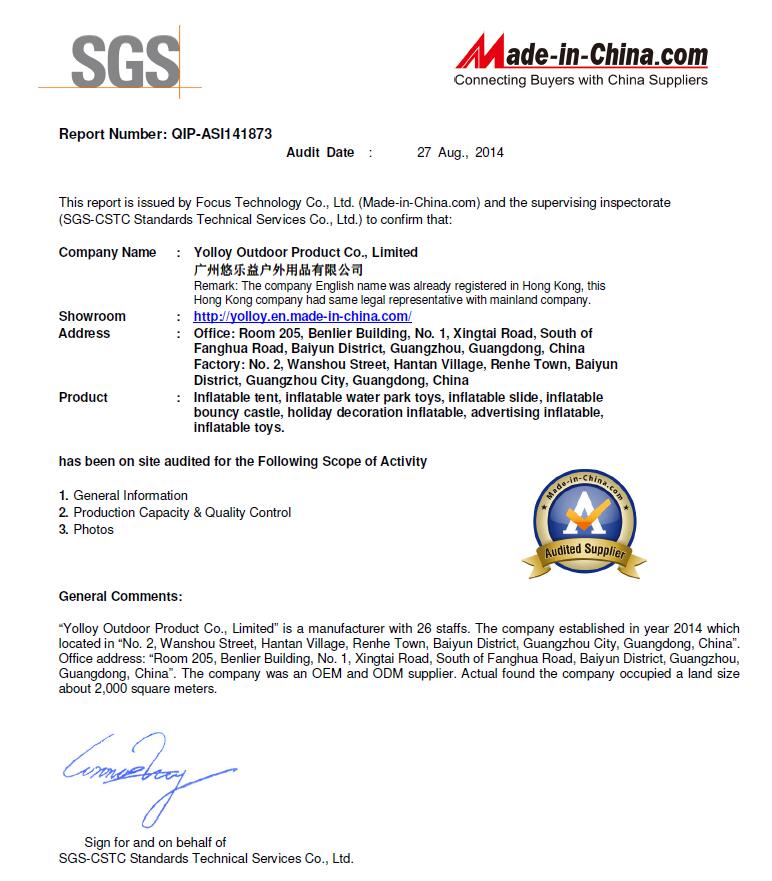
Looking for a reliable inflatable tent factory? YOLLOY Outdoor Product Co., Limited, based in Guangzhou, China, designs and manufactures custom inflatable tents, clear dome tents, planetarium domes, water park products, interactive sports games, commercial slides, bounce houses, paintball bunkers, air mattresses, and advertising inflatables. With commercial-grade PVC tarpaulin, certified materials, precision sewing and welding equipment, a one-piece minimum order quantity, and a 95% on-time delivery rate, YOLLOY serves clients across Europe, Asia, South America, Africa, the Middle East, and Latin America. Contact us at [email protected] or visit www.yolloy.net to discuss your project.

Behind the Seams: What Really Happens Inside a Professional Inflatable Tent Factory

Author:yolloy Date:2026/8/10 10:11:49

When you place an order for a commercial inflatable tent, the product that arrives at your doorstep is the result of dozens of decisions made on a factory floor hundreds or thousands of miles away. The fabric selected, the stitching technique used, the reinforcement added at stress points, and the quality checks performed before packing — every one of these factors determines whether your tent will survive its first season or its hundredth event. Understanding what goes on inside a professional inflatable tent factory is not just helpful background knowledge; it is the difference between making a smart investment and learning an expensive lesson.
The Raw Material Decision: Where Quality Begins
Walk into any serious inflatable tent factory and the first thing you will notice is the material. Not all PVC tarpaulin is the same, and the grade a factory stocks tells you a lot about its target market. Commercial-grade PVC tarpaulin — dense, tear-resistant, and UV-stabilized — is the standard for tents intended for repeated business use. But a versatile factory will also stock Oxford fabric, nylon, and TPU, selecting the right material for each application. A clear inflatable dome tent for a restaurant terrace needs transparent, flexible PVC panels. A heavy-duty inflatable spray booth for automotive work requires a material that resists chemical exposure. A factory that stocks multiple material types and can explain why one is better than another for your project is a factory that understands its craft.
Equally important is what happens to those materials before they reach the cutting table. Reputable inflatable tent manufacturers have their materials tested against recognized standards — EN71 for toy safety, EN14960 for inflatable play equipment, EN15649 for water park products, and RoHS for hazardous substance restrictions. These certifications are not marketing bullet points. They are independent verification that the fabric touching your customers' skin, sitting under the sun for hours, and holding up in wind and rain has been rigorously evaluated. When you ask a factory for certification documentation and they hesitate, you have your answer.
From Design to Cutting: The Engineering Behind the Fabric
A well-run inflatable tent factory does not start production the moment an order lands. The process begins with design. For a standard product, the factory's design team pulls up existing templates and adjusts dimensions, colors, and print layouts to match the order. For a custom inflatable tent, the workflow is more involved: the client submits a proposal — a description, a rough sketch, a photograph of the site, or a set of dimensions — and the design team produces simulation renderings. These renderings go back and forth with the client until every detail is approved. Only then does the file move to production.
On the production floor, the first physical step is cutting. Precision automated cutting machines translate the digital design into fabric panels with millimeter accuracy. Manual cutting still exists in smaller workshops, but a factory that has invested in automated cutting equipment is signaling that it values consistency and speed — two qualities that directly benefit the buyer. After cutting, the panels are marked for assembly, and any printed graphics — logos, branding, decorative patterns — are applied using digital printing technology that bonds the ink to the fabric at a molecular level rather than simply sitting on the surface.
Sewing and Welding: Two Paths to Structural Integrity
This is where the assembly line splits into two parallel workflows, and the best factories run both under one roof. Sewn products — including most outdoor inflatable tents, party tents, and shelters — move to the sewing station. Here, precision industrial sewing machines fitted with waterproof nylon thread join the panels together. The operators reinforce every seam, double-stitching high-load areas and adding extra layers of fabric at corners and attachment points. D-ring anchors and round metal anchor plates are integrated into the seams during this stage, not added as an afterthought. These anchoring systems are what keep an inflatable dome tent or party structure grounded when the wind picks up.
For airtight products — such as sealed inflatable structures, water park components, and certain types of air mattresses — the panels go to the high-temperature fusion welding station instead of the sewing line. Welding creates a hermetic seal by melting the PVC layers together at the seam, producing a bond that is actually stronger than the surrounding material. A factory that operates both sewing and welding lines under one roof has the flexibility to produce virtually any inflatable product, from a stitched canvas-style inflatable party tent to a fully sealed floating water platform.
The Quality Control Gate: Inspection Before It Ships
Quality control is not a single checkpoint at the end of the line; it is a series of gates that the product must pass through at every stage. After cutting, panels are checked against the design specifications. After sewing or welding, seams are inspected visually and tested under tension. After final assembly, the complete product is inflated and held under pressure while inspectors examine every seam, every anchor point, and every printed surface for defects. The blower is tested to confirm it matches the specified voltage — 110V, 220V, or 380V — and that it delivers the correct airflow for the tent size.
Only after passing every inspection does the product move to packaging. A detail-oriented factory wraps the product in soft carpet protection, encloses it in a waterproof PVC bag, and seals everything in an outer layer of PE film. Large products ship on steel pallets to prevent crushing. A repair kit — containing patching material, adhesive, and instructions — is included in every package. The presence of a repair kit is a small but telling sign: it means the manufacturer is thinking about your long-term ownership experience, not just closing a sale.
The Range Test: What a Factory's Catalog Reveals
A factory's product range is a window into its capabilities. A facility that produces only one type of inflatable tent — say, basic camping shelters — has a narrow skill set and limited equipment. A factory that manufactures cube tents, tunnel tents, dome tents, clear bubble tents, inflatable shelters, car tents, party tents, sports tents, and portable planetarium domes — alongside water park inflatables, interactive sports games, commercial slides, bounce houses, paintball bunkers, air mattresses, and advertising inflatables — has invested in the machines, materials, and skilled workforce to handle virtually any project. This breadth also means you can consolidate your sourcing. Whether you need an inflatable tent for a wedding this month and a water park attraction next season, a single capable factory can serve both needs.
Questions That Separate Factories from Facades
Before you sign a purchase order, a handful of direct questions will tell you more about a factory than any brochure or website. Start with the minimum order quantity: some factories demand bulk purchases, while others accept a single piece. A factory with a one-piece MOQ is signaling confidence — it believes you will be satisfied enough to reorder. Ask about production timelines: a typical lead time of 6 to 15 days for a regular product is reasonable, with longer timelines for complex custom projects. Press for shipping details: air freight takes roughly 5 to 7 days, while sea freight can take 15 to 30 days or more. Confirm that the blower voltage is matched to your location before the order is finalized.
Finally, ask about what happens after the sale. A factory that responds to emails within 24 hours, provides a repair kit with every product, and stands behind a three-year expected service life is a factory that values its reputation. These are not extravagant promises — they are the baseline for a professional manufacturing operation. A factory that cannot meet them is not one you want to trust with your business investment.
Looking for a reliable inflatable tent factory? YOLLOY Outdoor Product Co., Limited, based in Guangzhou, China, designs and manufactures custom inflatable tents, clear dome tents, planetarium domes, water park products, interactive sports games, commercial slides, bounce houses, paintball bunkers, air mattresses, and advertising inflatables. With commercial-grade PVC tarpaulin, certified materials, precision sewing and welding equipment, a one-piece minimum order quantity, and a 95% on-time delivery rate, YOLLOY serves clients across Europe, Asia, South America, Africa, the Middle East, and Latin America. Contact us at [email protected] or visit www.yolloy.net to discuss your project.