Products Category
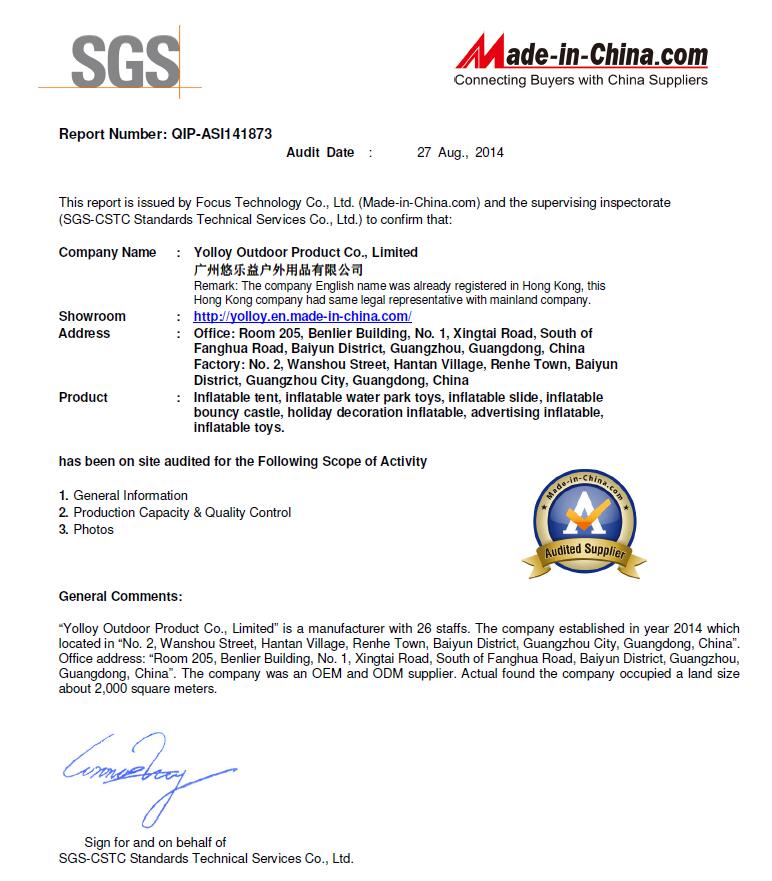
Certification

News

• New Order Successfully Finished for Long-Time Cooperated Japanese Client | YOLLOY Wins Full Client Recognition

• YOLLOY Custom Inflatable Pool Tent for Danish Client: Professional Pool Repair Shelter & Debris Protection

• Trusted Once Again! Greek Captain Re-orders Our Products After 4 Years

• Revolutionize Your Outdoors: The All-Terrain Inflatable Floating Tent for Land & Water

• Elevate Your Summer Fun: The Ultimate Inflatable Water Floating Volleyball Court Trampoline

• Innovative Inflatable Nightclub Tents & Pop-Up Bars: The Ultimate Solution for Portable Party Venues

Contact Us

Name: Sunny Yang
Tel: +86-20-8370 0771
Fax: +86-20-8370 0771
Mobile: 13570587575
E-mail: [email protected]
Add: No 5,Xiong wei Bo Nan Road,ZhongLuoTan Town,Baiyun district,Guangzhou,China
Friend me on Facebook Follow me on Twitter Add me to your circles Follow me on Pinterest Watch my channel on YouTube
News

How does an inflatable zorb ball differ from a regular zorb ball?

Author:yolloy Date:2026/8/13 20:56:20

Zorb balls have become a staple of outdoor recreation, team-building events, and water park attractions worldwide. But not all zorb balls are created equal. If you are shopping for a zorb ball—whether for a rental business, an adventure park, or a community event—you have likely come across two main categories: the inflatable zorb ball and the regular (traditional harnessed) zorb ball. Understanding how they differ in design, materials, safety, and intended use is essential before making a purchase decision.

What Is an Inflatable Zorb Ball?

An inflatable zorb ball is a single-layer, air-filled sphere made from commercial-grade PVC tarpaulin or TPU material. It is inflated using an electric blower and typically features one or two entry points with zippered closures. Once inflated, the ball maintains its shape through continuous air pressure supplied by the blower or by sealing the valve after inflation.

These balls are widely used for water walking, bubble soccer, bumper ball games, and casual rolling on flat surfaces like grass fields or indoor gym floors. Users either climb inside and walk (in the case of water balls) or wear the ball as a torso covering with legs free (in the case of bumper balls). Because they rely on a single air chamber, inflatable zorb balls are lightweight, easy to transport, and quick to set up.

A reliable inflatable zorb ball manufacturer will use high-frequency welding technology to seal the seams, reinforced stitching at stress points, and materials tested to international safety standards such as EN71 and EN14960. These construction details directly affect the ball's durability and lifespan, especially under frequent commercial use.

What Is a Regular (Traditional) Zorb Ball?

A regular zorb ball—often simply called a "zorb"—is a double-layered sphere consisting of an inner ball and an outer ball separated by an air cushion. The two layers are connected by hundreds of small nylon strings that maintain the gap between them. This air gap acts as a shock absorber, damping bumps and impacts as the ball rolls downhill or across uneven terrain.

Traditional zorb balls are typically around 3 meters (10 feet) in outer diameter, with the inner chamber measuring roughly 2 meters across. The rider is secured inside with a harness system, allowing them to tumble and rotate safely as the ball rolls. These balls are designed for high-velocity downhill rolling—the sport known as "zorbing"—which originated in New Zealand and has since spread to adventure parks globally.

Because of their double-layer construction, regular zorb balls are heavier, bulkier, and more expensive than their inflatable counterparts. They also require more involved setup and dedicated storage space. The transparent plastic outer shell is typically around 0.8 mm thick, and the entry point is a tunnel-like opening that riders climb through.

Key Differences at a Glance

FeatureInflatable Zorb BallRegular (Traditional) Zorb Ball
ConstructionSingle-layer PVC or TPU, inflated by blowerDouble-layered with nylon-string air cushion between inner and outer shells
Safety MechanismSingle air chamber; padded walls absorb light impactsAir cushion between layers acts as shock absorber; internal harness secures the rider
Primary UseWater walking, bubble soccer, bumper games, flat-surface rollingDownhill zorbing, adventure racing, commercial zorb tracks
Weight & PortabilityLightweight; deflates compactly for easy transport and storageHeavier and bulkier; requires more space and effort to move
Setup TimeQuick—inflates in minutes with a standard blowerLonger assembly; requires proper anchoring and harness checks
CostMore affordable; suitable for businesses with frequent turnoverHigher upfront investment; suited for dedicated adventure venues
Rider ExperienceOpen or semi-enclosed; legs often free for movementFully enclosed; rider is harnessed and tumbles with the ball
Typical DiameterVaries; commonly 1.5 m to 2.5 m depending on modelStandard outer diameter around 3 m, inner around 2 m

Material and Build Quality

Material selection is one of the most important factors separating a durable zorb ball from one that fails after a few uses. Inflatable zorb balls from a quality-focused inflatable zorb ball supplier are typically made from high-density PVC tarpaulin with reinforced seams. The seams are welded using high-temperature fusion equipment rather than simply glued, which significantly improves airtightness and tear resistance. Additional reinforcement is applied at high-stress areas such as the entry zipper and handle attachment points.

Regular zorb balls use transparent thermoplastic polyurethane (TPU) or PVC film for the outer shell, with the inner and outer layers connected by hundreds of nylon cords. The plastic film must be both flexible and puncture-resistant, as it needs to withstand the friction of rolling over grass, gravel, and pavement. The harness system inside is typically made from nylon webbing with quick-release buckles, and the entry tunnel is reinforced to prevent tearing during repeated use.

Both types benefit from materials that have passed relevant safety testing. For inflatable products, EN71 (toy safety) and EN14960 (inflatable play equipment) are common benchmarks. Water park products may additionally reference EN15649. Buyers should verify that the manufacturer can provide documentation of material compliance before placing an order.

Which One Should You Choose?

The right choice depends on your specific use case, budget, and operational setup.

Choose an Inflatable Zorb Ball If:

  • You run a rental business, party planning service, or community event where quick setup and takedown matter.
  • Your activities involve water—such as walking on a lake or pool surface—since the single-layer design works well for buoyancy.
  • You need lightweight equipment that can be transported in a standard vehicle and stored in limited space.
  • You are organizing bubble soccer matches, bumper ball games, or casual flat-ground rolling games for mixed-age groups.
  • You want a lower per-unit cost so you can stock multiple balls for high-turnover events.

Choose a Regular Zorb Ball If:

  • You operate a dedicated adventure park, zorbing track, or downhill course with trained staff on site.
  • Your customers expect a high-speed, adrenaline-focused experience with full-body rotation.
  • You have the storage space and transport logistics to handle larger, heavier equipment.
  • You are willing to invest more upfront for a product engineered specifically for high-velocity rolling.
  • You need the added safety of a harness system and double-layer impact absorption for commercial-grade downhill use.

Customization options: Whether you choose an inflatable or regular zorb ball, many manufacturers offer customization. You can specify colors, sizes, printed logos, and even add LED lighting for nighttime events. YOLLOY, for example, provides fully customized zorb balls—from material selection to artwork printing—so your equipment matches your brand identity and operational requirements.

YOLLOY Zorb Ball Solutions

YOLLOY Outdoor Product Co., Limited, based in Guangzhou, China, is a specialized manufacturer of inflatable products including zorb balls, water balls, bumper balls, and interactive sport games. With years of experience serving clients across Europe, Asia, the Middle East, Africa, and the Americas, YOLLOY offers a complete design-to-production service: from concept renderings and material selection to factory production, quality inspection, and global shipping.

Every YOLLOY zorb ball is built with commercial-grade PVC tarpaulin, precision-sewn and high-temperature welded seams, and reinforced entry points. Products are tested before shipment, and a repair kit is included with each unit. The company supports custom sizes, colors, logos, and can supply blowers configured for 110V, 220V, or 380V electrical systems depending on your region. Air and sea shipping options are available, with typical air transit times of 5–7 days and sea freight of 15–30 days.

Bottom line: An inflatable zorb ball gives you portability, affordability, and quick deployment—ideal for water activities, party games, and rental operations. A regular zorb ball delivers the full adrenaline experience with harnessed safety and double-layer impact protection—perfect for commercial zorbing tracks and adventure parks. By understanding these differences and choosing a manufacturer that prioritizes material quality and safety compliance, you can invest in equipment that performs reliably and keeps your customers coming back.


How does an inflatable zorb ball differ from a regular zorb ball?

Author:yolloy Date:2026/8/13 20:56:20

Zorb balls have become a staple of outdoor recreation, team-building events, and water park attractions worldwide. But not all zorb balls are created equal. If you are shopping for a zorb ball—whether for a rental business, an adventure park, or a community event—you have likely come across two main categories: the inflatable zorb ball and the regular (traditional harnessed) zorb ball. Understanding how they differ in design, materials, safety, and intended use is essential before making a purchase decision.

What Is an Inflatable Zorb Ball?

An inflatable zorb ball is a single-layer, air-filled sphere made from commercial-grade PVC tarpaulin or TPU material. It is inflated using an electric blower and typically features one or two entry points with zippered closures. Once inflated, the ball maintains its shape through continuous air pressure supplied by the blower or by sealing the valve after inflation.

These balls are widely used for water walking, bubble soccer, bumper ball games, and casual rolling on flat surfaces like grass fields or indoor gym floors. Users either climb inside and walk (in the case of water balls) or wear the ball as a torso covering with legs free (in the case of bumper balls). Because they rely on a single air chamber, inflatable zorb balls are lightweight, easy to transport, and quick to set up.

A reliable inflatable zorb ball manufacturer will use high-frequency welding technology to seal the seams, reinforced stitching at stress points, and materials tested to international safety standards such as EN71 and EN14960. These construction details directly affect the ball's durability and lifespan, especially under frequent commercial use.

What Is a Regular (Traditional) Zorb Ball?

A regular zorb ball—often simply called a "zorb"—is a double-layered sphere consisting of an inner ball and an outer ball separated by an air cushion. The two layers are connected by hundreds of small nylon strings that maintain the gap between them. This air gap acts as a shock absorber, damping bumps and impacts as the ball rolls downhill or across uneven terrain.

Traditional zorb balls are typically around 3 meters (10 feet) in outer diameter, with the inner chamber measuring roughly 2 meters across. The rider is secured inside with a harness system, allowing them to tumble and rotate safely as the ball rolls. These balls are designed for high-velocity downhill rolling—the sport known as "zorbing"—which originated in New Zealand and has since spread to adventure parks globally.

Because of their double-layer construction, regular zorb balls are heavier, bulkier, and more expensive than their inflatable counterparts. They also require more involved setup and dedicated storage space. The transparent plastic outer shell is typically around 0.8 mm thick, and the entry point is a tunnel-like opening that riders climb through.

Key Differences at a Glance

FeatureInflatable Zorb BallRegular (Traditional) Zorb Ball
ConstructionSingle-layer PVC or TPU, inflated by blowerDouble-layered with nylon-string air cushion between inner and outer shells
Safety MechanismSingle air chamber; padded walls absorb light impactsAir cushion between layers acts as shock absorber; internal harness secures the rider
Primary UseWater walking, bubble soccer, bumper games, flat-surface rollingDownhill zorbing, adventure racing, commercial zorb tracks
Weight & PortabilityLightweight; deflates compactly for easy transport and storageHeavier and bulkier; requires more space and effort to move
Setup TimeQuick—inflates in minutes with a standard blowerLonger assembly; requires proper anchoring and harness checks
CostMore affordable; suitable for businesses with frequent turnoverHigher upfront investment; suited for dedicated adventure venues
Rider ExperienceOpen or semi-enclosed; legs often free for movementFully enclosed; rider is harnessed and tumbles with the ball
Typical DiameterVaries; commonly 1.5 m to 2.5 m depending on modelStandard outer diameter around 3 m, inner around 2 m

Material and Build Quality

Material selection is one of the most important factors separating a durable zorb ball from one that fails after a few uses. Inflatable zorb balls from a quality-focused inflatable zorb ball supplier are typically made from high-density PVC tarpaulin with reinforced seams. The seams are welded using high-temperature fusion equipment rather than simply glued, which significantly improves airtightness and tear resistance. Additional reinforcement is applied at high-stress areas such as the entry zipper and handle attachment points.

Regular zorb balls use transparent thermoplastic polyurethane (TPU) or PVC film for the outer shell, with the inner and outer layers connected by hundreds of nylon cords. The plastic film must be both flexible and puncture-resistant, as it needs to withstand the friction of rolling over grass, gravel, and pavement. The harness system inside is typically made from nylon webbing with quick-release buckles, and the entry tunnel is reinforced to prevent tearing during repeated use.

Both types benefit from materials that have passed relevant safety testing. For inflatable products, EN71 (toy safety) and EN14960 (inflatable play equipment) are common benchmarks. Water park products may additionally reference EN15649. Buyers should verify that the manufacturer can provide documentation of material compliance before placing an order.

Which One Should You Choose?

The right choice depends on your specific use case, budget, and operational setup.

Choose an Inflatable Zorb Ball If:

  • You run a rental business, party planning service, or community event where quick setup and takedown matter.
  • Your activities involve water—such as walking on a lake or pool surface—since the single-layer design works well for buoyancy.
  • You need lightweight equipment that can be transported in a standard vehicle and stored in limited space.
  • You are organizing bubble soccer matches, bumper ball games, or casual flat-ground rolling games for mixed-age groups.
  • You want a lower per-unit cost so you can stock multiple balls for high-turnover events.

Choose a Regular Zorb Ball If:

  • You operate a dedicated adventure park, zorbing track, or downhill course with trained staff on site.
  • Your customers expect a high-speed, adrenaline-focused experience with full-body rotation.
  • You have the storage space and transport logistics to handle larger, heavier equipment.
  • You are willing to invest more upfront for a product engineered specifically for high-velocity rolling.
  • You need the added safety of a harness system and double-layer impact absorption for commercial-grade downhill use.

Customization options: Whether you choose an inflatable or regular zorb ball, many manufacturers offer customization. You can specify colors, sizes, printed logos, and even add LED lighting for nighttime events. YOLLOY, for example, provides fully customized zorb balls—from material selection to artwork printing—so your equipment matches your brand identity and operational requirements.

YOLLOY Zorb Ball Solutions

YOLLOY Outdoor Product Co., Limited, based in Guangzhou, China, is a specialized manufacturer of inflatable products including zorb balls, water balls, bumper balls, and interactive sport games. With years of experience serving clients across Europe, Asia, the Middle East, Africa, and the Americas, YOLLOY offers a complete design-to-production service: from concept renderings and material selection to factory production, quality inspection, and global shipping.

Every YOLLOY zorb ball is built with commercial-grade PVC tarpaulin, precision-sewn and high-temperature welded seams, and reinforced entry points. Products are tested before shipment, and a repair kit is included with each unit. The company supports custom sizes, colors, logos, and can supply blowers configured for 110V, 220V, or 380V electrical systems depending on your region. Air and sea shipping options are available, with typical air transit times of 5–7 days and sea freight of 15–30 days.

Bottom line: An inflatable zorb ball gives you portability, affordability, and quick deployment—ideal for water activities, party games, and rental operations. A regular zorb ball delivers the full adrenaline experience with harnessed safety and double-layer impact protection—perfect for commercial zorbing tracks and adventure parks. By understanding these differences and choosing a manufacturer that prioritizes material quality and safety compliance, you can invest in equipment that performs reliably and keeps your customers coming back.