If you have ever set up a traditional pole tent at an outdoor event, you know the frustration — tangled poles, pinched fingers, and a setup process that eats into your event time. An inflatable canopy tent solves all of that by replacing rigid metal frames with pressurized air beams. But how exactly does this technology work, and what makes it a better choice for commercial events, trade shows, and outdoor promotions? This article breaks down the mechanics, materials, and practical advantages of inflatable canopy tents.
What Is an Inflatable Canopy Tent?
An inflatable canopy tent is a freestanding shelter that uses air-filled beams instead of metal or fiberglass poles to support the structure. The core concept is simple: you pump air into sealed tubes integrated into the tent fabric, and the internal pressure makes those tubes rigid enough to hold the entire canopy upright. Once inflated, the tent looks and functions like a conventional event shelter, but the underlying mechanics are fundamentally different — and the setup speed is dramatically faster.
Unlike traditional pop-up canopies that rely on folding scissor frames and multiple locking joints, an inflatable tent eliminates separate pole assemblies entirely. You unfold the tent, stake it down, connect a pump, and let the air do the work. A single person can set up a 10x10 ft inflatable canopy in under five minutes, compared to the 10-20 minutes typically required for a comparable pole-based structure.
How Air Beams Create Structural Rigidity
The key to understanding how an inflatable canopy tent works lies in the physics of pressurized air. When you seal air inside a flexible tube and increase the pressure, the air molecules push outward equally against all sides of the tube wall. This creates uniform tension throughout the beam, giving it column-like stiffness from top to bottom. A properly inflated air beam at 5-9 PSI can match the structural performance of an aluminum pole of similar diameter.
The outer fabric shell plays an equally important role. When wind hits the side of the tent, the canopy fabric distributes that force across multiple beams and anchor points rather than concentrating the load on a single structural member. This distributed loading mechanism is why inflatable tents perform well in gusty conditions — they flex slightly and return to shape, unlike rigid poles that can bend or snap under sustained pressure.
Beam geometry adds another layer of stability. Manufacturers route air beams along curved or arched paths rather than straight vertical lines. Curved structural elements carry compressive loads more efficiently, which is the same engineering principle behind arched bridges. Your inflatable canopy tent borrows that geometric advantage to stay upright through demanding weather conditions.
The Anatomy of an Inflatable Canopy Tent
Every inflatable canopy tent is built around several core components working together:
- Outer Fabric Shell: Made from heavy-duty materials such as Oxford fabric, polyester, or commercial-grade PVC tarpaulin, chosen for tear resistance, UV protection, and weather durability.
- Air Beams: Sealed tubes that follow the tent's frame path. Each beam consists of an inner TPU or welded PVC bladder (the airtight layer) and an outer high-tenacity fabric sleeve (the structural and protective layer).
- Valve System: The entry and exit point for air. Most modern commercial tents use high-flow valves that allow all beams to be inflated through a single connection point, and many include pressure relief mechanisms to prevent over-inflation.
- Anchor Points: D-ring or round metal anchor systems built into the base perimeter, along with guy line attachments, keep the tent secured to the ground and resist wind uplift.
The two-layer beam construction is especially important for durability. A small scratch on the outer sleeve rarely causes a failure because the inner bladder stays protected behind it. Meanwhile, the sleeve controls how far the beam can expand, ensuring consistent geometry and predictable stiffness every time you inflate.
Step-by-Step Setup Process
Setting up an inflatable canopy tent is straightforward, but following the correct sequence makes a significant difference in speed and stability:
1. Site Preparation and Positioning
Clear the ground of sharp objects, rocks, or debris. Unroll the tent completely on the footprint where it will stand, and orient the entry panels and branding panels in the desired direction before staking anything down.
2. Stake Before Inflation
Push your ground stakes through the perimeter anchor points at each corner and along the base. Run guy lines from the upper attachment points and peg them at roughly a 45-degree angle. Staking before inflation means the structure rises into its correct shape as the beams fill, rather than shifting positions once upright.
3. Inflate the Beams
Connect your electric pump to the main inflation valve. For most commercial inflatable tents, full inflation takes between three and seven minutes. You will see the arch beams lift the canopy off the ground and pull the fabric tight as pressure builds. Once the frame is fully upright, check the pressure against the manufacturer's rated PSI, close the valve firmly, and walk the perimeter to confirm all stakes are seated and guy lines are tensioned evenly.
Quick Tip: Avoid pressing down on beams while they are partially inflated. Uneven pressure distribution can cause the tent to shift off its stake points before the frame is fully rigid.
Materials and Construction Quality
The longevity of an inflatable canopy tent depends heavily on the quality of materials and manufacturing processes. Leading inflatable tent manufacturers like YOLLOY use commercial-grade PVC tarpaulin with reinforced seams, waterproof nylon thread, and additional reinforcement at high-load areas. Airtight products are manufactured with high-temperature fusion and welding equipment, ensuring consistent seam integrity across the entire structure.
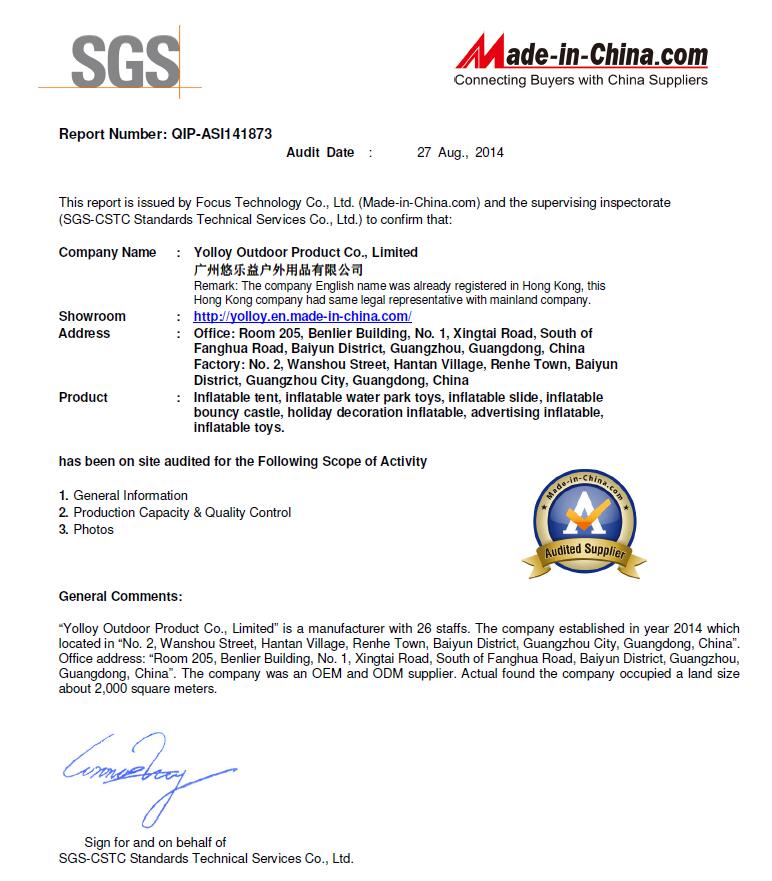
Quality certifications matter. Reputable manufacturers have their materials tested against international standards. YOLLOY's products, for example, reference EN71, EN14960, and RoHS compliance for materials, while blowers meet CE or UL requirements. Each product is inspected and tested before shipment, and a repair kit is included with every inflatable tent — a practical detail that keeps your tent operational across multiple event seasons.
Wind Resistance and Weather Performance
A common concern with inflatable tents is wind performance. In practice, a properly staked and inflated tent handles outdoor conditions better than many expect. The flexible air beam system absorbs and distributes wind force across the entire structure rather than rigidly resisting it. When a gust pushes against the side wall, the curved beams flex slightly and recover their shape — a structural behavior that actually outperforms rigid poles, which concentrate stress at joints and can snap under sudden loads.
Most commercial inflatable canopy tents are rated for sustained winds between 25 and 45 mph when properly anchored. The real-world weak point is rarely the air beam itself — it is the anchoring. Using quality steel stakes on grass, sandbag weights on beaches, or water weights on concrete makes the difference between a tent that stays up through a storm and one that tips over. Always check that your D-ring anchors and guy lines are properly tensioned before weather arrives.
Customization: Making the Tent Work for Your Brand
One of the biggest advantages of choosing an inflatable canopy tent over a standard pop-up is the customization potential. For businesses, event organizers, and marketing teams, the tent itself becomes a branded asset. A custom inflatable tent can feature full-color printed logos, artwork, and brand messaging directly on the canopy fabric, turning a functional shelter into a high-visibility marketing tool.
YOLLOY, a China-based inflatable product manufacturer with over a decade of experience, offers fully customized designs. Customers can specify custom sizes, colors, and printed graphics. The design team prepares simulation renderings from the client's proposal, and revisions continue until the design meets approval before moving to production. Whether you need a cube tent for a trade show booth, a tunnel tent for a product activation, or a dome tent for a VIP lounge, custom manufacturing ensures the final product matches your exact requirements.
Inflatable Canopy Tent vs. Traditional Pop-Up: A Quick Comparison
| Feature | Inflatable Canopy Tent | Traditional Pop-Up Tent |
|---|
| Setup Time | 3-7 minutes (1 person) | 10-20 minutes (2 people) |
| Structural Frame | Pressurized air beams | Metal scissor frame with joints |
| Wind Performance | Flexes and recovers; rated 25-45 mph | Rigid; joints can bend/snap at 20-25 mph |
| Portability | Compresses into a single carry bag | Multiple pole sections, separate hardware |
| Customization | Full-color printed fabric panels | Limited to canopy top printing |
| Durability | Two-layer beam construction; repairable | Metal fatigue; bent poles require replacement |
| Maintenance | Valve checks, proper storage, occasional patching | Joint lubrication, rust prevention, bent frame repair |
Maintenance and Long-Term Care
Getting long-term value from an inflatable canopy tent requires consistent care, but the routine is simple. After each use, let the tent dry completely before packing — storing a damp tent promotes mildew and can degrade the TPU lining over time. Fold the tent lengthwise into a flat panel, then roll it toward the valve end to push any residual air out of the beams. Keep the valve caps fully closed and store the packed tent in a cool, dry space away from direct sunlight.
Before each event, do a quick inspection: check all valve connections for secure fit, examine the outer fabric for any abrasions, and test the pump to confirm it is working. If you notice a slow leak, a soapy water test on the valve and seams will quickly reveal the source — most leaks occur at valve connections rather than in the main fabric and can be fixed with a small dab of seam sealer. With proper care, a quality inflatable canopy tent from a reputable manufacturer can serve reliably for three years or more across dozens of events.
Key Takeaway: Inflatable canopy tents work by replacing rigid poles with pressurized air beams that become structurally rigid when inflated to the correct PSI. The combination of durable materials, distributed load mechanics, and curved beam geometry creates a shelter that is faster to set up, more wind-resistant when properly anchored, and easier to customize than traditional pole-based alternatives. For businesses, event planners, and rental operators looking for a reliable outdoor shelter solution, the technology offers a compelling upgrade over conventional pop-up canopies.