Products Category
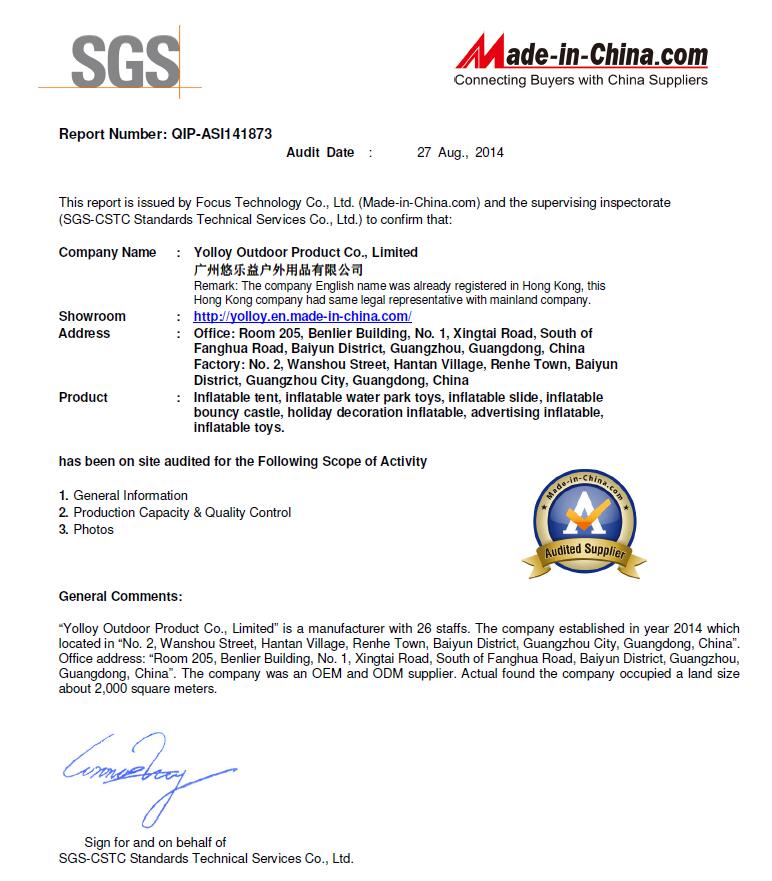
Certification

News

• New Order Successfully Finished for Long-Time Cooperated Japanese Client | YOLLOY Wins Full Client Recognition

• YOLLOY Custom Inflatable Pool Tent for Danish Client: Professional Pool Repair Shelter & Debris Protection

• Trusted Once Again! Greek Captain Re-orders Our Products After 4 Years

• Revolutionize Your Outdoors: The All-Terrain Inflatable Floating Tent for Land & Water

• Elevate Your Summer Fun: The Ultimate Inflatable Water Floating Volleyball Court Trampoline

• Innovative Inflatable Nightclub Tents & Pop-Up Bars: The Ultimate Solution for Portable Party Venues

Contact Us

Name: Sunny Yang
Tel: +86-20-8370 0771
Fax: +86-20-8370 0771
Mobile: 13570587575
E-mail: [email protected]
Add: No 5,Xiong wei Bo Nan Road,ZhongLuoTan Town,Baiyun district,Guangzhou,China
Friend me on Facebook Follow me on Twitter Add me to your circles Follow me on Pinterest Watch my channel on YouTube
News

How does an inflatable boat slide differ from a regular water slide?

Author:yolloy Date:2026/8/19 9:54:19
At first glance an inflatable boat slide and a regular water slide look almost identical, but they are built for completely different environments. A boat slide is mounted to a dock or a vessel's swim platform and drops riders straight into open water. A regular water slide, by contrast, is a land-based attraction set up on lawns, at fairs, events and in water parks, with its own climbing tower and usually a splash pool at the exit. Understanding these differences is the first step to choosing the right unit for your business.

Where each slide is used: The single biggest difference is location and purpose. An inflatable boat slide exists to move people off an elevated deck or platform and safely into the water as quickly as possible, which makes it popular at marinas, lakefront resorts, floating docks and yacht charter fleets. A regular inflatable water slide is a freestanding attraction that provides recreation rather than entry into the water. It keeps riders on board, funnels them down one or more lanes and leads them to a landing pool or mat. If you run a resort, a family-style commercial site or an event company, the regular water slide is often the better fit; if your site sits on a waterfront, a boat-mounted model changes the experience.

Structure and mounting: The engineering also differs. A boat slide is designed around a moving, unstable platform, so it relies on carabiners, strap-and-buckle attachments, rail clamps or bolted plates to hold it to a pontoon railing, dock post or yacht pad-eye. It has to tolerate hull movement, wave action and changing freeboard height. A regular water slide does not mount to anything. It stands on the ground using an air frame, gets held in place by D-ring anchor points, sandbags or water ballast, and stays upright because a continuous blower keeps its chambers inflated. The air-frame design of a regular slide means a wide stable base, side rails that keep sliders centered, a climb lane and a smooth reinforced slide surface.

Materials and durability: Because a boat slide spends its whole life near water, its material needs are stricter. It generally calls for reinforced PVC tarpaulin with UV-stabilized and anti-salt treatment, plus heat-welded seams that hold up better than glued joints, especially in saltwater. A regular commercial inflatable water slide still needs strong commercial-grade PVC tarpaulin for heavy daily use, but it is rarely exposed to saltwater, so the coating requirements are more forgiving. Either way, careful seam reinforcement at high-load areas makes a meaningful difference to how many seasons the product lasts.

Power and setup: Neither type is truly "self-standing" on its own, both rely on a blower to stay firm. Most commercial units need a blower rated for continuous operation, and voltage matters depending on your site. Many suppliers, including YOLLOY, can provide blowers built for 110V, 220V or 380V, so confirm your local power supply before ordering. A boat slide is generally quicker to take down and pack when it is not in use, while a regular water slide tends to stay set up for a whole season at entertainment venues.

Safety and weight limits: Safety rules are similar but not identical. Both need clear age and weight restrictions, non-slip surfaces on the climbing and entry areas, and a supervised landing zone. A regular water slide usually lands riders in a built-in pool or soft mat, while a boat slide relies on the water itself, so the landing zone must be checked for pilings, anchor lines, ladders and submerged structure, and deep enough for the slide height. Riders entering open water feet-first reduces risk, and a trained spotter in the water is strongly recommended for boat-mounted units.

Maintenance: Regular water slides take heavy abuse from UV and daily traffic, so they need routine checks of seams, valves and air pressure. Boat slides add an extra layer because of water exposure: if they are used in saltwater they should be rinsed with fresh water after each session, dried completely before folding, and stored away from moisture to prevent mildew. Starting with quality stitching and reinforced seams makes all of these maintenance routines far less stressful.

Customization and buying: Both types can be customized to fit your space and brand. Reputable manufacturers such as YOLLOY can produce an inflatable boat slide or a regular inflatable water slide in custom sizes and colors, print your logo and artwork on the surface, and design from a simple description, drawing, photograph or site plan. Customization usually adds a little to production time, but it is what makes the attraction feel built for your venue rather than bought off a shelf.

Whichever you choose: There is no single correct answer, it depends on where you will use the product. If your business sits on a waterfront and you want guests to enter the water from a dock or boat, look at an inflatable boat slide. If you run an event, party or amusement site on solid ground, a standard inflatable water slide is usually the more practical investment. The good news is that both fall under the same family of commercial inflatable water slides, so you can source either one from a single experienced manufacturer.

Talk to a supplier: Before you commit, ask about the material grade and seam type, the included mounting or anchoring hardware, the blower specification and voltage, the rated weight limit, and whether your application needs a saltwater-friendly coating. A clear answer on these points is the difference between a slide that lasts one season and one that keeps earning across many. For competitive pricing, customization support and honest delivery timelines, YOLLOY, an inflatable manufacturer in Guangzhou, China, is ready to help you compare the two options side by side.

How does an inflatable boat slide differ from a regular water slide?

Author:yolloy Date:2026/8/19 9:54:19

At first glance an inflatable boat slide and a regular water slide look almost identical, but they are built for completely different environments. A boat slide is mounted to a dock or a vessel's swim platform and drops riders straight into open water. A regular water slide, by contrast, is a land-based attraction set up on lawns, at fairs, events and in water parks, with its own climbing tower and usually a splash pool at the exit. Understanding these differences is the first step to choosing the right unit for your business.

Where each slide is used: The single biggest difference is location and purpose. An inflatable boat slide exists to move people off an elevated deck or platform and safely into the water as quickly as possible, which makes it popular at marinas, lakefront resorts, floating docks and yacht charter fleets. A regular inflatable water slide is a freestanding attraction that provides recreation rather than entry into the water. It keeps riders on board, funnels them down one or more lanes and leads them to a landing pool or mat. If you run a resort, a family-style commercial site or an event company, the regular water slide is often the better fit; if your site sits on a waterfront, a boat-mounted model changes the experience.

Structure and mounting: The engineering also differs. A boat slide is designed around a moving, unstable platform, so it relies on carabiners, strap-and-buckle attachments, rail clamps or bolted plates to hold it to a pontoon railing, dock post or yacht pad-eye. It has to tolerate hull movement, wave action and changing freeboard height. A regular water slide does not mount to anything. It stands on the ground using an air frame, gets held in place by D-ring anchor points, sandbags or water ballast, and stays upright because a continuous blower keeps its chambers inflated. The air-frame design of a regular slide means a wide stable base, side rails that keep sliders centered, a climb lane and a smooth reinforced slide surface.

Materials and durability: Because a boat slide spends its whole life near water, its material needs are stricter. It generally calls for reinforced PVC tarpaulin with UV-stabilized and anti-salt treatment, plus heat-welded seams that hold up better than glued joints, especially in saltwater. A regular commercial inflatable water slide still needs strong commercial-grade PVC tarpaulin for heavy daily use, but it is rarely exposed to saltwater, so the coating requirements are more forgiving. Either way, careful seam reinforcement at high-load areas makes a meaningful difference to how many seasons the product lasts.

Power and setup: Neither type is truly "self-standing" on its own, both rely on a blower to stay firm. Most commercial units need a blower rated for continuous operation, and voltage matters depending on your site. Many suppliers, including YOLLOY, can provide blowers built for 110V, 220V or 380V, so confirm your local power supply before ordering. A boat slide is generally quicker to take down and pack when it is not in use, while a regular water slide tends to stay set up for a whole season at entertainment venues.

Safety and weight limits: Safety rules are similar but not identical. Both need clear age and weight restrictions, non-slip surfaces on the climbing and entry areas, and a supervised landing zone. A regular water slide usually lands riders in a built-in pool or soft mat, while a boat slide relies on the water itself, so the landing zone must be checked for pilings, anchor lines, ladders and submerged structure, and deep enough for the slide height. Riders entering open water feet-first reduces risk, and a trained spotter in the water is strongly recommended for boat-mounted units.

Maintenance: Regular water slides take heavy abuse from UV and daily traffic, so they need routine checks of seams, valves and air pressure. Boat slides add an extra layer because of water exposure: if they are used in saltwater they should be rinsed with fresh water after each session, dried completely before folding, and stored away from moisture to prevent mildew. Starting with quality stitching and reinforced seams makes all of these maintenance routines far less stressful.

Customization and buying: Both types can be customized to fit your space and brand. Reputable manufacturers such as YOLLOY can produce an inflatable boat slide or a regular inflatable water slide in custom sizes and colors, print your logo and artwork on the surface, and design from a simple description, drawing, photograph or site plan. Customization usually adds a little to production time, but it is what makes the attraction feel built for your venue rather than bought off a shelf.

Whichever you choose: There is no single correct answer, it depends on where you will use the product. If your business sits on a waterfront and you want guests to enter the water from a dock or boat, look at an inflatable boat slide. If you run an event, party or amusement site on solid ground, a standard inflatable water slide is usually the more practical investment. The good news is that both fall under the same family of commercial inflatable water slides, so you can source either one from a single experienced manufacturer.

Talk to a supplier: Before you commit, ask about the material grade and seam type, the included mounting or anchoring hardware, the blower specification and voltage, the rated weight limit, and whether your application needs a saltwater-friendly coating. A clear answer on these points is the difference between a slide that lasts one season and one that keeps earning across many. For competitive pricing, customization support and honest delivery timelines, YOLLOY, an inflatable manufacturer in Guangzhou, China, is ready to help you compare the two options side by side.