Products Category
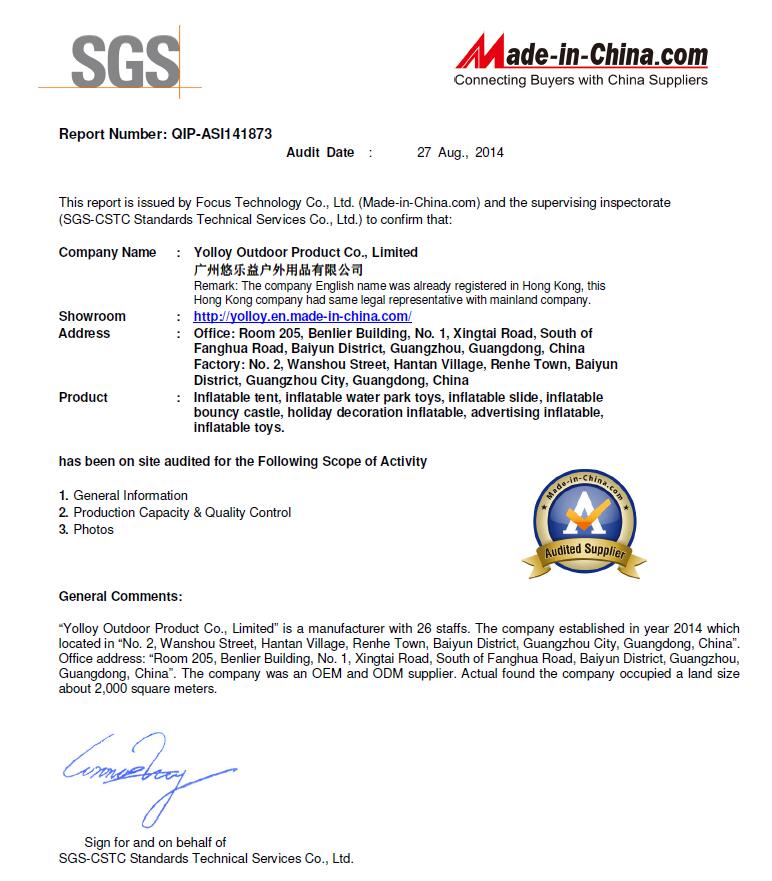
Certification

News

• New Order Successfully Finished for Long-Time Cooperated Japanese Client | YOLLOY Wins Full Client Recognition

• YOLLOY Custom Inflatable Pool Tent for Danish Client: Professional Pool Repair Shelter & Debris Protection

• Trusted Once Again! Greek Captain Re-orders Our Products After 4 Years

• Revolutionize Your Outdoors: The All-Terrain Inflatable Floating Tent for Land & Water

• Elevate Your Summer Fun: The Ultimate Inflatable Water Floating Volleyball Court Trampoline

• Innovative Inflatable Nightclub Tents & Pop-Up Bars: The Ultimate Solution for Portable Party Venues

Contact Us

Name: Sunny Yang
Tel: +86-20-8370 0771
Fax: +86-20-8370 0771
Mobile: 13570587575
E-mail: [email protected]
Add: No 5,Xiong wei Bo Nan Road,ZhongLuoTan Town,Baiyun district,Guangzhou,China
Friend me on Facebook Follow me on Twitter Add me to your circles Follow me on Pinterest Watch my channel on YouTube
News

How do I choose the right inflatable water slide for a water park?

Author:yolloy Date:2026/8/19 8:43:32

Choosing the right inflatable water slide for a water park is one of the most important buying decisions an operator will make. Get it wrong and you either cap your daily capacity, burn through a repair budget, or end up with a slide that spends most of the season deflated in storage. Get it right, and the same unit becomes the attraction guests line up for all summer. This guide walks through everything a water park operator should check before placing an order, from venue and audience to materials, safety, and what to ask the supplier.

The decision is about more than just height and lane count. Your operating model, your expected footfall, and the age range of your guests should drive every specification you choose. Below we break the selection process into practical steps that help you purchase with confidence instead of guessing.

1. Start with Your Venue and Operating Model

No two water parks run the same way, and the right slide for one venue can be completely wrong for another. Before you compare dimensions or prices, be clear about how the slide will be used.

A fixed water park that operates every day throughout the season should prioritise durability and rider throughput over portability, because the unit will be inflated for long periods and used by hundreds of visitors a day. A touring or rental operator, by contrast, is limited by setup speed and how easily the slide packs into a trailer, so a simpler, more compact unit is usually the better investment. Seasonal event venues should look for visual impact that matches the ticket price, which often means a larger combo unit with multiple features.

2. Know the Different Types of Water Slides

Inflatable water slides come in several distinct categories, and treating them all as the same product is a common mistake. Understanding what each type offers helps you match the unit to your audience's expectations.

Drop slides are the simplest design: a single lane with a near-vertical descent that needs a relatively small footprint and a minimal crew. They are easy to set up and ideal for venues with limited space.

Multi-lane racing slides let several riders descend side by side at the same time. The competitive element drives repeat rides, which makes them the workhorse choice for busy venues that need to process high volumes of guests quickly.

Combo water parks combine slides with climbing features, splash pools, and water cannons in a single unit. They have the largest footprint and the highest cost, but they also deliver the most value per square metre because they entertain a whole group of visitors at once.

For family-oriented venues, combo units and commercial inflatable water slide configurations designed with splash pools and gentle lanes are usually the safest bet for younger children and mixed-age groups.

3. Match Size and Capacity to Your Throughput

Size is driven by two things: the physical space you have available and the number of riders you expect each hour on your busiest days. A slide that is too small creates long queues, while one that is oversized for your staff levels can become a safety and maintenance liability.

Think about how many attendants you can reasonably staff at the top and the landing zone. Throughput is directly tied to staffing, so the operating cost of a high-capacity slide includes the people who supervise it. Planning a realistic staff-to-riders ratio is just as important as picking the correct lane count.

4. Check Material and Build Quality

Commercial water slides live a hard life. They are exposed to constant water, heavy foot traffic, strong sunshine, and repeated setup and teardown. The material and the way it is joined together determine how long the unit lasts.

High-grade PVC tarpaulin is the standard choice for water slides because smooth PVC stands up to constant water contact without breaking down and keeps the surface slippery for a fast, safe ride. Look for a supplier whose inflatable water slide for sale is built from commercial-grade PVC and welded, rather than only sewn, at the high-load seams. Resistance to ultraviolet light, reinforced stitching at stress points, and strong seams at the slide bed and splash pool are all signs of a unit built to last.

5. Safety, Anchoring, and Compliance

Safety is non-negotiable in a commercial water park, and it starts before the slide is even ordered. A reputable manufacturer should be transparent about the standards its products meet and the test reports behind them.

For water parks, check that the unit and its materials are tested to the relevant standards for inflatable play and water recreation equipment. Confirm the certification details with the supplier rather than accepting marketing claims at face value.

Anchoring deserves special attention because an under-secured slide is the biggest single safety risk on any water park. Look for sturdy anchor points built around the perimeter and check that the supplier explains how the unit is secured for both soft ground and hard surfaces. Proper anchoring protects guests in windy conditions and keeps the slide stable while it is in use.

6. Check the Blower, Water, and Set-up

A water slide cannot stay standing and firm without the right blower. Check that the blower's power and voltage match your park's power supply, and confirm whether the design needs one continuous unit or a more powerful setup for larger slides. A backup blower is a worthwhile investment, because a blower failure in the middle of a busy day means a full shutdown until it is repaired.

Water supply is just as important. Confirm the connection type, the number of attachment points, and the flow rate needed to keep the whole slide surface lubricated. Insufficient flow creates dry spots that increase friction, slow riders down, and cause premature wear on the material.

7. Account for Lead Time and Delivery

A water slide ordered too late in the season is a cost with no return. Because most parks prepare months ahead, production time and shipping should be factored into the purchasing plan from the very start.

Custom units naturally take longer than standard models, since they are designed to your exact dimensions, colours, and graphics. When comparing suppliers, ask for a clear production timeline and a realistic transport estimate. A manufacturer that is upfront about how long custom work will take is far easier to plan around than one that only promises to "deliver fast" without a schedule.

8. Work With a Supplier Who Customises

No two water parks have identical layouts, budgets, or branding, and a supplier who only sells off-the-shelf units will never quite fit your venue. Look for a manufacturer that designs from your own description, drawing, sketch, site plan, or budget, and that can produce a simulation rendering before committing to production. This kind of design-to-production workflow removes surprises and lets you approve the design before anything is built.

YOLLOY is a custom inflatable manufacturer in Guangzhou, China, specialising in water park products, commercial slides, and inflatable tents. Orders start from just one piece, and products are supplied with appropriately powered blowers for 110V, 220V, or 380V. Each inflatable ships with a repair kit, and the company reports a 95% on-time delivery rate, with answers to enquiries within 24 hours.

Final Checklist Before You Buy

Use this short checklist to compare suppliers and avoid common buying mistakes:

✓ Confirm the slide matches your venue type and daily footfall.
✓ Choose a lane configuration suited to your audience's age and expectations.
✓ Verify the PVC is commercial-grade and the seams are properly welded.
✓ Ask for certification details and test reports, not just logos.
✓ Check anchoring options for both soft ground and hard surfaces.
✓ Confirm blower power, voltage, and water flow requirements.
✓ Clarify production time and delivery before you order.
✓ Work with a manufacturer who can customise the design to your park.

Choosing the right inflatable water slide for a water park comes down to matching the unit to your venue, your guests, and your budget. Take the time to compare materials, safety, and support, and your slide will deliver strong returns for many seasons to come.


How do I choose the right inflatable water slide for a water park?

Author:yolloy Date:2026/8/19 8:43:32

Choosing the right inflatable water slide for a water park is one of the most important buying decisions an operator will make. Get it wrong and you either cap your daily capacity, burn through a repair budget, or end up with a slide that spends most of the season deflated in storage. Get it right, and the same unit becomes the attraction guests line up for all summer. This guide walks through everything a water park operator should check before placing an order, from venue and audience to materials, safety, and what to ask the supplier.

The decision is about more than just height and lane count. Your operating model, your expected footfall, and the age range of your guests should drive every specification you choose. Below we break the selection process into practical steps that help you purchase with confidence instead of guessing.

1. Start with Your Venue and Operating Model

No two water parks run the same way, and the right slide for one venue can be completely wrong for another. Before you compare dimensions or prices, be clear about how the slide will be used.

A fixed water park that operates every day throughout the season should prioritise durability and rider throughput over portability, because the unit will be inflated for long periods and used by hundreds of visitors a day. A touring or rental operator, by contrast, is limited by setup speed and how easily the slide packs into a trailer, so a simpler, more compact unit is usually the better investment. Seasonal event venues should look for visual impact that matches the ticket price, which often means a larger combo unit with multiple features.

2. Know the Different Types of Water Slides

Inflatable water slides come in several distinct categories, and treating them all as the same product is a common mistake. Understanding what each type offers helps you match the unit to your audience's expectations.

Drop slides are the simplest design: a single lane with a near-vertical descent that needs a relatively small footprint and a minimal crew. They are easy to set up and ideal for venues with limited space.

Multi-lane racing slides let several riders descend side by side at the same time. The competitive element drives repeat rides, which makes them the workhorse choice for busy venues that need to process high volumes of guests quickly.

Combo water parks combine slides with climbing features, splash pools, and water cannons in a single unit. They have the largest footprint and the highest cost, but they also deliver the most value per square metre because they entertain a whole group of visitors at once.

For family-oriented venues, combo units and commercial inflatable water slide configurations designed with splash pools and gentle lanes are usually the safest bet for younger children and mixed-age groups.

3. Match Size and Capacity to Your Throughput

Size is driven by two things: the physical space you have available and the number of riders you expect each hour on your busiest days. A slide that is too small creates long queues, while one that is oversized for your staff levels can become a safety and maintenance liability.

Think about how many attendants you can reasonably staff at the top and the landing zone. Throughput is directly tied to staffing, so the operating cost of a high-capacity slide includes the people who supervise it. Planning a realistic staff-to-riders ratio is just as important as picking the correct lane count.

4. Check Material and Build Quality

Commercial water slides live a hard life. They are exposed to constant water, heavy foot traffic, strong sunshine, and repeated setup and teardown. The material and the way it is joined together determine how long the unit lasts.

High-grade PVC tarpaulin is the standard choice for water slides because smooth PVC stands up to constant water contact without breaking down and keeps the surface slippery for a fast, safe ride. Look for a supplier whose inflatable water slide for sale is built from commercial-grade PVC and welded, rather than only sewn, at the high-load seams. Resistance to ultraviolet light, reinforced stitching at stress points, and strong seams at the slide bed and splash pool are all signs of a unit built to last.

5. Safety, Anchoring, and Compliance

Safety is non-negotiable in a commercial water park, and it starts before the slide is even ordered. A reputable manufacturer should be transparent about the standards its products meet and the test reports behind them.

For water parks, check that the unit and its materials are tested to the relevant standards for inflatable play and water recreation equipment. Confirm the certification details with the supplier rather than accepting marketing claims at face value.

Anchoring deserves special attention because an under-secured slide is the biggest single safety risk on any water park. Look for sturdy anchor points built around the perimeter and check that the supplier explains how the unit is secured for both soft ground and hard surfaces. Proper anchoring protects guests in windy conditions and keeps the slide stable while it is in use.

6. Check the Blower, Water, and Set-up

A water slide cannot stay standing and firm without the right blower. Check that the blower's power and voltage match your park's power supply, and confirm whether the design needs one continuous unit or a more powerful setup for larger slides. A backup blower is a worthwhile investment, because a blower failure in the middle of a busy day means a full shutdown until it is repaired.

Water supply is just as important. Confirm the connection type, the number of attachment points, and the flow rate needed to keep the whole slide surface lubricated. Insufficient flow creates dry spots that increase friction, slow riders down, and cause premature wear on the material.

7. Account for Lead Time and Delivery

A water slide ordered too late in the season is a cost with no return. Because most parks prepare months ahead, production time and shipping should be factored into the purchasing plan from the very start.

Custom units naturally take longer than standard models, since they are designed to your exact dimensions, colours, and graphics. When comparing suppliers, ask for a clear production timeline and a realistic transport estimate. A manufacturer that is upfront about how long custom work will take is far easier to plan around than one that only promises to "deliver fast" without a schedule.

8. Work With a Supplier Who Customises

No two water parks have identical layouts, budgets, or branding, and a supplier who only sells off-the-shelf units will never quite fit your venue. Look for a manufacturer that designs from your own description, drawing, sketch, site plan, or budget, and that can produce a simulation rendering before committing to production. This kind of design-to-production workflow removes surprises and lets you approve the design before anything is built.

YOLLOY is a custom inflatable manufacturer in Guangzhou, China, specialising in water park products, commercial slides, and inflatable tents. Orders start from just one piece, and products are supplied with appropriately powered blowers for 110V, 220V, or 380V. Each inflatable ships with a repair kit, and the company reports a 95% on-time delivery rate, with answers to enquiries within 24 hours.

Final Checklist Before You Buy

Use this short checklist to compare suppliers and avoid common buying mistakes:

✓ Confirm the slide matches your venue type and daily footfall.
✓ Choose a lane configuration suited to your audience's age and expectations.
✓ Verify the PVC is commercial-grade and the seams are properly welded.
✓ Ask for certification details and test reports, not just logos.
✓ Check anchoring options for both soft ground and hard surfaces.
✓ Confirm blower power, voltage, and water flow requirements.
✓ Clarify production time and delivery before you order.
✓ Work with a manufacturer who can customise the design to your park.

Choosing the right inflatable water slide for a water park comes down to matching the unit to your venue, your guests, and your budget. Take the time to compare materials, safety, and support, and your slide will deliver strong returns for many seasons to come.