An inflatable planetarium tent is one of the most practical ways to bring astronomy lessons to life without building a permanent planetarium. It inflates in minutes, packs into a couple of bags, and turns any school hall, gym, or library into a dome full of stars. But not every inflatable planetarium tent is built the same, and the features that matter most for education are the ones that decide whether your students see a crisp night sky or a washed-out grey blur. Here is a practical look at the features worth checking before you buy.
1. Portability and fast setup
The biggest advantage of an inflatable planetarium tent is that it moves. A typical dome packs into one or two wheeled bags and can be carried by one or two people. Setup takes around ten to fifteen minutes with a continuous blower: unroll the fabric, connect the blower, and the dome rises into shape. That speed matters for schools that share facilities or run outreach programs across several campuses. When you compare options, ask for the packed dimensions and weight, not just the inflated size, because those numbers decide whether the dome fits your van and whether one person can handle it alone.
2. Blackout interior for a real night sky
The single most important feature for education is the interior surface. A projection dome has to be genuinely dark before the projector is switched on, because contrast is what makes the experience feel immersive. Quality domes use a blackout or double-layer fabric that stops ambient room light from bleeding through, plus a matte dark interior coating so projected light does not scatter. In a cheap single-layer white dome, gym lights glow straight through the fabric and every star turns pale grey. If you can, see the dome lit inside a bright room before you commit, because that test tells you whether the blackout is real.
3. Continuous airflow and ventilation
An inflatable planetarium is a cold-air structure, not a sealed balloon. A quiet electric blower pushes a constant stream of air in, and a small amount bleeds out through the seams and door, keeping the dome firm for the whole session. That continuous-airflow design is forgiving: a pinhole leak does not deflate the dome because the blower simply keeps up. The same airflow drives ventilation, which matters when a class of thirty students sits inside for thirty to forty-five minutes. Look for a blower rated for continuous running, and confirm the power supply matches your site, whether that is 110V, 220V, or 380V.
4. Materials and durability
For school use, a dome gets inflated, deflated, packed, and transported week after week, so the fabric needs to survive that cycle. Commercial-grade PVC tarpaulin is the common choice, with Oxford fabric, nylon, or TPU available depending on the project. Reinforced seams, waterproof thread, and extra reinforcement at high-load areas all extend the life of the dome. Safety certifications matter for education too: materials that have passed EN71, EN14960, and RoHS-related testing give schools and parents real confidence, and blowers that meet CE or UL requirements are a sensible baseline.
5. Customization to fit your space
Every school has different needs. Some want a specific size to fit a particular hall, while others want their school name or logo printed on the dome. A manufacturer that offers custom sizes, colors, and printed artwork makes it possible to get a portable planetarium dome that fits your space and your branding. Custom design services that start from a description, a drawing, or even a photograph and a budget mean you are not limited to off-the-shelf sizes. For schools, a low minimum order quantity is a practical bonus, since most programs only need one dome at a time.
6. Safety features
An inflatable planetarium tent is an occupied structure, so safety features are non-negotiable. Look for fire-retardant fabric, an entry tunnel that works as a light-lock and a clear exit, and anchoring points such as D-rings or round metal anchors for stability. A repair kit supplied with the dome is a small detail that saves a lot of trouble later. And always respect the rated occupancy: never exceed the number of students the dome is designed to hold, and keep the entry clear as an exit at all times.
7. Size options and capacity
Domes are sold by floor diameter, and diameter maps directly to how many students can sit inside. A 4 to 5 metre dome seats roughly 15 to 20 students and fits under a standard ceiling. A 6 metre dome seats around 25 to 30, which suits a full class. Larger 7 to 8 metre domes seat 35 to 50 and work for combined classes or public sessions. Match the size to the group you actually run most weeks: a dome that is too large for your room wastes setup time and airflow, and a half-empty dome kills the intimacy that makes the projection feel immersive.
8. What comes in the package
Check what is included before you compare prices. A complete setup usually comes with the blower, a floor mat, and anchoring accessories, and many suppliers include a repair kit. Projection equipment is normally separate, so budget for a projector with a fisheye lens if you do not already have one. A single fisheye projector is the simplest and most popular setup for education, filling the whole hemisphere from one unit, while multi-projector edge-blend systems are better suited to permanent installations.
Choosing the right supplier
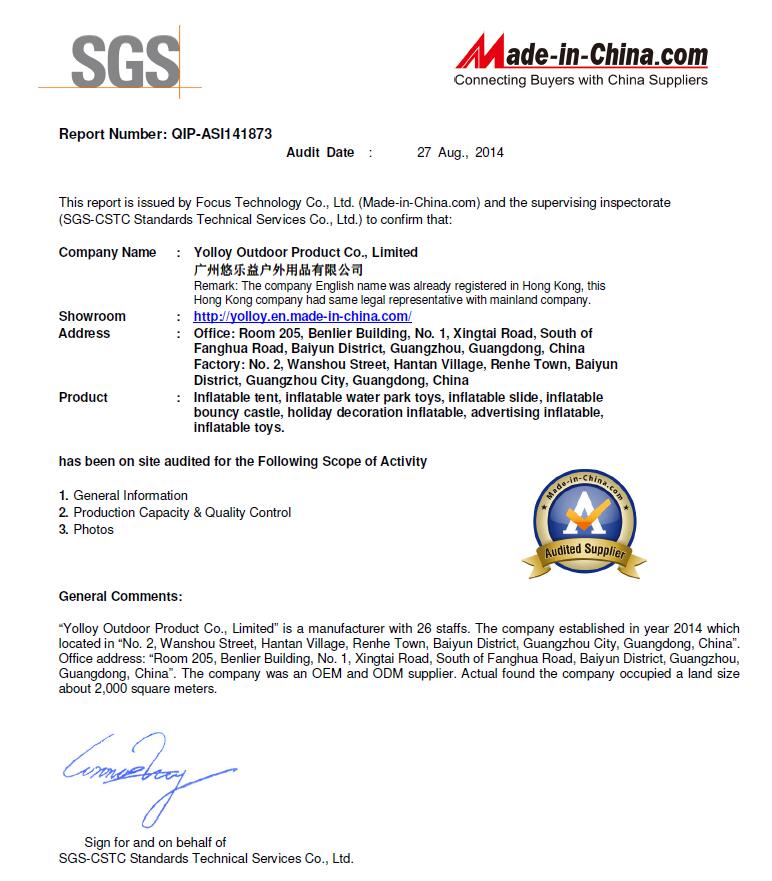
For schools and education programs, the supplier matters as much as the product. Look for a manufacturer that offers custom design, a reasonable minimum order quantity, and responsive support. YOLLOY, an inflatable-product manufacturer based in Guangzhou, China, is one example of a supplier that works this way: it designs custom inflatable tents and planetarium domes from a customer's description, drawing, or budget, accepts orders from a single piece, and typically produces a regular inflatable in six to fifteen days. A supplier that answers inquiries within 24 hours, reports a high on-time delivery rate, and backs the product with a repair kit and a sensible service life expectation makes the whole process much smoother. Ask about production lead time as well, because a typical inflatable takes one to two weeks to produce before shipping, and complex custom projects take longer.
An inflatable planetarium tent is a cost-effective way to bring immersive astronomy education to your school. The features that matter, including the blackout interior, continuous airflow, durable materials, safety, portability, and customization, decide whether students walk away amazed or disappointed. Choose a dome built for real classroom use, and the night sky can come to your school any day of the week.